Google’s Official “GEO Guidelines”: GEO Does Not Exist—This Is Both Truth and Rhetoric
TechFlow Selected TechFlow Selected
Google’s Official “GEO Guidelines”: GEO Does Not Exist—This Is Both Truth and Rhetoric
Understanding Google’s motivations is more important than memorizing what Google says.
 Navigating Web3 tides with focused insights
Author: TechFlow
On May 15, Google quietly released an official guide titled “Optimizing your website for generative AI features on Google Search.” This marks Google’s first formal response to the GEO (Generative Engine Optimization) topic—a subject that has dominated discussions over the past year.
If you only follow English-language SEO news briefs, you’ll likely walk away with a simple conclusion: “Google says GEO doesn’t exist—so it’s just SEO.”
This conclusion is both right and wrong.
It’s right in that Google explicitly dismisses nearly all the so-called “hacks” promoted over the past year under the GEO banner: llms.txt, content chunking, rewriting copy specifically for AI, artificially inflating “mentions,” etc. Google’s stance boils down to two words: not useful.
It’s wrong in that Google speaks only for itself. One critical fact remains conspicuously unaddressed throughout the entire document: the AI search market does not belong to Google alone. Perplexity, ChatGPT, Claude, Gemini API, and numerous vertical AI assistants each operate distinct retrieval systems, citation logics, and content preferences. Treating Google’s position as representative of the entire AI search market is the most dangerous misreading of this guide.
What did Google say?
The core logic chain in Google’s document is remarkably clear—just three steps.
Step 1: The foundation of AI search is SEO.
Google explicitly states that AI Overviews and AI Mode rely on two technologies: RAG (Retrieval-Augmented Generation, also known as grounding) and query fan-out. The former retrieves relevant web pages from Google’s search index to serve as source material for AI responses; the latter breaks a single user query into multiple related queries for parallel retrieval.
The key point is this: the “R” (retrieval) in RAG depends entirely on Google’s existing search ranking system. For a page to be cited in an AI Overview, it must first rank well in traditional Google Search. AI does not start from scratch—it layers generation atop the existing SEO index.
Step 2: If the foundation is SEO, then SEO best practices are GEO best practices.
Google repeatedly emphasizes producing “non-commodity content”—original, firsthand, expert-driven material with independent perspectives; maintaining clean technical structure (crawlable, indexable, with strong page experience); and using structured data where appropriate. These are all fundamentals SEO practitioners have discussed for two decades—and Google’s message is: keep doing them. That’s enough.
Step 3: Explicitly debunking popular GEO tactics.
This section contains the most actionable information in the entire guide. Rarely does Google directly list what *not* to do:
- No need for
llms.txtor any AI-specific files—Google won’t treat them specially; - No need to break content into small chunks (“chunking”)—Google’s systems understand full-page nuance;
- No need to rewrite copy specifically for AI—AI understands synonyms and semantics;
- No need for inauthentic “mentions”—artificial mention inflation will trigger anti-spam systems;
- No need to overuse structured data—it’s not a prerequisite for AI search.
The document ends with a newly introduced concept: agentic experiences. Google notes that future AI agents will access websites via DOM structure, accessibility trees, and even page screenshots—hinting at the next frontier of “optimization.” Yet Google offers no further elaboration.
That’s the full scope of Google’s official position.
Why did Google say this?
Most Chinese-language SEO reposts stop here. But understanding Google’s motivations matters more than memorizing its statements.
Why did Google release this guide—now, and in this tone?
Motivation 1: To suppress the market narrative that “GEO is a standalone discipline.”
Over the past year, “GEO/AEO services” have spawned a small gray-market ecosystem in the English-speaking world: consulting firms selling GEO audits, SaaS tools offering “AI visibility monitoring,” and marketing agencies pitching “AI citation optimization packages.” The underlying implication? SEO is obsolete—you need new methodologies, new vendors, and new budgets.
If this narrative gains traction, it poses a dual threat to Google: First, it destabilizes the SEO ecosystem—a space from which Google draws search advertising revenue and tool integrations; second, it frames AI search as a market independent of Google, thereby amplifying the perceived threat posed by rivals like Perplexity and ChatGPT. So Google had to step in and declare: It’s the same thing—don’t overcomplicate it. Return to the SEO framework.
Motivation 2: To prevent websites from over-optimizing for AI—and degrading index quality.
If the entire web starts producing content according to llms.txt standards, slicing paragraphs per “chunking” logic, or rewriting copy for “AI readability,” Google’s index quality will deteriorate. Such content is optimized for machines—not humans—and may become harder to read for people. Having spent the past decade cracking down on “search-engine-first” writing, Google cannot now allow “AI-first” writing to pollute its index.
Motivation 3: To safeguard its own authority.
Google does not want a “GEO community” to emerge as a domain where rules are defined outside Google’s control. So the real message behind this document is: Only Google gets to define how to optimize for Google’s AI search—and everyone else’s advice is unreliable.
Understanding these three motivations helps explain why the document reads simultaneously as transparent and guarded.
Which parts are true: What Google got right
Google’s stance isn’t wholly incorrect. In fact, regarding Google’s own AI search features, most of the guidance holds up.
Truth #1: Being cited in Google AI Overview is fundamentally an SEO issue.
The retrieval layer powering Google AI Overview is Google’s search ranking system. That means websites already performing well in traditional SEO naturally enjoy higher citation probability in AI Overview. There is no such thing as “special optimization for Google AI”—because the underlying system is identical.
Truth #2: llms.txt is an ineffective signal.
This deserves deeper explanation—especially since many GEO service providers in Chinese markets tout “llms.txt deployment” as a key selling point. llms.txt is a community-initiated proposal designed to let websites tell AI crawlers “what content I have and how to read it.” But no major AI company—including OpenAI, Anthropic, or now Google—has publicly committed to reading llms.txt. It’s a wishful standard whose primary current utility is as yet another billing item for SEO vendors.
Truth #3: Artificially inflating “mentions” is inefficient.
Over the past six months, some firms have sold “AI citation boosting” services—essentially hiring low-cost labor to spam brand names across Reddit, Quora, and blog comment sections, betting that AI models will pick up those mentions during training or retrieval. Google correctly points out that this tactic is not only useless but also risks triggering anti-spam systems. As AI models grow increasingly sophisticated in evaluating source quality, low-quality mentions carry rapidly diminishing weight.
Truth #4: Content quality remains foundational.
Google’s emphasis on “non-commodity content”—original perspective, firsthand experience, expert insight—aligns with what all AI search engines prefer. Whether it’s Google AI Overview, Perplexity, or ChatGPT, they all favor sources with clear viewpoints and exclusive information—not AI-generated secondary summaries.
Which parts are rhetoric: What Google omitted or sidestepped
But if you stop at these “truths,” you’ve fully fallen into Google’s narrative trap.
Rhetoric #1: Google only represents Google.
This is the document’s most critical blind spot. Google repeats “AI search = SEO,” but this equation holds true only within Google’s AI Overview and AI Mode.
Let’s examine the real AI search market:
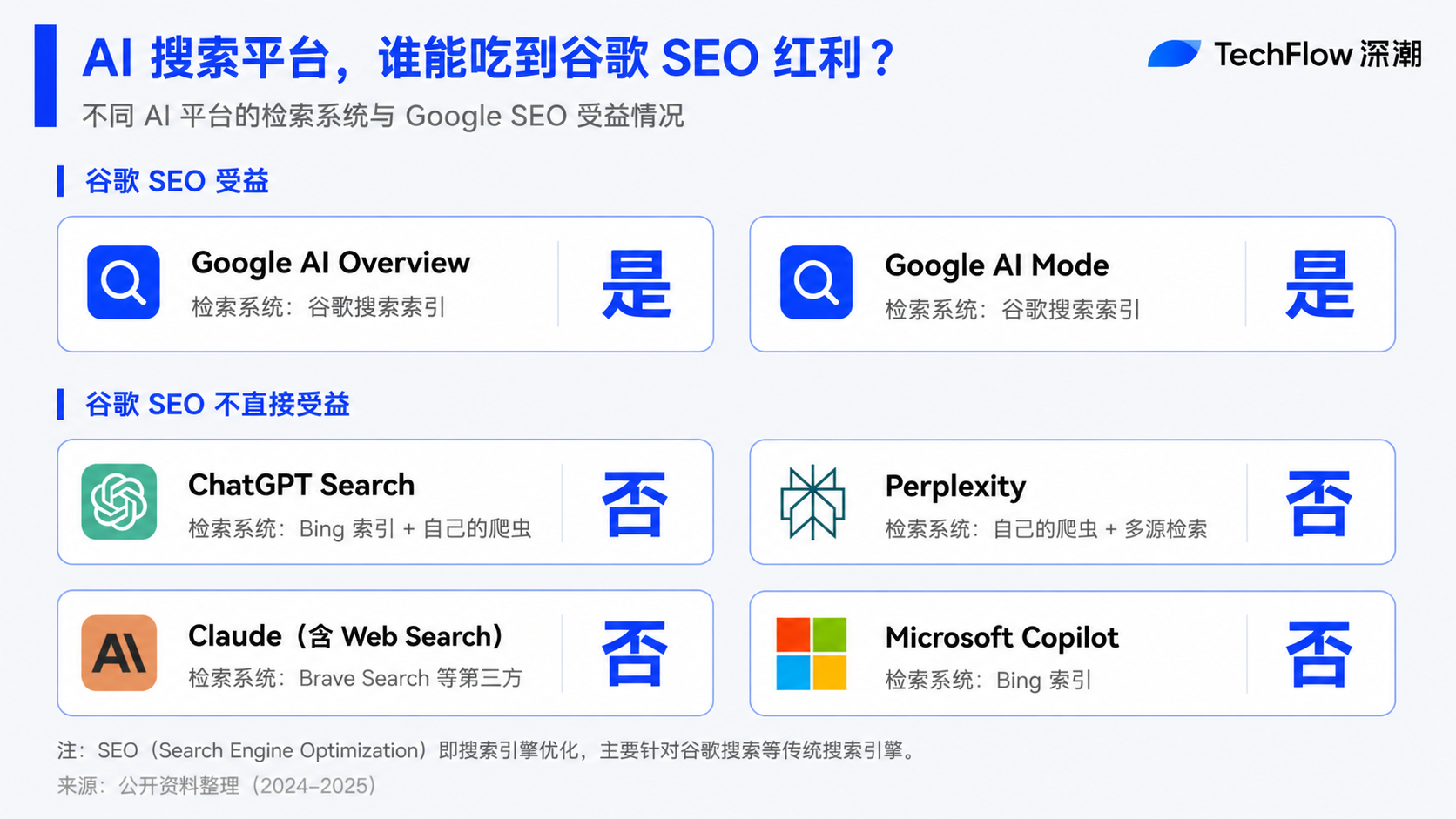
ChatGPT, Perplexity, and Claude collectively reach a substantial share of high-value users—investors, researchers, decision-makers. Their retrieval systems are entirely independent of Google’s SEO infrastructure. Google’s guide says absolutely nothing about optimizing visibility on these platforms.
This is precisely where GEO as a standalone service finds its footing.
Rhetoric #2: The definition of “non-commodity content” is less objective than claimed.
Google urges creators to “produce unique, valuable content”—who could disagree? But what qualifies as “non-commodity” is determined by models—and models carry biases.
Take crypto as an example. Established English-language outlets like CoinDesk and The Block receive significantly higher citation rates in AI Overview than emerging outlets of comparable quality. Not because their content is inherently more “unique,” but because their historical Google search authority is stronger. During AI retrieval, content from “high-authority sites” is prioritized—an age-old chicken-or-egg problem. New entrants—even with superior content quality—struggle to gain rapid citation traction.
Google won’t disclose this, because it reveals how AI Overview algorithmically reinforces existing search head effects.
Rhetoric #3: “Agentic experiences” represent the next big variable—but Google glosses over it.
The document’s closing mention of AI agents accessing websites via DOM and accessibility trees is arguably its most insightful—and most underestimated—passage.
Why? Because the rise of AI agents will disrupt the very notion of “search.” When users stop searching manually and instead delegate tasks to agents—e.g., asking an agent to research a crypto project, compare exchange fees, or monitor market anomalies—websites must be designed to be “agent-friendly,” not merely “human-SEO-friendly.”
Google brushes this off in one paragraph—but it’s actually the most critical evolution expected over the next 12–24 months. Google avoids elaboration because its own product strategy in this area remains early-stage—and it prefers not to set premature market expectations.
Rhetoric #4: “You don’t need to do anything” is itself a strategic stance.
Reading the full document, you’ll realize Google’s core recommendations boil down to just two: write good content and execute solid SEO fundamentals. This sounds helpful to content creators—but it ultimately serves to protect Google’s central role in the indexing ecosystem.
If Google acknowledged that “AI search requires new optimization methods,” it would effectively concede that the SEO era is over. So Google’s strategy is to absorb all AI search optimization back into the SEO framework—keeping website owners playing by Google’s rules. It’s sound business strategy—but readers should recognize this as a positionally motivated official statement, not a neutral industry guide.
What does this mean for China’s crypto industry?
Returning to the concrete context of China’s crypto sector, here are several practical takeaways:
First, the “GEO demand” from Chinese crypto projects over the past year is genuine—but the service methodology needs restructuring.
Many crypto projects have asked the same question: “Why does ChatGPT return outdated, inaccurate, or negatively skewed descriptions when users search our project name?” This is a real pain point—especially for early-stage projects whose information landscape is dominated by KOL tweets and niche blogs.
The correct solution isn’t deploying llms.txt, chunking website content, or spamming Reddit mentions. The right approach is:
- Publish structured, factual content (team background, technical architecture, funding history, product milestones) on mainstream crypto media (e.g., TechFlow)—to give AI models clear, consistent, verifiable reference points;
- Actively monitor how ChatGPT, Perplexity, Claude, and other AI platforms describe your project—and promptly overwrite inaccuracies with fresh, authoritative content;
- Optimize factual content on your official website—not just marketing copy—but especially FAQ sections, documentation, and blog posts, which AI models frequently cite.
Second, Google AI Overview carries relatively low importance in the Chinese crypto context.
We must acknowledge reality: Among Chinese crypto users, Google Search’s share of information consumption is far smaller than in English-speaking markets. WeChat Official Accounts, Twitter/X, Telegram, Binance Square, and vertical media like TechFlow collectively wield far greater influence than Google Search.
Thus, for Chinese crypto projects, visibility on Perplexity and ChatGPT matters far more than visibility on Google AI Overview. The former are tools increasingly adopted by Web3 founders, VCs, and researchers; the latter remains a secondary touchpoint in the Chinese crypto context.
Google’s guide offers limited direct guidance for China’s crypto industry.
Third, multilingual, multi-platform distribution is gaining strategic value.
Google stresses that AI “prioritizes high-quality, independently-perspectived content.” To fulfill that requirement, such content must exist in AI-accessible formats across multiple platforms—not just Chinese-language sites, but also English versions, visible to crawlers from multiple AI platforms. Multilingual distribution is no longer just a brand expansion tactic—it’s a content asset preservation tool for the AI era.
Final thoughts
The most valuable part of Google’s guide isn’t what it tells you to do—or not do.
Its greatest value lies in clarifying one fundamental truth: In the AI search era, “optimization” is splitting into two distinct layers.
One layer is Google-defined: “AI search = SEO.” Its rules are relatively stable—focus on content quality and technical fundamentals.
The other layer is what Google doesn’t address—and refuses to address: “Optimization for non-Google AI platforms.” Perplexity, ChatGPT, and Claude each use different retrieval logic, citation preferences, and content standards. There is no official guide, no unified standard—this layer remains genuinely early-stage.
For project teams, recognizing this duality matters more than memorizing any specific recommendation.
Join TechFlow official community to stay tuned
Telegram:https://t.me/TechFlowDaily
X (Twitter):https://x.com/TechFlowPost
X (Twitter) EN:https://x.com/BlockFlow_News
 深潮TechFlow