The New "Yi Zhongtian" Emerges! GEO Goes Viral — Understand It All in One Article
TechFlow Selected TechFlow Selected
The New "Yi Zhongtian" Emerges! GEO Goes Viral — Understand It All in One Article
The next generation of advertising may no longer be about "buying exposure," but rather about "being written into the answers."
 Navigating Web3 tides with focused insights
Today, A-share's AI application sector saw a long-awaited collective surge.
On the market front, multiple stocks including Zhi De Mai (Worth Buying) and Zhuo Yi Information hit涨停; a new "Yi-Zhong-Tian" trio—Yidian天下 (Eclicks), Chinese Online, and Tianlong Group—each recorded a20CM gain in the morning session.
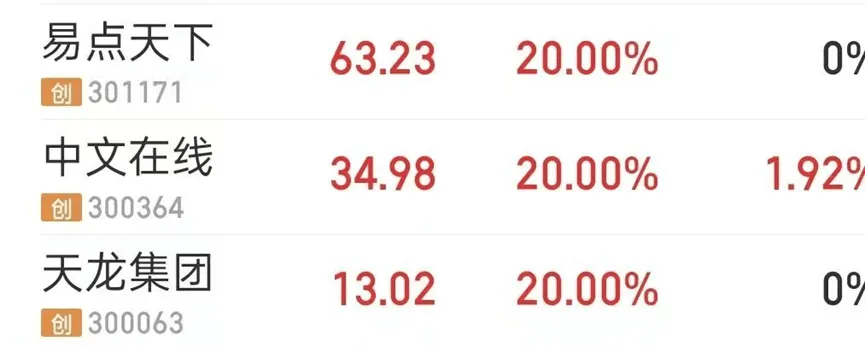
At the same time, BlueFocus surged on high volume, with trading turnover reaching as high as 19.32 billion yuan, ranking first among all A-share stocks for daily turnover.

Beneath this surface-level heat, the industry is undergoing a deeper, disruptive transformation—brand visibility logic is being rewritten as user decision-making shifts from “clicking links” to “reading AI-generated answers.”
A new form of competition is emerging: GEO (Generative Engine Optimization) is becoming the traffic gateway and survival rule for marketing in the age of AI search.
When users no longer “click links,” the foundation of advertising begins to crack
Imagine this scenario:
It’s 11 PM. You pick up your phone and casually ask, “Which baby formula suits sensitive stomachs?” In the past, you’d open a search engine, scan a list of blue links, jump to review sites, browse e-commerce platforms, and make decisions amid conflicting opinions.
But this time it’s different.
You turn to an AI-powered search tool. It delivers a doctor-like response—well-structured, point-by-point, listing pros and cons of several products along with suitable user profiles.
You don’t even need to click any webpage—the answer is already “complete” right before your eyes. A chart from CITIC Construction Investment makes this shift clearer: traditional search follows “search → browse list → click link,” while AI search resembles “search → read answer directly,” where links are either delayed or entirely skipped.
At that moment, the foundation of marketing starts to shake.
For the past two decades, brand “visibility” on the internet has heavily relied on one action: user clicks.
SEO, paid rankings, feed-based ad placements, content seeding… regardless of the method, the essence has always been fighting for that single click—to bring people into your page, product detail, or store.
But AI search collapses this process:
Users no longer need to “enter a webpage” to access information. The AI retrieves, digests, reorganizes, and directly delivers information in the form of answers. Thus, a new question emerges:
CITIC Construction Investment illustrated this migration with a diagram:
Past: Search → Browse link list → Click webpage
Now: Search → Read AI-generated answer directly (links can be completely skipped)
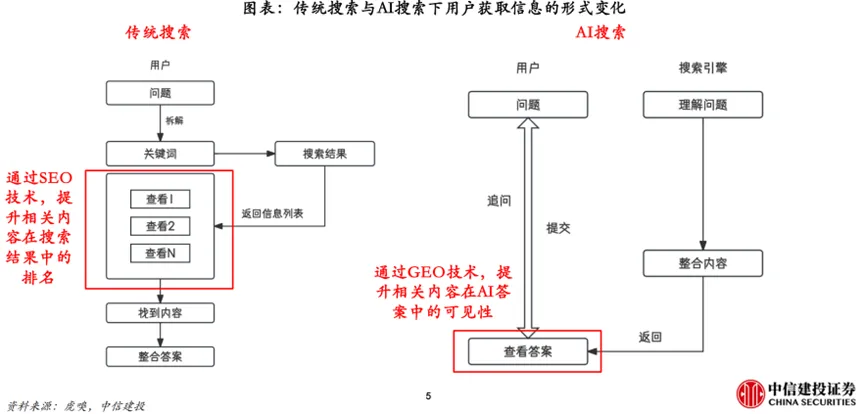
When links cease to be entry points, brand exposure mechanisms are fundamentally transformed.
When users stop clicking links, how can brands still “be seen”?
When answers are generated by AI, how can brands “be actively mentioned”?
This is the root of GEO’s rise—not a minor marketing trick, but a survival strategy after a shift in entry points.
Migration of Entry Points: Advertising budgets always follow “time”
The essence of advertising is reaching more audiences; wherever audience attention goes, budgets will flow.
When links are no longer gateways, brand exposure mechanisms are fundamentally altered.
Guotai Haitong, in its research report, reviewed a clear chain of migration:
In the PC internet era, search engines and portals were the gateways;
In the mobile internet era, super apps and information feeds/short videos became dominant;
In the AI era, entry points are further shifting toward AI platforms like DeepSeek, Doubao, Kimi. The “search box” is evolving from a portal to webpages into an interface for instant knowledge synthesis.
This migration isn't a future possibility—it's already happening.
Data cited by CITIC Construction Investment shows ChatGPT and Doubao App have monthly active users of 780 million and 170 million respectively, both exceeding 10% penetration. By contrast, Baidu’s traditional search traffic fluctuates between 650–750 million MAUs, showing signs of stagnation.
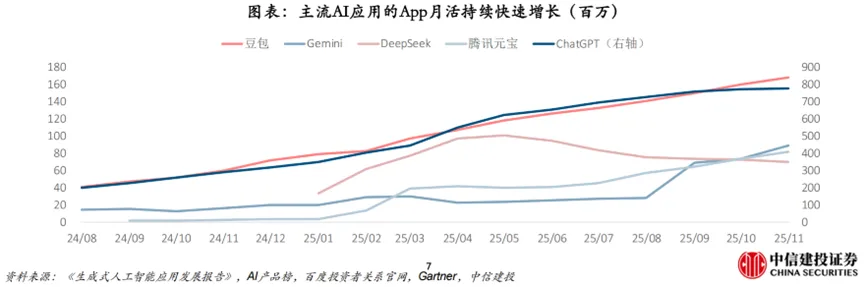
More importantly, consulting firms offer even bolder predictions: Gartner forecasts a 25% decline in search engine traffic by 2026, with AI chatbots and virtual agents capturing a growing share of search marketing.
This means:
The deterministic logic of search ads—pay-per-click—is weakening; the battle for “answer visibility” will become the new frontline.
Why SEO suddenly stopped working: click-through rates collapse in front of AI answers
When AI starts delivering direct answers within search results, users naturally click less.
Citing observations from Seer Interactive, CITIC Construction Investment noted that when Google's AI Overviews are triggered, organic CTR drops from about 1.5% to around 0.5%, with paid CTR also trending downward.
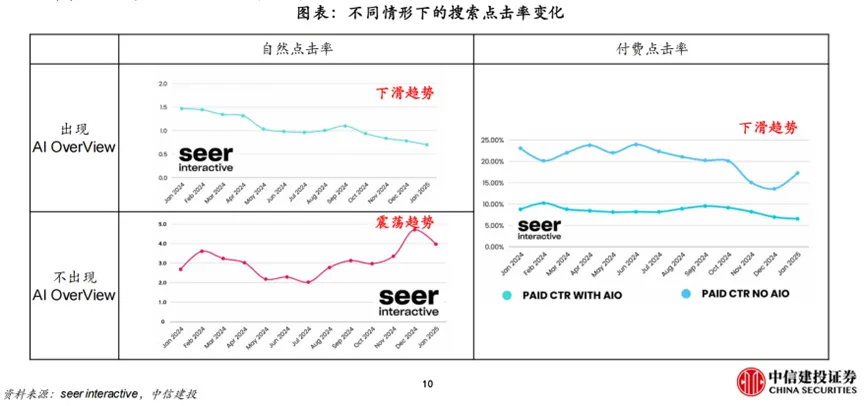
The harsh truth behind these numbers:
This isn’t just “industry volatility”—it’s structural erosion.
Even if you optimize your site to rank #1 or #2, you may “win the ranking” yet lose clicks; spending more for higher placement might get you visibility, but not traffic—because users finalize decisions right on the results page, without even giving you a glance.
Thus, SEO’s classic slogan—“make it easier for users to find you”—is quietly being rewritten as:
Make AI want to reference you. Make AI say your name when answering.
What exactly is GEO: From “being searchable” to “being spoken by AI”
CITIC Construction Investment offers a precise definition of GEO: GEO is a marketing technology service whose core is ensuring brands are proactively mentioned in AI search results.
If SEO optimizes “ranking,” then GEO focuses on two more subtle, foundational elements:
1) Large models’ awareness of brand content
2) Large models’ trust in brand content
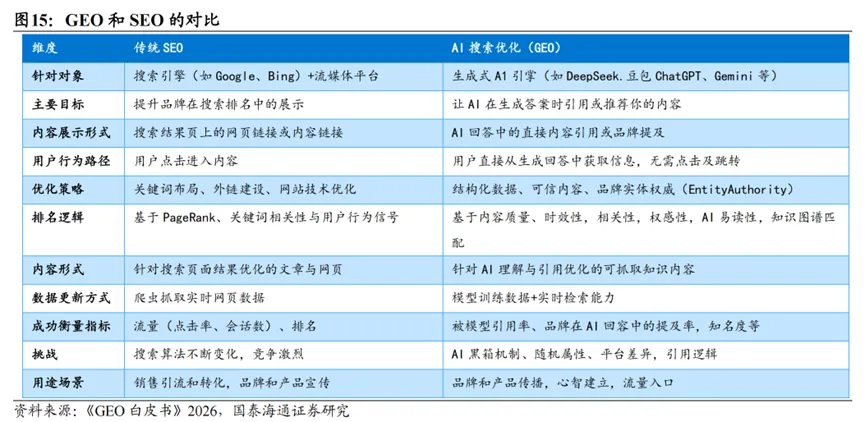
Guotai Haitong frames the difference more technically: Traditional search relies on matching (inverted index, PageRank)—SEO is deterministic optimization; AI search relies on analysis (vector retrieval + RAG)—GEO is probabilistic optimization. Every action you take increases the likelihood of being recalled, trusted, and cited.
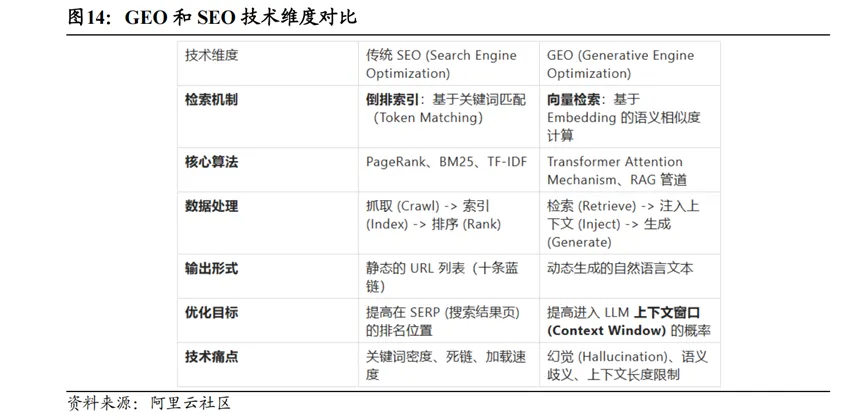
This is why GEO may look like marketing, but at its core resembles “content engineering + trust engineering.”
How AI search generates answers: Understanding RAG unlocks GEO’s leverage points
Many assume AI search simply says whatever the model “remembers.” But Guotai Haitong breaks down the process clearly: most current AI search systems use RAG (Retrieval-Augmented Generation) architecture.
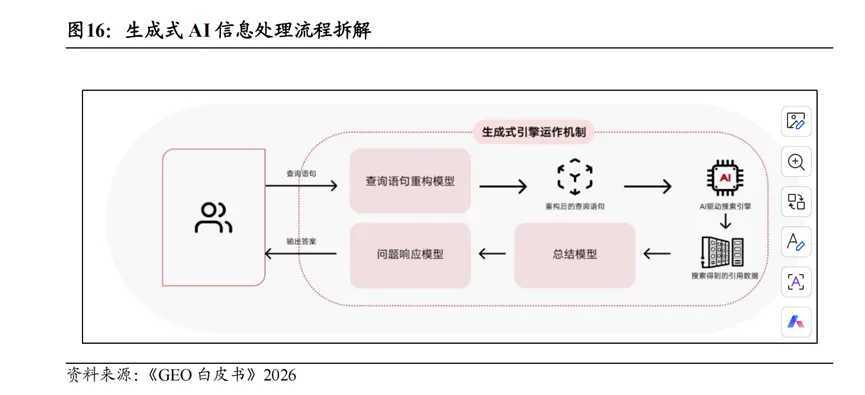
Think of it as an assembly line:
Step 1: Storage
Web content is split into chunks, converted into vectors using embedding models, and stored in a vector database.
Here, content isn’t “text”—it’s “coordinates.”
Step 2: Semantic Retrieval
The user’s query is also vectorized. The system calculates similarity and retrieves the top-K relevant chunks.
Here, AI doesn’t match keywords—it matches “intent.”
Step 3: Context Injection and Generation
Retrieved chunks are injected into the model’s prompt. The model uses attention mechanisms to assess credibility and informativeness, then generates the final answer.
Here, chunks that are “well-structured, entity-rich, and data-backed” are more likely to be cited.
You’ll notice GEO’s key leverage points lie exactly at two stages of this pipeline:
Information retrieval: making your content easier to recall from the vector database;
Content evaluation: making the model more willing to treat your content as a “source of truth.”
That’s why GEO isn’t about “adding more keywords,” but about “writing like a manual for the model.”
How to do GEO: Content isn’t better when there’s more, but when it’s more “cite-worthy”
CITIC Construction Investment cites the GEO paper *GEO: Generative Engine Optimization*, which lists seven common optimization methods and compares their effectiveness. One of the most effective? Including original quotes from well-known figures or authoritative institutions closely related to the topic—delivering ~40% visibility gain. Adding specific statistics also significantly boosts performance.
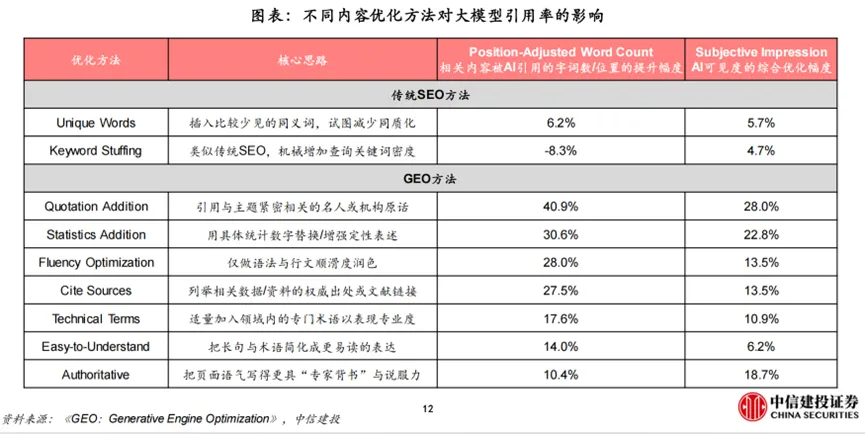
This reveals a simple truth:
Models favor expressions that can serve as evidence.
Saying “our sales are great” won’t impress the model;
But saying “according to a certain institution’s data, China’s GEO market grew over 200% YoY in Q2 2025” makes the model far more likely to cite you.
Guotai Haitong further proposes a framework that feels methodological: the DDS principle—
Semantic Depth
Data Support
Authoritative Source
Together, they build content that AI prioritizes for trust.
If we translate DDS into plain language:
Explain clearly, thoroughly, with evidence, and convincingly (and ideally, actually true)
Platform preferences: Where you publish determines who sees you
Many brands are used to publishing content solely on their official websites. But AI’s knowledge sources go far beyond that.
CITIC Construction Investment cites research from overseas GEO firm Profound: ChatGPT most frequently cites Wikipedia, Reddit, Forbes, etc.; Google AI Overviews and Perplexity show stronger preference for Reddit, YouTube, Quora, Gartner, and others.
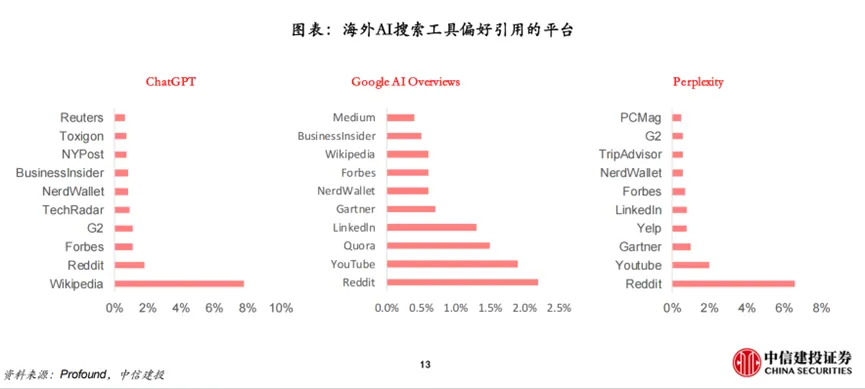
The same applies domestically. Taking “baby formula recommendations” as an example, CITIC Construction Investment analyzed citation sources across DeepSeek, Doubao, and Yuanbao: all three platforms show clear preference for vertical parenting media and general portals; Yuanbao notably cites WeChat public accounts at a significant rate.
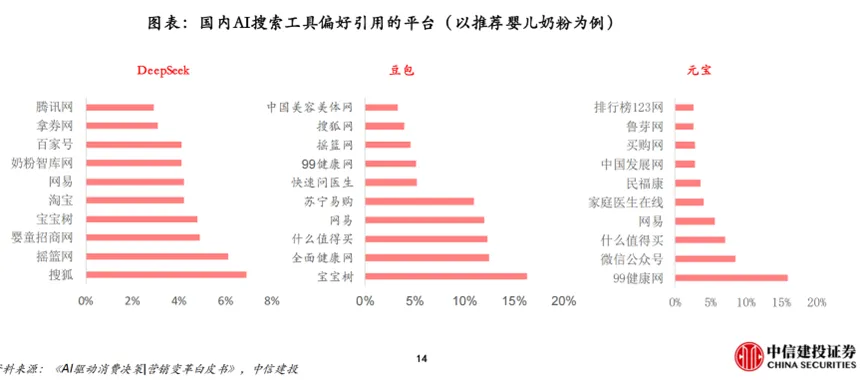
This means GEO isn’t just about “writing good content,” but also “publishing in the right places.”
To appear in AI answers, you must enter the model’s “high-frequency trusted channels.”
Business models are changing: For the first time, ad agencies can earn like SaaS companies
This might be the most important section in both reports for industry professionals:
GEO isn’t just a new ad format—it could push advertising agencies from labor-intensive services toward tech-driven ones.
CITIC Construction Investment notes that current GEO firms typically adopt monthly subscriptions or project-based pricing. For example, Profound, a leading overseas player, charges $399/month to track 100 prompts for one brand across three AI search products, with custom services available. Other firms charge $3,000–20,000/month, often tied to KPIs (e.g., ChatGPT Top-3 mention rate, Perplexity citation rank).

Guotai Haitong provides more detailed tiered pricing: Profound’s Starter plan costs $99/month (only tracks ChatGPT, 50 prompts); Growth plan is $399/month (monitors 3 AI platforms, 100 prompts, includes 6 optimized articles per month); Enterprise plans are customized. The firm reportedly serves around 500 enterprise clients.
Putting these numbers together, GEO’s revenue model looks increasingly software-like:
Subscription-based
Per-seat/per-quota
Based on number of tracked prompts/platforms
Tied to measurable metrics
This is exactly what traditional ad agencies struggle with—but deeply desire:
Shifting from one-off project fees to recurring, renewable revenue.
Why is the industry excited? Because profit structures will change.
CITIC Construction Investment offers a comparison: After nearly 30 years, the SEO industry remains highly fragmented. Market leader Semrush generates only about $400 million in revenue, with ~0.5% market share. Fragmentation implies low barriers, low margins, and reliance on manpower.
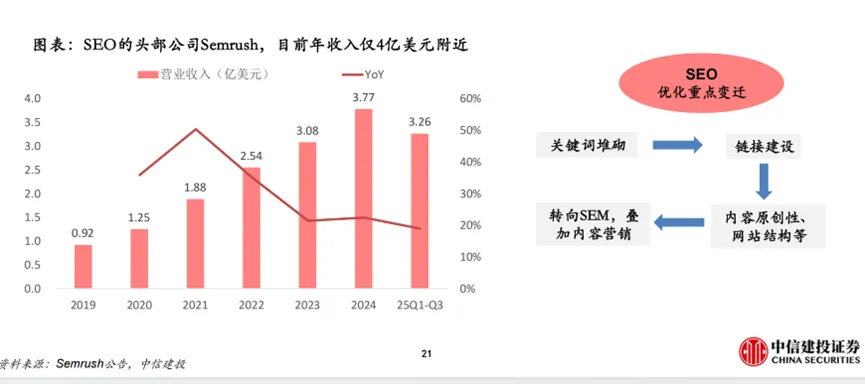
But GEO has higher barriers:
Black-box nature and randomness of large models
Differences in output across platforms
Complexity of getting models to understand and cite your content
Therefore, market concentration may actually increase.
With greater concentration, leaders could achieve software-like scale effects:
More data → Better model evaluation → Stronger optimization → Higher renewal → Stronger data loop.
Market potential: Why “billions in revenue” isn’t hype, but a natural successor to SEO
Both reports provide straightforward benchmarks for market size.
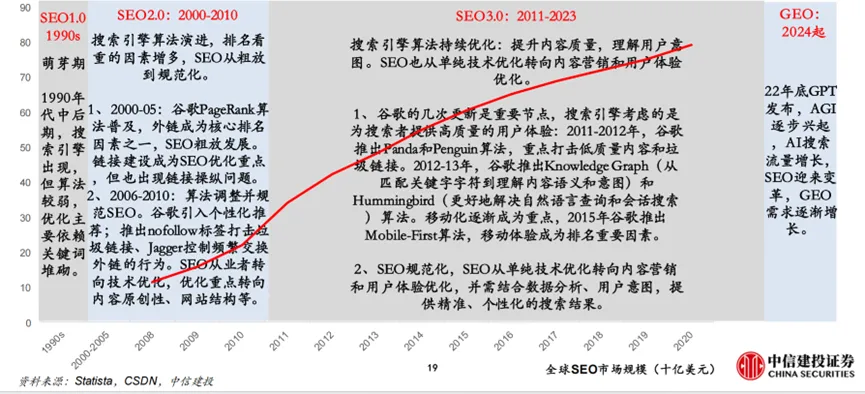
CITIC Construction Investment: Global SEO market was worth ~$80 billion in 2024. GEO is poised to replace traditional SEO in the AI era, potentially reaching tens of billions in scale.
Guotai Haitong goes further with projections:
Global GEO market to reach ~$11.2 billion in 2025, ~2.9 billion yuan in China;
Expected to surpass $100 billion globally by 2030, with ~24 billion yuan in China (as stated in the report’s executive summary).
The logic behind these forecasts is simple:
Shift in entry points → Shift in attention → Shift in budgets → Surge in new optimization services.
Moreover, GEO enjoys a “window of opportunity”: Guotai Haitong believes commercialization of large models remains low in the short-to-medium term, creating a “monetization vacuum.” GEO firms can capitalize on this gap by establishing “brand visibility management” as a business before platforms fully lock down monetization.
This mirrors early mobile internet feed ads: when platform ad systems are immature, third-party providers move fastest.
If you’re a brand: a practical GEO startup checklist
Many articles stop at the buzzword stage. But CITIC Construction Investment and Guotai Haitong lay out clear execution paths.
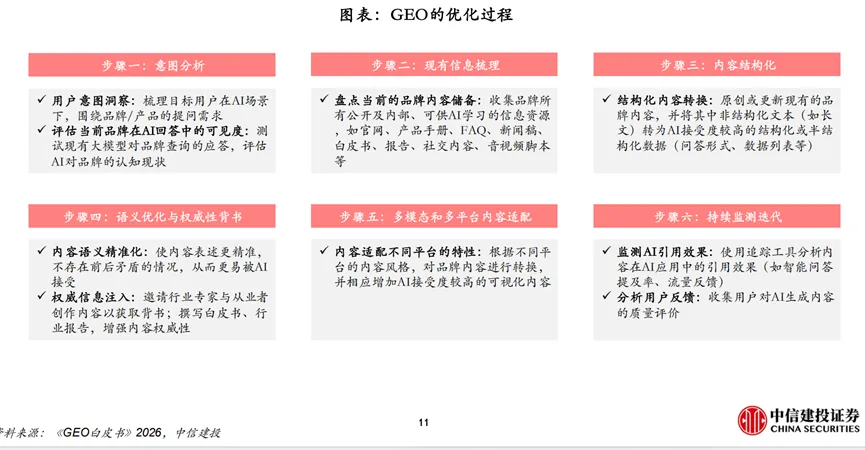
CITIC Construction Investment proposes a six-step approach:
1) Intent analysis: Map out how users might ask about you
2) Information audit: Inventory all public/internal data you can “feed” to AI
3) Content structuring: Turn long-form content into Q&A, data tables, semi-structured formats
4) Semantic optimization & authority backing: Precise wording + expert/institutional endorsement
5) Multimodal & multi-platform adaptation: Rewrite and distribute per platform style
6) Continuous monitoring & iteration: Track mention rate, position, sentiment, and refine
Guotai Haitong leans more technical:
Clear header structure affects chunk slicing boundaries
Explicit entities (brand, product, expert) strengthen vector retrieval features
Pyramid-in-reverse writing resists context window limits and attention decay
Combining both reports into an actionable version boils down to four keywords:
Prompt assets, structured knowledge base, authoritative distribution, visibility monitoring.
You're not just “publishing more content”—you're building a “brand knowledge infrastructure for the AI era.”
Final warning: GEO has high ceilings, but deep pitfalls
Every “optimization” eventually breeds gray markets—that’s history repeating itself.
Early SEO involved keyword stuffing and backlink manipulation; GEO will inevitably see fake authority endorsements, stitched-together data, and content factories. And since AI inherently involves black boxes, randomness, and platform differences, both reports flag challenges: opaque citation logic, significant inter-platform variation, and stochastic outputs.
Therefore, long-term success in GEO won’t go to those best at “gaming the system,” but to organizations that consistently produce high-quality, verifiable, traceable content assets.
As AI becomes the new “medium,” brand competition returns to an old yet often overlooked truth:
Who is more credible gets repeated more easily. Who gets repeated more easily gets chosen more often.
Conclusion: The next generation of advertising may no longer be “buying impressions,” but “being written into answers”
If we compress the history of internet advertising into one sentence:
PC era fought for rankings, mobile era fought for recommendations, AI era fights for citations.
The emergence of GEO is essentially a wake-up call for every brand:
Shift from “traffic thinking” to “answer thinking”;
From “pulling people in” to “getting AI to speak for you.”
As users grow accustomed to asking AI one-line questions for conclusions, brand fate will increasingly depend on:
Whether you’re mentioned in that conclusion; how you’re mentioned; whether you’re treated as a credible option.
This isn’t a minor tweak for marketing departments—it’s a systemic upgrade following a shift in entry points.
You may dislike it, but you can hardly avoid it.
Join TechFlow official community to stay tuned
Telegram:https://t.me/TechFlowDaily
X (Twitter):https://x.com/TechFlowPost
X (Twitter) EN:https://x.com/BlockFlow_News