a16z's latest insights: How is the traffic playbook being rewritten—from SEO to GEO?
TechFlow Selected TechFlow Selected
a16z's latest insights: How is the traffic playbook being rewritten—from SEO to GEO?
GEO is not just a new marketing strategy; it represents a fundamental shift in the way brands interact with consumers.
 Navigating Web3 tides with focused insights
Author: a16z
Translation: DeepThought Circle
Have you ever considered that the $80 billion SEO industry might be heading toward obsolescence? For over two decades, the rules of search we've taken for granted—keyword rankings, backlinks, page optimization—are being completely overturned by an entirely new game. When Apple announced it would embed AI-native search engines like Perplexity and Claude directly into Safari, Google's long-standing distribution monopoly began to crumble. We are witnessing the most significant paradigm shift in search history: moving from the link-based search era to a new age of generative engine optimization (GEO) powered by language models.
This isn't incremental improvement—it's a complete rewrite. Imagine that in traditional search, success meant having your webpage appear among the top few results. In the GEO era, the definition of success is entirely different: Is your content directly cited within the AI-generated answer? Does your brand occupy a prominent position in the model’s "memory"? This transformation is reshaping the entire digital marketing ecosystem—from content creation strategies to how brand visibility is measured—everything needs rethinking. What I see isn't just technological iteration, but a fundamental restructuring of business models and competitive landscapes.
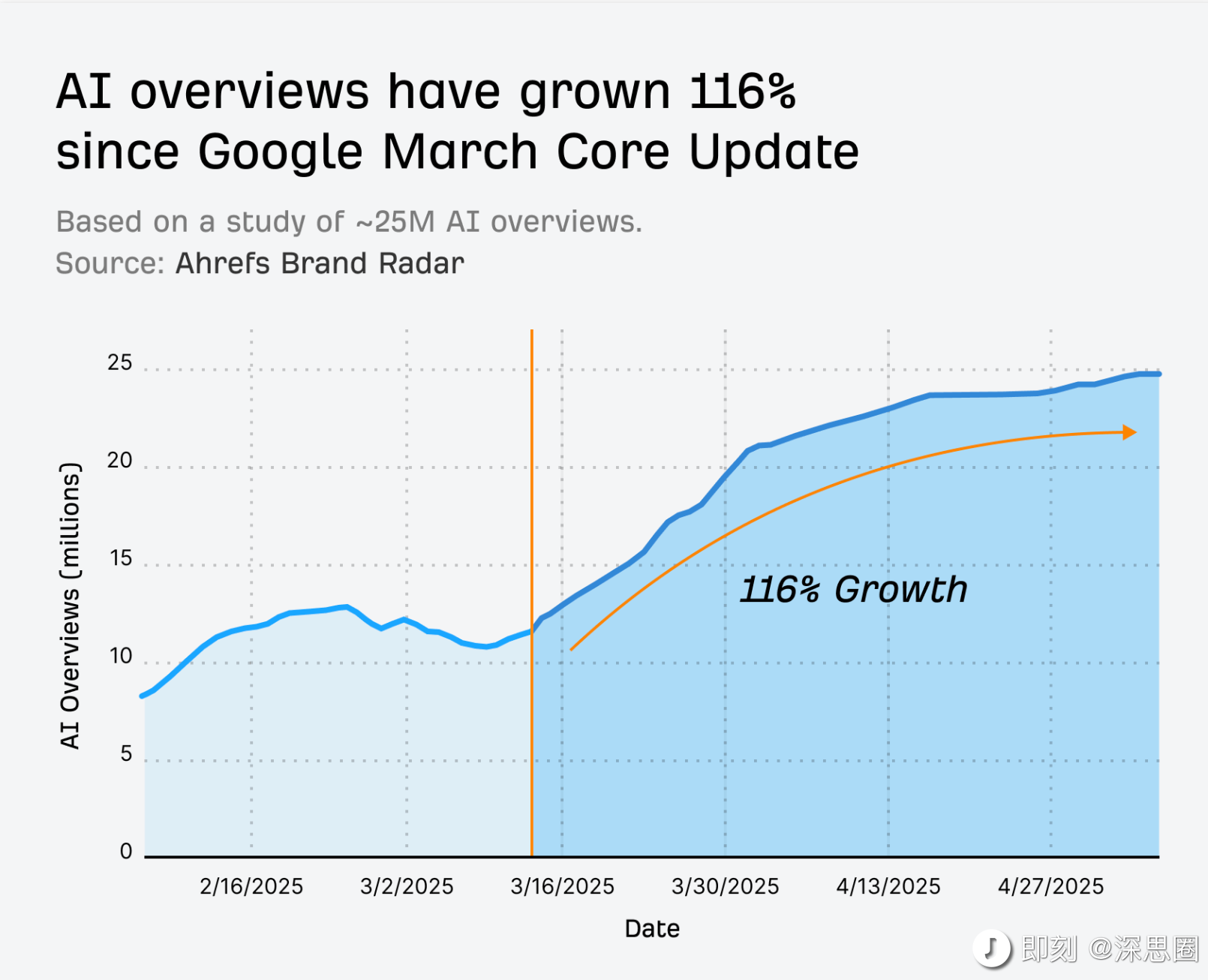
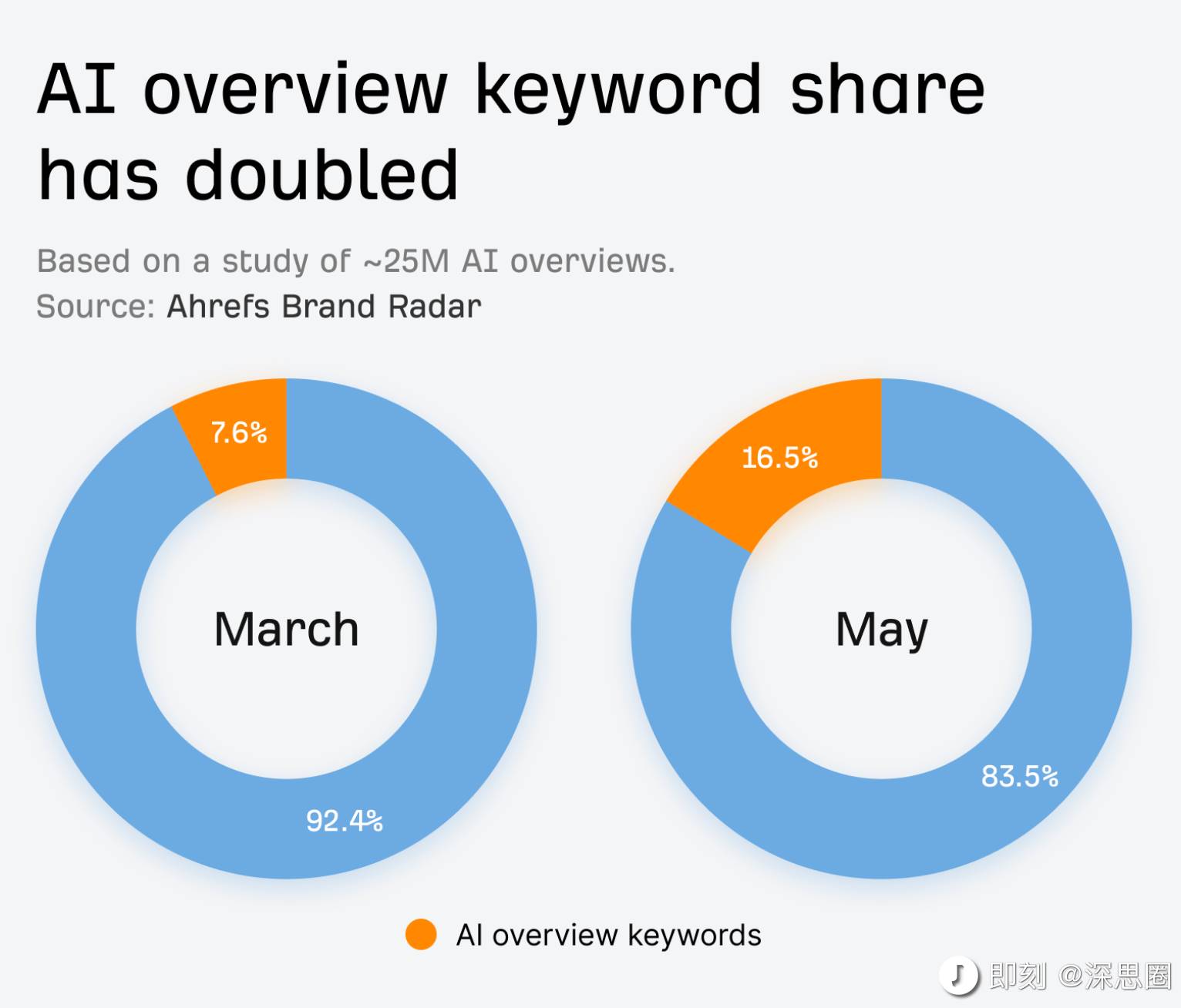
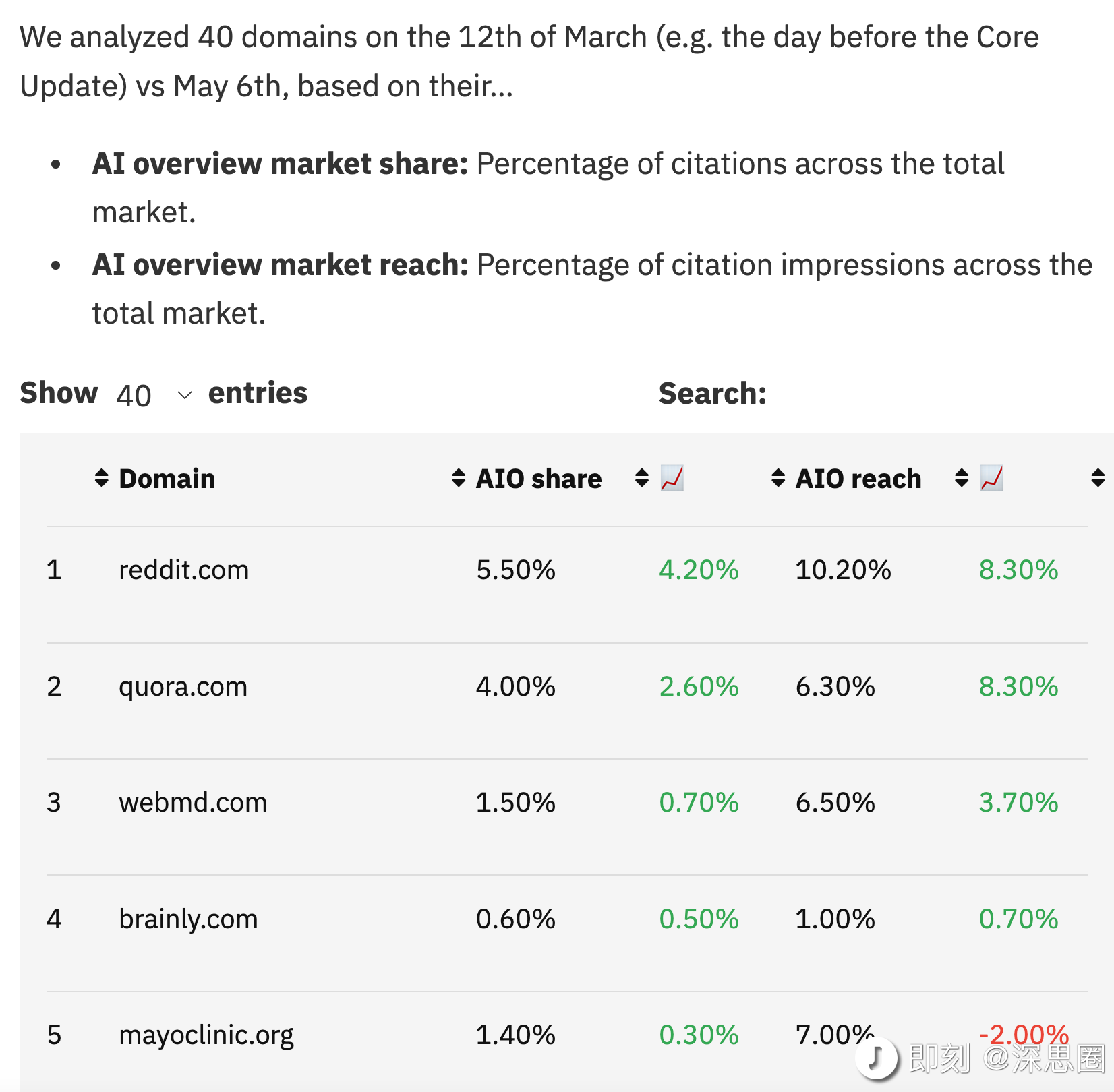
The most crucial change from SEO to GEO lies in traffic distribution channels. For anyone involved in marketing and growth, channel shifts are the most sensitive indicators—each new channel signals a fresh wave of traffic opportunities. Recently, I shared some latest data and insights on Google AI Overview via Jike; interested readers can refer to the image below. Coincidentally, a16z published a new article today explaining how the emergence of GEO is changing the rules of traffic and marketing. Combined with my own reflections, I’m sharing it here.

Bridging the Gap: From the Link Era to the Language Model Era
Traditional search is built on links, while GEO is built on language understanding. This difference may seem subtle, but it actually represents two fundamentally different worldviews. In the SEO era, visibility meant ranking high on search engine results pages (SERPs), achieved through optimizing factors such as keyword matching, content depth and breadth, backlinks, and user experience. But today, when large language models like GPT-4o, Gemini, and Claude become people’s primary interface for information retrieval, the meaning of visibility has fundamentally changed: You need to appear directly within the answer itself—not merely rank highly on a results page.
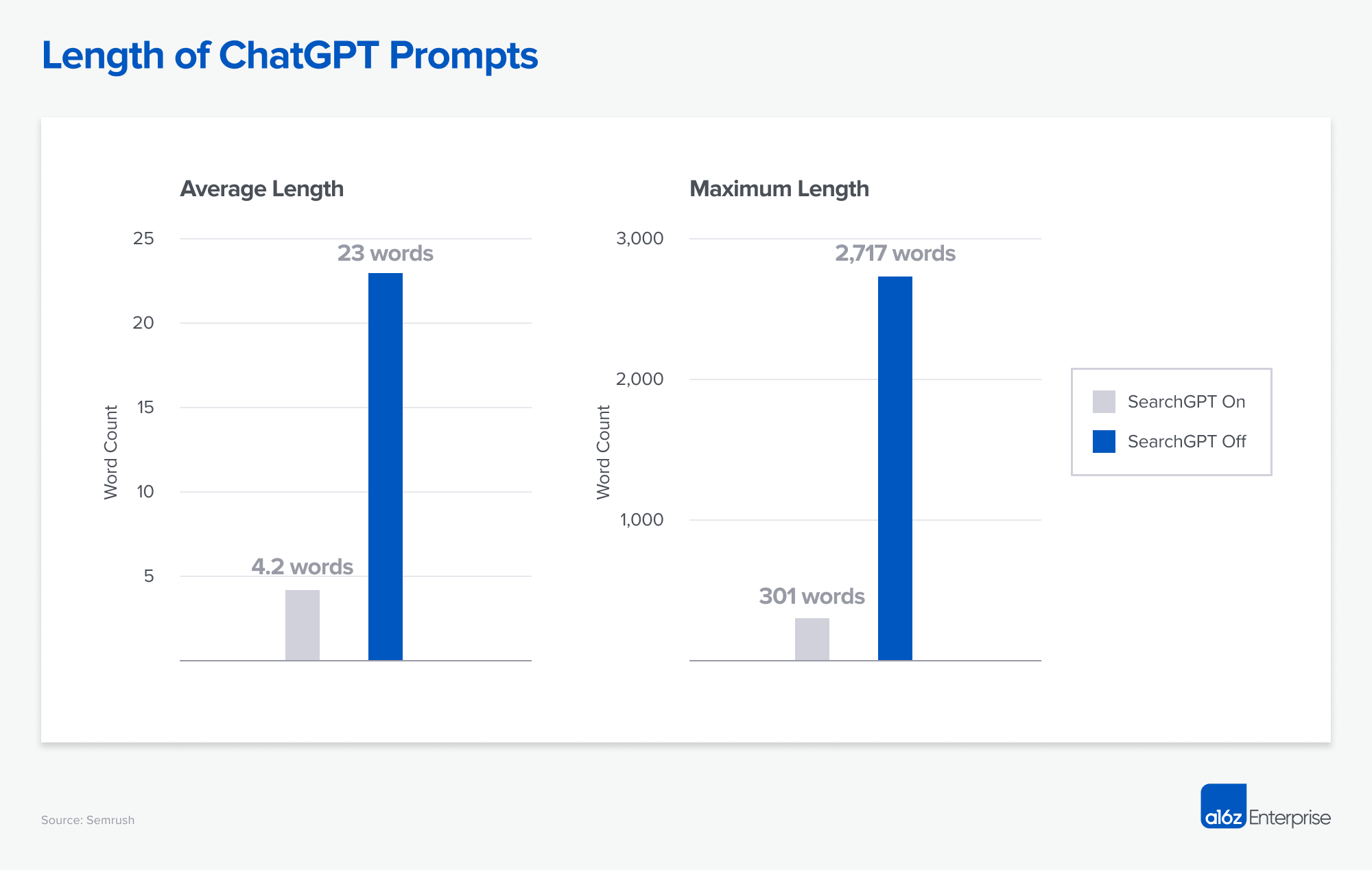
I’ve found the implications of this shift run much deeper than they first appear. The change in answer format is transforming user search behavior. AI-native search is fragmenting across platforms, with Instagram, Amazon, and Siri each driven by different models and user intents. User queries are becoming longer (averaging 23 words compared to just 4 in traditional search), search sessions more in-depth (averaging 6 minutes), and responses vary based on context and sources. Unlike traditional search, large language models possess memory, reasoning, and the ability to synthesize personalized, multi-source responses. This fundamentally alters how content is discovered—and how it must be optimized.
More importantly, the large language model market differs significantly from traditional search in terms of business models and incentive structures. Classic search engines like Google monetize user traffic through advertising, with users paying in data and attention. In contrast, most large language models are subscription-driven services behind paywalls. This structural shift affects how content is referenced: model providers have little incentive to showcase third-party content unless it enhances user experience or reinforces product value. While ad markets may eventually emerge on LLM interfaces, their rules, incentives, and participants will likely differ substantially from traditional search.
In this new environment, I’ve observed an interesting phenomenon: traditional SEO rewards precision and repetition, whereas generative engines prioritize well-structured, easily parsed, meaning-dense content (not just keyword density). Phrases like "summarize" or bullet-point formatting help large language models efficiently extract and reproduce content. This difference reveals the fundamental adjustments needed in content optimization strategies—from catering to algorithms to aligning with language understanding systems.
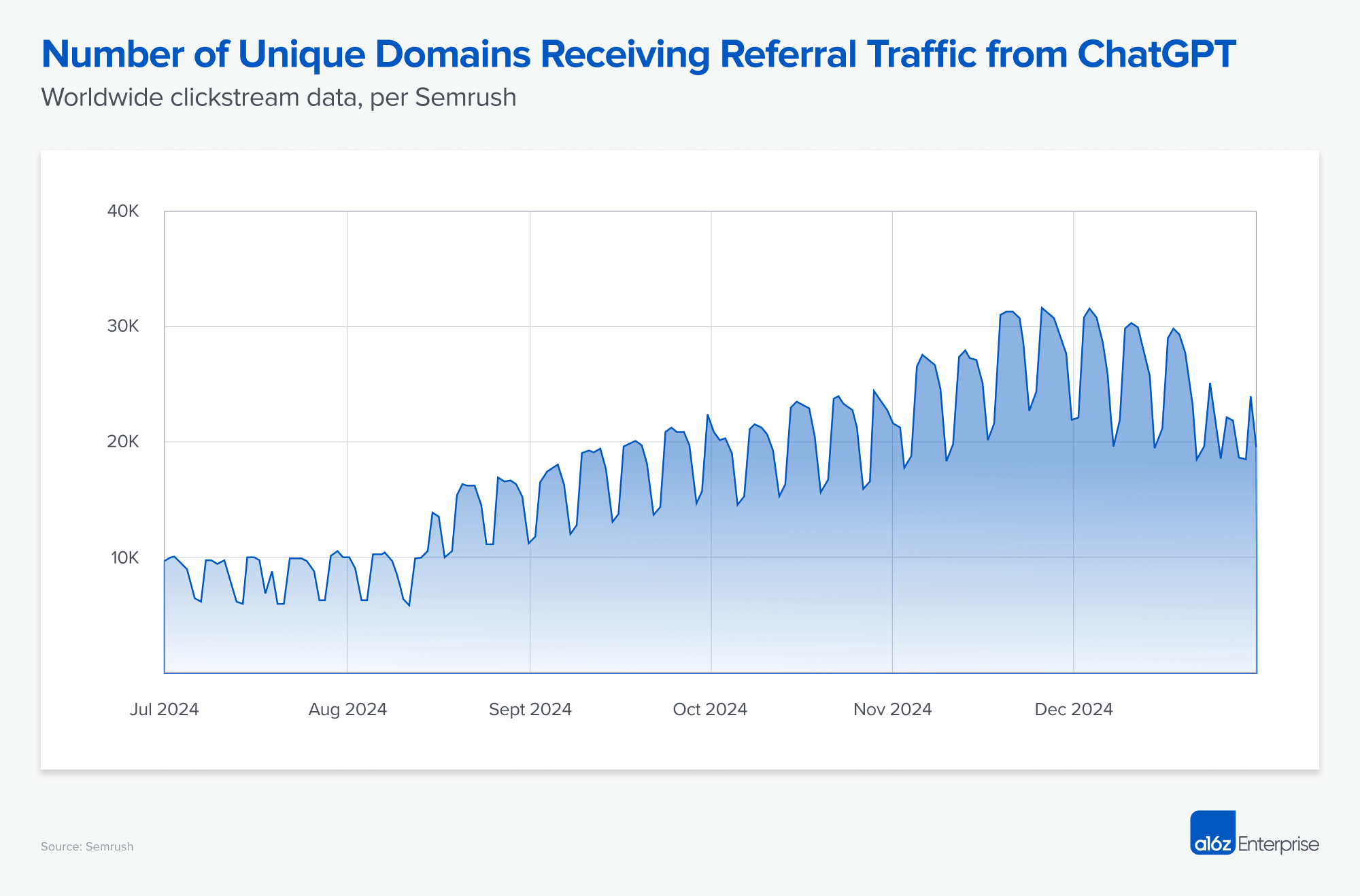
One emerging signal worth noting is outbound click volume from large language model interfaces. For example, ChatGPT is already driving referral traffic to tens of thousands of unique domains. This suggests that even in an era where AI directly answers questions, high-quality original content still holds value—but its realization is fundamentally different from the past. Brands and content creators must rethink how to create and sustain value within this new ecosystem.
From Ranking to Model Relevance
The current game is no longer just about click-through rates, but citation rates: How frequently is your brand or content cited or used as a source in model-generated answers? In a world of AI-generated output, GEO means optimizing for which content the model chooses to cite—not whether or where you appear in traditional search. This shift is redefining how brand visibility and performance are measured.
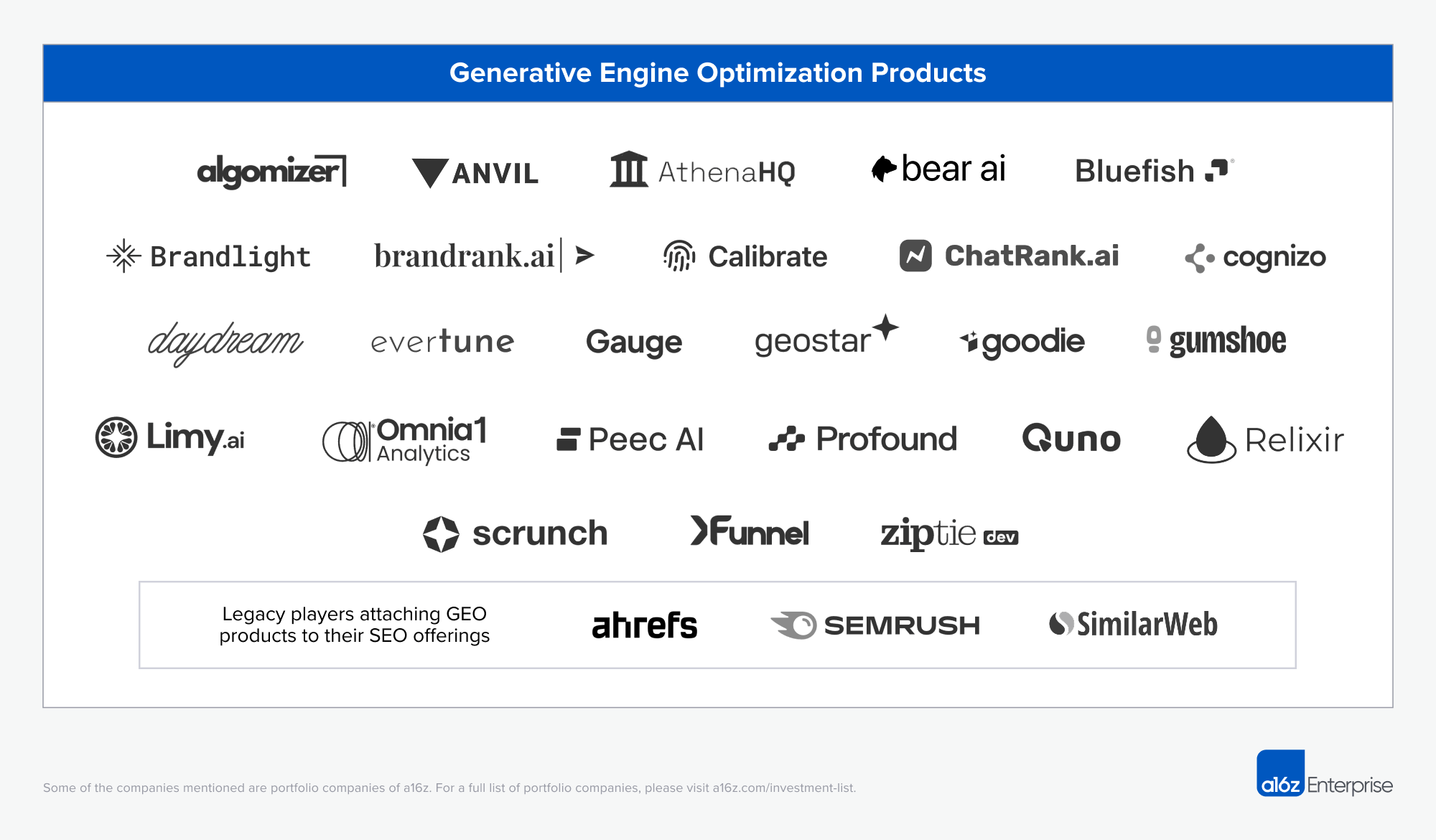
I’ve seen new platforms like Profound, Goodie, and Daydream emerge, enabling brands to analyze their performance in AI-generated responses, track sentiment in model outputs, and identify publishers influencing model behavior. These platforms work by fine-tuning models to mirror brand-relevant prompt language, strategically injecting top SEO keywords, and running synthetic queries at scale. Outputs are then organized into actionable dashboards that help marketing teams monitor visibility, message consistency, and share of voice against competitors.
Canada Goose has used such tools to understand how LLMs reference the brand—not just product features like warmth or waterproofing, but brand perception itself. The key insight isn’t how users find Canada Goose, but whether the model spontaneously mentions the brand—an indicator of unaided brand awareness in the AI era. Such monitoring is becoming as critical as traditional SEO dashboards. Tools like Ahrefs’ Brand Radar now track brand mentions in AI Overviews, helping companies understand how they’re positioned and remembered by generative engines.
Semrush has also launched a dedicated AI toolkit designed to help brands track awareness on generative platforms, optimize content for AI visibility, and rapidly respond to new mentions appearing in LLM outputs. This indicates traditional SEO players are adapting to the GEO era. We are witnessing the emergence of a new kind of brand strategy: one that considers not only public perception, but also model-level perception. How you're encoded into the AI layer—that's the new competitive advantage.
Currently, GEO remains experimental, much like the early days of SEO. Each major model update carries the risk of having to relearn—or forget—how best to interact with these systems. Just as Google’s algorithm updates once forced companies to scramble over ranking fluctuations, LLM providers are still refining the rules behind how models cite content. Multiple approaches are emerging: some GEO strategies are already clear (e.g., being mentioned in source documents cited by LLMs), while others remain speculative—such as whether models favor news content over social media, or how preferences shift across different training sets.
I believe this uncertainty presents both challenges and opportunities. For brands able to adapt quickly and experiment aggressively, this is a moment to gain first-mover advantage. At the same time, investment decisions require greater caution, as today’s effective strategies may become obsolete tomorrow. This demands marketing teams cultivate stronger adaptability and experimental mindsets rather than rely on fixed best practices.
Lessons from the SEO Era
Despite its massive scale, the SEO market never produced monopolistic winners. This observation offers valuable insights. Tools that help companies with SEO and keyword research—such as Semrush, Ahrefs, Moz, and Similarweb—have all succeeded in their niches, yet none has fully dominated the entire tech stack (or grown through acquisitions, as Similarweb did). Each carved out its own segment: backlink analysis, traffic monitoring, keyword intelligence, or technical audits.
SEO has always been fragmented. Work is distributed among agencies, internal teams, and freelancers. Data is messy, rankings are inferred rather than verified. Google holds the algorithmic keys, yet no single vendor controls the entire market. Even at their peak, the largest SEO players were merely tool providers—they lacked user engagement, data control, or network effects to become central hubs for SEO activity. Clickstream data—the record of users clicking links while browsing websites—was arguably the clearest window into real user behavior. Historically, however, this data was hard to access, locked behind ISPs, SDKs, browser extensions, and data brokers. This made building accurate, scalable insights nearly impossible without deep infrastructure or privileged access.
GEO changes all this. The key to this transformation is that large language models operate in ways that are inherently more transparent and predictable. While we cannot fully understand their internal mechanisms, we can analyze behavioral patterns through large-scale querying. This opens the door for a new generation of tools and platforms capable of delivering more precise and actionable insights than ever possible in the SEO era.
Winning GEO platforms will go beyond brand analytics to provide operational infrastructure: generating marketing campaigns in real-time, optimizing model memory, iterating daily as LLM behaviors evolve. These systems will be operational. This unlocks a broader opportunity than mere visibility. If GEO ensures a brand is cited in AI responses, it also enables managing an ongoing relationship with the AI layer itself. GEO becomes a system of record for interacting with LLMs, allowing brands to track presence, performance, and outcomes across generative platforms. Whoever owns that layer controls the underlying budget.
The Rise of GEO Tools and Platform Opportunities
This is not just a tool shift—it’s a platform opportunity. I believe the most competitive GEO companies won’t settle for mere data measurement. They’ll build proprietary model fine-tuning capabilities, learning from billions of implicit prompts across industries. They’ll achieve full closed-loop operations—insight, creative input, feedback, iteration—using differentiated technology to not only observe LLM behavior but actively shape it. More critically, they’ll find ways to access clickstream data and integrate first- and third-party data sources.
In my view, this is where monopoly potential lies: not just offering insights, but becoming the channel itself. If SEO was a decentralized, data-adjacent market, GEO may be its opposite—centralized, API-driven, and directly embedded into brand workflows. GEO may be the most visible wedge, especially given shifting search behaviors, but ultimately, it cuts into the broader performance marketing domain. The brand principles and user data understanding underpinning GEO can equally drive growth marketing. This is how big enterprises are built: software products that test multiple channels, iterate, and optimize across them. AI makes autonomous marketers possible.
Timing matters. Search is only beginning to transform, but advertising budgets move fast—especially when arbitrage opportunities arise. In the 2000s, it was Google’s AdWords. In the 2010s, Facebook’s targeting engine. Now, in 2025, it’s large language models and the platforms helping brands navigate how their content is ingested and cited by these models. In other words, GEO is the race for model-mindedness.
A key trend I’ve observed is that successful GEO platforms are evolving from simple analytics tools into full-stack marketing operating systems. They don’t just tell brands how they perform in AI responses—they provide tools to create, optimize, and distribute content to boost visibility in generative engines. This integrated approach creates stronger customer lock-in and higher lifetime value.
Even more interestingly, some GEO platforms are beginning to explore predictive capabilities. By analyzing LLM behavior patterns, they can forecast which types of content are more likely to be cited in future queries, or which topics are about to trend. This forward-looking ability gives brands a significant strategic edge, allowing them to position themselves ahead of competitors.
I believe the real opportunity lies with platforms that integrate GEO into the broader marketing tech stack. When GEO tools seamlessly connect with CRM systems, content management platforms, social media management tools, and analytics dashboards, they cease to be standalone optimization tools and become central hubs for marketing operations. This integration not only improves efficiency but unlocks new data insights and automation possibilities.
The Future of Marketing: Competing for Brand Memory in the AI Age
In a world where AI becomes the front door to commerce and discovery, marketers face a new question: Will the model remember you? This question is deeper and more complex than it appears. It’s not just about brand awareness—it’s about your brand’s standing within AI systems, the context in which it’s cited, and its relative importance compared to others.
I’ve found the nature of this competition fundamentally different from traditional marketing. In the SEO era, brands competed for positions on search result pages. In the social media era, they fought for user attention and engagement. But in the GEO era, brands compete for space and weight within the AI model’s "memory." This is a new competitive dimension requiring entirely new strategic thinking.
Even more intriguing, this competition isn’t limited to within-industry rivals—it occurs across industries. When users ask “best investment options,” traditional financial brands may find themselves competing with tech companies, real estate platforms, or even crypto projects for AI citations. This cross-industry rivalry blurs traditional boundaries, forcing brands to rethink their positioning and value propositions.
I believe successful GEO strategies must be grounded in a deep understanding of how AI systems work—not just technically, but also in terms of training data, update frequency, and bias tendencies. Brands need to understand the characteristics and preferences of different AI models as thoroughly as they once studied Google’s algorithm. For instance, some models may favor authoritative content, while others prioritize novelty or practicality.
In the long run, I believe GEO will give rise to entirely new marketing roles and skill sets. Just as SEO specialists became standard in digital marketing teams over the past two decades, GEO experts will become indispensable members of future marketing teams. These professionals will need deep AI technical knowledge, data analysis skills, content strategy acumen, and agility to adapt rapidly to technological change.
I also see profound impacts of GEO on content creation. Traditional content marketing focused on creating value for human readers. In the GEO era, content must deliver value to both humans and AI systems. This requires content creators to master new skills—understanding how to produce content that appeals to human audiences while also being effectively understood and cited by AI systems.
Ultimately, GEO is not just a new marketing tactic—it represents a fundamental shift in how brands interact with consumers. In this new world, brand success depends less on how many consumers they can reach, and more on whether they are selected and recommended by AI systems at critical moments. This shift demands brands reevaluate their value propositions, content strategies, and technology investments to remain competitive in an AI-driven future.
I firmly believe brands that early understand and master GEO principles will gain tremendous competitive advantages in the coming years. Those clinging to traditional marketing mindsets may find their visibility plummeting in the AI era. This isn’t alarmism—it’s the inevitable outcome of technological change. The GEO era has arrived. The rules have changed. The key question is: Are you ready?
Join TechFlow official community to stay tuned
Telegram:https://t.me/TechFlowDaily
X (Twitter):https://x.com/TechFlowPost
X (Twitter) EN:https://x.com/BlockFlow_News
 a16z
a16z