Bitcoin’s “Identity Crisis”: Why It Is Increasingly Resembling a Risk Asset
TechFlow Selected TechFlow Selected
Bitcoin’s “Identity Crisis”: Why It Is Increasingly Resembling a Risk Asset
Bitcoin’s identity has never been static.
 Navigating Web3 tides with focused insights
By: Machines & Money
Translated by: AididiaoJP, Foresight News
Everyone Is Asking the Wrong Question
Since hitting a record high of $126,000 on October 6, 2025, Bitcoin has fallen by 50%.
Gold, meanwhile, reached an all-time high of $5,595 on January 29, 2026.
Since Bitcoin’s peak, gold has risen over 25%, while Bitcoin’s price has been cut in half.
The cryptocurrency market’s “Fear & Greed Index” plunged to an unprecedented 5 on February 6 — lower than during both the COVID-19 pandemic and the FTX collapse — and has since only marginally rebounded into the teens.
Crypto commentators have once again revived the familiar debate: Is Bitcoin truly “digital gold”?
But this question itself is flawed. It presumes Bitcoin’s identity as an asset is fixed and immutable. In reality, Bitcoin’s behavior has shifted markedly across different macroeconomic environments. In 2017, it tracked gold; in 2021, it followed tech stocks; and from late 2024 through today, it has become tightly correlated with software stocks.
For institutional investors, a more practically relevant question is: What factor is currently driving Bitcoin’s price action — given today’s liquidity environment?
Based on evidence available as of February 2026, the answer is clear: Bitcoin now behaves like a highly volatile software stock. Whether this correlation reflects a temporary phenomenon driven by shared sensitivity to macroeconomic factors — or signals a permanent redefinition of Bitcoin’s role within investment portfolios — remains to be seen. But the data are becoming increasingly difficult to ignore.
How Strong Is This Correlation — and How Long Has It Lasted?
Bitcoin’s relationship with IGV — an ETF tracking software stocks — has grown progressively tighter across three distinct timeframes:
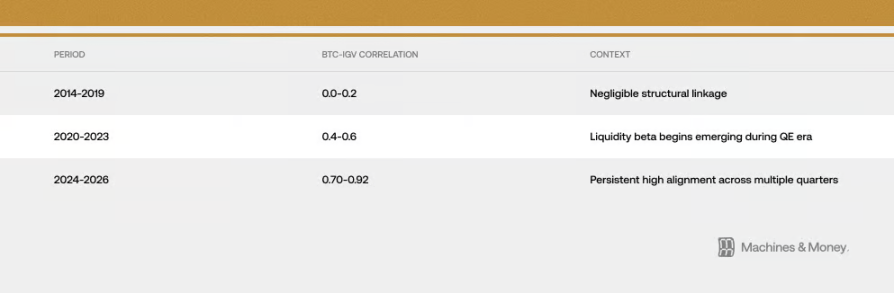
By late February 2026, their 30-day rolling correlation coefficient had reached approximately 0.73. More importantly, this high correlation — consistently above 0.5 — has persisted for over 18 months. That duration clearly exceeds typical short-term style rotations (which usually last just 3–6 months), yet falls short of confirming a permanent shift spanning a full market cycle (4–7 years).
The most recent downturn has made this linkage even more apparent. By late February 2026, IGV was down roughly 23% year-to-date, while Bitcoin declined 19–20%. IGV — the software-stock ETF — is enduring its worst quarter since the 2008 financial crisis. Over the past month and quarter, Bitcoin and IGV have moved almost in lockstep, meaning their magnitude of gains and losses has been extremely similar. During the sell-off, Bitcoin’s volatility has been about 1.1–1.3 times that of software stocks — significantly lower than the commonly assumed 2–3 times.
One caveat: Short-term correlations often spike during market turbulence — regardless of any fundamental link — as risk appetite simultaneously declines across asset classes. Yet this high degree of synchronicity has now lasted over 18 months, suggesting something more substantive than random noise underlies it. Still, correlation alone cannot establish causation — nor can it prove this relationship will persist indefinitely.
2025: A Defining Test for Bitcoin’s “Safe-Haven” Identity
If any year could test whether Bitcoin truly hedges against currency debasement, it was 2025. That year saw accelerating fiscal expansion, a weakening U.S. dollar, escalating geopolitical risks, stubbornly persistent inflation, and growing market expectations for Federal Reserve rate cuts.
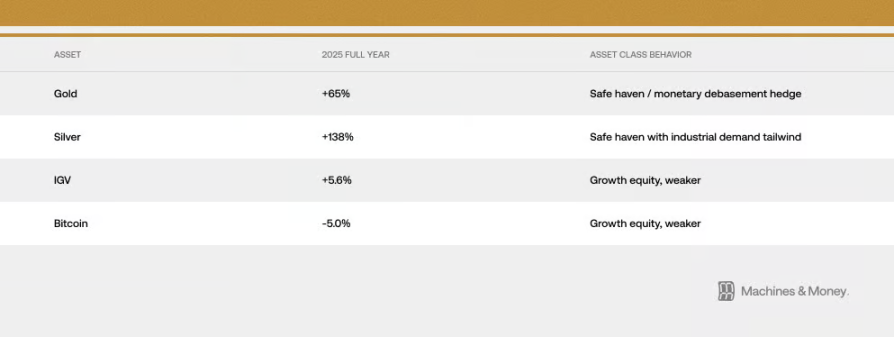
This should have been the ideal environment for Bitcoin to demonstrate its “digital gold” properties. Yet what unfolded since October 2025 tells a different story: Gold rose from $4,400 to a record $5,595, while Bitcoin fell from $126,000 to just over $60,000. Two assets assigned identical “inflation-hedge” functions moved in diametrically opposite directions precisely when conditions were most favorable for them to fulfill that function. The result:
Gold hit its all-time high of $5,595 on January 29, 2026. Central banks purchased 863 tons of gold in 2025 — marking their third consecutive year of massive buying. Not a single central bank bought Bitcoin.
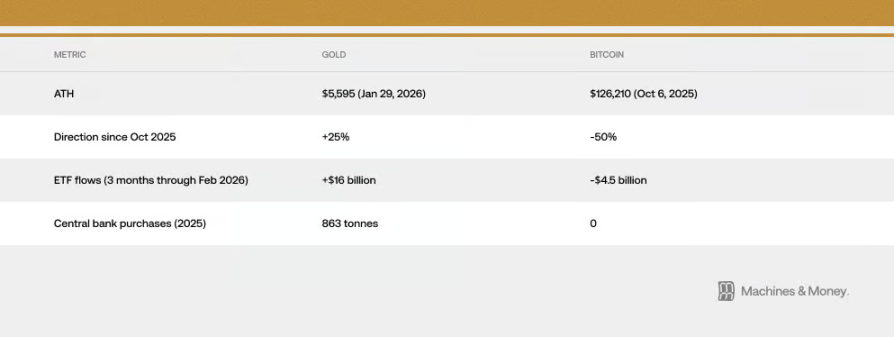
This stark divergence in capital flows delivers the strongest rebuttal yet to the “digital gold” thesis: When major institutions and sovereign wealth funds actually needed safe-haven assets to protect against precisely the macro conditions Bitcoin claims to insulate investors from, they allocated capital to gold at more than a 3:1 ratio over Bitcoin.
That does not mean Bitcoin can never become a safe-haven asset in the future. It simply means that, at this moment — given the current investor composition, market structure, and liquidity environment — it is not functioning as one. In 2025, both Bitcoin and software stocks delivered only meager single-digit returns, while traditional hard assets performed spectacularly. In this stress test, Bitcoin and tech growth equities exhibited remarkably aligned behavior — one of the strongest pieces of evidence supporting the view that the two are converging.
Why Is This Happening? Three Structural Drivers
1. Institutional Capital Allocation Has Changed
The launch of Bitcoin ETFs has fundamentally altered how institutions trade Bitcoin.
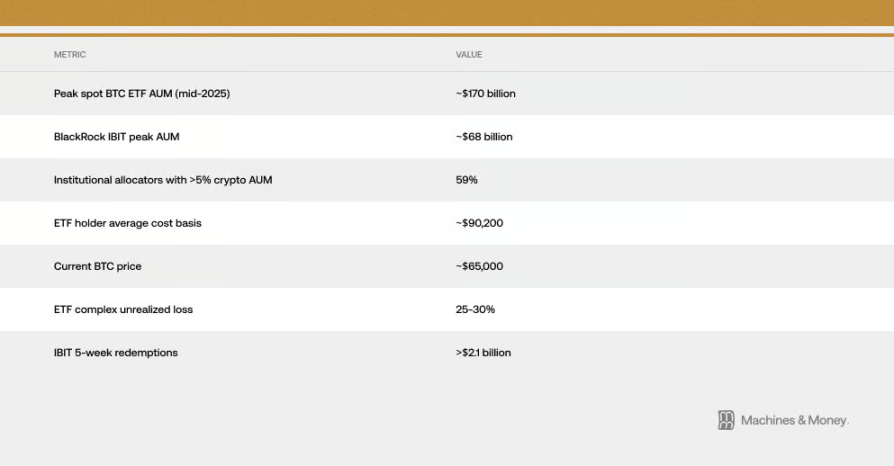
The result is that Bitcoin is now evaluated within the same investment decision framework as software stocks. Risk management systems treat them identically; when portfolio adjustments are required, institutions buy or sell both asset classes simultaneously; and performance benchmarks frequently group them together under the broader “tech” umbrella. When a multi-asset fund deems growth stocks too risky and decides to reduce exposure, it sells both its software holdings and Bitcoin in the same transaction.
This creates a self-reinforcing loop: Because institutions classify Bitcoin as a tech stock, its capital flows align with those of tech stocks — and that alignment, in turn, reinforces the institutional perception of Bitcoin as a tech stock. Estimates suggest the average cost basis for U.S. spot Bitcoin ETF holders sits around $90,000. With Bitcoin trading near $64,000, the entire ETF ecosystem is sitting on paper losses of 25–30%. This cost gap matters critically: It transforms what might otherwise be long-term, strategic institutional capital into a persistent source of selling pressure. Investors who bought ETFs expecting diversification or safe-haven benefits now watch gold ETFs rise while their own positions bleed red. Since early 2026, we’ve observed in real time the chain reaction of ETF redemptions triggering Bitcoin price declines — with outflows lasting longer than any period since ETFs launched. Just BlackRock’s IBIT fund alone saw over $2.1 billion in outflows over the past five weeks.
2. Shared Macroeconomic “Sensitivity Points”
Both Bitcoin and software stocks respond similarly to the same macroeconomic signals: changes in real interest rates, monetary supply (M2), Fed balance sheet expansion or contraction, U.S. dollar strength or weakness, and overall market risk appetite (measured via the VIX and credit spreads). Both are “long-duration” assets sensitive to interest-rate shifts: They rally when real rates fall and decline when real rates rise. They benefit when liquidity expands and suffer when liquidity tightens.
A key question arises: Is Bitcoin uniquely tied to software stocks — or broadly linked to all liquidity-sensitive growth assets? Evidence strongly supports the latter. Bitcoin’s price movements aren’t driven by software companies’ earnings performance per se, but rather by the same tightening environment that depresses software valuations — an environment that also drains speculative capital from the broader market. This correlation reflects shared macroeconomic sensitivity — not inherent equivalence.
At times, the transmission mechanism is strikingly direct. In February 2026, the launch of two AI products entirely unrelated to Bitcoin nonetheless impacted its price — via the very “institutional pipeline” described above. This is correlation in action.
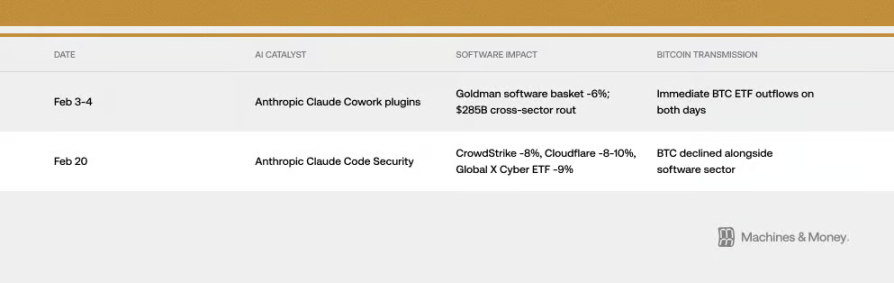
The VIX index further illustrates the point. When VIX spikes due to inflation data, both Bitcoin and software stocks fall. Yet when VIX declines from low levels, neither rallies significantly. This behavior perfectly matches that of highly volatile growth equities — not safe-haven assets.
Understanding this distinction is critical. If correlation stems solely from shared macro sensitivity, then a shift in macro conditions — even absent any material Bitcoin-specific developments — could cause Bitcoin and software stocks to decouple. Precedents exist: Bitcoin tracked gold in 2017 and tech stocks in 2021 — both relationships ended as macro conditions changed.
3. MicroStrategy’s “Amplifier” Effect
Strategy (formerly MicroStrategy) is the world’s largest publicly listed Bitcoin holder — and is classified as a software/tech company on the Nasdaq. This creates a direct, mechanical linkage between the software sector’s performance and Bitcoin’s “sentiment.”
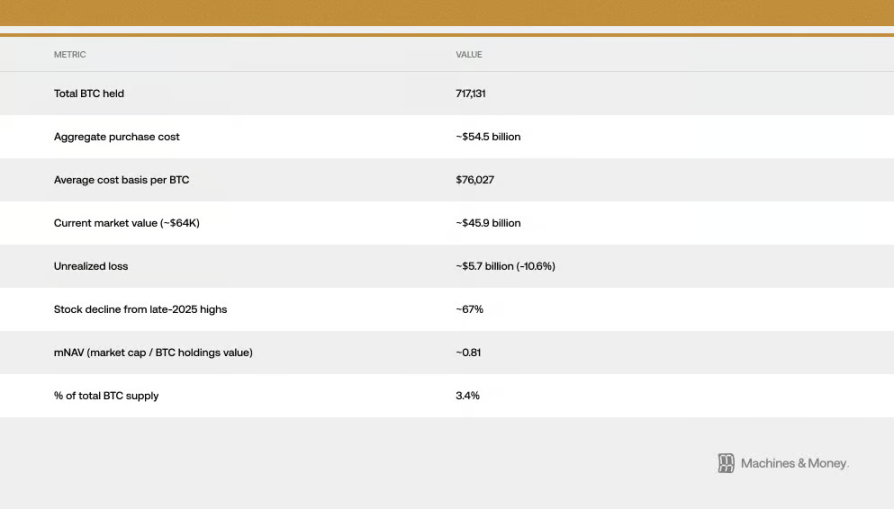
The feedback loop works both ways. A weakening software sector drags down Strategy’s stock price — which in turn intensifies pessimism toward Bitcoin and may even trigger tangible selling pressure. During market downturns, this loop tightens the correlation between Bitcoin and software indices. Strategy’s share price has fallen ~67% from its late-2025 peak — far exceeding both the software ETF and Bitcoin’s own drawdowns. Its current market cap is even lower than the value of the Bitcoin it holds — effectively trading at a discount. This indicates that, atop Bitcoin’s and software stocks’ baseline correlation, Strategy adds an additional layer of amplification.
In January 2026, MSCI considered removing companies holding over 50% digital assets from certain indices. If implemented, such a move could force massive passive outflows. This episode highlighted how vulnerable firms like Strategy are to conventional financial rules. Though MSCI ultimately postponed the decision — stating it would revisit the issue later — the risk remains live.
What Lies Ahead? Three Possible Frameworks
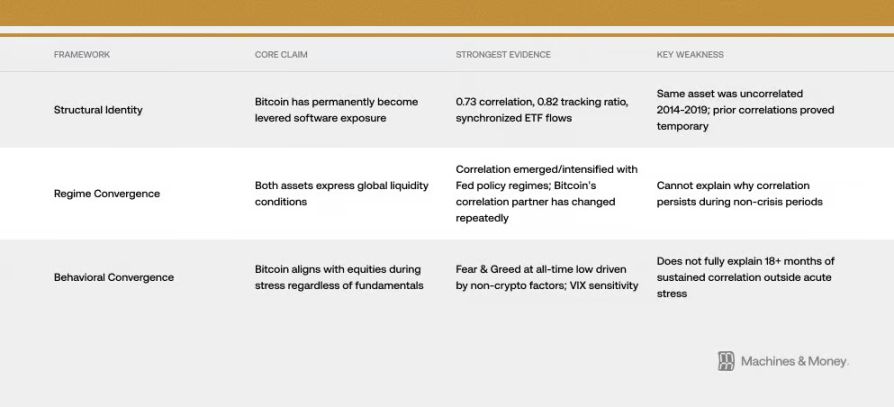
Framework One: Bitcoin Has Become a Leveraged Software Stock (Identity Permanently Changed)
This view holds that Bitcoin has been permanently redefined. Supporting evidence includes its 0.73 correlation with software stocks, near-perfect price synchronization, parallel ETF fund flows, and overlapping institutional ownership. Under this framework, the ETF era embedded Bitcoin into tech-oriented portfolios — permanently altering its risk profile. This correlation would persist regardless of market-cycle shifts.
The flaw with this view lies in history. Bitcoin itself hasn’t changed — yet its correlation with software stocks was nearly zero between 2014 and 2019. Previous episodes of high correlation — e.g., with altcoins in 2017–2018 or the Nasdaq in 2021–2022 — proved temporary. To confirm permanence, Bitcoin must survive at least one full Fed hiking-and-cutting cycle — a test not yet completed.
Framework Two: Both Are Merely “Liquidity Gauges” (Cyclical Convergence)
This explanation is simpler. Bitcoin and software stocks are both liquidity-sensitive “long-duration” assets — and happen to exhibit strong synchronicity amid today’s “liquidity drought.” This convergence began during the 2020 liquidity surge, intensified during the 2022 tightening phase, and persists through today’s liquidity-constrained environment.
Under this framework, the synchronicity could break once the next easing cycle begins (i.e., when the Fed resumes quantitative easing). Historically, Bitcoin has tended to rally one to two months ahead of software stocks following Fed policy pivots. Additionally, Bitcoin’s own supply dynamics — notably the “halving” event — historically trigger bull markets 12–18 months afterward, potentially enabling Bitcoin to decouple from software stocks entirely by late 2026.
Framework Three: Bitcoin “Huddles Up” With Equities During Stress (Behavioral Convergence)
At its core, Bitcoin is a highly volatile risk asset. During market panic and broad-based selloffs, it behaves like equities — irrespective of its intrinsic nature. At such moments, “risk-on” or “risk-off” sentiment dominates everything. When the VIX surges, both fall together. Sometimes, overarching narratives — e.g., concerns that AI disruption will render many tech firms obsolete — simultaneously impact software valuations and overall risk appetite, reinforcing synchronicity. On February 6, 2026, crypto’s Fear & Greed Index hit an all-time low — not due to crypto-specific news, but because the entire growth-asset complex was being liquidated amid macro and tech-sector concerns. Bitcoin’s most bearish sentiment in history was triggered by the exact same drivers affecting software stocks.
Current evidence best supports “Framework Two” (cyclical convergence), though the mechanisms outlined in “Framework One” — especially institutional trading behavior — are indeed prolonging this convergence within the present environment.
What’s Next? Potential Scenarios
Frankly, we cannot yet determine which scenario will definitively unfold. But we can map out the possibilities — and identify the signals that would allow us to rule some out.
Scenario One: Correlation Persists (Baseline Case). If market liquidity remains tight throughout 2026, Bitcoin will continue behaving like a highly volatile growth stock — maintaining a high correlation of 0.5–0.8 with software-stock ETFs. Questions about Bitcoin’s “true identity” remain unresolved. Absent significant shifts in Fed policy, institutional positioning, or Bitcoin-specific catalysts, this is the most likely outcome.
Scenario Two: Decoupling. If the Fed begins easing, combined with the delayed effects of the 2024 halving and waning concerns over AI-driven disruption, Bitcoin could meaningfully outperform software stocks in H2 2026. Their correlation would drop to 0.3–0.5. Such a development would validate “Framework Two” (cyclical convergence), confirming the current synchronicity as temporary.
Scenario Three: Permanent Convergence. If their correlation rises above 0.8 and endures across the next full easing cycle — culminating in formal inclusion in tech indices by major index providers — then Bitcoin’s identity would indeed have undergone a permanent transformation.
The key litmus test is simple. If correlation breaks when the Fed begins cutting rates and easing, then “cyclical convergence” is confirmed. If they remain tightly coupled despite easing, “identity shift” becomes the dominant explanation.
Until the next easing cycle (2026–2027) delivers clarity, this question remains genuinely open.
Conclusion
Bitcoin’s identity has never been static. It has always been what its dominant buyers believe it to be. Today, those dominant buyers are institutional investors allocating to it as a growth stock. That, too, may change — Bitcoin’s foundational attributes remain unchanged. But markets price assets based on who holds them and why — not on their original design intent. Until the next major macro shift, this synchronicity is reality. And for anyone seeking to understand Bitcoin’s practical role in their portfolio — right now — reality is all that matters.
Join TechFlow official community to stay tuned
Telegram:https://t.me/TechFlowDaily
X (Twitter):https://x.com/TechFlowPost
X (Twitter) EN:https://x.com/BlockFlow_News
 @machinesmoneyA1