Wintermute: Crypto Volatility Plummets Sharply as Retail Capital Flocks Frantically to U.S. Equities
TechFlow Selected TechFlow Selected
Wintermute: Crypto Volatility Plummets Sharply as Retail Capital Flocks Frantically to U.S. Equities
Retail investors are flooding into the U.S. stock market at a record pace, causing the crypto market and U.S. equities to shift from moving “in tandem” to operating like a “seesaw.”
 Navigating Web3 tides with focused insights
Author: Wintermute
Translation: TechFlow
TechFlow Intro: This article, authored by a Wintermute OTC trader, offers an in-depth analysis of the fundamental reasons behind retail investors’ capital outflow from today’s crypto market. Historically, crypto bull markets have been driven by retail speculation—but fresh data shows retail investors are flocking to U.S. equities at a record pace, shifting the relationship between crypto and U.S. stocks from “moving in tandem” to “a seesaw.” As crypto market volatility declines, on- and off-ramps become smoother, and AI empowers retail investors with superior analytical capabilities in U.S. equities, cryptocurrencies are no longer retail’s top speculative vehicle. Understanding this capital rotation logic is essential for rethinking multi-asset investment frameworks.
Full Text Below:
Retail activity has long powered the crypto market. Through speculation, reflexive buying-the-dip behavior, and nimble capital rotation across tokens, retail investors have defined every major cycle in crypto history. Yet new data suggests the relationship between retail investors and the crypto market is undergoing a structural shift.
For some time, we’ve warned that U.S. equities are drawing retail attention—siphoning liquidity away from altcoins. The latest data from J.P. Morgan’s Strategy team, combined with our proprietary crypto retail fund flow data, further confirms that U.S. equities and crypto are becoming substitutable risk assets.
Correlation Reversal
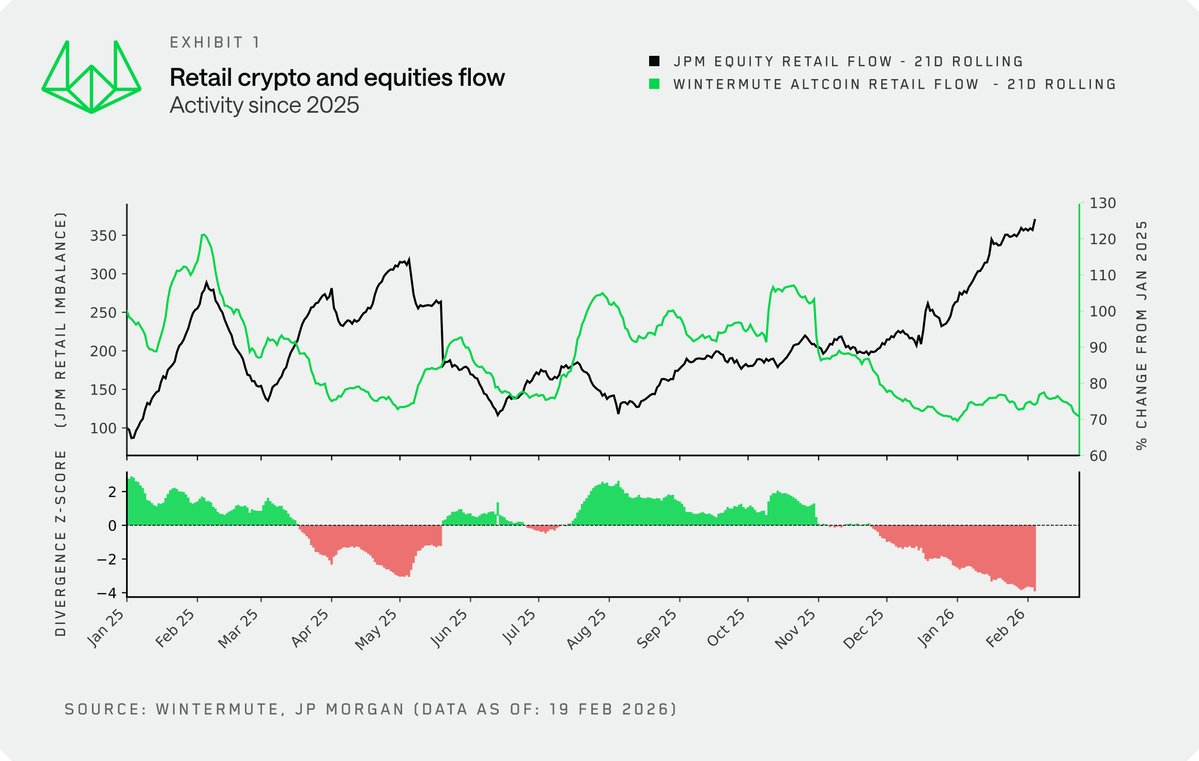
Overlaying Wintermute’s proprietary crypto retail fund flow data against J.P. Morgan’s data on retail inflows into U.S. equities yields a fresh perspective on how retail activity relates across these two markets.
Historically, the two moved in sync. Until the end of 2024, rising risk appetite typically meant buying in both markets—since, to some extent, both served as outlets for excess capital (see M2 data) and elevated risk sentiment. Since late 2024, however, that correlation has broken down. Today we’re witnessing the most severe divergence in recent history: retail investors are flooding into U.S. equities at a record pace, while standing pat—or even pulling back—in crypto.
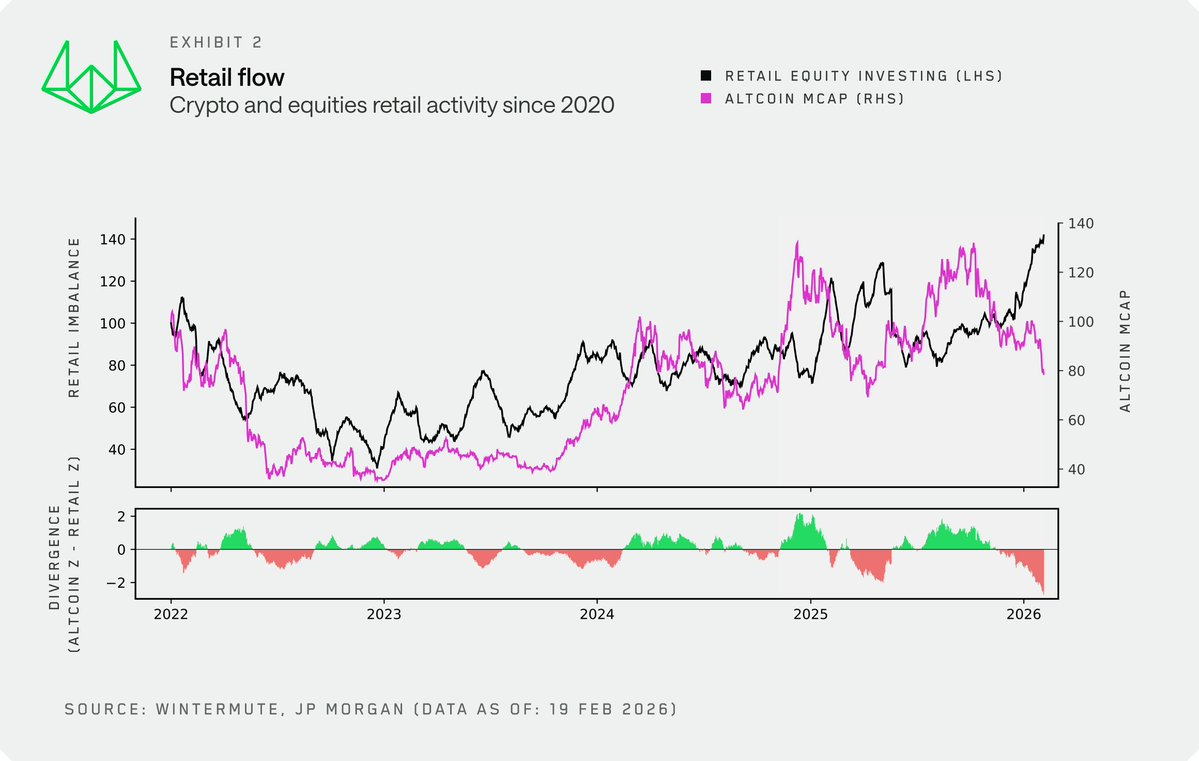
Zooming out, we use total altcoin market cap as a long-term proxy for retail crypto activity. It aligns closely with our retail fund flow data and offers a more objective, longer historical series. From 2022 through year-end 2024, crypto and U.S. equities broadly tracked each other, with retail treating both as components of a high-risk portfolio. But the decoupling since late 2024 stands out sharply—retail trading behavior has grown increasingly short-term-driven, volatile, and structurally unanchored.
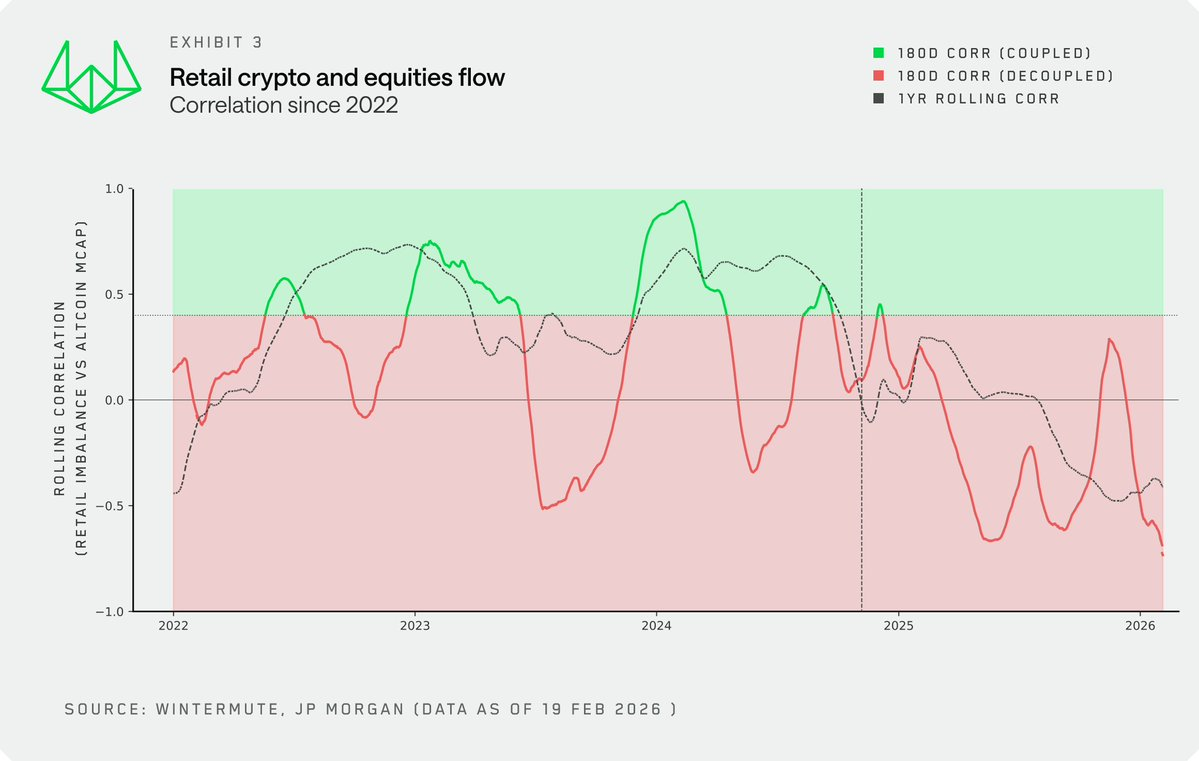
The rolling correlation between retail activity and altcoin market cap confirms this shift. What was once a volatile but consistently positive relationship has now flipped to negative. Retail investors are now making an “either/or” allocation decision—not buying both simultaneously.
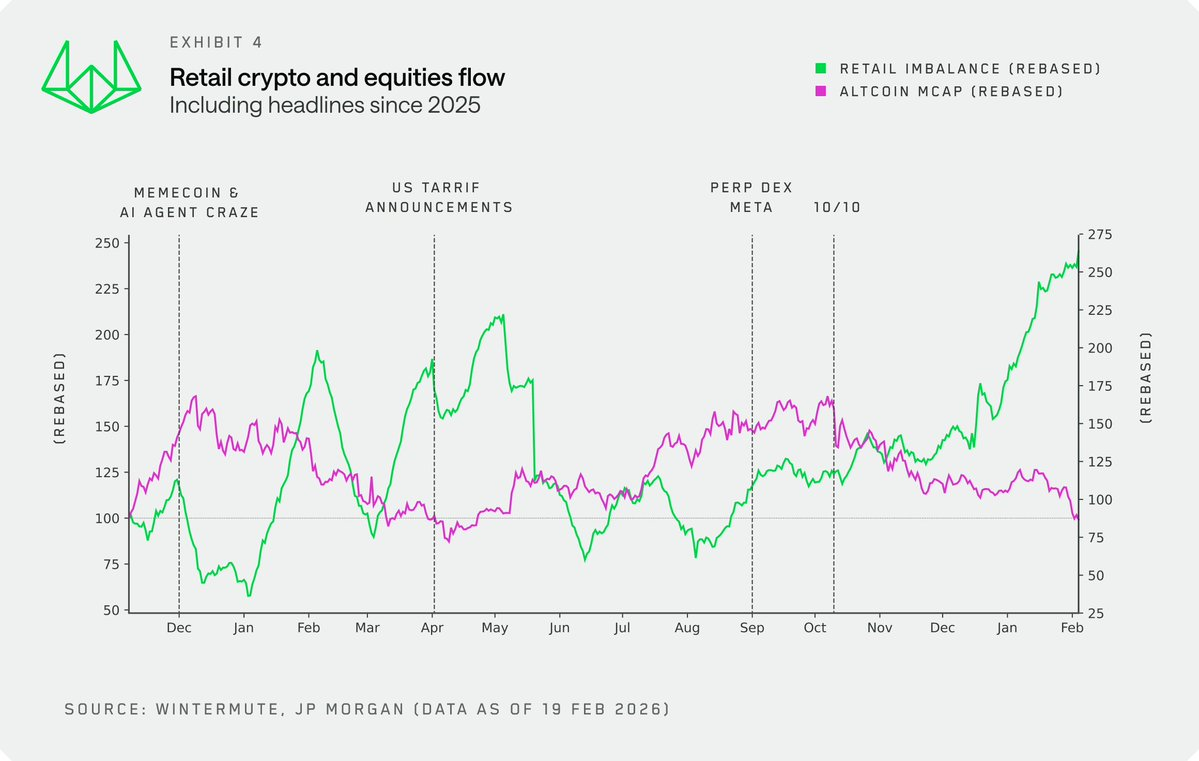
Focusing on 2025—and incorporating key catalyst events—this dynamic becomes even clearer. Several patterns stand out:
- When U.S. equity market activity stalled, memecoins and AI agents seized the spotlight, as retail redirected speculative demand into these niches.
- Whether during the April 2025 tariff announcement or more recently, retail investors continued aggressively buying the dip in U.S. equities.
- Since October 10, capital has shifted almost entirely toward U.S. equities—and this trend continues to date.
Causality
One point must be made unequivocally: we do not believe the crypto retail base is large enough to pull capital *out* of U.S. equities. Quite the opposite—the surging retail enthusiasm in U.S. equities is draining liquidity from crypto.
New data supports this view. Retail activity in U.S. equities has emerged as a new variable—one crypto investors must monitor closely to identify potential windows where retail capital could provide sustained buying support for crypto.
Volatility Is the Product
While multiple factors contribute, one core reason retail investors were—and remain—drawn to crypto is its inherent volatility. Volatility itself is the product. It was precisely this feature that first pulled retail into the crypto ecosystem.
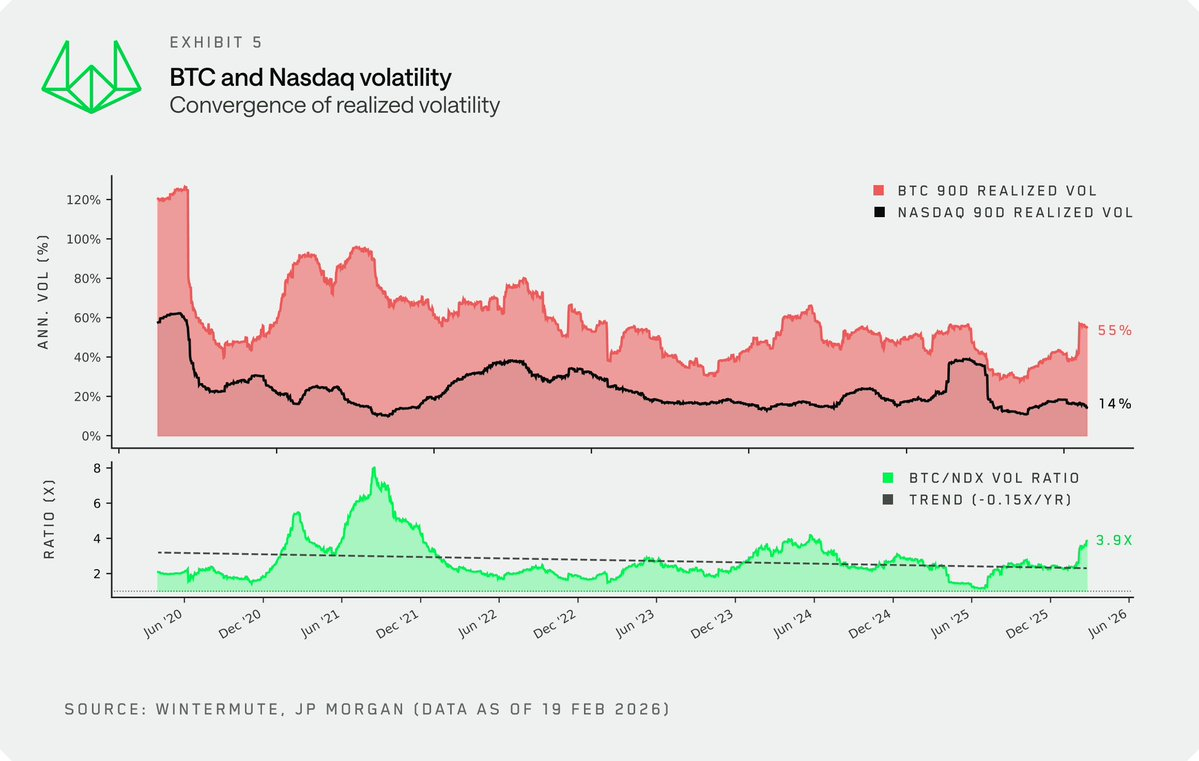
Yet although realized crypto volatility remains far higher than that of U.S. equities, it has undergone a structural compression—and this trend appears difficult to reverse. The BTC-to-Nasdaq-100 (NDX) volatility ratio has steadily declined, falling below 2x in the first half of 2025.
Key drivers behind this include:
- Market maturation. Growing participation by institutional and sophisticated investors—alongside new liquidity tools like ETFs and DATs—has dampened the reflexive volatility spikes characteristic of earlier cycles.
- Market scale. With total crypto market cap now at $2.3 trillion—even after a 40% drawdown from all-time highs—the amount of capital required to move the market upward is vastly larger than five years ago.
As volatility compresses, crypto’s core appeal to retail erodes. The extreme boom-bust cycles that defined the 2021–2022 bull run—and brought an entire generation of retail investors into the space—are gone. For volatility-seeking retail, U.S. equities are becoming increasingly attractive.
Technology-Driven Factors
Beyond crypto’s internal structural shifts, technology-driven forces are accelerating this capital rotation—yet this aspect remains under-discussed in market commentary.
- Access convergence. Fintech platforms and traditional brokerages have integrated crypto trading (or crypto-native platforms have added U.S. equity access), lowering entry barriers. But their deeper impact lies in facilitating *exit*. In prior cycles, cumbersome on- and off-ramp processes effectively locked capital inside crypto, fueling organic rotation among tokens. Today’s frictionless on- and off-ramps mean capital can shuttle freely—and without resistance—between crypto and U.S. equities.
- The “edge.” Retail appears increasingly drawn to U.S. equities partly because AI has conferred a novel advantage. Large language models (LLMs) have dramatically enhanced retail analytical capability—fostering an illusion of level playing fields with institutions.
No such illusion exists in crypto. While data-driven analysis of crypto projects is possible, the sector lacks consensus valuation frameworks and token value-capture mechanisms—and the universe of investable assets continues expanding infinitely—making it hard for retail to ever feel they hold a genuine “edge.”
Conclusion
Retail investors were once crypto’s most reliable source of reflexive demand. Now, however, their risk appetite is increasingly satisfied elsewhere. U.S. equities offer compelling volatility, grant retail a growing analytical edge, and—via a single app on your phone—enable seamless capital movement between crypto and equities. Cryptocurrencies still hold a place in retail portfolios—but today they’re just one tool among many, no longer the primary vehicle for speculation.
This shift should also reshape how investors observe the market. Some formerly reliable indicators have lost efficacy. For crypto investors to succeed, it’s no longer sufficient to simply identify leading indicators of risk appetite and map them onto crypto-native frameworks. Instead, investors must increasingly adopt a multi-asset portfolio lens when evaluating crypto—just as has long been standard practice in U.S. equities and fixed-income markets.
Join TechFlow official community to stay tuned
Telegram:https://t.me/TechFlowDaily
X (Twitter):https://x.com/TechFlowPost
X (Twitter) EN:https://x.com/BlockFlow_News
 @wintermute_t