ARK Invest: Bitcoin’s Institutionalization Path
TechFlow Selected TechFlow Selected
ARK Invest: Bitcoin’s Institutionalization Path
Compared to previous cycles, Bitcoin’s drawdowns and volatility are declining.
 Navigating Web3 tides with focused insights
By David Puell and Matthew Mena
Translated by Luffy, Foresight News
In 2025, Bitcoin continued integrating into the global financial system. The launch and expansion of spot Bitcoin ETFs, the inclusion of digital-asset-related public companies in mainstream stock indices, and an increasingly clarified regulatory environment collectively elevated Bitcoin from a fringe crypto asset to a new, institutionally allocable asset class.
We believe the central theme of the current cycle is Bitcoin’s evolution from an “optional” novel monetary technology into a strategic allocation for an increasing number of investors. Four key trends are reinforcing Bitcoin’s value proposition:
- Macroeconomic and policy conditions driving demand for scarce digital assets;
- Structural shifts in holdings by ETFs, corporations, and sovereign entities;
- Bitcoin’s relationship with gold—and broader stores-of-value frameworks;
- Reduced drawdowns and volatility relative to prior cycles.
This article examines each of these trends in turn.
The 2026 Macroeconomic Backdrop
Monetary Conditions and Liquidity
After an extended period of monetary tightening, the macroeconomic landscape is shifting: the U.S. quantitative tightening (QT) program concluded in December last year; the Federal Reserve’s rate-cutting cycle remains in its early stages; and over $10 trillion in low-yielding money market funds and fixed-income ETFs may soon rotate into risk assets.
Policy and Regulatory Clarity
Regulatory clarity remains both a constraint on and a potential catalyst for institutional adoption. Policymakers in the U.S. and globally are advancing frameworks to clarify digital asset regulation, standardize custody, trading, and disclosure practices, and provide clearer guidance for institutional investors.
Take the U.S. CLARITY Act as an example: it would assign oversight of digital commodities to the Commodity Futures Trading Commission (CFTC) and digital securities to the Securities and Exchange Commission (SEC), significantly reducing compliance uncertainty for relevant firms and institutions. The bill establishes a compliant pathway across the full lifecycle of digital assets and introduces a standardized “maturity test,” allowing tokens to transition from SEC to CFTC oversight once sufficiently decentralized. Additionally, the dual-registration regime for broker-dealers helps close long-standing legal gaps that previously forced digital asset firms to relocate overseas.
The U.S. government has also taken targeted actions specifically regarding Bitcoin:
- Lawmakers and industry leaders have discussed adding Bitcoin to national reserves;
- Rules governing the handling of seized Bitcoin held by federal agencies are being formalized;
- States such as Texas have taken the lead in adopting Bitcoin as a reserve asset.
Structural Demand: ETFs and Digital Asset Treasuries
ETFs as a New Structural Buyer
The scale-up of spot Bitcoin ETFs has fundamentally reshaped market supply-demand dynamics. In 2025, U.S. spot Bitcoin ETFs and digital asset treasuries (DATs) absorbed 1.2 times the total amount of newly mined Bitcoin plus previously dormant coins re-entering circulation. By end-2025, ETFs and DATs collectively held over 12% of Bitcoin’s total circulating supply.
Despite demand outpacing supply, Bitcoin’s price declined—primarily due to external factors: a large-scale liquidation event on October 10 last year, market concerns about Bitcoin peaking at the end of its four-year cycle, and negative sentiment surrounding quantum computing threats to Bitcoin’s cryptography.
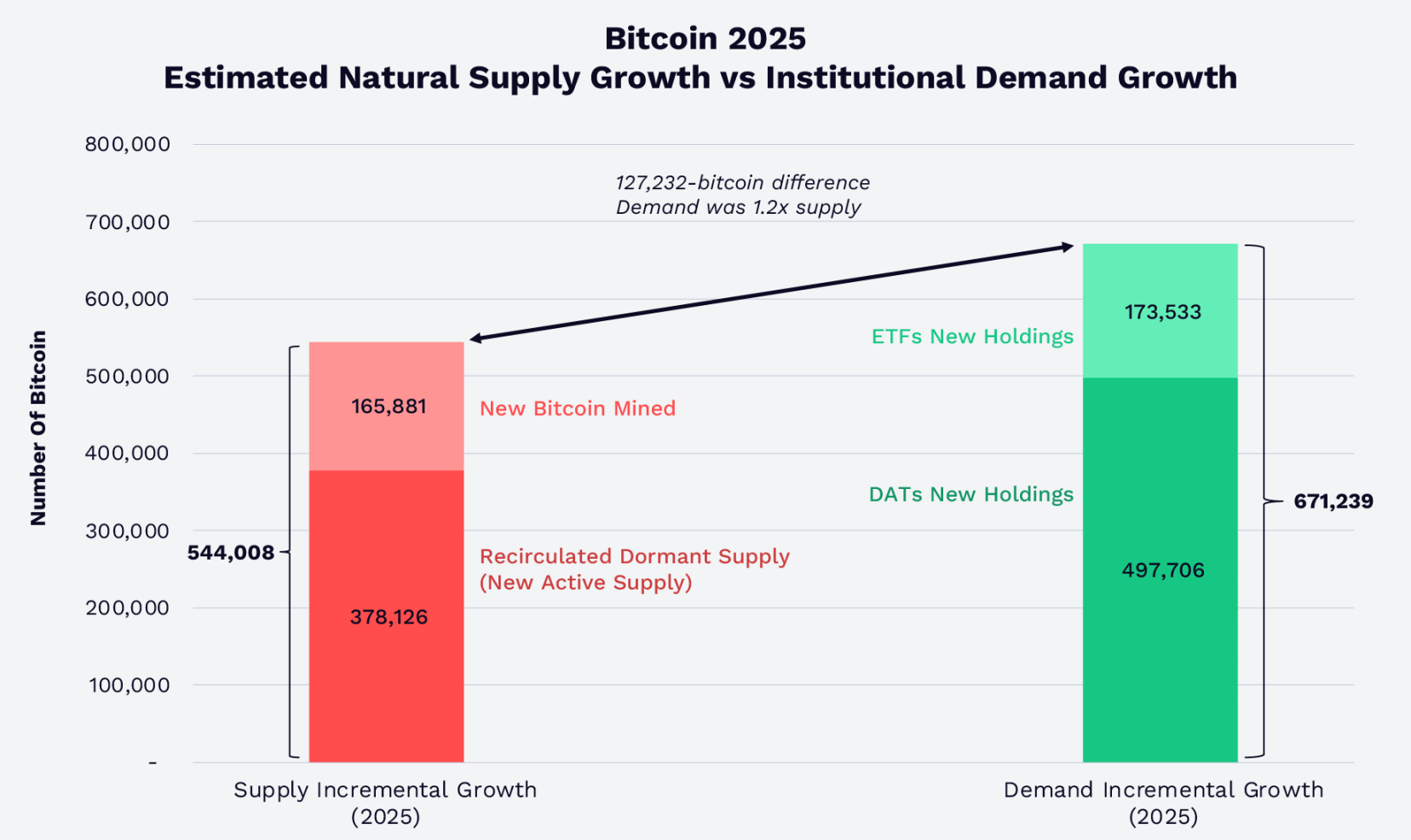
Comparison of Bitcoin’s new circulating supply versus institutional demand in 2025. Source: ARK Investment Management LLC and 21Shares
In Q4, Morgan Stanley and Vanguard both added Bitcoin to their investment platforms:
- Morgan Stanley opened access to compliant Bitcoin products—including spot ETFs—for its clients;
- Vanguard, which had long excluded cryptocurrencies and commodities, now offers third-party Bitcoin ETFs.
As ETFs mature, they will increasingly serve as a structural bridge between Bitcoin markets and traditional capital.
Corporate Treasury Accumulation
Corporate adoption of Bitcoin has expanded beyond a handful of early adopters to a broader set of enterprises. Stocks of companies like Coinbase and Block—now included in the S&P 500 and Nasdaq 100—enable mainstream portfolios to gain indirect Bitcoin exposure.
Strategy (formerly MicroStrategy), a leading digital asset treasury (DAT) firm, has built a massive Bitcoin position representing 3.5% of total supply. As of end-January 2026, Bitcoin-holding DAT companies collectively held over 1.1 million BTC—5.7% of total supply—valued at approximately $89.9 billion, predominantly held by long-term investors.
Sovereign Entities and Strategic Holdings
Following El Salvador, the Trump administration established the U.S. Strategic Bitcoin Reserve (SBR) in 2025 using confiscated Bitcoin. The reserve currently holds approximately 325,437 BTC—1.6% of total supply—valued at $25.6 billion.
Bitcoin vs. Gold: A Store-of-Value Comparison
Gold Leads, Bitcoin Follows?
In recent years, gold and Bitcoin have responded differently to macro narratives including currency debasement, negative real interest rates, and geopolitical risk. In 2025, gold surged 64.7% amid inflation, fiat depreciation, and geopolitical anxieties—while Bitcoin fell 6.2%, marking a pronounced divergence.
But this is not unprecedented:
- In 2016 and 2019, gold rallies preceded Bitcoin rallies;
- Following the initial pandemic shock in early 2020, gold rebounded first; Bitcoin then surged dramatically amid fiscal and monetary liquidity surges.
Historically, Bitcoin functions as a high-beta, natively digital analog to gold—a macro asset.
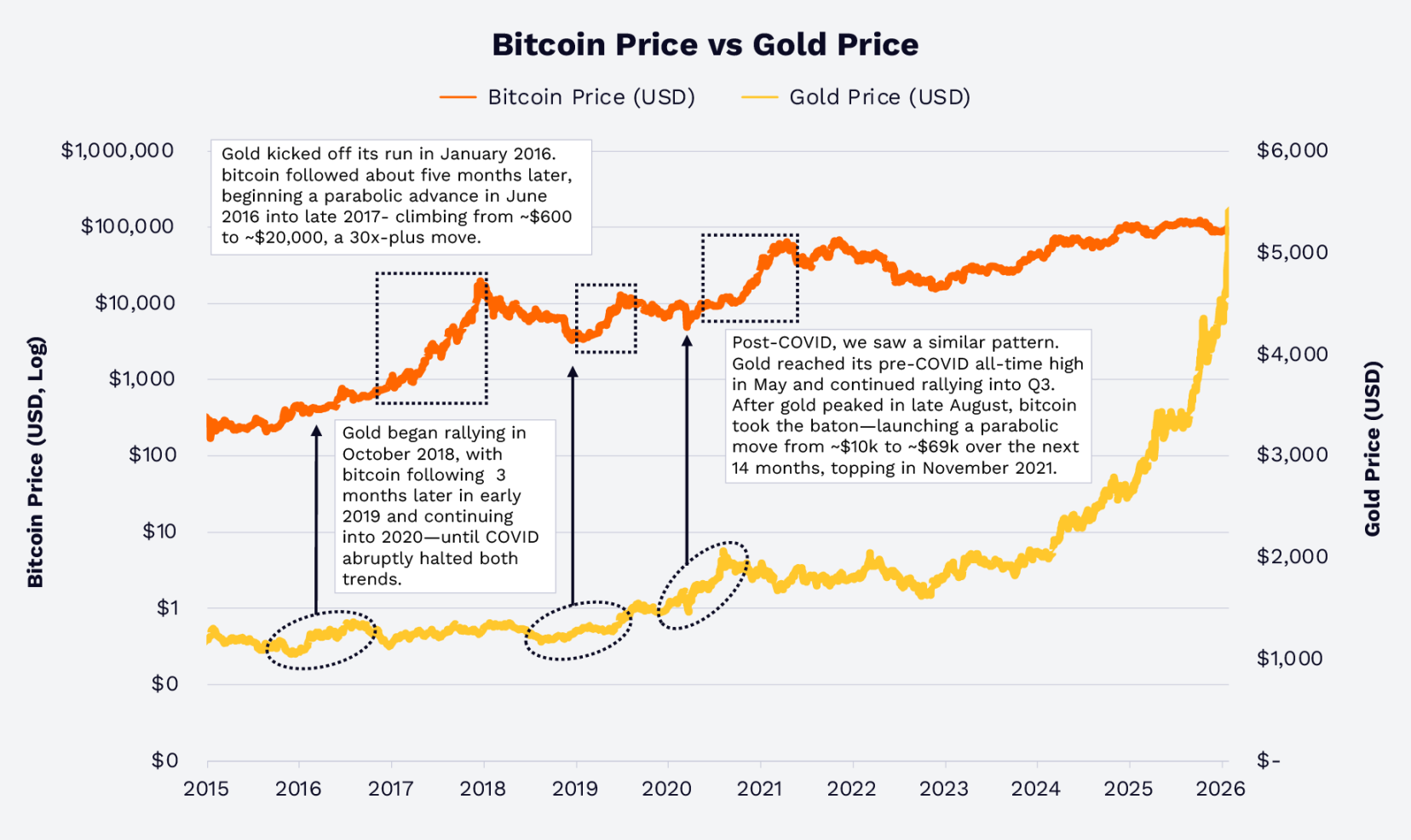
Bitcoin vs. gold price comparison. Source: ARK Investment Management LLC and 21Shares
ETF Scale: Bitcoin’s Growth Far Outpaces Gold’s
In cumulative ETF inflows, spot Bitcoin ETFs achieved in under two years what gold ETFs took over 15 years to accomplish. This suggests financial advisors, institutions, and retail investors increasingly recognize Bitcoin’s role as a store of value, diversification tool, and new asset class.
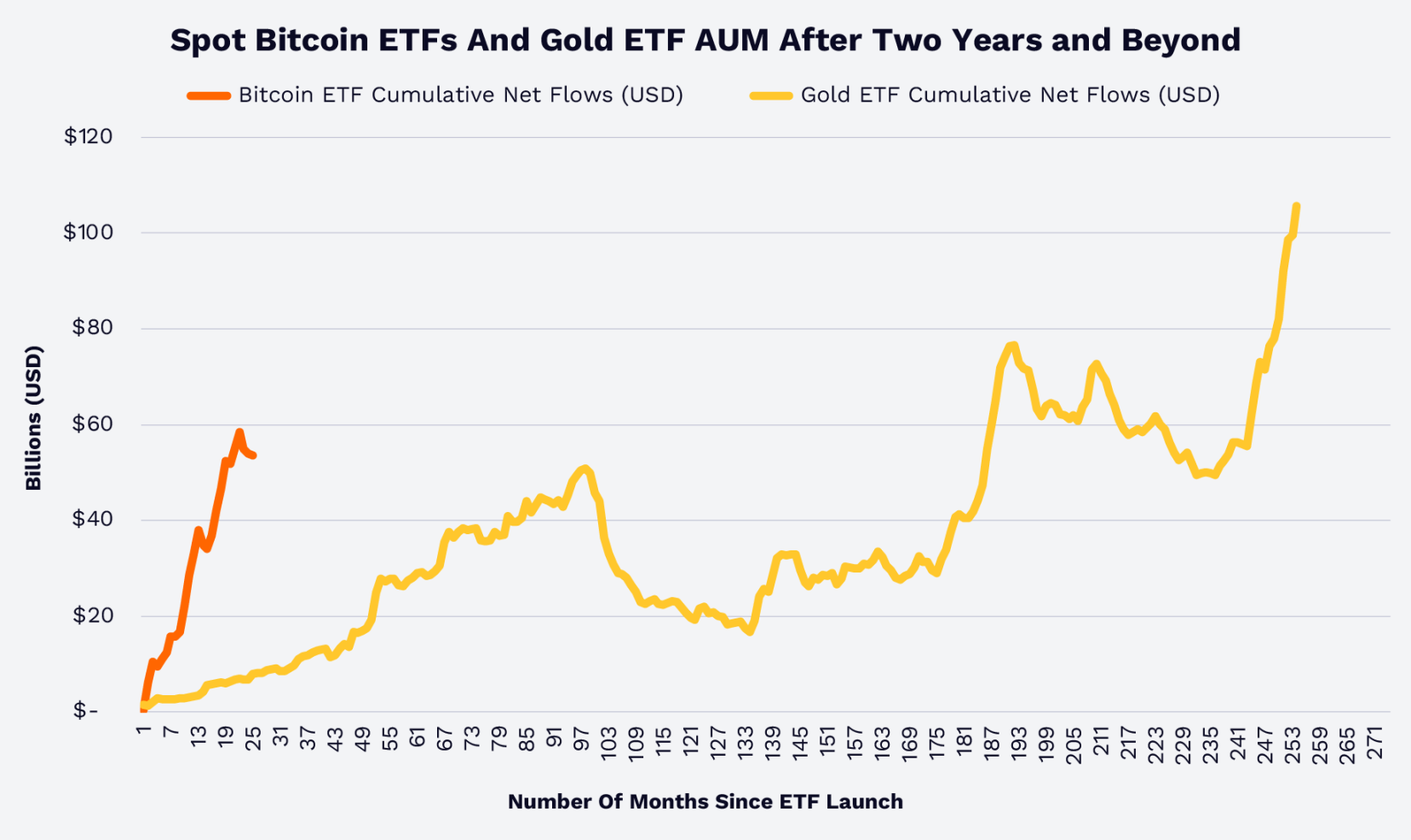
AUM growth of spot Bitcoin ETFs vs. gold ETFs. Source: ARK Investment Management LLC and 21Shares
Notably, Bitcoin and gold’s return correlation remains low across the 2020–present market cycle. Yet gold may still act as a leading indicator for Bitcoin.
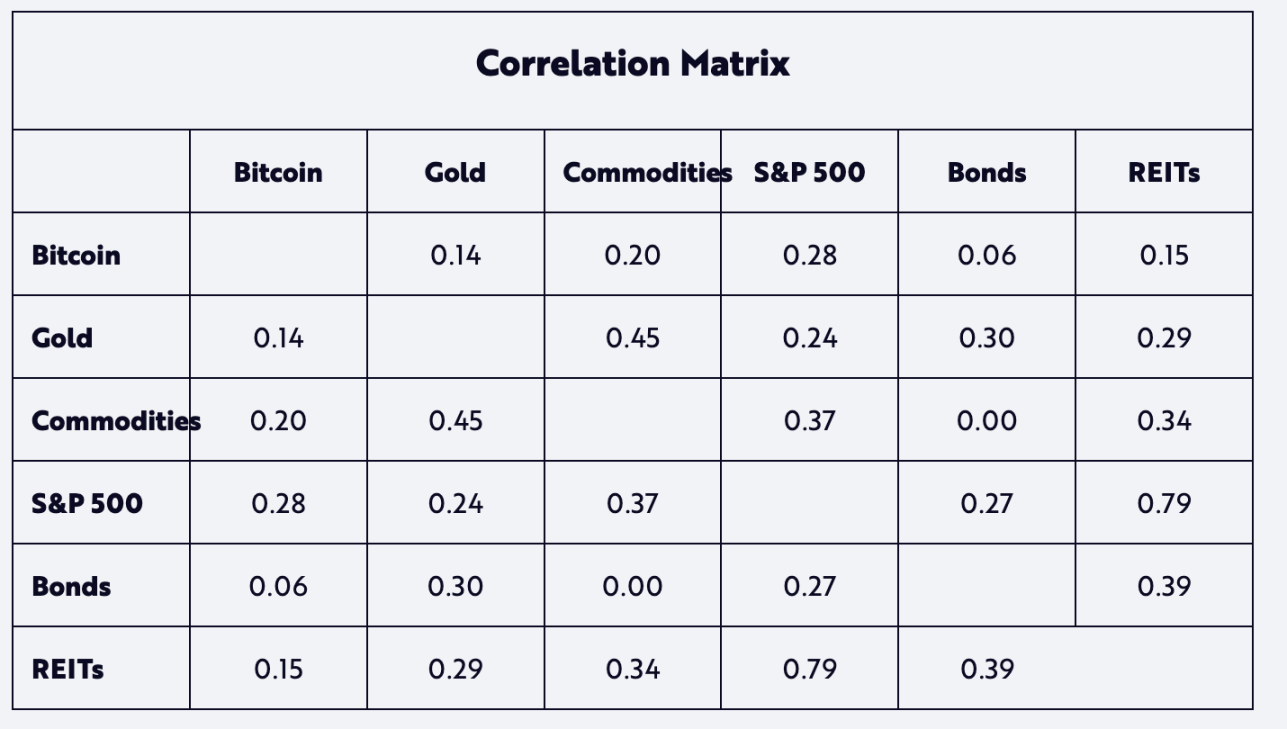
Correlation matrix of major assets
Market Structure and Investor Behavior
Drawdowns, Volatility, and Market Maturity
While Bitcoin remains volatile, its drawdowns are gradually narrowing. In prior cycles, peak-to-trough declines routinely exceeded 70–80%. In contrast, during the current cycle—beginning in 2022—the price decline from its all-time high never exceeded ~50% as of February 8, 2026 (as shown below), signaling growing participation and improved liquidity.
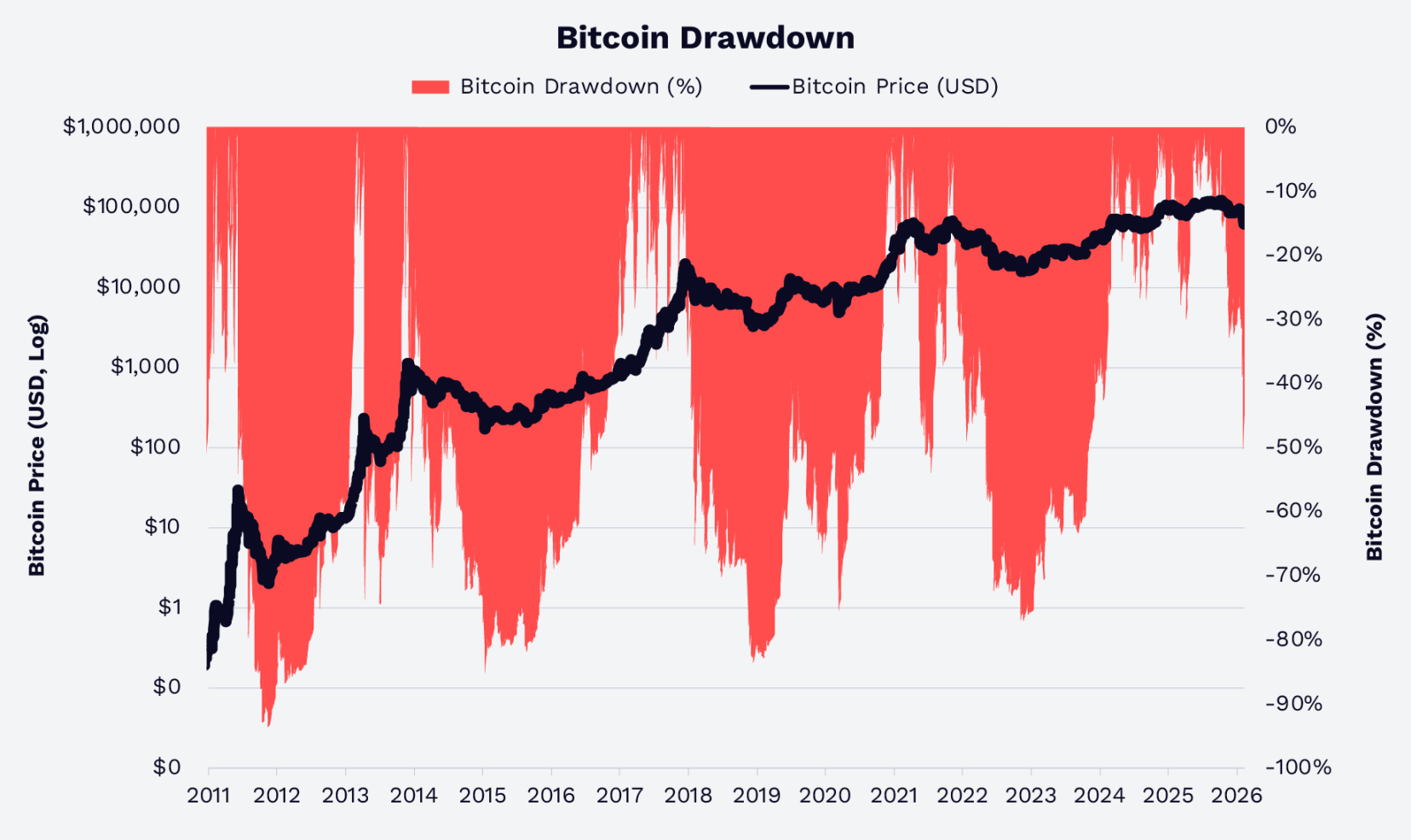
Holding Wins Over Timing
Per Glassnode data, even the “worst investor”—who bought $1,000 worth of Bitcoin at the annual high each year from 2020 to 2025—would have turned a $6,000 principal into ~$9,660 by end-2025 (a ~61% gain); retained ~45% gains by end-January 2026; and still held ~29% gains after the early-February correction, as of February 8.
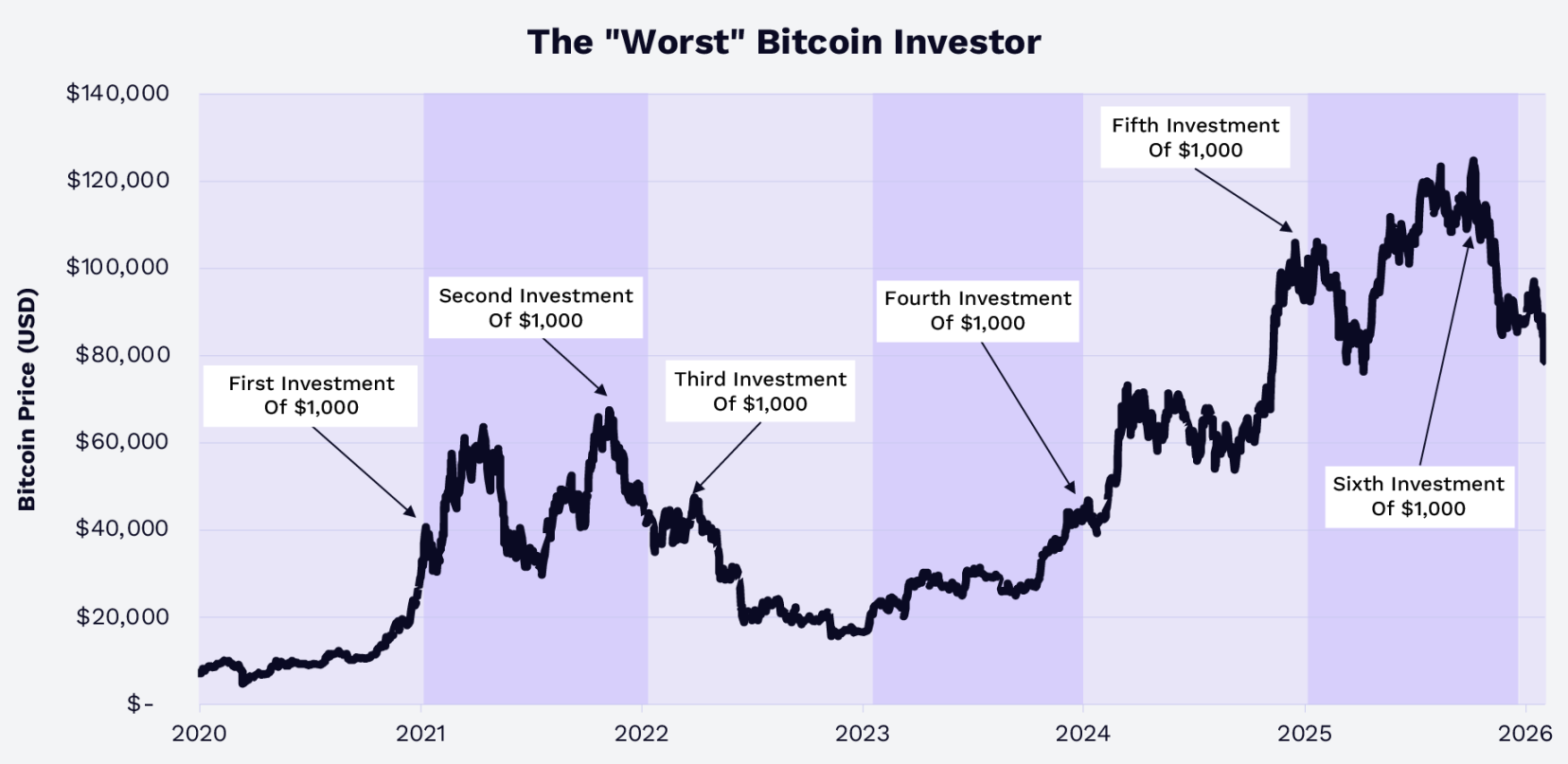
The conclusion is clear: since 2020, holding duration and position management have mattered far more than market timing.
Bitcoin’s Current Strategic Imperative
By 2026, Bitcoin’s core narrative has shifted away from “Can it survive?” toward “What role does it play in a diversified portfolio?” Bitcoin is:
- A scarce, non-sovereign asset in an environment of global monetary expansion, fiscal deficits, and trade tensions;
- A high-beta extension of traditional stores of value like gold;
- A globally liquid macro asset accessible via compliant instruments.
Long-term holders—including ETFs, corporate treasuries, and sovereign entities—have absorbed a large share of newly minted Bitcoin. Meanwhile, regulatory and infrastructure improvements continue broadening access. Historical data shows Bitcoin’s low correlation with other assets—including gold—combined with lower volatility and shallower drawdowns in this cycle, suggesting Bitcoin allocations can enhance portfolio risk-adjusted returns.
We believe the question facing investors in 2026 is no longer “Should I allocate?” but rather “How much should I allocate—and through which instruments?”
Join TechFlow official community to stay tuned
Telegram:https://t.me/TechFlowDaily
X (Twitter):https://x.com/TechFlowPost
X (Twitter) EN:https://x.com/BlockFlow_News
 @ARKInvest