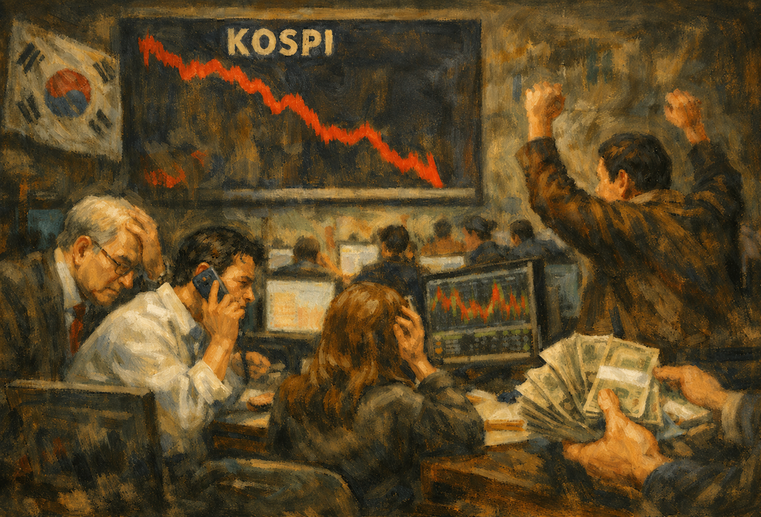
February 13 Market Recap: Apple’s Worst Single-Day Performance in Five Years; Tonight’s CPI Report Is the Ultimate Arbiter
TechFlow Selected TechFlow Selected
February 13 Market Recap: Apple’s Worst Single-Day Performance in Five Years; Tonight’s CPI Report Is the Ultimate Arbiter
If the CPI comes in higher than expected, the psychological resistance level of $60,000 will face its first real test.
 Navigating Web3 tides with focused insights
Author: TechFlow
U.S. Equities: A “Perfect Earnings Report” That Dragged the Entire Market into the Mud
Yesterday (February 12) was one of the worst days for U.S. equities so far this year.
The Dow Jones Industrial Average fell 669 points, or 1.34%, closing at 49,452—erasing last week’s newly minted milestone of “breaking above 50,000.” The S&P 500 dropped 1.57% to close at 6,832; the Nasdaq plunged 2.03% to 22,597—the steepest single-day decline since April. The VIX Fear Index surged 16% intraday, and whiteboards across trading floors were once again scribbled with “Sell everything.”
The culprit? Cisco.
The company delivered an earnings report that looked strong from virtually every angle: quarterly revenue of $15.3 billion, up 10% year-on-year and a record high; EPS of $1.04, beating Wall Street’s consensus estimate of $1.02; product orders up 18%, with AI infrastructure orders especially robust and networking equipment revenue surging 21%. Even CEO Chuck Robbins declared on the earnings call that Cisco is well positioned as “a trusted infrastructure builder for the AI era.”
Yet Cisco’s stock crashed 12.3%—its largest single-day drop since May 2022.
Why?
Because Cisco disclosed in its earnings that rising memory chip prices are already eroding gross margins. Its non-GAAP gross margin stood at 67.5%, slightly below market expectations. Services revenue declined 1% year-on-year. And its full-year FY2026 EPS guidance of $4.13–$4.17 already incorporates tariff-related cost impacts—meaning trade tensions remain very much alive.
The market interpreted this report as a signal: If even one of the most direct beneficiaries of the AI wave is seeing profits squeezed by memory costs and tariffs, just how wide is the moat around the AI narrative?
Panic quickly spread outward. Apple plunged 5%—its worst single-day performance since April this year; Disney fell 5.31%; Meta, Amazon, NVIDIA, and Microsoft all declined between 1% and 5%. AppLovin, despite reporting better-than-expected quarterly results, continued falling—its share price down 45% year-to-date. The software ETF (IGV) tumbled 3.7% in a single day, retreating back to last week’s lows.
The only sector moving against the tide was defensive stocks. Walmart rose 3.8%; McDonald’s gained 2.7%. Just weeks ago weighed down by AI anxiety and weak consumer data, these names became safe havens yesterday.
Two bright spots pre-market today suggest markets aren’t yet fully resigned to despair: Applied Materials posted an after-hours earnings beat and its stock jumped 12%; Rivian issued strong delivery guidance and its shares rose 16%. Buying interest in semiconductor manufacturing equipment and EVs signals the market isn’t retreating en masse—it’s discriminating.
Today’s Biggest Wildcard: January CPI, Due Tonight at Midnight (Beijing Time)
This is the week’s ultimate make-or-break moment.
At 9:30 p.m. Beijing time tonight (February 13), the U.S. Bureau of Labor Statistics will release the January CPI inflation report. This release was delayed due to a partial federal government shutdown.
Market consensus forecasts: headline CPI annual rate dipping modestly from December’s 2.7% to 2.5%, with a 0.3% month-on-month increase. Core CPI annual rate is also expected to fall to 2.5%.
But risk is asymmetric right now—if CPI comes in “surprisingly low,” markets will breathe a sigh of relief: rate-cut expectations return, tech stocks catch their breath, and gold and Bitcoin may stage short-term rebounds. If CPI prints “surprisingly high,” layered atop already-strong nonfarm payroll data, the rate-cut window will be pushed further out, Treasury yields will jump again—and tech stocks face another nightmare.
Per CME FedWatch data, markets currently assign nearly a 95% probability to no rate cut in March and about a 93% chance of a 25-basis-point cut in June. A CPI surprise would force a full recalibration of those odds.
Gold & Silver: Falling Back Below $5,000—Awaiting CPI’s Verdict
Yesterday (February 12), gold moved lower alongside broader risk sentiment—but its decline was far more muted than equities’. Spot gold closed near $4,980–$5,000 per ounce, giving back nearly two days’ gains; silver plunged over 8% to ~$77 per ounce, once again nearing the lows seen after last week’s sharp selloff.
Gold’s relative resilience during this pullback is worth noting: on days when U.S. equities fell 1.5%–2.0%, gold declined only ~2.7%, and found quick buying support just below $5,000. This suggests long-term institutional gold holders haven’t been shaken out by this technical panic.
The real test arrives with tonight’s CPI: if inflation data proves benign and Treasury yields retreat, gold could reclaim $5,000+; if CPI surprises to the upside, gold will remain under short-term pressure. The People’s Bank of China’s 15-month streak of gold purchases provides structural floor support, as do ongoing geopolitical risks—including the still-unresolved U.S.-Iran nuclear talks.
Silver’s situation is more complex. London silver inventories continue shrinking, and industrial demand—especially for solar panels—is structurally strong. Yet short-term ETF outflows and incomplete repair of speculative positioning mean volatility will remain elevated.
Crypto Markets: Bitcoin Slips Toward $65,000—“Extreme Fear” Lingers
Bitcoin currently trades near $65,000–$66,700, extending its gradual four-day downtrend. Ethereum clings to fragile support just below $1,990; XRP hovers near $1.40.
The tech-stock selloff hit crypto markets doubly: first, via correlated risk-asset liquidation; second, because Cisco’s warning about “rising AI memory costs” subtly hints at a potential slowdown in AI-related capital expenditures—a narrative that crypto bulls had previously leaned on to justify the thesis that “increased compute demand drives on-chain activity.”
Key current metrics: the Fear & Greed Index remains in the single digits (“extreme fear”); U.S. spot Bitcoin ETFs have seen net outflows exceeding $1 billion year-to-date; Polymarket now assigns an 82% probability to Bitcoin trading below $65,000 this year. Wolfe Research cites historical precedent, noting Bitcoin’s average peak-to-trough drawdown across its four-year cycles is 75%—which, if repeated, implies a theoretical bottom near $31,000–$35,000. Though that represents tail risk, the immediate focus remains whether Bitcoin can hold $60,000.
Tonight’s CPI is the nearest-term inflection point. If inflation cools unexpectedly, Bitcoin may see a brief oversold bounce targeting $70,000–$74,000; if CPI overshoots, the psychological $60,000 level will face its first true test.
In summary, Cisco turned an earnings beat into a hand grenade that blew a hole through the entire market—accidentally puncturing a belief the market had been carefully nurturing: Can AI’s profitability sustainably outpace its costs?
At 9:30 p.m. tonight, half the answer will arrive in the January CPI print. The line between bear market and recovery runs precisely on either side of that number.
Join TechFlow official community to stay tuned
Telegram:https://t.me/TechFlowDaily
X (Twitter):https://x.com/TechFlowPost
X (Twitter) EN:https://x.com/BlockFlow_News
 深潮TechFlow