A Co-Founder of Twitter Sends a Sincere Layoff Letter: “AI Can Do Your Job—You’re Let Go”
TechFlow Selected TechFlow Selected
A Co-Founder of Twitter Sends a Sincere Layoff Letter: “AI Can Do Your Job—You’re Let Go”
I don’t think we acted too early—I think most companies acted too late.
 Navigating Web3 tides with focused insights
Author: Kuli, TechFlow
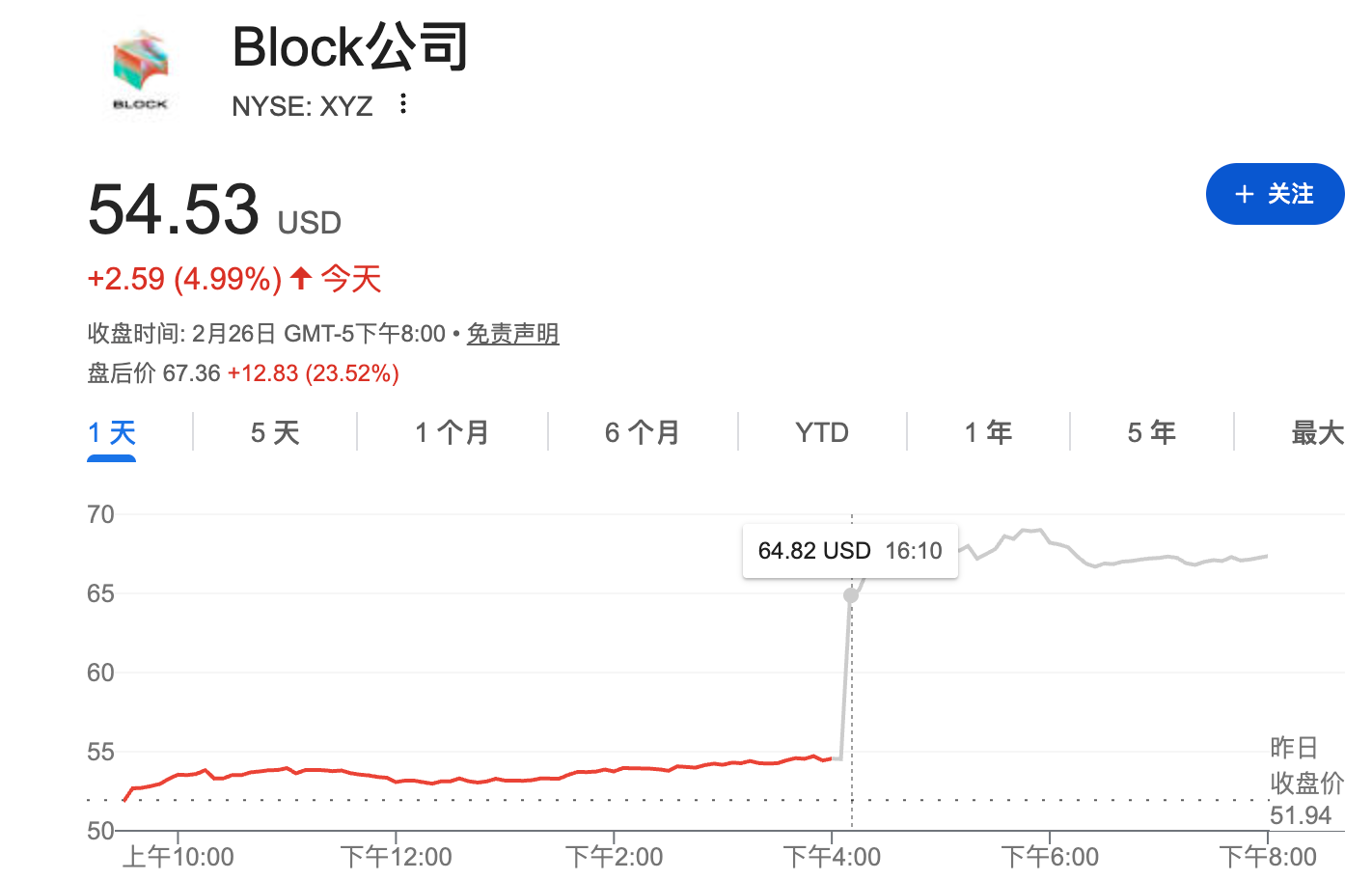
Last night, after U.S. market hours, Block’s stock surged 25%.
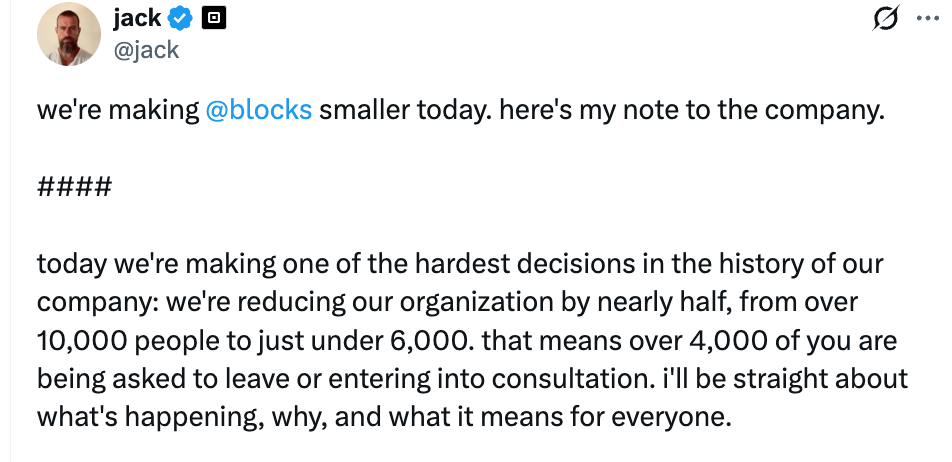
Not because it launched a new product. Not because it landed a major client. But because its CEO announced plans to cut nearly half its workforce.
From over 10,000 employees down to fewer than 6,000—over 4,000 people gone.
As soon as the news broke, investors voted with real money. The closing price was $54; after-hours, it jumped straight to $67. In one night, Block’s market capitalization increased by nearly $3 billion.
Cutting 4,000 jobs added $3 billion to market cap.
That works out to $750,000 per person cut.
You may not have heard of “Block,” but you’ve almost certainly seen its products.
Square—the white square card reader you see on sidewalks across the U.S., used by small merchants for payments. Cash App—the peer-to-peer payment app popular among American youth, akin to Alipay in the U.S.
In 2025, the company posted $24.2 billion in annual revenue and over $10 billion in gross profit. It’s a Nasdaq-listed fintech giant.
Its CEO is Jack Dorsey. You may not know his name—but you definitely know what he co-founded: Twitter. He launched it in 2006, served twice as CEO, and stepped down in 2021.
A year later, his friend Elon Musk bought Twitter and rebranded it X.
Today, Dorsey is fully focused on Block. He’s also a Bitcoin maximalist: Block holds Bitcoin on its balance sheet and invests in Bitcoin mining and self-custody tools.
When companies lay off staff, most CEOs use the same script.
“Strategic realignment.” “Organizational optimization.” “Focusing on core business.” In plain English: You’re fired—but I don’t want to say it too bluntly.
Dorsey didn’t do that.
In his letter to shareholders, he wrote directly: “Intelligence tools are changing how companies are built and operated. A smaller team, empowered by the tools we’re building, can do more—and do it better. And these tools grow more capable every week.”
Translation: AI can do your job—and it’s getting better at it.
He even avoided using the word “AI,” perhaps thinking it sounds less jarring that way.
Yet on X, he added this: He could have chosen to downsize gradually—laying off people in waves over months or even years. But he believed repeated layoffs destroy morale, so he opted for one decisive action instead.
“I’d rather make a difficult but clear decision now than slowly reduce headcount toward the same outcome.”
This may be the first time, amid the AI boom, that a CEO has openly attributed layoffs solely to AI—without citing industry cycles, macroeconomic conditions, or strategic missteps. His message is direct: Tools simply outperform people.
It’s hard to call him insincere. Yet this sincerity is somehow more unsettling than canned corporate speak.
We also reviewed Block’s historical headcount data.
Public records show that at the end of 2019, Block employed 3,835 people. Then came the pandemic: digital payments exploded, Cash App users surged, and the company went on a hiring spree—reaching 10,205 employees by end-2025.
In six years, headcount nearly tripled.
Now it’s being slashed back to 6,000.
That means the roughly 6,000 people hired during the pandemic—after years of work—are now collectively categorized as “replaceable by intelligence tools.”
Block isn’t alone. During the pandemic, nearly every tech company raced to hire. Meta doubled its headcount in two years—then began three rounds of layoffs starting in 2022. Amazon and Google underwent similar cycles of expansion and contraction.
But Block’s case stands apart. Other firms still cite secondary justifications for layoffs. Dorsey pinned the cause squarely on AI.
His shareholder letter included another line:
“I don’t think we’re acting too early—I think most companies are acting too late. Within a year, most will reach the same conclusion and make similar adjustments.”
His approach also echoes someone else.
In October 2022, Elon Musk acquired Twitter for $44 billion—and within his first week, laid off ~3,700 people, nearly half the workforce.
At the time, Silicon Valley thought he’d lost his mind. Advertisers fled. Systems crashed repeatedly. Public opinion turned overwhelmingly against him. Twitter’s valuation plummeted from $44 billion to under $20 billion under his stewardship.
Dorsey watched all of it closely—not only as Twitter’s co-founder, but also as an open supporter of Musk’s acquisition. The two are close friends.
Three years later, Dorsey executed nearly the identical move at his own company.
Cutting nearly half the workforce—in one go, decisively, without delay. Even management tactics were copied:
Musk mandated federal employees at DOGE submit weekly emails listing their top five achievements; Dorsey required Block employees to email him weekly with their five key accomplishments.
Then he used AI to summarize those emails.
The difference lies in outcomes. After cutting Twitter, markets saw Musk as a destroyer. After cutting Block, markets hailed Dorsey as a visionary. Same action—one cost over $20 billion in valuation, the other earned $3 billion in market cap.
What’s the difference?
Dorsey did two things others didn’t. First, he delivered a stellar earnings report: Q4 gross profit up 24%, Cash App gross profit up 33%, and 2026 profitability guidance exceeding analyst expectations. Second, he framed the layoffs with the era’s most potent narrative:
“This isn’t downsizing—it’s AI transformation.”
In fact, before last night’s cuts, Block had already been in turmoil for weeks.
In early February, the company conducted an initial round of layoffs—cutting ~10% of staff, about 1,100 roles. Simultaneously, Dorsey issued a directive: “All employees must integrate AI tools into daily work.”
According to Wired, some employees voiced internal pushback: “If these tools were truly effective, we’d already be using them.”
Then came the weekly email requirement—each employee sending Dorsey a weekly summary of their five most recent work achievements. Dorsey used AI to synthesize those emails.
Consider the process: You’re asked to prove your value to the CEO every week—while the CEO doesn’t even read your words himself.
Per Wired, during an all-hands meeting, one employee said outright: “This is the lowest point for my morale in four years—the company’s culture is collapsing.” Another admitted they couldn’t plan their lives because they didn’t know if they’d still have jobs next week.
Dorsey’s response? “Some of you have been coasting.”
One side says, “I don’t know if I’ll have a job tomorrow.” The other replies, “Some of you have been slacking.” Both statements happened in the same room.
Block won’t be the first—or the last—to take this path.
Shopify’s CEO told staff this year that any request to hire must first demonstrate why AI can’t handle the task. Klarna’s CEO publicly celebrated AI replacing 700 customer service agents. An internal Amazon memo stated the company needs “fewer layers” because AI is “the most transformative technology since the internet…”
Yet most firms still veil AI-driven layoffs behind terms like “efficiency gains” or “organizational upgrades.” Dorsey is the first to rip away the veil entirely: “AI can do your job—and capital markets rewarded him with a 25% stock surge.”
That’s what’s truly terrifying.
CEOs now know: Publicly declaring “I replaced half my workforce with AI” won’t draw punishment—it may earn reward.
Finally, after reading Dorsey’s shareholder letter and his full X post last night, here’s what struck me: He really isn’t lying.
The company’s financials are strong—he’s not playing victim. The reason for layoffs is AI—he’s not hiding behind other excuses. Severance packages include 20 weeks’ base pay plus one additional week per year of tenure, six months of healthcare coverage, and a $5,000 relocation stipend—more generous than many peers.
He even hosted a dedicated video livestream to personally thank departing employees—admitting it might feel awkward.
We have grounds to believe he’s sincere.
But sincerity changes nothing. Tomorrow, 4,000 people wake up unemployed—while Dorsey wakes up to a more valuable company.
Here’s a detail every worker should note.
In recent weeks, Block’s soon-to-be-laid-off employees were instructed to use AI daily—and to email the CEO weekly proving their value. They complied. And still got laid off.
In other words: Proficiency in AI won’t protect you. Demonstrating your value won’t protect you. When a company decides to do the same work with fewer people, your effort only accelerates that conclusion.
Dorsey says most companies will follow suit within a year.
I don’t know if he’s right—but one thing is certain:
When your boss starts seriously calculating how many roles AI can replace, you’d better start seriously asking whether your income depends solely on this one paycheck.
Join TechFlow official community to stay tuned
Telegram:https://t.me/TechFlowDaily
X (Twitter):https://x.com/TechFlowPost
X (Twitter) EN:https://x.com/BlockFlow_News
 深潮TechFlow