








From the MCP Store to 100 Internal Agents: Cobo’s AI Transformation in Action
TechFlow Selected TechFlow Selected
From the MCP Store to 100 Internal Agents: Cobo’s AI Transformation in Action
“Many companies talk about AI + Web3. But if they haven’t even AI-ized their internal operations, what they’re promoting externally is just conceptual.”
 Navigating Web3 tides with focused insights
Author: alexzuo4, Investment & Custody VP @Cobo
Since the end of 2024, Cobo—beyond its core businesses of crypto custody and stablecoin payments—has been actively exploring the convergence of AI and blockchain.
Our earliest observation centered on MCP’s potential for standardized skill integration. In theory, if skills become sufficiently standardized, AI could invoke capabilities like plug-ins, and blockchain would naturally serve as AI’s optimal financial infrastructure.
We therefore internally incubated an MCP app store—but quickly disproved its viability.
At that time, AI adoption remained prohibitively high: only seasoned engineers could use it proficiently. Meanwhile, MCP lacked sufficient standardization; each integration demanded significant time, effort, and cost—and progress was painfully slow, with real-world outcomes falling far short of expectations.
Yet the AI team had already been assembled—expensive to build, difficult to staff, and impossible to disband lightly.
So we pivoted. Since we couldn’t yet reshape our customers’ world, we decided to start by transforming ourselves.
First Challenge: Security
As a digital asset custodian, Cobo handles extremely sensitive data and internal technical process frameworks, with strict internal data-tiering policies. Yet without data—and without real business inputs—we couldn’t train our own company-specific agents.
Our initial idea was local model deployment. But reality intervened: locally deployed models lacked sufficient intelligence. They ran—but were impractical; they answered—but weren’t smart enough.
Ultimately, we opted primarily for Claude and Gemini (both support ZDR—Zero Data Retention clauses—to achieve the highest level of data isolation).
Still, large language models are merely the underlying “brain” for our business. What’s truly complex is data governance and permission control.
We subsequently built a comprehensive internal knowledge base and agent framework.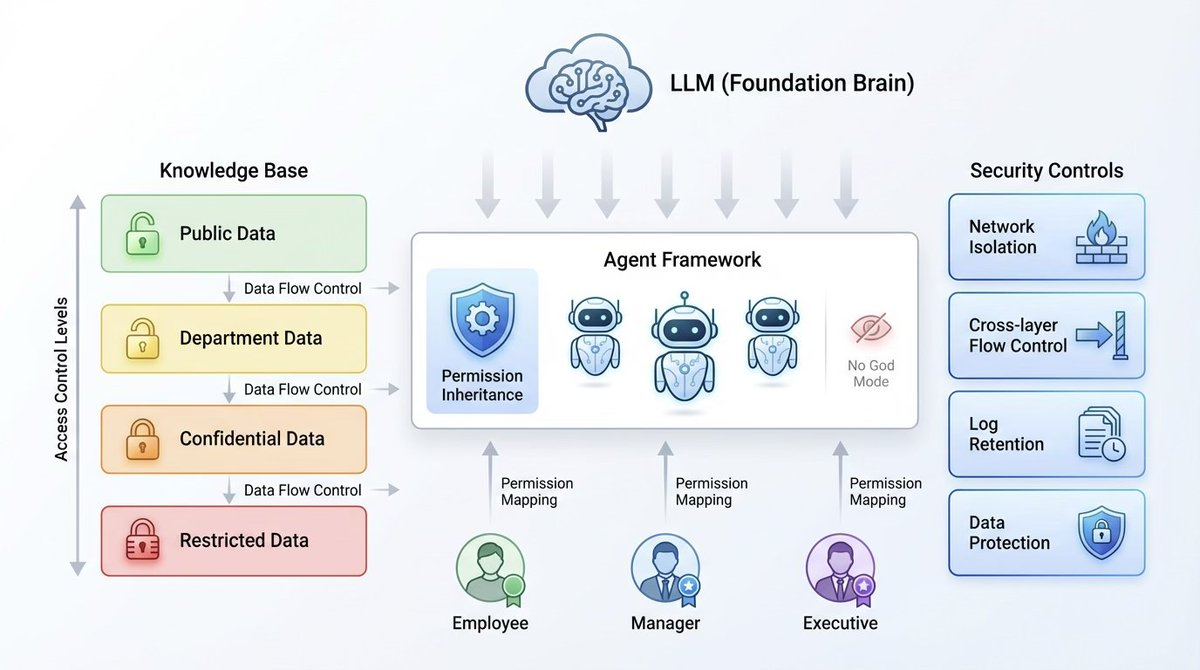
Internal knowledge base + Cobo-developed agent system
The knowledge base governs internal data segmentation, assigning read-access scopes based on employee permissions.
When agents query the knowledge base, they inherit the user’s permissions—not “god-mode” access.
Key implementation details include:
- How to isolate network environments
- How to restrict cross-tier data flow
- How to enforce auditable, controlled log retention
- How to prevent sensitive information leakage
None of these are glamorous—but they determine whether this initiative can sustain long-term operation. AI must never become a security vulnerability.
After Architecture: Adoption Lag
Even today, Cobo faces a stark reality: many frontline teams remain dismissive of AI.
Merely encouraging usage won’t transform workflows.
We soon realized we needed to start at the organizational management level.
First Breakthrough: OKR Agent
Our first aggressively deployed use case wasn’t customer support or code generation—it was OKRs.
We leveraged AI to break down corporate strategy, assist in setting OKRs, track progress, and conduct retrospective bottleneck analysis.
In other words, we began shifting company management—from purely human-driven management toward silicon-carbon co-governance. This transition proved deeply uncomfortable for employees.
Previously, goals could be worded elegantly; processes justified plausibly. Now, weekly metrics sit exposed—excuses dwindling rapidly.
From that moment, objectives ceased being mere agenda items in meetings—and became persistent, system-recorded artifacts.
Weekly strategy OKR tracking driving business progress
But it was precisely through performance management that employees truly began engaging with AI—because non-participation directly impacted compensation.
From Performance to Operations: Full Agent Adoption
Once OKR automation gained traction, we pushed internal service agentification across departments—using a combination of evaluation metrics and bonus incentives to mandate that every department develop agents aligned with its core functions.
Customer support built a support agent. Legal built a contract-assistance agent. Sales built a CRM agent.
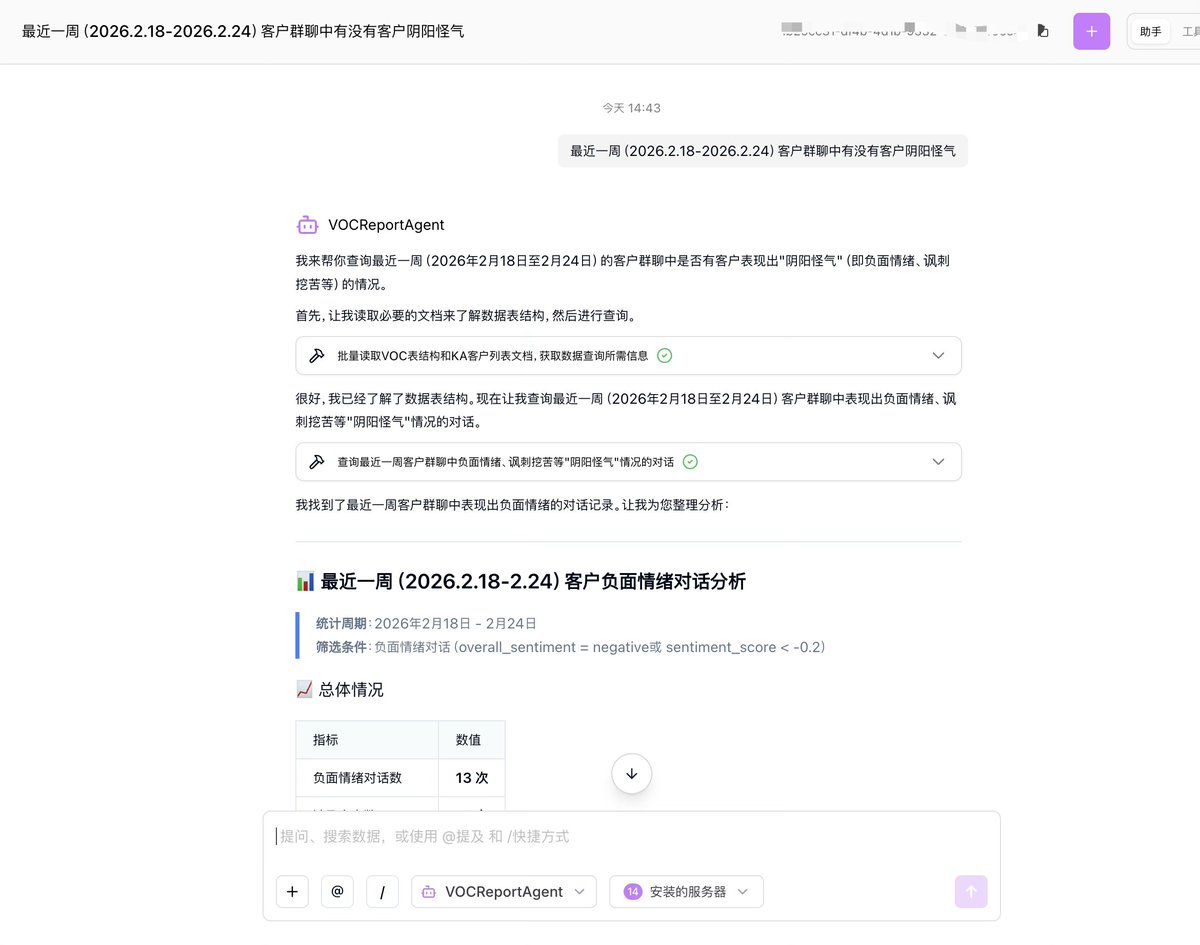
Identifying the most sarcastic customer agent
Ultimately, over 100 agents went live.
We cannot precisely quantify the impact of “silicon-carbon co-governance.”
But one shift is unmistakable:
When problems arise, the instinctive response used to be, “Should we hire another person?” Now it’s, “Can we first involve the system?”
That, to us, *is* silicon-carbon co-governance—not AI replacing humans, but humans developing the habit of working *with* systems.
Lessons from a Year of Real-World Implementation
First: Healthy cash flow is essential.
Without solid cash flow, such transformation stalls. AI isn’t a cost-cutting tool—it’s a front-loaded investment enabling long-term structural upgrades. We’re grateful that Cobo’s core business continues generating healthy cash flow.
Second: Top-down execution is non-negotiable.
Organizations don’t self-transform. Without strong executive sponsorship, initiatives inevitably fade.
As widely known, Cobo’s founders are deep AI practitioners. Our CTO, Dr. Jiang, began AI research during his postdoc at CMU in the early 2000s.
Third: Mandated usage is critical.
Encouragement alone confines AI to email drafting. Meaningful workflow integration demands a degree of “enforced adoption.”
Fourth: Start with your own operations.
Many companies tout “AI + Web3,” yet if they haven’t AI-enabled their own internal functions, external claims remain pure abstraction.
Looking Back
We still cannot fully quantify this transformation—but Cobo is gradually shifting from “people-driven processes” to “goal-driven systems.”
If truly intelligent organizations ever emerge, they won’t evolve organically. They’ll be forged—repeatedly—through discomfort.
Because every employee participates, the company gains deeper insight into authentic AI-era needs.
That, too, is a valuable byproduct of our internal transformation.
Recently, we launched Cobo WaaS Skill. Designed specifically for AI coding agents, Cobo WaaS Skill is an integration and operations layer that enables agents to accurately invoke WaaS APIs—via structured knowledge, executable examples, and scenario orchestration. We’re upgrading wallet APIs into financial capability modules directly callable by AI agents—shortening development cycles from weeks to conversational turns.
This isn’t born from a single product insight. It’s the natural outward extension of our internal silicon-carbon co-governance journey.
We’re still learning.
But one thing is certain: Today’s Cobo is no longer the company it was in 2024.
Join TechFlow official community to stay tuned
Telegram:https://t.me/TechFlowDaily
X (Twitter):https://x.com/TechFlowPost
X (Twitter) EN:https://x.com/BlockFlow_News
 Cobo
Cobo


