The Covert Battle of AI Payments: Google Brings 60 Allies, While Stripe Builds the Entire Road
TechFlow Selected TechFlow Selected
The Covert Battle of AI Payments: Google Brings 60 Allies, While Stripe Builds the Entire Road
When AI begins independently participating in economic activities, is our human-designed financial system still sufficient?
 Navigating Web3 tides with focused insights
By Lin Wanwan, TechFlow
Money has already moved into code.
Six months ago, AI-powered payments existed only as slides on a conference stage. Today, AI is rapidly becoming the “cash register.”
Open ChatGPT now and search for any product—you’ll see a blue “Buy” button. Enter your address, make payment, and receive your order—all without leaving the interface or opening any external webpage.
Last week, Google followed suit, integrating Etsy and Wayfair products directly into Search and Gemini, enabling checkout entirely within the chat interface. Microsoft’s Copilot simultaneously launched shopping checkout functionality. Meanwhile, Meta’s Mark Zuckerberg recently announced a full strategic pivot toward AI agent–driven commerce.
Yet an even more subtle commercial battle is unfolding behind the scenes—the fight over transaction fees in AI payments. This contest traces back to two rival AI payment coalitions emerging this autumn of 2025.
On September 16, Google convened over 60 companies to release the “AI Agent Payment Protocol.”
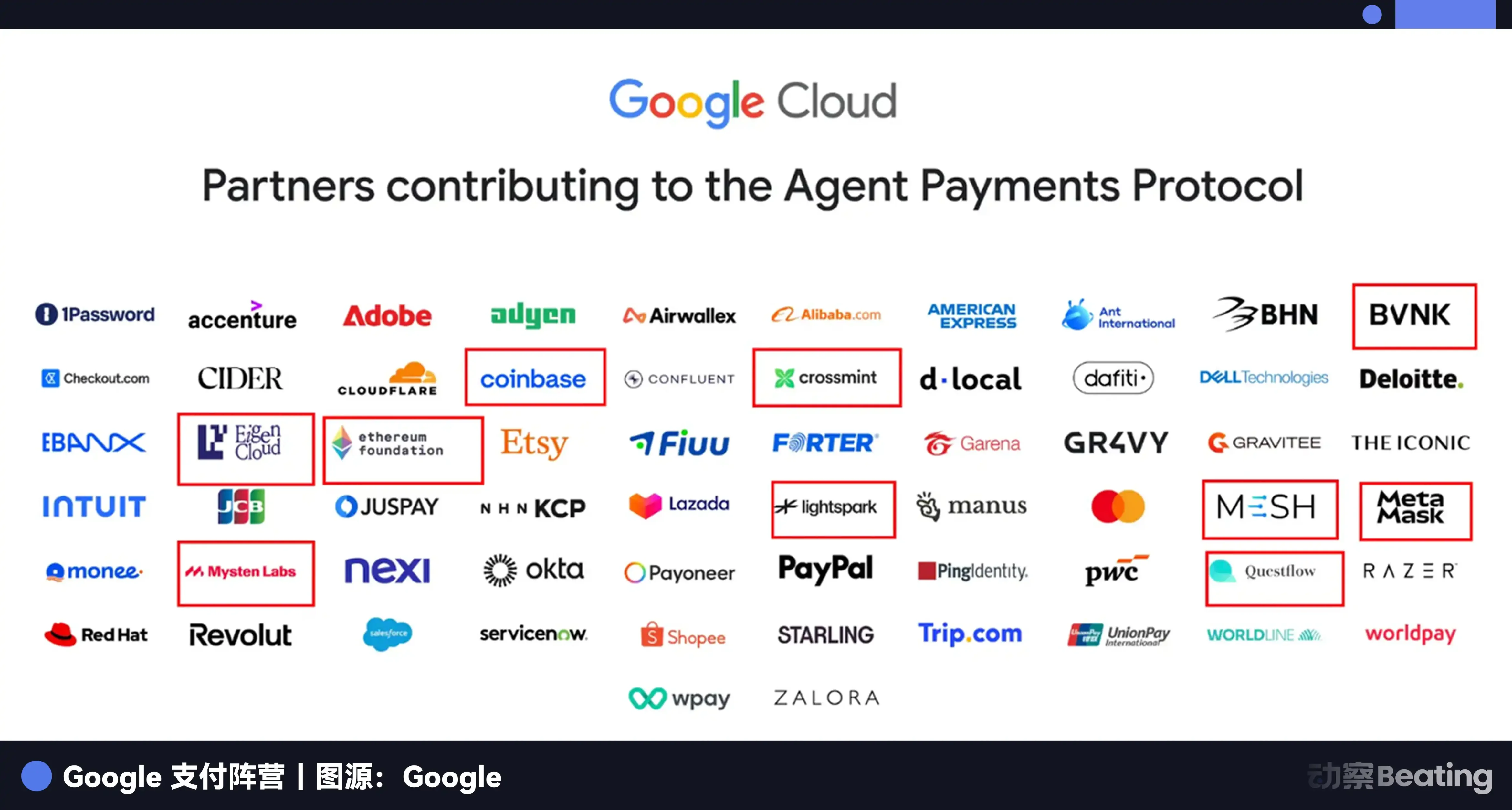
The list features familiar names from traditional finance: Mastercard, PayPal, American Express—plus a few tech allies.
On September 29 of the same month, Stripe partnered with OpenAI to unveil another framework: the Agentic Commerce Protocol (ACP). Stripe also announced it was testing ACP-based agent commerce solutions with Microsoft Copilot, Anthropic, Perplexity, and other AI-native companies.
The two lists share almost no overlap. Coinbase appears in both Google’s AP2 ecosystem and as a long-standing Stripe partner.
What these two camps are vying for is a seemingly mundane—but trillion-dollar—question: When AI spends money on behalf of humans, through whose pipes does that money flow?
You might think this is distant from your daily life. But consider: You already ask ChatGPT to book flights; you let AI assistants compare prices before purchasing; you deploy agents to automatically procure office supplies. These scenarios are rapidly materializing in real time. Every such transaction requires a “pipe” to move money from your pocket to the merchant’s account.
Whoever builds that pipe collects a toll on every transaction.
That is the essence of this war.
A Roundtable That Changed Everything in 12 Months
The story begins with a dinner meeting.
In the summer of 2024, Stripe hosted U.S. Deputy Treasury Secretary Wally Adeyemo at its San Francisco headquarters for a fintech roundtable.
A group of payment company CEOs gathered to discuss industry trends. Among them were two individuals who had never met before: Stripe CEO Patrick Collison and a young entrepreneur named Zach Abrams.
Abrams’ background is impressive. Together with co-founder Sean Yu, he launched Evenly in 2013—a peer-to-peer payments startup akin to Venmo in the U.S.—which was later acquired by Square (now Block).
Abrams subsequently served as Head of Consumer Products at Coinbase and Chief Product Officer at Brex. Yu worked as an engineer at DoorDash and Airbnb. In 2022, the duo reunited to found Bridge, a firm helping enterprises integrate stablecoin payments. Its clients include Coinbase and SpaceX.
The roundtable’s agenda was broad, but Abrams later recalled being stunned: Over 90% of the discussion centered on stablecoins—even though his company was the only stablecoin-focused participant present.
Prior to the event, Bridge had been pursuing Stripe as a customer, aiming to embed its technology into Stripe’s payments infrastructure. But after the roundtable, the dynamic shifted. Collison began meeting Abrams frequently—not to discuss partnership, but acquisition.
In October 2024, Stripe announced its $1.1 billion acquisition of Bridge. Just months earlier, in March 2024, Bridge had closed a $40 million Series A—the company’s first institutional funding round—at a $200 million valuation.
The acquisition price represented a 5.5x multiple on that valuation—and potentially over 100x on revenue. Sequoia Capital noted in its post-investment commentary that it believes Bridge will join the ranks of Instagram, YouTube, PayPal, and WhatsApp—companies whose full potential was unlocked only after acquisition.
The deal officially closed in February 2025. Bridge’s 60-person team relocated to Stripe’s San Francisco headquarters and enrolled in Stripe’s biweekly new-hire onboarding program.
That was just the beginning.
Things accelerated rapidly thereafter. In May 2025, Stripe launched its Stablecoin Financial Account, enabling businesses in 101 countries to hold stablecoin balances and send/receive payments globally using stablecoins.
That same month, ChatGPT rolled out shopping recommendation functionality, allowing users to search for products, compare options, and be redirected to merchants’ websites to complete purchases.

In June, Stripe acquired Privy, a digital wallet infrastructure company.
Privy’s mission is simple: enable any app to embed a digital wallet so users can execute on-chain payments without downloading separate cryptocurrency wallet software. At the time, Privy powered over 75 million accounts.
Patrick Collison tweeted plainly: “Money has to reside somewhere, and Privy builds the world’s best programmable vaults.”
In September, Stripe partnered with crypto investment giant Paradigm to incubate Tempo—a new blockchain purpose-built for payments. Matt Huang, Paradigm’s co-founder and also a Stripe board member, personally led the initiative.
The list of companies joining Tempo’s design coalition reads like a payments industry all-star roster: OpenAI, Anthropic, Deutsche Bank, Visa, Shopify, Standard Chartered, Nubank (Brazil’s largest digital bank), DoorDash, Revolut, and Coupang (South Korea’s e-commerce leader).
Stripe CEO Patrick Collison stated that Tempo can process tens of thousands of transactions per second, confirm them in sub-second time, charge less than $0.001 per transaction, and denominate fees in U.S. dollar–pegged stablecoins—eliminating the need to hold highly volatile native tokens.
Also in September, Stripe and OpenAI jointly launched the ACP protocol and introduced ChatGPT’s Instant Checkout feature—enabling users to purchase recommended items directly within the chat interface, with no redirects or card-swiping required.
Etsy merchants were the first to support it; Shopify’s one million merchants followed shortly thereafter.
In October, Tempo raised its first $500 million in funding, led by Greenoaks and Thrive Capital, with participation from Sequoia, Ribbit Capital, and SV Angel. Its valuation stood at $5 billion—a staggering figure for a blockchain project less than two months old. Neither Stripe nor Paradigm participated in this round.
In December, Tempo opened public testing. UBS, Mastercard, and Klarna—the European buy-now-pay-later giant—joined its partner network.
Zach Abrams of Bridge also announced that Bridge had applied to the U.S. Office of the Comptroller of the Currency (OCC) for a national bank trust charter—aligning with the requirements of the GENIUS Act, the stablecoin regulatory law signed into effect in July 2025.
Connecting these milestones: $1.1 billion to acquire token issuance capability; launching stablecoin financial accounts; acquiring a wallet infrastructure company; incubating a dedicated blockchain; applying for a banking license.
From token issuance to blockchain development, wallet integration, protocol standardization, and regulatory licensing—Stripe built every layer itself.
Google, by contrast, assembled a coalition of over 60 companies, published an open protocol, and launched a GitHub repository. Google has everything—except its own blockchain, its own stablecoin, or its own wallet.
A coalition is born from meetings. Stripe built a system that goes live once one person signs off.
When Google unveiled its AP2 protocol, Tempo was already in active testing.
No Matter Who Wins, Circle Wins
There’s one player in this war even smarter than Stripe.
It takes no sides, wages no battles, and speaks little—if at all. Yet regardless of who wins, it wins.
That player is Circle.
Circle issues USDC, the world’s most compliant digital dollar.
Another company, Tether, issues the larger-scale stablecoin USDT—but questions persist around whether its reserves are sufficient and whether its audits meet rigorous standards. Regulators have debated these points for years without resolution. Retail investors may not care—but in the AI world, where tens of thousands of automated transactions may occur daily, each must withstand audit scrutiny. No serious enterprise would build its AI-driven transaction infrastructure atop a stablecoin whose compliance remains questionable.
Circle? It’s a publicly traded company listed on the NYSE. The U.S. Securities and Exchange Commission (SEC) has reviewed its books. It publishes quarterly financial reports, disclosing exactly how much of its reserves consist of U.S. Treasuries versus cash—transparently, for the entire world to see.
Hence an intriguing reality emerges: Stripe’s stablecoin financial accounts support USDC. OpenAI transacts via Stripe using USDC. And in Google’s coalition, Coinbase integrates USDC as well.
The two camps battle fiercely over the “entry point”—who controls the interface and protocol governing how AI spends money. Yet regardless of which entry point prevails, funds ultimately convert to stablecoins and flow across blockchains. And in the compliant stablecoin market, USDC faces virtually no competition.
Two camps fight for the entry point; Circle captures settlement volume.
Consider the numbers. In 2024, global stablecoin transaction volume reached $15.6 trillion—a figure comparable to Visa’s annual transaction total.
A technology less than a decade old has already matched the scale of Visa’s six-decade-old network.
And AI-driven transactions have only just begun. Consulting firm Edgar Dunn & Co. forecasts that AI-powered transaction volume will reach $1.7 trillion by 2030. Nearly every one of those $1.7 trillion transactions will likely flow through stablecoins.
U.S. Treasury Secretary Scott Bessent stated publicly during a June 2025 Senate hearing that a $2 trillion stablecoin market capitalization represents a “very reasonable expectation.”
Patrick Collison himself observed: The average interest rate on U.S. bank deposits stands at just 0.40%, with $4 trillion in deposits earning zero interest.
He called this consumer-unfriendly practice a “loser strategy,” predicting that younger generations will inevitably shift their funds into higher-yielding stablecoins.
He’s describing a trend. And Circle sits squarely at its center.
Epilogue
Finally, let’s zoom out.
On the surface, this AI payment standards war is about two business coalitions jockeying for territory. But beneath lies a deeper question: As AI begins independently participating in economic activity, is our human-designed financial infrastructure still fit for purpose?
Patrick Collison envisions a future where AI agents are primary economic actors—comparing prices, procuring goods, making payments, and settling transactions, all without a single human click. This is the pinnacle of efficiency—and also the frontier of risk.
Google and its alliance of traditional finance institutions envision a different future: AI should be grafted onto existing financial infrastructure, governed by established regulatory frameworks, and operating within pre-existing trust architectures.
Two futures. Two logics. Two coalitions.
Yet one thing is certain regardless of which future unfolds: AI must spend money; money must flow on-chain; and on-chain settlements require stablecoins.
So Circle continues winning. Stripe and Google continue fighting. Regulators continue chasing. Merchants continue integrating. Consumers remain unaware of which pipe their money flows through.
Until one day, an AI-purchased item goes wrong—and you discover that neither a human nor an AI knows who to contact for a refund.
On that day, everyone will suddenly recall the unanswered questions we ignored today.
But by then, the pipes will already be built—and toll collection will already be underway.
History always works this way: get on the train first, buy the ticket later.
Only this time, the train is moving far too fast.
Join TechFlow official community to stay tuned
Telegram:https://t.me/TechFlowDaily
X (Twitter):https://x.com/TechFlowPost
X (Twitter) EN:https://x.com/BlockFlow_News
 BlockBeats