Institutional Entry: A Victory or a Surrender for Crypto?
TechFlow Selected TechFlow Selected
Institutional Entry: A Victory or a Surrender for Crypto?
“Institutional adoption” is not a mission—it’s an extraction strategy.
 Navigating Web3 tides with focused insights
By Meltem Demirors
Translated by Saoirse, Foresight News
Institutions have finally “entered crypto”—but they’re not here to bail the industry out.
They’re here to turn the crypto economy into a fee-generating cash flow engine for scaling their assets under management (AUM).
This is neither judgment nor criticism—just an observation of reality.
Note: My remarks below focus primarily on crypto assets as tokens/digital currencies—not necessarily on blockchains as financial infrastructure (which can function without tokens; indeed, most current DeFi governance tokens demonstrate precisely this point).
I’ve held this view since last year’s Digital Asset Summit, where my opening keynote was titled “Believe in Something.” Nothing over the past year has changed my mind—in fact, the picture has only grown clearer.
Recently, two excellent pieces—one by Evgeny of Wintermute, and another by Dean of Markets Inc—explored so-called “institutional adoption” in crypto and its implications for market cycles. They inspired me to write a third piece, adding a new layer atop their analyses: the rapidly shifting capital landscape and intensifying AUM arms race.
No time for the full read? One-sentence summary:
“Institutional adoption” isn’t a mission—it’s an extraction strategy.
The real question is singular: Can the crypto industry build and nurture its own native institutions quickly enough to retain economic value on-chain—rather than letting it flow endlessly into traditional finance (TradFi)?
Traditional Finance Is Already Extracting Most of Crypto’s Value
Follow the money—and it becomes immediately clear who truly profits in crypto:
Not DeFi protocols—but the very financial institutions Satoshi Nakamoto sought to displace in the Bitcoin whitepaper.
- USDT and USDC alone generate roughly $10 billion in annual net interest margin—accruing to Tether, Coinbase, and Circle. Though vital participants in the crypto ecosystem, they ultimately answer only to shareholders.
- Cantor Fitzgerald—led by U.S. Commerce Secretary Howard Lutnick—earns hundreds of millions annually by managing Treasury securities for Tether and arranging trades for digital asset firms and investment products.
- President Trump, his family, and partners have collectively earned billions through a series of crypto-related projects and token-based tools.
- BlackRock’s IBIT Bitcoin ETF reached ~$100 billion in AUM within ~18 months—making it the fastest-growing ETF in history and BlackRock’s most profitable product.
- Apollo Global Management and others are quietly channeling crypto collateral and treasury funds into their own credit and multi-asset funds.
Every year, traditional financial institutions extract tens—or even hundreds—of billions of dollars in assets and profits from the crypto economy. Often, they earn more than the native protocols actually creating value.
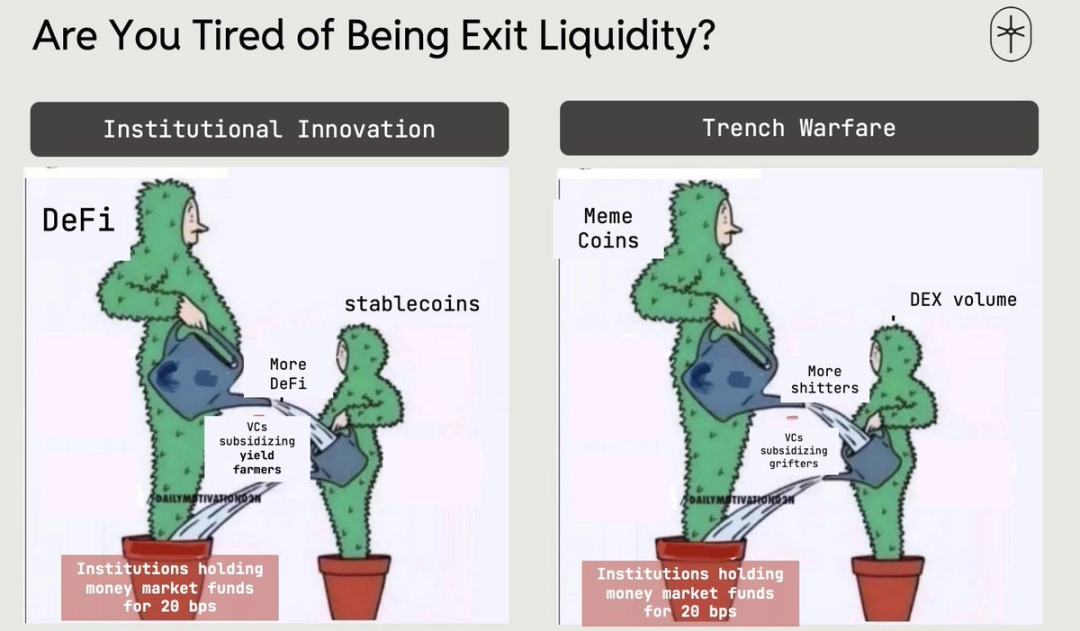
Those “industry innovators” loudly championing institutional entry at countless conferences—and those “frontline warriors” feverishly trading meme coins on X—are far more alike than you might think.
It’s time to stop cheering reflexively—and start thinking independently.
What Are Institutions Really Thinking?
Corporations have one objective: maximize profit.
Crypto helps them do that in two ways:
- Cost reduction
Distributed ledgers, on-chain collateral, and instant settlement drastically cut back- and middle-office costs while boosting collateral liquidity and utilization.
- Revenue generation
Packaging crypto into ETFs, tokenized funds, structured products, custody services, lending, cash management solutions—all yield rich, recurring fees and attract fervent enthusiasm from the crypto community.
For the past decade, institutions cared only about the first.
When we founded DCG in 2015, I spent three years pitching Bitcoin’s global ledger and final-settlement advantages to every financial institution. Back then, crypto wasn’t seen as a new revenue stream—just too risky. Touching Bitcoin or token systems was deemed wholly uneconomical for boards.
In early 2018, I left DCG to join CoinShares. There, our AUM grew from tens of millions to billions. A handful of bold independent portfolio managers who dared allocate meaningfully to Bitcoin delivered extraordinary returns.
Early 2024 marked the inflection point: institutions began treating crypto as Path #2—a new revenue engine.
BlackRock’s IBIT launch was the tidal wave that broke the dam.
IBIT became the most successful ETF ever—and massively boosted BlackRock’s bottom line.
Key facts:
- IBIT scaled to $70 billion in AUM within its first year—roughly five times faster than GLD, the previous record-holder among gold ETFs.
- After IBIT options launched at end-2024, over $30 billion flowed in—outpacing all competitors and commanding >50% of total Bitcoin ETF AUM.
- IBIT is BlackRock’s most profitable ETF: ~$100 billion in AUM generates hundreds of millions in annual fees—exceeding revenues from BlackRock’s flagship S&P 500 index fund, which manages nearly $1 trillion.
IBIT offered the industry a blueprint:
Wrap Bitcoin and digital assets into traditional fund structures, list them publicly—and transform them into stable, lucrative fee cows.
From DATs and tokenized Treasuries to on-chain money market funds—the playbook is being copied and pasted across the board.
The AI Capex Super-Cycle Is Consuming Global Capital
Let’s pivot briefly to another critical trend—also the core reason I launched Crucible immediately after IBIT’s 2024 debut.
The compute-and-energy value chain is actively reshaping the global capital landscape in real time.
Over the next decade, building the AI economy—chips, data centers, power infrastructure, factories—will require hundreds of trillions of dollars in capital expenditures.
Where will that money come from?
All liquid assets unconnected to AI—crypto, non-AI equities, even credit assets—are being sold off and replaced with what markets deem “must-own AI assets.”
Meanwhile, many LPs (limited partners) face excessive private-market allocations, slowing exits and distributions—prompting quiet reductions or delays in new private-credit and PE (private equity) commitments.
Fundraising cycles are growing longer, more volatile, and harder to predict.
Competition for high-quality AUM channels has become white-hot.
The result?
Asset managers and private-equity firms scramble for capital—from insurance reserves, retail and affluent investors, and sovereign wealth platforms—while traditional pensions and endowments retreat.
Markets are desperately cash-hungry.
Any structure resembling a capital pool gets drained dry.
On-Chain Capital Is the Next AUM Battleground
In the AUM arms race, crypto is no longer a quirky toy—
It’s a multi-trillion-dollar latent AUM opportunity, sitting plainly in plain sight.
IBIT proved crypto can be a massive profit engine—and a “honey pot” for institutional allocators.
The Trump administration has also signaled strong support for creating an extremely permissive environment for crypto innovation.
Today, on-chain asset management and treasury funds already total hundreds of billions of dollars.
- Stablecoin supply totals ~$300 billion—USDT ~60%, USDC ~25%.
- Multi-chain DeFi total value locked (TVL) stands at ~$90–100 billion.
- Tokenized money market funds, tokenized gold, consumer credit products, and other real-world assets (RWAs) add several hundred billion more.
- Yet average on-chain yields sit at just 2%–4%—well below traditional money funds’ ~4.1%; even Lido’s ~$18 billion stETH pool yields only ~2.3%.
To hungry asset accumulators, this isn’t “DeFi TVL”—it’s untapped, monetizable cash flow, ready to be packaged, pledged, re-lent, and fee-charged.
This isn’t moral commentary—it’s institutional instinct, as natural as breathing.
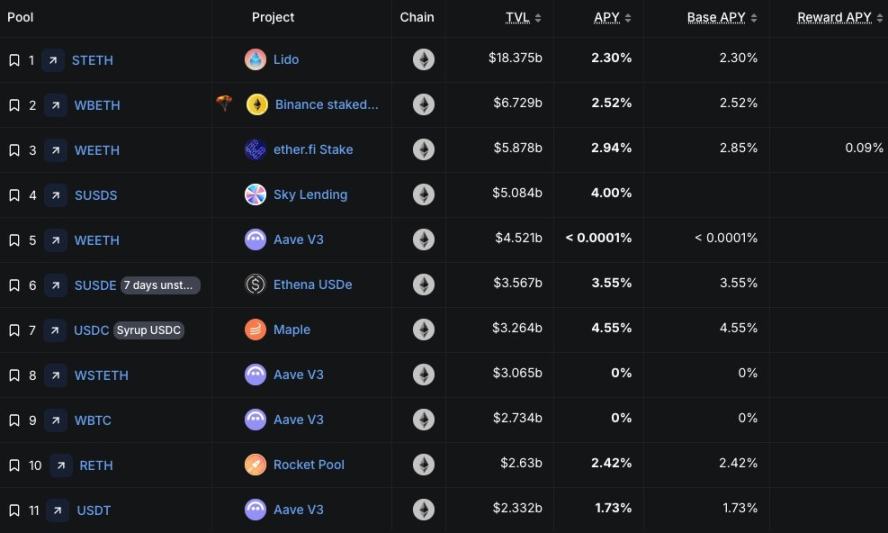
Source: DefiLlama
Tokenization and regulatory compliance packaging transform formerly “off-limits” crypto capital into fee-generating AUM compatible with traditional custody and risk frameworks.
When enterprises, DAOs, and protocols accumulate massive crypto treasuries and seek safer external yields, asset managers repackage those assets into tokenized funds, money market funds, and structured products.
For companies facing funding pressure and intensifying traffic competition:
“Raiding” crypto balance sheets is one of the cleanest paths to scaling fee-based AUM—bypassing saturated traditional channels entirely.
A Wake-Up Call: Act Now—or Be Absorbed
Just as Western economies introduced populations whose cultural values and worldviews diverged sharply from their own—and now pay social and economic costs for it—crypto faces a similar existential crisis.
The crypto economy—and its key opinion leaders—are inviting traditional financial institutions that reject crypto’s core values and show no commitment to native economic growth.
The entire industry will soon pay steep social and economic costs.
If left unchecked, the crypto economy will ultimately become just another liquidity appendage—fueling AUM expansion for traditional financial institutions.
The sole path forward:
Build and scale our own native institutions—fast.
Including on-chain asset management, risk management & underwriting, native financial products, and crypto-native allocation firms…
These institutions can compete for treasury AUM, design products serving crypto’s long-term interests, and keep economic value inside the crypto ecosystem—rather than leaking out to fatten traditional giants’ income statements.
If we don’t prioritize nurturing native crypto institutions now, “institutional adoption” won’t be a victory—it’ll be absorption.
Stand for something—or stand for nothing.
Join TechFlow official community to stay tuned
Telegram:https://t.me/TechFlowDaily
X (Twitter):https://x.com/TechFlowPost
X (Twitter) EN:https://x.com/BlockFlow_News
 @Melt_Dem