X Tightens Promotion Rules—Is the Era of Unregulated Crypto Twitter Marketing Over?
TechFlow Selected TechFlow Selected
X Tightens Promotion Rules—Is the Era of Unregulated Crypto Twitter Marketing Over?
The era of aggressive marketing on encrypted Twitter may be coming to an end—courtesy of the platform itself.
 Navigating Web3 tides with focused insights
Author: David, TechFlow
On February 21, Nikita Bier, X’s Head of Product, publicly demanded that the author of a post disclose it as a paid promotion—otherwise, the account would be suspended.
The post originated from the account @infodexx and featured a ranking titled “Most Valuable Startups of 2025,” predicting that prediction market platform Kalshi would rank second with an $11 billion valuation.
The post garnered over 420,000 views—but the poster’s bio stated “Kalshi partner,” and the post itself contained no disclosure indicating it was a paid promotion.
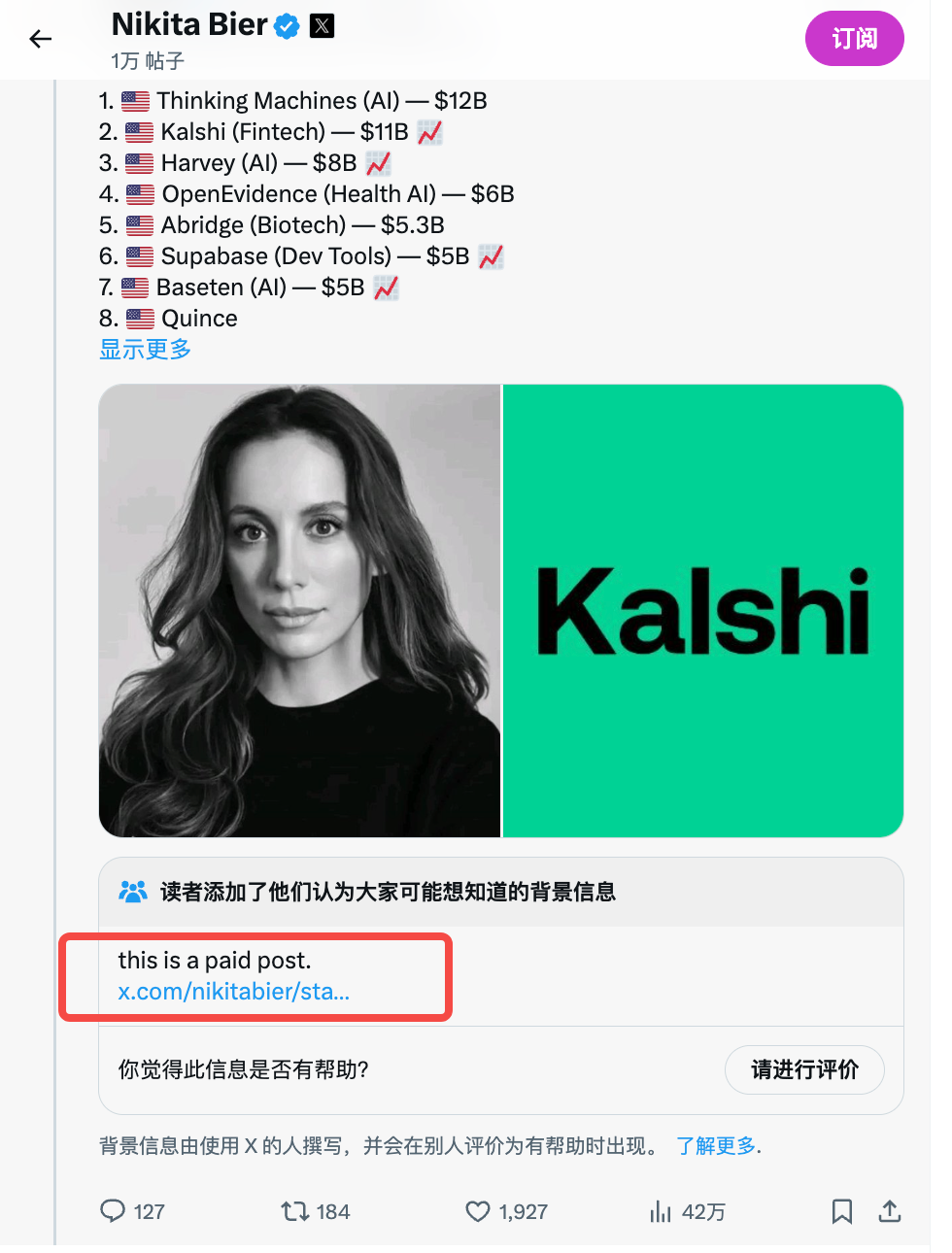
Subsequently, users flagged the post via X’s Community Notes feature—a collaborative fact-checking mechanism where approved notes appear directly beneath posts—labeling it as commercial promotion, i.e., native advertising.
Bier then announced that X would launch a new paid promotion disclosure feature the following week, requiring all posts involving paid partnerships to include clear labeling, with violations resulting in account suspension.
The poster later added a disclaimer to the original post confirming it was a paid promotion.
Yet mandatory disclosure is merely the latest step in this broader regulatory shift.
Over the past five months, X has removed 1.7 million spam marketing bots, revoked API access for InfoFi-type apps, deployed anti-automation detection mechanisms, and restricted programmatic reply interfaces…
Though these actions occurred at different times, taken together they form a clear timeline.
The era of unregulated, aggressive marketing on crypto Twitter may now be ending—by the platform’s own hand.
Six Regulatory Cuts in Five Months—Severing Crypto Marketing’s Main Artery
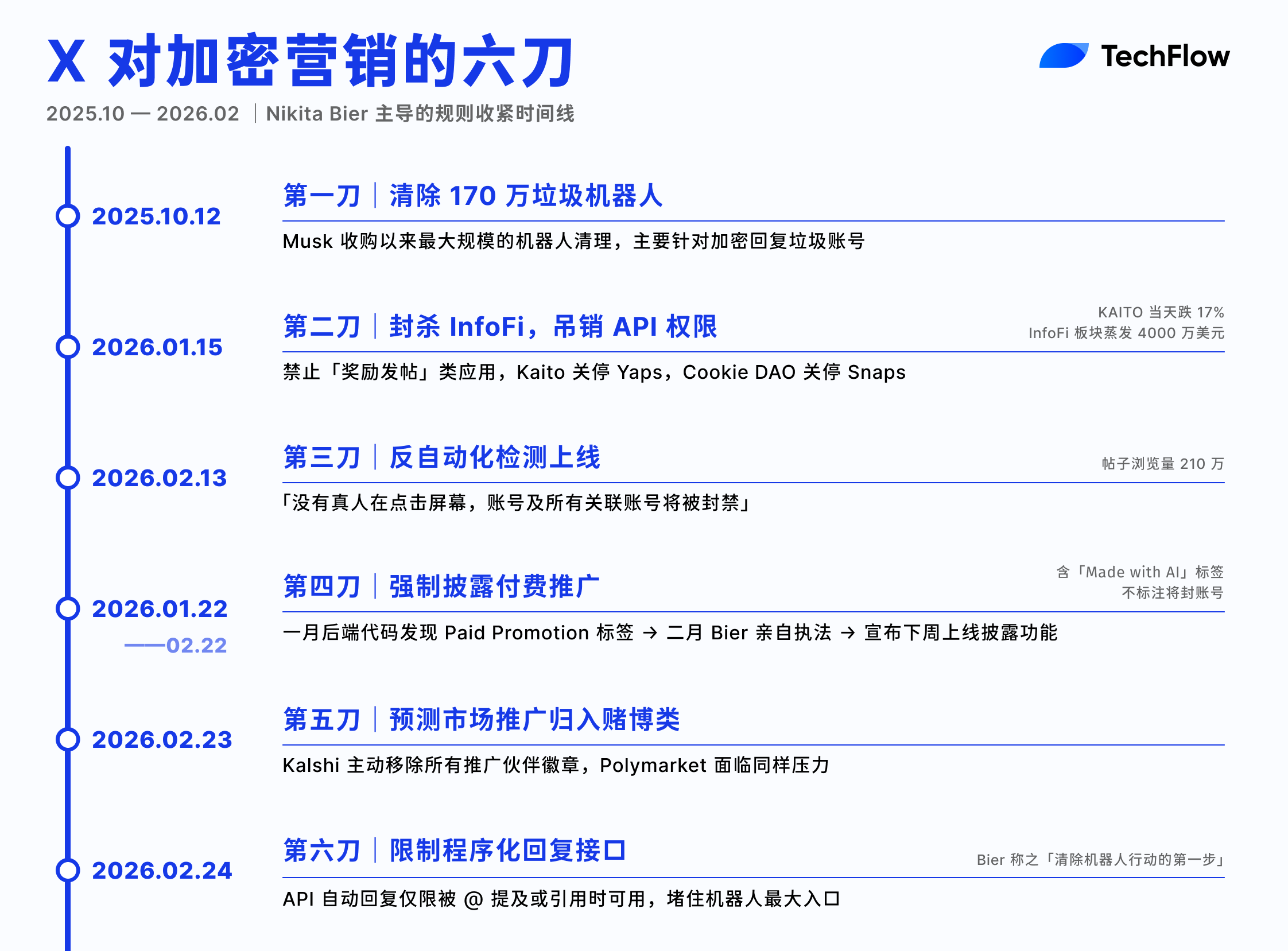
X’s evolving marketing policies have delivered six major regulatory “cuts” over the past five months. Below is a timeline summarizing key milestones and critical dates:
Cut One: Spam Bots
In October 2025, Bier announced that X had removed 1.7 million reply-spam bots within one week—the largest such cleanup since Elon Musk’s acquisition. The primary targets were crypto-related automated accounts. Anyone who has scrolled through crypto posts on X has seen them:
fraudulent links replying instantly under popular posts, fake accounts impersonating Elon Musk, and generic “gm” bots posting identical replies.
Removing 1.7 million bots was only the first step—the underlying problem runs far deeper.
Cut Two: InfoFi and “Post-to-Earn” Models
These bots proliferated largely due to InfoFi.
Third-party platforms tracked users’ posts and interactions on X and rewarded them with tokens or points. The original intent was to incentivize valuable information sharing—but once posting itself became monetizable, quantity quickly overtook quality. Bot farms and AI-generated replies rapidly dominated leaderboards.
Kaito—the largest such project—saw its Yaps product peak at over 157,000 active users. By January 9, 2026, CryptoQuant detected 7.75 million crypto-related posts on X in a single day—12 times the normal volume.
On January 15, 2026, Bier announced revised Developer API policies prohibiting all apps that reward users for posting on X—and immediately revoked related API access.
Kaito promptly shut down Yaps; its token KAITO dropped ~17% that day. Cookie DAO discontinued its similar product Snaps. The entire InfoFi sector lost roughly $40 million in market cap in a single day.
(See also: X Pulls the Rug Out: The Era of “Mouth-Licking” Is Over)
Cut Three: Human-Impersonating Accounts
On February 13, Bier announced the rollout of a new round of automation detection.
If no human is physically interacting with the screen, the account—and all associated accounts—may be suspended. This cut targets not just traditional bots, but all accounts operated via scripts, automation tools, or AI agents.
Bier noted that X plans to support compliant agent use cases in the future—but until formal rules are established, developers are advised to pause integrations and rely on official APIs when necessary.
Cut Four: Native Advertising (Undisclosed Paid Promotions)
The first three cuts addressed automation and spam. The fourth targets a much broader gray area: failure to disclose paid promotions.
Anyone who regularly scrolls crypto Twitter knows this is nearly an industry norm.
In September 2025, on-chain investigator ZachXBT published a spreadsheet listing promotional rates and payment wallet addresses for over 200 crypto KOLs. Roughly 160 accepted paid promotions—but fewer than five disclosed them as “ads” in their posts.
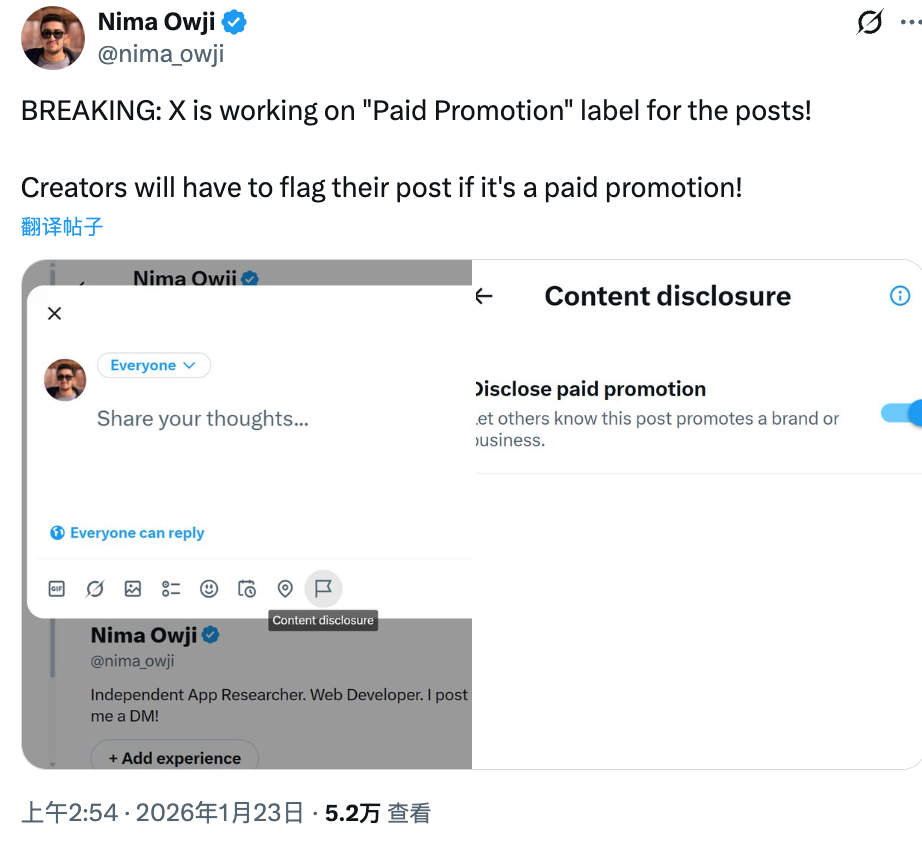
On January 22, app researcher Nima Owji discovered the development of a “Paid Promotion” labeling feature in X’s backend code. Creators will need to indicate whether a post is sponsored during composition, and the label will appear directly on the post.
By February 21, when Bier personally intervened in the Kalshi post case, the feature was ready for launch. He also announced a forthcoming “Made with AI” label, requiring disclosure for AI-generated content.
Cut Five: Prediction Market Promotions
Immediately following the announcement of the disclosure feature, X updated its Paid Partnerships Policy, explicitly classifying prediction markets—including Kalshi and Polymarket—as gambling-related products and banning all undisclosed promotional activity related to them.
Kalshi proactively removed its “Promotion Partner” badge from X on February 23. Its spokesperson cited implementation difficulties and the risk that users might mistakenly interpret badge-bearing accounts as officially endorsed by Kalshi.
Cut Six: Programmatic Replies
The final cut landed on February 24. X’s Developer Platform announced restrictions on automated replies sent via API.
Programmatic replies will only be permitted if the original post’s author explicitly @mentions or quotes the replying account. Product lead Bier described this as the first step in eliminating bots—aimed squarely at closing the largest remaining entry point.
Across these six cuts—from bots to incentive models, from automation tools to covert ads, from category-specific promotions to programmatic interfaces—X’s regulation of crypto content has advanced layer by layer.
Together, they systematically dismantle the marketing infrastructure upon which crypto Twitter has relied for years.
X Rejects Free Riding—Welcomes Paying Customers
These cumulative policy changes are reshaping the cost structure of crypto marketing. For years, crypto projects acquired users on X primarily through three free channels:
- InfoFi platforms incentivized users to post and amplify content;
- KOLs accepted covert promotions without ad disclosures;
- Automation tools mass-replied to trending posts to drive traffic.
All three channels are now either severely restricted or fully closed. Meanwhile, X’s algorithm is widening the visibility gap between paid and unpaid accounts.
Premium users receive 2–4× weighting boosts in both the “For You” feed and reply sorting. Creators testing this found that after March 2025, median engagement for non-Premium accounts posting external links approached zero.
Organic reach for crypto content declined even earlier. In December 2025, crypto trader Lisa Edwards analyzed that month’s algorithm update and reported an ~80% drop in reach for posts containing ticker symbols like BTC or ETH.
As free distribution channels close, paid alternatives open up.
X’s advertising policy for crypto-related ads has been steadily liberalized. According to X’s official advertising policy changelog, DeFi product ads were approved starting in 2024; blockchain game ads opened in the U.S. and Brazil; and crypto exchange and wallet ads expanded from a dozen initial markets to include Denmark, Israel, the Netherlands, Portugal, Ghana, Kenya, and others.
According to AWISEE, X’s crypto ad approval rate stands at ~60%—the highest among major platforms (Meta’s is ~50%; Google’s is lower, and it explicitly bans DeFi ads).
One side sees systematic compression of free distribution; the other sees continuous expansion of paid ad categories and markets. This is the classic monetization path followed by all content platforms:
First nurture a free content ecosystem to attract users and creators; once network effects take hold and creators become dependent on the platform, gradually tighten organic reach—and steer traffic toward paid channels.
Facebook did exactly this with brand pages in 2014: organic reach collapsed from double-digit percentages to single digits, forcing brands to shift from content operations to ad spending.
What X is doing to crypto content is, in essence, the same playbook.
Who Pays? Who Gets Cut?
With free channels severed, the bill ultimately gets passed on to every stakeholder across the industry—impacting crypto marketing on at least three levels.
First, rising customer acquisition costs.
Previously, a crypto project could leverage InfoFi points to incentivize tens of thousands of users to amplify its presence on X—now that avenue is gone.
Once the disclosure feature launches, legitimate KOL promotions will become more transparent—but labeled “ad” posts suffer reduced trust and engagement. Projects must either increase budgets to compensate for lower performance—or accept diminished results.
Second, KOL economics undergo repricing.
ZachXBT’s data leak last year revealed that over 160 KOLs accepted promotions without disclosure, with per-post fees ranging from hundreds to $60,000. With mandatory disclosure, the operational space for “appearing organic while actually being paid” shrinks dramatically. KOL pricing logic will shift—from “I can help you masquerade as organic content” to “How much conversion can my labeled ad still deliver?”
The former is priced on information asymmetry; the latter on measurable outcomes.
This isn’t necessarily bad for the industry—but in the short term, many KOLs and agencies thriving in ambiguous gray zones will exit.
Third, platform dependency risk is repriced.
When Bier banned InfoFi, his exact words to affected developers were: “Consider pivoting to Threads and Bluesky.”
A platform product lead openly urging developers to migrate to competitors signals that X doesn’t mind crypto projects dispersing—and may even be facilitating it. After this wave of changes, concentrating all social assets solely on X is no longer conservative—it’s risky—for both projects and KOLs.
For ordinary users, however, this isn’t all bad news.
In the past, six out of ten crypto posts you scrolled might have been paid—but none told you so. With disclosure enabled, at least you’ll know which posts are promotions and which reflect genuine opinions. The information environment becomes cleaner—and your cognitive load drops.
Of course, this tightening coincides with a bear market.
Bear markets naturally compress marketing budgets; fewer projects are willing to spend on promotion, making feeds quieter overall. Whether the cleaner environment stems from regulation—or simply from cold, quiet markets—will only be truly tested when the bull market returns.
Either way, whether you’re a project, a KOL, or an everyday creator: if you want to be seen on crypto Twitter today, the price of admission is rising.
The old business logic was “whoever shouts loudest wins.” Going forward, it will be “only those willing to pay get heard.”
Join TechFlow official community to stay tuned
Telegram:https://t.me/TechFlowDaily
X (Twitter):https://x.com/TechFlowPost
X (Twitter) EN:https://x.com/BlockFlow_News
 深潮TechFlow