Crypto's "Marketing Aesthetics"
TechFlow Selected TechFlow Selected
Crypto's "Marketing Aesthetics"
The rise of tokens, the flourishing of projects, and the revival of public blockchains all essentially originate from a successful marketing campaign.
 Navigating Web3 tides with focused insights
Author: Zeke, Researcher at YBB Capital
I. Celebrity Tokens: From Inception to Marketing
Warren Buffett has carried on the charitable legacy of his late wife Susan Buffett for 23 years, transforming admiration from a circle of business elites into the globally celebrated "Time Auction"—a model that created the most iconic "billion-dollar lunch" in human philanthropy history.
The monetization of celebrity time is not uncommon in Web3 either. From the ancient days of Time New Bank to Friend.tech, the path of SocialFi has been explored for over seven or eight years—but more often than not, it's all thunder and little rain. After all, in the on-chain world, speculation and trading usually outweigh such "fragile social connections" built around tokens. Most users don’t truly care about the exclusive insights shared by celebrities; instead, they focus solely on the celebrity’s “price-volume” dynamics. Conversely, top-tier celebrities find the earning potential on SocialFi platforms too small and operationally cumbersome. For KOLs, deploying their scarce influence on a transparent-priced, low-user SocialFi platform feels awkward and even foolish.
Lack of substance has注定 (doomed) the SocialFi path—for now. Thus, the monetization of celebrity value in Web3 must first differentiate, transition, and then evolve. What influencers really need today is a paid subscription-based community combined with a verified blue checkmark on X—an established Web2 stack with real staying power. Meanwhile, the conversion path for top celebrities remains inefficient, like a massive enterprise sitting on millions of products with no viable outlet: B2B isn’t profitable, and B2C lacks a proper channel.
Moving from monetizing time to monetizing influence was a relatively successful first step. For a long time, NFTs served as this vehicle. But clearly, the inherent traits of NFTs—scarcity, fixed-price launches, poor liquidity—left both buyers and sellers unsatisfied. This form of digital merchandising failed after fizzling out in the BTC ecosystem.
Celebrity value needed a new carrier. Though the answer had long been hidden in Elon Musk’s Doge story, it required certain catalysts. Last year, the launch of Pump.fun ignited a token-issuance frenzy across crypto. Meme mania coincided with the U.S. presidential election, spawning countless grassroots-created presidential tokens. The explosive gains and attention caught the eye of behind-the-scenes manipulators, who began signing or luring actual celebrities to issue tokens, while retaining operational control themselves. This sounds somewhat like the MCN-influencer partnership model, but in practice, it’s extremely aggressive. From Caitlyn Jenner (Olympic decathlete champion, one of Trump’s biggest fans)’s JENNER token to President Milei’s LIBRA—each launched with a single tweet and ended with a vertical crash on the chart. The cycle typically lasts days at most, sometimes less than hours—a full harvest completed. Then comes the usual script: social media influencers rush to investigate, team members post public accusations blaming each other, and eventually everything fades away. Amid this chaos, the concept of "celebrity tokens" was born.
Yet regardless, this path has become strikingly clear. Judging purely by initial results, meme coins serve as a near-perfect low-barrier distribution channel. But once the hype dies down and PvP ends, what becomes of these valueless celebrity memes? The problem shifts from the carrier to longevity. AI Agents can talk about humanity’s future; RWA can paint a picture of a hundred-trillion-dollar market. What narrative can celebrity tokens offer?
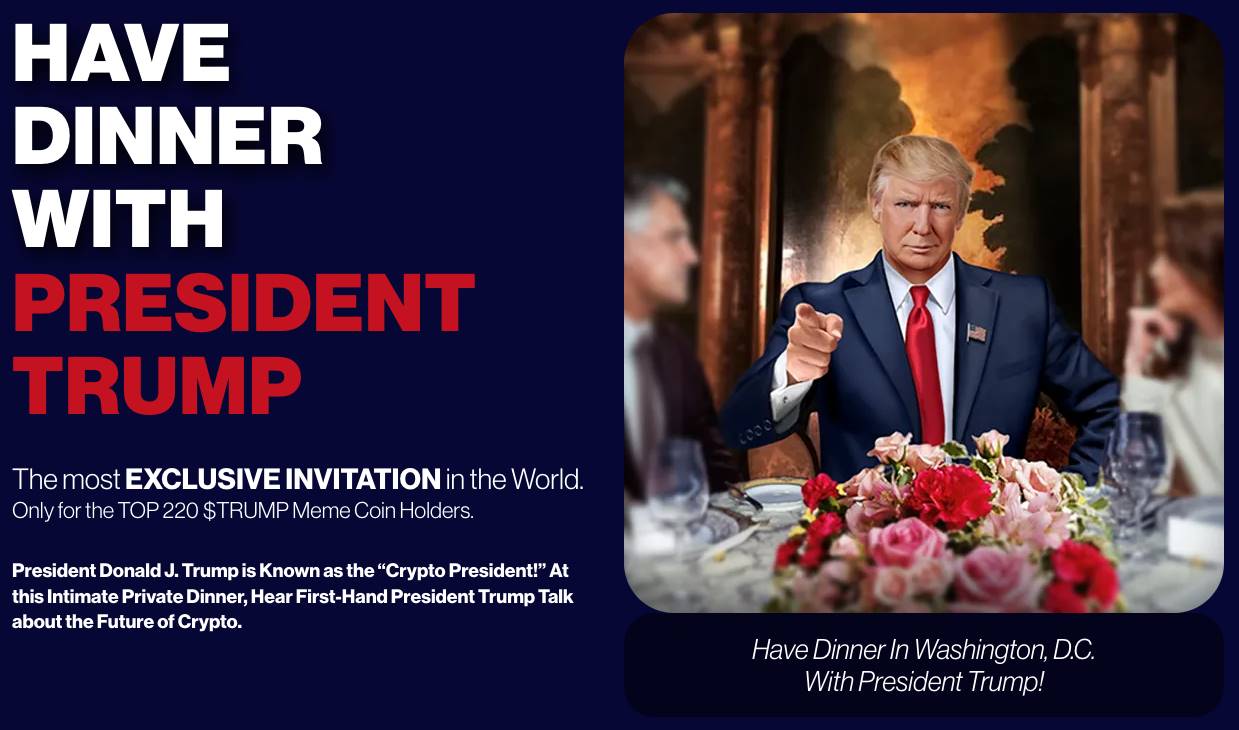
Trump’s answer is rather cliché: he promises the top 220 holders of TRUMP an opportunity to spend “presidential time” with him, while the top 25 will be invited to an exclusive VIP tour of the White House the following day. Thus, the value backing of celebrity tokens reverts back to “time.” In my view, this approach may ease short-term selling pressure but cannot sustain long-term price appreciation.

A great meme should emphasize emotion and narrative—not utility. The value of a celebrity token does not lie in the celebrity’s insights or time, but in their story and the emotions behind it. Trump’s dinner invitation resembles selling an ultra-premium version of a social token. Once the presidential experience ends, everything vanishes. To properly market TRUMP, Trump’s crypto team might want to consult Doge’s minister. Doge is tied to Elon Musk, SpaceX, and Tesla. “To The Moon” remains etched in every crypto user’s mind. The idea of “the people’s currency” makes holders believe 1 Doge = 1 USD; challenging traditional finance aligns perfectly with crypto’s DNA. In truth, each of these points reflects how Musk sells emotion to the masses using his own influence—even if most of these stories remain unrealized. The marketing of celebrity tokens still has a long road ahead. Meme-ifying personal influence shouldn’t be reduced to just one tweet or one piece of good news. Making money in crypto isn’t shameful—but at least understand crypto first.
II. The Dragon
Blur is rarely mentioned anymore. I recall the last time I brought it up was during Blast’s points-based incentive program launch.
With the fading narrative around NFTs, many stories have become relics of the past. Yet Pacman’s mark on this space won’t disappear. Blur defeated OpenSea back then using a three-pronged strategy: “Points + zero fees & royalties + social virality,” executing a Pinduoduo-style campaign that surrounded the city from the countryside. On airdrop day, the orange logo flooded Twitter—no NFT player could forget that. From a marketing standpoint, Blur’s trifecta was unbeatable. It didn’t just defeat an opponent other NFT platforms wouldn’t dare challenge—it also attracted countless users who’d never touched NFTs before into the points-farming army, breaking multiple records within months. Since then, nearly every Web3 project has treated this marketing blueprint as gospel.
NFT users, long frustrated with OpenSea, rejoiced at the time. But Blur eventually transformed from a dragon-slayer into the dragon itself. Let’s start small: Airdrop3 was the first time I felt disgust toward a Web3 incentive event. Blur used a self-destructive tactic to inflate TVL and trading volume. At the time, I warned that NFTs would accelerate toward death. The “Bid for Airdrop” mechanism encouraged users to place bids without actually buying, creating artificial demand and triggering a spiral decline in prices. The system attracted arbitrageurs, not genuine buyers. Once Blur’s token value collapsed, all blue-chip NFTs were dragged down with it. In my view, Blur’s bidding incentives kicked off the downfall of NFTs, while Azuki’s Elementals launch delivered the final blow. Of course, the deeper issue lies in NFTs never finding a sustainable path forward (Pudgy doesn’t count).
Later, Pacman launched two protocols: Blend, an NFT lending protocol, and Blast, an Ethereum Layer2. Both followed the core strategies pioneered by Blur. Blend uses a points-based reward system—users earn airdrop points by participating in NFT-backed loans, continuing the “trade-to-mine” logic. Blast employs a “deposit points + referral points” model, where users earn native yield and airdrop points by staking ETH or stablecoins. The former generates returns via lending interest and liquidation arbitrage—standard mechanisms in lending markets. The latter earns yield by depositing ETH into DeFi protocols like Lido. Through these three platforms, Pacman locked up vast amounts of ETH to build a self-sustaining encrypted bank, yet the returns provided to users are unequal. Only Blur’s early participants enjoyed rich rewards; subsequent incentive campaigns essentially marked the end of the airdrop era. Centralized point systems turned all incentives into black boxes—rules arbitrarily set, points distributed opaquely—drawing widespread criticism.
What consequences did the points system bring? First, false prosperity: when rewards are visible, users lock assets into various protocols solely to obtain project tokens. Projects then leverage these inflated metrics and sky-high TVL to raise funds and secure listings. VCs, accustomed to judging value through data, suffer heavy losses. Second, innovation is stifled: doing great projects matters less than running flashy campaigns, burying technically sound but poorly marketed ones. Third, liquidity fragmentation: valuable assets get locked across protocols in pursuit of what seems like risk-free gains. Fourth—and most importantly—the introduction of points equals revealing a launch roadmap, causing studios, retail traders, and whales alike to flood in, fighting over a limited pie. Whether competing in scale or capital, retail allocations often become so tiny they can’t even cover gas fees. With this, the airdrop era truly ended.
Today, the points system remains dominant in Web3. “Points mining” fuels rampant speculation, and the Point Market only amplifies this trend. Airdrop incentives have distorted the nature of early adopters and communities. Years ago, Uniswap’s airdrop had noble intentions—it sparked DeFi Summer and achieved real user retention and growth. Now, however, each project launch signals mass capital withdrawal and the creation of another “ghost town.” Abandoning this model leaves projects even more vulnerable. Trapped in this dilemma, users are forced to seek new homes.
III. Public Chains
Ethereum formed its vast ecosystem through technological development and unwavering commitment to decentralization during the frontier era. But success paths differ across eras. Ten years ago, who could’ve imagined Tencent couldn’t replicate a short video platform, or that Taobao would eventually be overtaken by an e-commerce app filled entirely with “chop-for-discount” buttons? Similarly, two years ago, I couldn’t have imagined Solana might actually trip up the giant. Yet here we are. In this era of stagnant application-layer innovation, marketing and usability outweigh so-called technical dogma.
Two days ago, EF published three articles reaffirming Ethereum’s future vision and foundation governance structure. The key messages weren’t complicated: first, decentralization of EF’s authority—strategic intervention when necessary, stepping back when not. Second, leadership restructuring to improve execution efficiency and strengthen communication with the community. Third, maintaining a modular scaling roadmap, while also exploring RISC-V as an alternative to EVM. While still somewhat idealistic, EF has indeed lowered its stance.
But are these Ethereum’s real problems? I’d say they’re related, but not definitive. These changes mainly address user dissatisfaction with EF. Refusing to integrate into mainstream culture is indeed Ethereum’s flaw—and that person is naturally Vitalik. Not understanding or wanting to understand memes isn’t inherently wrong, but the mistake lies in Vitalik still wielding absolute leadership over Ethereum. A $220 billion project led by a somewhat idealistic and headstrong young man who refuses to embrace current crypto culture makes its current decline inevitable. Fortunately, among the aloof Layer2s, there’s still Base—capable of holding its own against Solana. If I were in EF, I’d definitely ask CB for some external help.
Looking at BNB without conspiracy theories, at least CZ—a leader equally unfamiliar with memes—has made sincere efforts to embrace these concepts. During his post-prison period, he helped spark trending sectors like DeSci. Still, lacking a solid Western user base causes every BNB boom to feel fleeting.
Solana’s victory stems from its lower profile. Post-SBF collapse, Solana was left as helpless as an orphan stripped of parental protection. Facing the behemoth Ethereum, it had to seize every opportunity. Starting with Silly Dragon as a catalyst, followed by a series of mega memes, dApps, and PayFi innovations. We used to joke that Solana was a single-player chain, but in terms of ecosystem inclusivity and support, it appears more decentralized.
Pump.fun didn’t revive Solana—rather, Pump.fun could only have emerged from Solana’s fertile ground. This mirrors Uni and Ethereum years ago. “The first chain for non-technical users” is Solana’s core marketing philosophy: accessible, user-friendly, efficient. As crypto moves toward mainstream Western adoption, pragmatism reigns supreme. Long live the common people. Indeed, Solana is well-suited to be that first chain.
Conclusion
I’ve omitted NFTs and GameFi from this discussion on marketing. If either revives in the future, perhaps I’ll revisit them. The narrative of the crypto world always evolves through tension between technological idealism and human greed. Token rallies, project booms, and chain resurgences—all fundamentally stem from successful marketing. Once, we listened to tech narratives. Today, we must embrace the mundane.
Join TechFlow official community to stay tuned
Telegram:https://t.me/TechFlowDaily
X (Twitter):https://x.com/TechFlowPost
X (Twitter) EN:https://x.com/BlockFlow_News
 @YBBCapital