Crypto Circle Strategy: Winning the Psychological Battle is the Best Marketing
TechFlow Selected TechFlow Selected
Crypto Circle Strategy: Winning the Psychological Battle is the Best Marketing
Today's crypto marketing involves not just advertising, but also a series of psychological battles.
 Navigating Web3 tides with focused insights
Author: TM
Translation: TechFlow
This is a masterclass in modern psychological warfare.
I shouldn't be writing this—there's too much information, and frankly, this is my superpower. But whatever, let's dive deep into marketing strategies in crypto: a masterclass in psyops.
If you don't know what "psyops" are yet, it means you've been manipulated your entire adult life.
Welcome to the Meme Wars.

Milady
Case 1: Kalshi’s Entry into Crypto
Let’s talk about @Kalshi. This isn’t fear, uncertainty, and doubt (FUD)—I actually admire their execution. Just some personal observations, no hard evidence.
After the memecoin hype cooled down, prediction markets started gaining attention. Some KOLs began pushing this narrative, one of them being @j0hnwang.
Prediction markets are indeed fairer than memecoins. Memecoins are brutal "1 vs 1000" games, while prediction markets at least offer more balanced odds. But honestly, degens in crypto have a deep-rooted love for tokens—and always will.
So here’s the challenge: How do you capture market share from memecoins without launching a token, while also attacking dominant players like @Polymarket?
The answer: Psychological warfare.
Here’s how it unfolded:
-
John Wang had already signed with Kalshi before any official announcement.
-
In the following months, engagement farms and researchers began boosting his account.
-
When the partnership was officially announced, the rollout was meticulously coordinated: news outlets, influencers, and "research" pages all covered the story—the signing of a KOL.
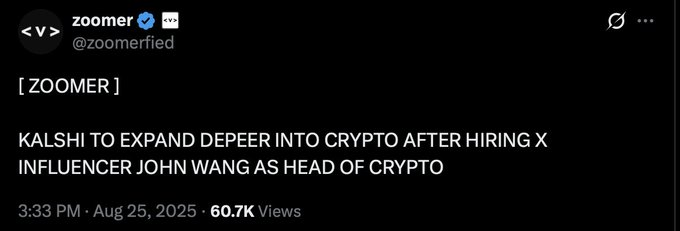
News sites reporting on a KOL signing in crypto?
This was treated as a landmark event—as if Kalshi had just poached an executive from Google or Apple.
A simple yet brilliant psyop: turning a personnel move into a full-scale marketing campaign.
Kalshi didn’t just enter crypto—they made it look like a paradigm shift.
They paid websites, researchers, and influencers to talk about the announcement. The hiring caused a sensation. Kalshi had officially entered the crypto space—as if it were a FAANG stock.
An incredibly simple but effective psychological tactic: they orchestrated the announcement and turned it into a massive marketing event.
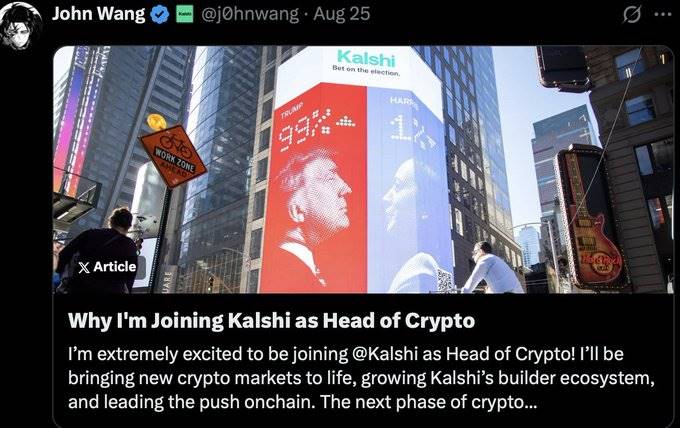
So, is John Wang Kalshi’s marketing manager?
Case 2: ai16z’s Flywheel Effect
Next, let’s talk about ai16z.
This operation was pure genius. For a time, it made people—including me—genuinely hopeful about the future of "crypto x AI."
Here’s how they did it:
-
They launched a meme DAO around the idea of "tokenizing a16z" (the famous VC giant).
-
Marc Andreessen himself engaged, lending credibility and authority to the meme.
-
Instantly, the entire industry’s attention shifted to this “new AI fund.”
Then they launched the product: Eliza AI agent.
It shot to #1 on GitHub. Timing was perfect. Hype was unstoppable.
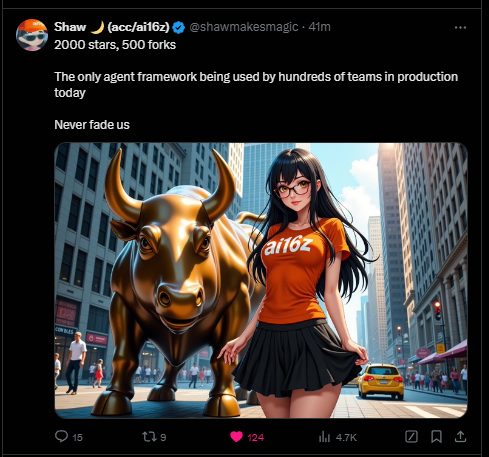
Shaw flexing
But in reality? Technically, it was just a wrapper over GPT. Essentially, connecting existing LLM APIs to a frontend interface. No groundbreaking innovation.
Did anyone care? Almost no one. The product worked, the vibe was right—that was enough.
The key to psyops isn’t just technology—it’s narrative.
Becoming a member of the ai16z DAO became a status symbol. Like wearing a Rolex early on, being an “ai16z partner” meant you were someone. It attracted elite developers from top universities and well-funded believers.
The DAO’s market cap hit $2.5 billion (with laughably weak liquidity). The flywheel spun: hype attracted liquidity, liquidity attracted investors, and investors created even more hype.
But then came the next question: How do you cash out without crashing the price chart?
The answer: You don’t cash out directly. Instead, ai16z “sold” their tech to other AI crypto projects, taking up to 10% of pre-token issuance supply in exchange for market support.
Result? A wave of half-baked AI projects emerged. These projects were propped up, hyped, and then quickly dumped.

After ditching AI projects he got for free.
In the end, the psyop worked. Liquidity was drained. And now, ai16z is preparing for its next comeback.
The Essence of Crypto Psyops
Here’s the key point: No tactic can be reused.
Once people see through the trick, it stops working. The crowd quickly moves on to the next shiny object. That’s why so many projects keep recycling clichés:
-
Airdrops
-
Roadmaps
-
Buybacks
-
Flywheels
-
Tokenomics
If you hear these terms, it means the team hasn’t caught up with the market. Today’s marketing isn’t empty announcements. In this market, only shipped products matter.
Welcome to the Meme Wars
Crypto marketing today isn’t just advertising—it’s war.
Narrative is the weapon. Engagement is ammunition. Every announcement, partnership, or controversy is a battle for “mindshare.”
The winners aren’t just projects selling technology—they’re teams that can orchestrate coordinated psychological operations: storytelling, meme creation, strategic planning—to make their target audience believe in their narrative.
Of course, not every project plays by the same rules.
If you want market share in this industry, you must arm yourself. Build your team like a Roman general preparing for conquest.
Because in crypto, it’s war.
"Si vis pacem, para bellum."
If you want peace, prepare for war.

My victory pose after defeating my opponent.
Your fight is against competitors, not your community. Your real allies are those who support you.
Join TechFlow official community to stay tuned
Telegram:https://t.me/TechFlowDaily
X (Twitter):https://x.com/TechFlowPost
X (Twitter) EN:https://x.com/BlockFlow_News
 @TMtheOG