Essential Crypto Marketing Guide for Founders: Value Delivery Over Ad Bombardment, Starting from the User's Perspective
TechFlow Selected TechFlow Selected
Essential Crypto Marketing Guide for Founders: Value Delivery Over Ad Bombardment, Starting from the User's Perspective
Becoming an excellent founder requires tremendous effort; there are no shortcuts.
 Navigating Web3 tides with focused insights
Author: Jim
Translation: TechFlow
Think back to the last time you saw an ad.
You were probably tired, mentally checked out, just wanting to watch a nice cooking video on YouTube—then boom, a 90-second ad about laundry detergent or something.
Or you're listening to a really helpful podcast, and suddenly it's interrupted: "Message from our sponsor."
Your whole body tenses up, your heart races, and you frantically smash the "Skip Ad" button, desperate to get rid of it.
We’ve all done this. It’s always been this way. Ever since the first merchant shouted about their wares in the marketplace, people have been bombarded with ads—and trying to ignore them.
So if we all agree that ads suck, why do you think anyone would like your ad?
Oh, you don’t think you’re doing ads?
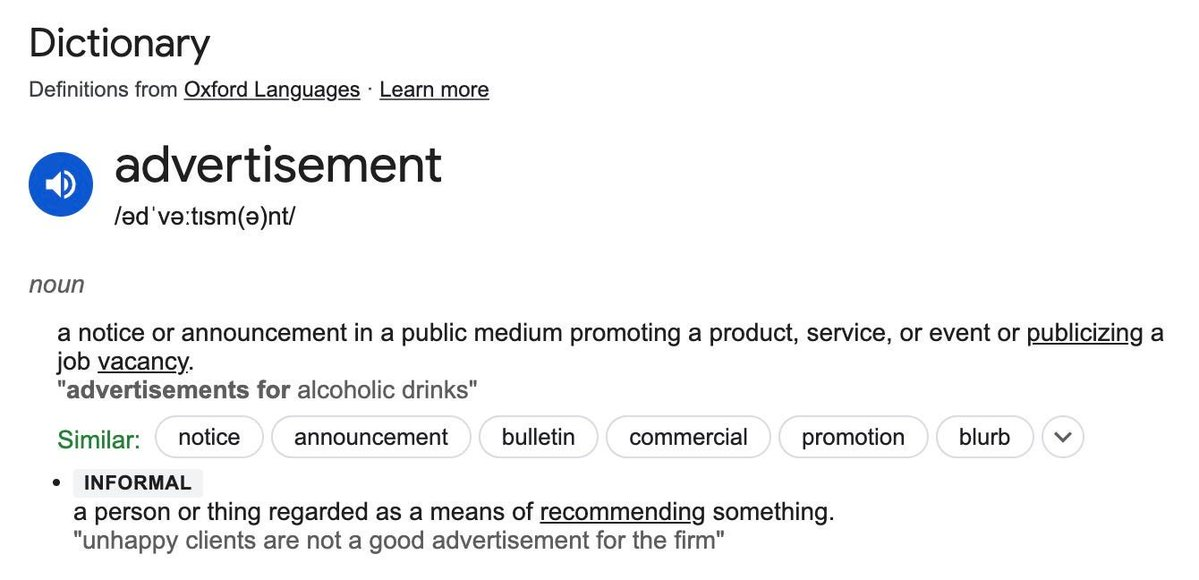
An ad is defined as “an announcement promoting a product to the public.”
So every time you tweet about your project on Twitter, that’s an ad.
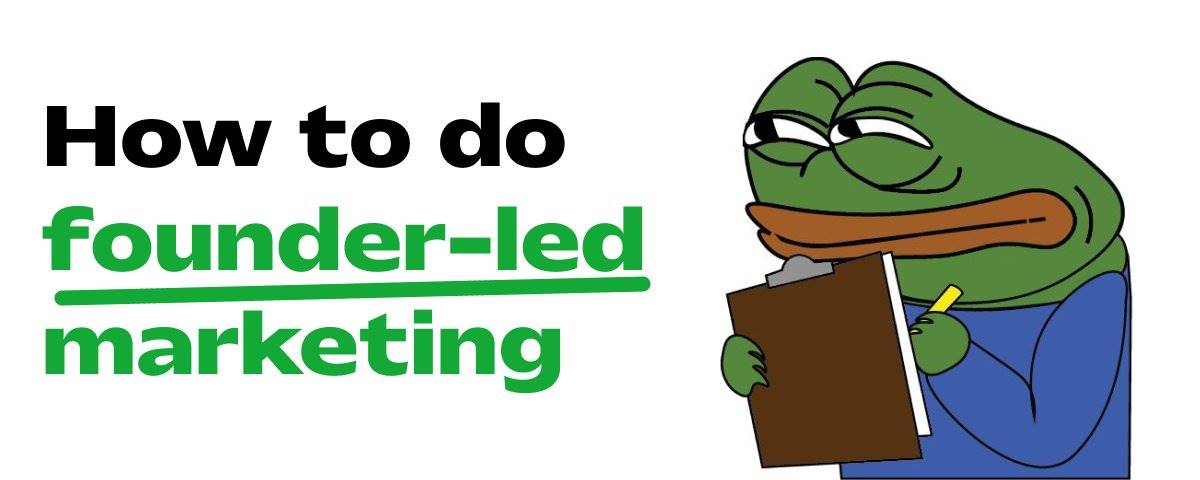
Yet most founders keep making the same mistake.
They assume founder-led marketing means talking about their project on Twitter, so they keep posting ads—and getting ignored. They post for a week, see zero engagement, then give up. (Don’t blame the “algorithm”—it’s not its fault.)
When I first launched Catalyst, I made the exact same mistake.
I aggressively promoted my product, but nobody cared.
I put so much effort into tweets only to be completely ignored. It felt awful. I even considered quitting Twitter entirely and just focusing on being a product manager for Catalyst.
In my day job, I kept switching between writing feature requirement documents and drafting tweets. Gradually, these two things started merging in my mind—until it finally clicked:
I needed to stop thinking like a marketer and start thinking like a product manager. I needed to create tweets that solved problems for my “users”—my followers—from their perspective.
That was the key to cracking founder-led marketing.
Be a Product Manager for Your Content
A product manager (PM) is the “voice of the user”—understanding their needs and ensuring the product satisfies them.
Being a product manager for your content means deeply understanding your audience and delivering exactly what they truly want.
Think about it: Why do people go on Crypto Twitter? Their goals are simple:
-
To improve their lives;
-
To be entertained.
For #1, they might hope to find valuable insights on their timeline (like trading tips). For #2, after a long day of losing money, they just want to laugh and ease the pain.
These are the types of content you need to create. If you can do both at once, even better.
Yet most founders mess this up—they can't resist self-promotion. Instead of asking, “What does my audience need?” they ask, “How can I make myself look cool?”
Your content must be either useful or entertaining—or it’s garbage.
Let me tell you how I do it.
I try to be useful by sharing my experiences as a founder (like this article!).
And I try to be entertaining by openly expressing my frustration with the current state of crypto, and my existential anxiety over dedicating my career to this “absurd industry.”
Coincidentally, these two types of content perform the best.
Of course—I can't only post content unrelated to my project. I need to tie things back to my project because I have growth targets and the company needs to survive. Otherwise, my team and investors will wonder what I’m actually doing all day.
This leads to the million-dollar question: How do you balance providing value with promoting your product?
I’ve found two key principles that make promotional content actually work:
(1) If You Must Promote, Do It Sparingly
There’s actually research behind how to balance promotional vs. non-promotional content (sometimes called the “give-to-get ratio”).
For example, TV shows include about 13 minutes of ads per 60 minutes of programming. That’s roughly a 2:7 ratio of promotion to non-promotion (for those bad at math: 13/(60 - 13)).
Facebook is slightly “gentler,” inserting one ad every four posts—a 1:4 ratio.
On Twitter, especially in fast-moving communities like Crypto Twitter (CT), I personally prefer to promote even less. I use a 1:9 ratio—10% promotional content, 90% value-giving.
But knowing when to promote isn’t enough. If your promotion isn’t compelling, all your efforts are wasted. The real secret is how you promote.
(2) If You Must Promote, Do It With Taste
My favorite ads don’t even feel like ads.
Like funny ones—such as Duolingo’s hilarious take on Lone Star trades or their Super Bowl ad; or emotional ones that make me tear up, like this unofficial Nintendo ad; or someweird-as-hell ads you can’t help but share with friends.
The best ads are so entertaining that you forget you’re being sold to. So entertaining that people willingly spend their free time watching ad compilations on YouTube.
So how do you achieve that?
Again, use product manager (PM) thinking—what do your users genuinely enjoy?
If you lack data, start by referencing what you yourself enjoy. Most of the time, if you're building a consumer-facing (B2C) product, you and your users likely share similar interests.
Here’s how I did it with CrossCats:
I noticed our Discord channel was full of cat memes, and I loved Adventure Time as a kid. So we combined the two, creating Cupcakes and their crew.
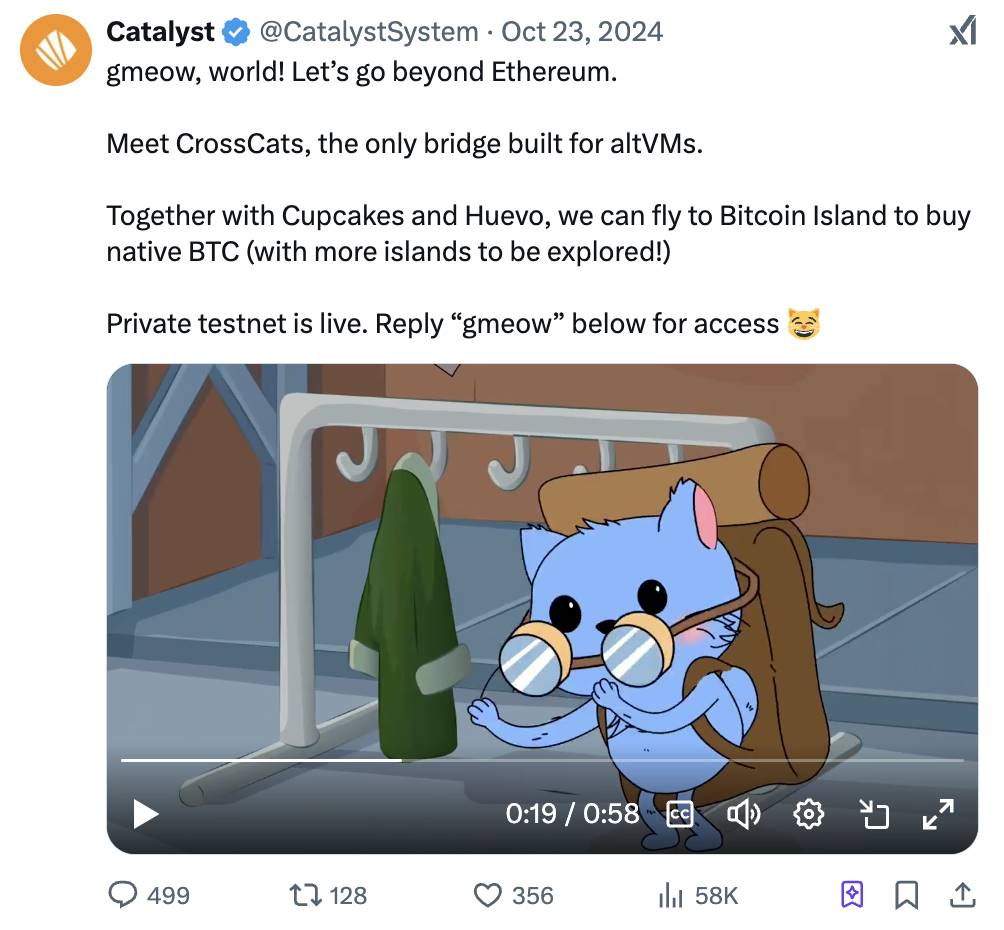
(See tweet)
Great Founder Marketing in Practice
But honestly, I’m far from the gold standard of “founder-led marketing.” So let’s look at founders who actually do it well.
Before we begin, one crucial point: Don’t try to copy what successful founders are doing right now. They already have momentum—a flywheel effect where almost anything they post goes viral.
For instance, vague short phrases used to stir hype only work if you already have a large following.
Instead, study what these founders did when they were still unknown.
Take Rushi—he gained attention by becoming a champion of Move, writing deep threads about why Move matters in the context of parallelization and inscription trends.
Or Keone, who used a strategy similar to mine—documenting his journey building Monad, from hiring to community-building:
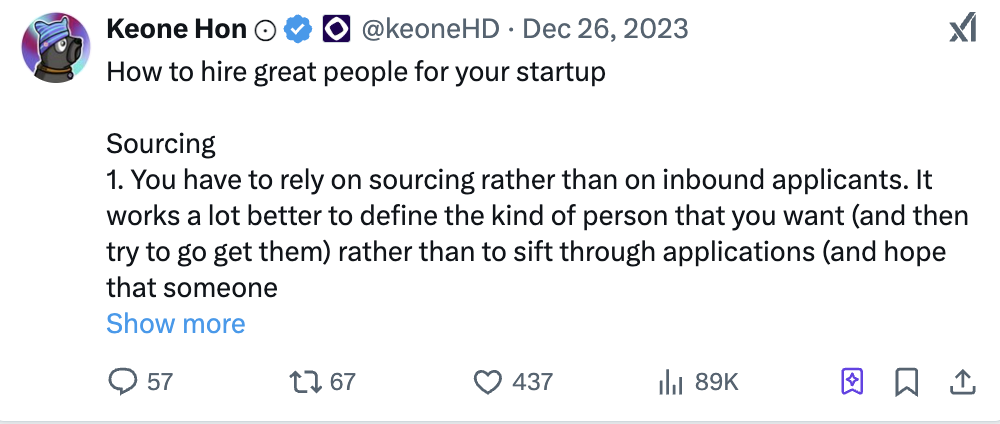
(See tweet)
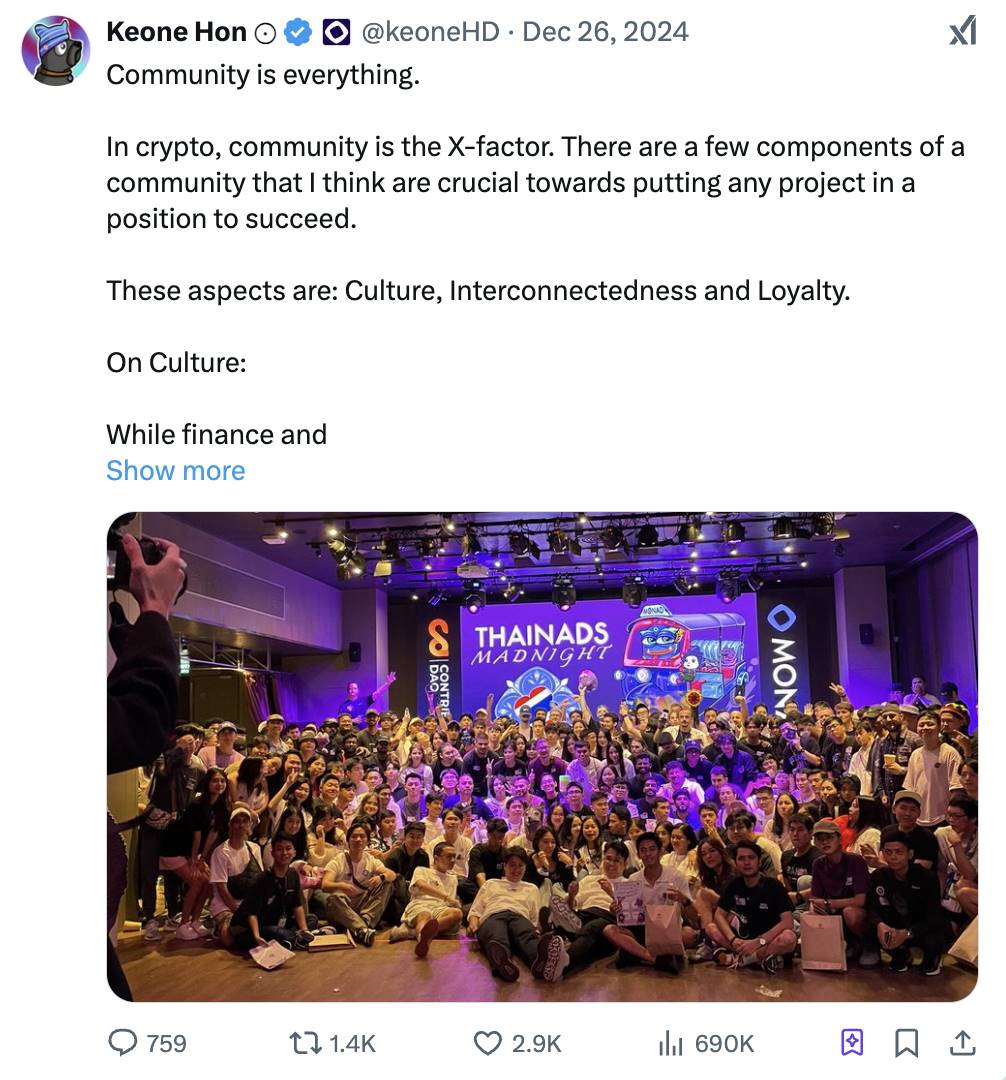
(See tweet)
Have Grit
I hope this helps clarify how founders should create quality content—so you won’t waste time posting things nobody cares about.
But remember: Knowing these strategies doesn’t guarantee success.
If you truly want to stand out in founder-led marketing, you must persist relentlessly. This is a long grind. Results won’t come overnight.
Don’t believe me? Follow the great founders I mentioned, and turn on notifications for their tweets. They publish high-quality content multiple times daily, consistently delivering value.
Don’t treat this as a short-term task—not a week, not a month. You need to make it a habit—spend at least one hour every day, for years.
If you’re truly willing to put in the work, the payoff is huge. With a strong personal brand, recruiting, partnerships, fundraising—all become easier.
If this sounds too hard, accept one truth: Being a great founder requires immense effort. There are no shortcuts. Not everyone can become a great founder, because not everyone is willing to go all-in.
But if you truly desire success, you’ll do whatever it takes.
Join TechFlow official community to stay tuned
Telegram:https://t.me/TechFlowDaily
X (Twitter):https://x.com/TechFlowPost
X (Twitter) EN:https://x.com/BlockFlow_News
 @0xJim