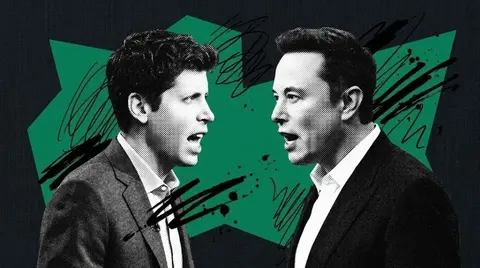
Awakening: When the Dreammaker OpenAI Starts Settling the Score
TechFlow Selected TechFlow Selected
Awakening: When the Dreammaker OpenAI Starts Settling the Score
OpenAI’s Journey from the Stargate Vision to Balance-Sheet Realities
 Navigating Web3 tides with focused insights
By Ada
A company valued in the hundreds of billions of dollars sought to borrow several billion dollars to build data centers.
The lenders said: “No.”
The reason was straightforward: Your business model hasn’t been validated. Analysts predict you could burn through all your cash by mid-2027. What will you repay us with?
This isn’t a startup’s fundraising mishap. It’s OpenAI’s real-world experience in 2025.
According to an exclusive report by The Information, OpenAI dispatched executives across the U.S. to scout locations for building its own data centers and attempted to raise several billion dollars to launch construction—only to be turned down by lenders. Tom’s Hardware cited analyst assessments indicating OpenAI could exhaust its cash as early as mid-2027.
A year ago, Sam Altman stood beside the podium at the White House and announced Project Stargate: $500 billion over four years, in partnership with SoftBank and Oracle, to build the world’s largest AI data center network. Donald Trump hailed it as “the largest AI infrastructure project in history.”
A year later, the joint venture has yet to form a team, develop any data centers, or even agree among the three partners on who does what. And OpenAI itself can’t build its own.
So OpenAI started doing the math.
The $500 Billion Dream Shattered Over “Who’s in Charge”
The Information’s report reconstructs a story that has been quietly deteriorating behind the spotlight for an entire year.
Within weeks of the White House announcement, Project Stargate ground to a halt. There was no lead party, no coordination mechanism. OpenAI, Oracle, and SoftBank repeatedly clashed over “who builds, who manages, and how money is split.”
OpenAI wanted to build its own data centers—a long-held conviction. The logic seemed sound: Renting compute long-term is too expensive; only by owning infrastructure can it control its destiny.
But lenders saw it differently.
A company burning $2.5 billion in cash every six months—and expected to burn $8.5 billion annually—wants to borrow several billion dollars to build data centers? Lenders don’t care about your pitch deck—they care about your cash flow. And OpenAI itself projects positive cash flow no earlier than 2029.
It’s like someone who hasn’t earned a cent yet walking into a bank asking for a loan to build a villa. The bank’s first question is: “What will you repay us with?” And he has no answer.
The self-build path was blocked. OpenAI was forced back to the negotiating table with its Project Stargate partners.
But negotiations were equally difficult. SoftBank already had several large-scale data center projects underway in Texas; OpenAI wanted one of them as its first facility. SoftBank refused, insisting on retaining full control. OpenAI’s team flew to Japan multiple times in September and October for face-to-face talks with Masayoshi Son.
The final agreement: OpenAI signs long-term leases and retains design control; SB Energy, a SoftBank subsidiary, handles development and ownership.
In other words, OpenAI went from aspiring landowner to tenant.
$800 Billion Vanished
If Project Stargate’s internal chaos was a hidden wound, then the next number represents a public course correction.
According to CNBC, OpenAI has lowered its total compute spending target before 2030 to approximately $600 billion—and added a clearer timeline and revenue forecast. It now expects revenue exceeding $280 billion by 2030, split evenly between consumer and enterprise segments.
That’s a 57% cut—from $1.4 trillion down to $600 billion.
The official explanation: “To better align spending with revenue growth.”
The real meaning: Investors aren’t buying it.
The original figure read more like a wish list; $600 billion, at least, is a number you can model. Even so, hitting over $280 billion in revenue by 2030 requires a compound annual growth rate (CAGR) above 50% for five straight years. Who’s willing to guarantee that?
OpenAI’s 2025 revenue was $13.1 billion, while it burned $8 billion in cash. It remains far from profitability—and the company itself projects cash flow breakeven no earlier than 2029. Until then, cumulative losses may reach $115 billion.
This is the sound of the dream waking up.
It’s not that Altman doesn’t want to spend $1.4 trillion. Reality tells him: You can’t afford to.
The Ledger Can’t Carry the Dream
Why must OpenAI shift from dreamer to accountant? Not because of strategic missteps—but because three hard facts arrived simultaneously.
First, money is flowing out far faster than it flows in.
In H1 2025, OpenAI generated $4.3 billion in revenue but burned $2.5 billion in cash. Full-year revenue: $13.1 billion; cash burn: $8 billion. According to investor documents cited by Fortune, the company expects operating losses to widen annually, peaking at $74 billion in 2028—only turning positive in 2029 or 2030. Cumulative losses are projected at $115 billion.
OpenAI’s current state is spending ten times faster than it earns—while revenue grows only twice as fast. Mathematically, those lines will eventually cross; the only question is whether that happens in 2029—or never.
Second, can compute efficiency offset explosive scale growth? Though OpenAI’s “compute margin”—revenue minus model-running costs—rose from 52% in October 2024 to 70% in October 2025, thanks to algorithmic optimization and improved hardware utilization, each new, larger model—and especially power-hungry features like video generation—eats up those gains.
Third, paid conversion has plateaued.
ChatGPT’s weekly active users surpassed 900 million. Yet according to Incremys data, its paid conversion rate stands at just ~5%, with over 95% of users remaining on the free tier. OpenAI has begun testing ads in its free version—a telling signal: when you start monetizing user attention, you’ve likely hit the ceiling of subscription-based monetization.
Meanwhile, competitors are winning users with less money. Per Similarweb, ChatGPT’s global traffic share dropped from 87% to ~65% within a year. Google Gemini surged from 5% to 21%—not via superior models, but via Android default integration and Workspace embedding. Anthropic’s Claude achieved the highest user engagement (34.7 minutes per day) with just 2% traffic share, pursuing a premium enterprise strategy and burning cash at a fraction of OpenAI’s pace.
“ChatGPT created this category, but once alternatives emerge, users naturally disperse,” said Tom Grant, Research VP at Apptopia.
And competitors deliver similar outcomes at lower cost. DeepSeek disrupted the market with open-source models and ultra-low expenses. Google dominates via distribution. Anthropic wins high-value clients via focus. If AI models converge functionally, what ultimately determines market leadership won’t be whose model is strongest—but whose ecosystem runs deepest and whose costs run lowest.
OpenAI is trying to win three wars at once: the model race, the infrastructure race, and the commercialization race—but historically, no company has ever won all three simultaneously.
Altman’s Plan B
The dream shattered—but Altman didn’t stop.
He did something every business textbook recommends but few dreamers are willing to do: abandon dogma and survive pragmatically.
The dream of building its own data centers was shelved. In its place: signing massive agreements outside the Project Stargate framework—$30 billion annually with Oracle, deepening ties with CoreWeave, and even filling gaps with AWS and Google Cloud. Chip supply is also diversifying: beyond Nvidia, AMD and startup Cerebras are now part of the mix.
Sarah Friar, OpenAI’s CFO, publicly stated at the World Economic Forum in Davos that the company is deliberately using partners to protect its balance sheet.
A year ago, that statement would have been unthinkable. Then, Altman spoke of trillion-dollar infrastructure commitments, 10 GW of compute capacity, and AGI transforming humanity. Now his CFO speaks of “protecting the balance sheet.”
Yet OpenAI’s fundraising remains staggering: its latest round may exceed $100 billion. According to Bloomberg, OpenAI is nearing completion of the first tranche of this round; including financing, its overall valuation could surpass $850 billion. Expected investors include Amazon ($50 billion), SoftBank ($30 billion), Nvidia ($20 billion), and Microsoft.
Note the identity of these investors: chip suppliers, cloud platforms, and strategic investors requiring OpenAI to use their services. This is no longer venture capital betting on a dream—it’s a supply chain locking in a major customer.
Previously, investing in OpenAI was like buying a lottery ticket. Today, it’s like signing a supply contract—the nature has completely changed.
Gravity
Let’s zoom back in on Project Stargate.
A year ago, on the White House stage, Sam Altman stood center-stage announcing the $500 billion “Project Stargate.”
A year later, the joint venture is embroiled in infighting. OpenAI bypassed its own joint-venture framework entirely, signing a separate deal with Oracle. Its compute target fell short: 10 GW planned, only 7.5 GW delivered. Spending expectations dropped from $1.4 trillion to $600 billion.
This isn’t a failure story. OpenAI hasn’t collapsed—it’s still raising money, still growing, still commanding over 900 million users.
But it is a story of awakening.
From “building the world’s largest data center empire” to “ensuring survival first—then fighting with others’ money and others’ infrastructure.” From aspiring landowner to tenant. From dreamer to accountant.
Facing Project Stargate’s stalled progress, Elon Musk coldly tweeted on X: “Hardware is hard.”
While biting, the remark points to a reality every AI company must eventually confront: At this stage of the compute arms race, the true bottleneck is no longer who trains the strongest model—but who can physically deploy gigawatt-scale infrastructure without burning themselves alive.
Altman chose not to burn himself alive. It may be his least glamorous—but most correct—decision to date.
As for that $500 billion Project Stargate dream? It hasn’t died. But it’s no longer what it was a year ago. It’s shifted from a narrative about reshaping human destiny to a balance sheet demanding line-by-line scrutiny.
Join TechFlow official community to stay tuned
Telegram:https://t.me/TechFlowDaily
X (Twitter):https://x.com/TechFlowPost
X (Twitter) EN:https://x.com/BlockFlow_News
 深潮TechFlow