
Crypto Morning Brief: ZachXBT Exposes Insider Trading by Axiom Executives; Magic Eden to Shut Down Bitcoin and EVM Marketplaces
TechFlow Selected TechFlow Selected
Crypto Morning Brief: ZachXBT Exposes Insider Trading by Axiom Executives; Magic Eden to Shut Down Bitcoin and EVM Marketplaces
Cryptocurrency exchange STS Digital has completed a $30 million funding round, led by CMT Digital.
 Navigating Web3 tides with focused insights
Author: TechFlow
Yesterday’s Market Highlights
U.S. Initial Jobless Claims for the Week Ending February 21: 212,000, vs. Expected 215,000
Initial jobless claims in the U.S. for the week ending February 21 totaled 212,000, below the consensus estimate of 215,000. The prior week’s figure was revised upward from 206,000 to 208,000.
Reuters: U.S. CFTC Asserts Authority to Regulate Improper Trading in Prediction Markets
According to Reuters, the U.S. Commodity Futures Trading Commission (CFTC) stated on Wednesday that it holds regulatory authority over illegal trading activities in prediction markets. This announcement followed Kalshi—a prediction market platform—reporting two insider trading incidents to the agency.
The CFTC asserted its “full regulatory authority” over misconduct involving event-market contracts and cited Kalshi’s report, which flagged and froze trading accounts linked to the two insider trading cases. As prediction markets expand, concerns about insider trading are intensifying; a senior official at the U.S. Department of Justice identified it as a key enforcement priority this month. State-level gambling regulators are also seeking oversight of such markets, viewing them as competitors to casinos and traditional betting operators.
Earlier reports indicated that Kalshi imposed bans and fines on an employee of MrBeast and a former California gubernatorial candidate for insider trading.
Bipartisan U.S. Lawmakers Introduce Bill to Shield Blockchain Developers from Criminal Prosecution
As reported by Eleanor Terrett, U.S. Republican Representatives Fitzgerald (Wisconsin) and Cline (Virginia), alongside Democratic Representative Lofgren (California), jointly introduced the “Blockchain Innovation Promotion Act of 2026,” aiming to clarify the scope of application of Title 18, Section 1960 of the U.S. Code. The bill explicitly limits Section 1960’s applicability to entities that control customer funds—not developers who merely write code. Previously, regulators applied this provision to non-custodial software developers in cases involving TornadoCash and Samourai Wallet, triggering strong backlash across the crypto industry. This legislation would provide legal safeguards for blockchain developers, addressing a long-standing point of tension between crypto innovation and regulation.
OCC Releases Proposed Rule to Implement the GENIUS Act, Seeks Public Comment
According to crypto journalist Eleanor Terrett, the U.S. Office of the Comptroller of the Currency (OCC) today released a proposed rule to implement the GENIUS Act and is soliciting public comment. The framework establishes baseline rules for licensed stablecoin issuers and foreign payment stablecoin issuers under OCC supervision, while also covering certain custodial activities.
Jonathan Gould, Acting Comptroller of the Currency, stated the rule aims to build a system where stablecoins can “thrive safely and soundly.” Notably, anti-money laundering (BSA/AML) and Office of Foreign Assets Control (OFAC) provisions are not included in this proposal and will be addressed separately in coordination with the U.S. Department of the Treasury.
ZachXBT: Axiom Exchange Executives Abused Internal Tools for Insider Trading
ZachXBT exposed Broox Bauer, Senior Business Development Manager at Axiom Exchange, for allegedly abusing internal system access privileges since early 2025 to conduct insider trading—tracking users’ private wallet activity via referral codes, wallet addresses, or user IDs. Evidence shows Broox shared screenshots of internal dashboards in April and August 2025, leaking private wallet and registration information of multiple traders. Axiom, founded in 2024 by Mist and Cal and incubated by Y Combinator, has grown rapidly and generated over $390 million in revenue to date.
Magic Eden to Shut Down Bitcoin and EVM Marketplaces, Discontinue Multi-Chain Wallet Services
According to Blockspace, NFT marketplace Magic Eden plans to shut down its Bitcoin and EVM marketplaces and discontinue its multi-chain wallet service. Sources indicate Magic Eden may announce this decision as early as this Friday, with the Bitcoin and EVM marketplaces scheduled to close during the first week of March. Its multi-chain wallet will enter export-only mode by mid-March and fully cease operations by early April.
Magic Eden will continue supporting Solana-based NFTs and assets, signaling a strategic return to its original Solana ecosystem. Magic Eden previously dominated the Bitcoin Ordinals (a Bitcoin-specific NFT standard) market. Jack Lu, CEO of Magic Eden, previously stated the company is shifting from an NFT marketplace toward “crypto entertainment,” including new areas such as prediction markets.
Caixin: Reports Emerge That Chinese Regulators Are Reviewing Jane Street’s Trading Behavior in China’s ETF Market
According to Caixin, unconfirmed reports suggest Chinese regulators are reviewing Jane Street’s trading behavior in China’s ETF market. However, a person familiar with Jane Street stated: “We are unaware of these rumors and have no reason to believe they are true; they should not be associated with Jane Street.” This week, Jane Street—as well as its co-founder and two employees—was charged with insider trading, fraud, and market manipulation, allegedly accelerating the $40 billion collapse of TerraUSD (UST) and its sister token Luna in 2022.
Founded in 1999, Jane Street is one of the world’s largest proprietary quantitative trading firms. In 2024, its net trading revenue exceeded $20 billion, with net profits approaching $13 billion. Unlike hedge funds, Jane Street does not accept external client capital, resulting in significantly lower disclosure obligations than traditional asset managers—a structure that has long contributed to its air of mystery.
Huanqiu.com Publishes WeChat Article: “The Chen Zhi and Zhao Changpeng Cases: The U.S. Profited Nearly $20 Billion”
Huanqiu.com published a WeChat article titled “The Chen Zhi and Zhao Changpeng Cases: The U.S. Profited Nearly $20 Billion.” According to a joint report released by institutions including the National Computer Virus Emergency Response Center of China, the U.S. leveraged technological hegemony to broadly seize global cryptocurrency assets. Between 2022 and 2025, the U.S. confiscated over $30 billion worth of cryptocurrency assets globally through various cases. In the Chen Zhi case, approximately 127,000 BTC—valued at roughly $15 billion—were seized, accounting for half of the total. In the case against Binance founder Zhao Changpeng, the U.S. secured a $4.3 billion penalty through combined civil and criminal proceedings.
The report further revealed that from 2023 to 2025, U.S.-government-backed hacking groups launched targeted attacks against more than 20 major global cryptocurrency exchanges, stealing users’ wallet private keys and platform transaction records. It notes that these actions not only increased U.S. fiscal revenue but also reinforced global cryptocurrency transactions’ dependence on the U.S. dollar.
SBF: “The Biggest Question for Crypto Is Whether AI Will Use It as a Payment Method”
Sam Bankman-Fried (SBF), founder of FTX, posted on X: “The biggest question facing crypto is:
Will AI use it?
Suppose an instance of ChatGPT or Claude needs additional compute resources.
Does it support wire transfers, credit cards, or cryptocurrency payments?
On one hand, traditional finance isn’t built for AI.
For example—how would it complete KYC? It has no passport, address, Social Security number—or even a name.
Crypto works far better—it’s natively digital, permissionless, and AI can already query blockchains, etc.
On the other hand, we might see an ‘agent’ model emerge:
Each AI is treated as an agent acting on behalf of a specific human, who handles KYC and assumes responsibility for the AI’s actions.
This raises a related question: Who bears legal liability for AI’s actions?
Either way, integrating AI into trading and payments requires work—either natively digital and crypto-based, or reliant on human ‘controllers’ to manage AI.
How this unfolds will profoundly impact the world—and one major consequence is crypto’s future.”
Supreme People’s Court: Next Phase of Crackdown Focuses on Money Laundering via Cryptocurrency and Underground Banking
According to the Shanghai Securities Journal, Wang Bin, Director of the Third Criminal Division of the Supreme People’s Court, stated at a press conference titled “Judicial Efforts Against Telecom Fraud and Property Crimes” held by the Supreme People’s Court on February 26 that courts will prioritize targeting ringleaders and core members of criminal syndicates, telecom fraud “financiers,” human smugglers (“snakeheads”), organizations providing armed protection for cross-border telecom fraud, as well as violent crimes—including intentional homicide, intentional injury, and kidnapping—committed during telecom fraud, and associated offenses such as money laundering using cryptocurrencies and underground banks.
Wang Bin added that courts will increase the application of financial penalties against telecom fraud offenders to ensure criminals gain no economic benefit. Courts will encourage individuals involved in “two-card” (bank card and phone card) related aiding-and-abetting or money-laundering offenses to voluntarily compensate victims, treating restitution and repayment as mitigating factors reflecting remorse and cooperation—and imposing stricter punishments on offenders who refuse to make restitution despite having the ability to do so.
Crypto Exchange STS Digital Secures $30 Million Funding Round Led by CMT Digital
According to Fortune, cryptocurrency exchange STS Digital recently announced a $30 million funding round led by CMT Digital, with participation from Kraken, Arrington Capital, and Fidelity Investments’ digital asset division. The platform specializes in options trading for over 400 cryptocurrencies catering to institutional investors and acts as a market maker to provide liquidity.
Founded in 2022 by former Credit Suisse and UBS traders Maxime Seiler and Gideon Hyams, STS Digital now employs nearly 50 people. Its revenue grew threefold between 2024 and 2025, and the firm is now profitable, counting prominent crypto entities—including the Uniswap Foundation—as clients.
The company plans to use the proceeds to scale trading volumes, serve larger institutional clients, and expand its workforce. Amid crypto market volatility, STS Digital believes options trading offers institutional investors superior risk management tools compared to perpetual futures.
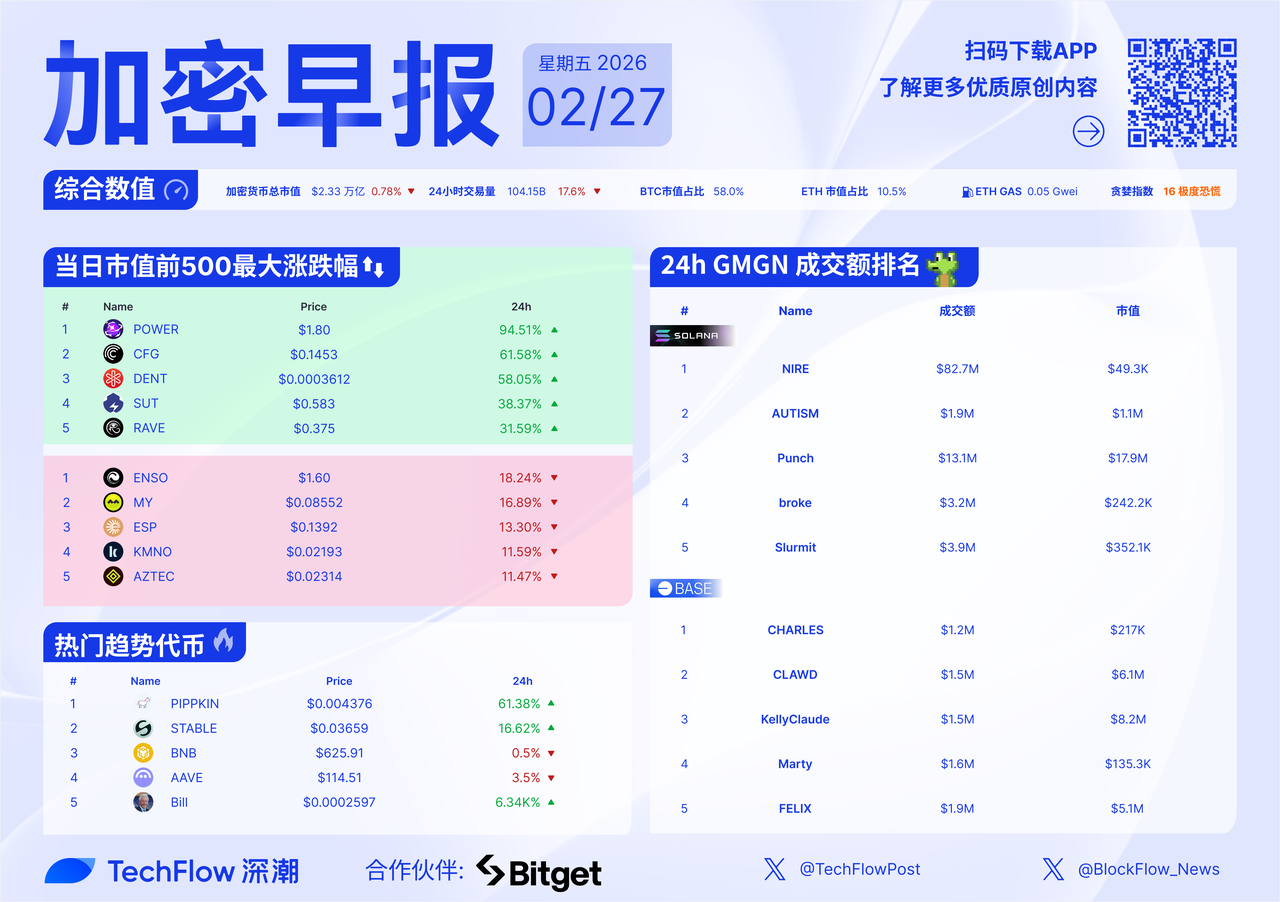
Market Data
Recommended Reading
Full ZachXBT Investigation: Axiom Employees Used Internal Access for Insider Trading
This report accuses multiple employees of cryptocurrency exchange Axiom of abusing internal privileges to conduct insider trading—including leveraging user wallet information to help accomplices quickly profit $200,000. Such conduct reveals critical flaws in the platform’s permission controls. The investigation details the accused employees’ operational methods—including tracking user data via backend systems, collaborating with team members to set rules, and transferring funds via centralized exchanges. It emphasizes Axiom’s lack of monitoring mechanisms and permission management, recommending further legal action.
Tokenizing China’s Electricity: Exporting Power to the World
This article explores how China’s large AI models and related technologies are achieving “electricity export” globally via tokens—and securing a pivotal position in the worldwide developer market. This phenomenon represents a new technological and economic contest, carrying profound strategic implications amid U.S.-China rivalry.
In This Pig-Butchering Scam, AI Handles Romance—and Forges Fake Lawyer Licenses
This article details the operational mechanics of scam syndicates—including how AI conducts romantic conversations, generates false information, estimates victims’ “extraction value,” and further defrauds victims through fake law firms and dating platforms. It notes that while AI hasn’t changed the fundamental nature of scams, it has dramatically lowered their cost—enabling larger-scale operations. The article also highlights AI’s potential risks, particularly when open-source models are deployed locally, making detection and prevention significantly harder.
This article discusses how NVIDIA’s earnings report ignited an AI boom, while Circle’s financial results boosted the crypto market—propelling Bitcoin higher. Stablecoins’ role as crypto infrastructure became evident, with rising USDC circulation signaling capital inflows into the crypto market. U.S. tech stocks rebounded strongly, with the Nasdaq leading gains; NVIDIA’s results further propelled market momentum.
We Built a Perp DEX—Everyone Says It’s Mind-Blowing
This article introduces Perpl, a decentralized exchange (DEX) designed as the first fully on-chain execution platform featuring a genuine centralized limit order book (CLOB) and highly efficient gas fee support. It explores Perpl’s technical architecture, performance optimizations, competitive advantages, and its potential impact on the broader decentralized finance (DeFi) ecosystem.
Join TechFlow official community to stay tuned
Telegram:https://t.me/TechFlowDaily
X (Twitter):https://x.com/TechFlowPost
X (Twitter) EN:https://x.com/BlockFlow_News
 深潮TechFlow