There is a 30% chance that the U.S. Bitcoin reserve is not actually its own.
TechFlow Selected TechFlow Selected
There is a 30% chance that the U.S. Bitcoin reserve is not actually its own.
The U.S. Strategic Bitcoin Reserve’s on-paper holdings of 94,643 BTC face legal risks—up to 30% could vanish with a single court ruling.
 Navigating Web3 tides with focused insights
Author: CryptoSlate / Oluwapelumi Adejumo
Translated by: TechFlow
TechFlow Intro: The core narrative behind President Trump’s executive order establishing a Strategic Bitcoin Reserve faces an under-discussed legal loophole: approximately 30% of the reserve’s Bitcoin is linked to the 2016 Bitfinex hack—and if a court rules these coins must be returned to victims, the reserve’s size would shrink immediately, even without the government selling a single coin. This article examines the fundamental distinction between “reserve” and “available” Bitcoin through the lens of legal ownership structures, and explains how LEO tokens have become the market proxy for this legal battle.
Full Text Below:
The U.S. Strategic Bitcoin Reserve could lose nearly 30% of its holdings in a single legal ruling—even without the government selling a single Bitcoin.
Last year, President Trump signed an executive order creating the Strategic Bitcoin Reserve. The order directed the Treasury Department to consolidate all BTC held by the U.S. government into a single reserve account and pledged that the U.S. would not sell any of those Bitcoins.
Yet the reserve’s headline number may overstate the quantity of BTC the government can truly treat as permanent strategic assets.
According to Bitcoin Treasuries data, the U.S. government controls approximately 328,372 BTC—the largest known national Bitcoin holding globally. At Bitcoin’s current price of roughly $65,842, this stash is worth about $21.6 billion.
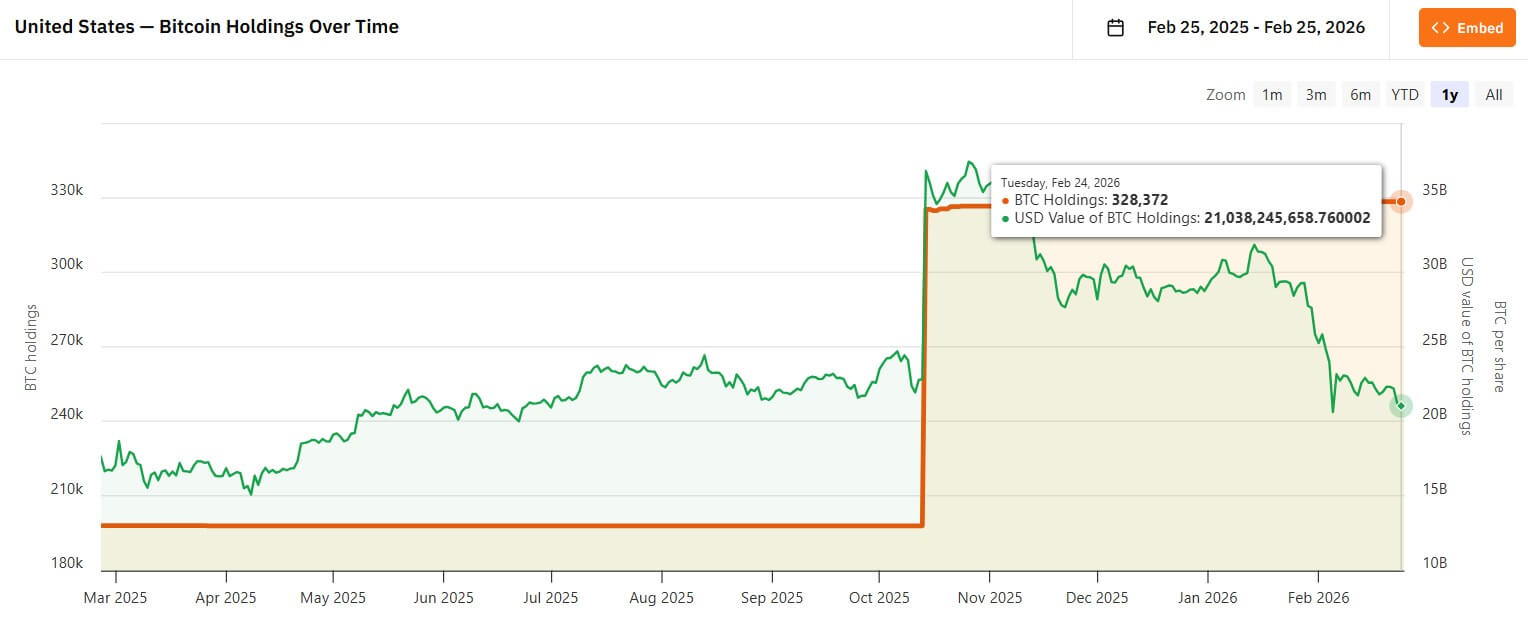
However, the issue lies in this: a large portion of that figure—though held by the government—is not cleanly owned by it in any strategic sense.
The executive order explicitly permits disposition “pursuant to a court order issued by a court of competent jurisdiction,” and includes a specific exemption for assets “that are required to be returned to identifiable and verifiable crime victims.”
This exemption is critical—because roughly 94,643 BTC (about 30% of the government’s total holding) are tied to the 2016 Bitfinex hack.
If those Bitcoins are returned as restitution, the reserve’s headline figure would mechanically drop to approximately 234,000 BTC.
The reserve number is real—but ownership remains unresolved
The Strategic Bitcoin Reserve is often discussed as if it were a clean sovereign balance sheet. In reality, it is a hybrid of legal and accounting constructs.
Some BTC held in the government’s name has been fully forfeited and clearly belongs to the United States. But another portion remains entangled in criminal proceedings, restitution claims, or procedural steps that may take years to resolve.
This gap has now become the central point of contention surrounding the U.S. reserve.
The 94,643 BTC linked to Bitfinex is the most prominent example. These coins appear in custodial accounts associated with the government—and markets include them in their tallies.
Yet if a court rules they must be returned to victims, they were never part of the permanent strategic reserve to begin with.
This is precisely where both bullish and bearish narratives risk missing the mark.
The bullish version overstates the reserve’s durability by treating all government-controlled Bitcoin as permanent strategic assets. The bearish version overstates the market impact by conflating restitution transfers with sovereign sales.
This legal distinction carries significant implications—for price, for market sentiment, and for how investors interpret the Strategic Bitcoin Reserve.
Why the Bitfinex-linked Bitcoin remains frozen
In August 2016, Bitfinex was hacked, resulting in the theft of 119,754 BTC—one of the largest Bitcoin thefts in crypto history.
In February 2022, U.S. authorities recovered approximately 94,643 BTC linked to that hack—a recovery notable both for its scale and its timing.
The next question has always been restitution.
In January 2025, prosecutors filed a motion in federal court seeking approval to return the recovered assets to Bitfinex in-kind—as Bitcoin—rather than selling them first and returning the proceeds in USD.
This distinction is crucial for market structure.
A government sale or auction would generate a visible supply event, with timing and scale known in advance. An in-kind return shifts the next decision point to the recipients—potentially Bitfinex, its former users, or both—depending on how the court resolves competing claims.
U.S. forfeiture procedures are deliberately designed to slow this stage. Third parties asserting rights to forfeited property may file claims in ancillary proceedings. In the Bitfinex case, this process has become the central battleground.
Some customers argue the stolen assets belong to them individually. Bitfinex contends it absorbed the losses—and compensated users via internal mechanisms—thereby ultimately bearing the economic loss.
The significance of this ruling therefore extends far beyond the case itself, potentially shaping how restitution is handled in future exchange hacks.
Until the court resolves these claims—or the parties reach a settlement—the recovered Bitcoin remains effectively frozen.
That is why the reserve’s on-chain number appears stable, while its legal status remains deeply uncertain.
LEO is acting as the market proxy for the court’s ruling
The legal process remains slow—but traders are attempting to price the outcome using UNUS SED LEO (LEO), Bitfinex and iFinex’s exchange token.
Bitfinex has stated that once the recovered BTC is returned, it will use 80% of the net proceeds to repurchase and burn LEO tokens within 18 months.
The company noted this process may include over-the-counter transactions—for instance, direct BTC-for-LEO swaps.
This policy effectively converts the federal court’s ruling into a massive buyback pipeline. It gives the market a mechanism to speculate on timing well before the legal decision is rendered.
Vetle Lunde, Research Head at K33 Research, models LEO’s value around two primary drivers: ongoing repurchases funded by Bitfinex’s trading revenue, and the anticipated future burn tied to the recovered Bitcoin.
Based on ~95,000 recovered BTC, Lunde estimates the 80% allocation amounts to roughly 75,000 BTC—worth approximately $5 billion at current prices.
Meanwhile, he estimates the fair value of repurchases driven solely by trading revenue sits at about $125 million.
Yet this catalyst is highly volatile.
CoinMarketCap data shows LEO’s market cap stands at roughly $8 billion—but its 24-hour trading volume is only $7.1 million. This low liquidity could severely amplify price swings.
At the same time, the high market cap means LEO is currently trading at a ~60% premium to its implied fair value.
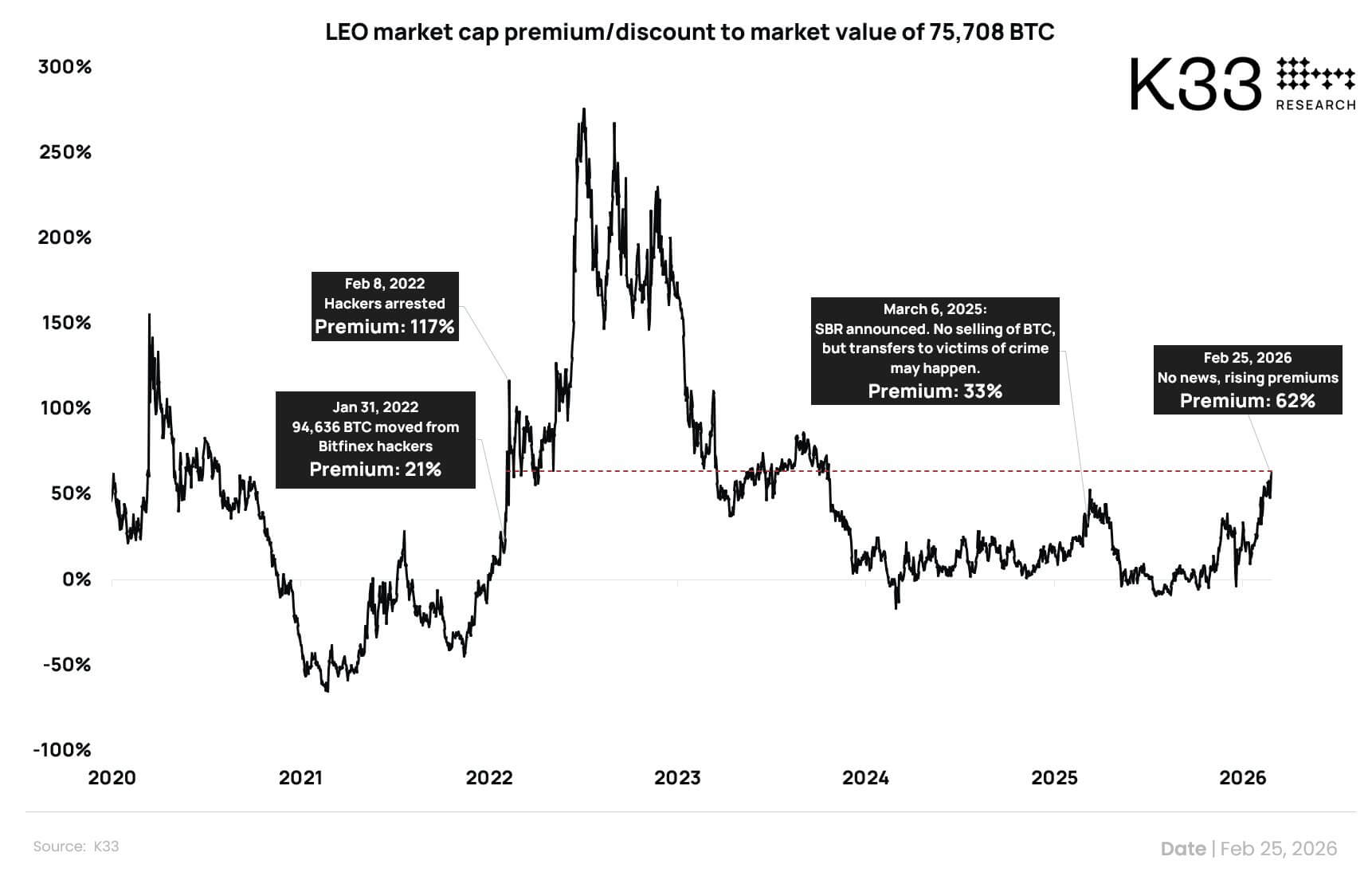
This is the highest premium level since the initial recovery announcement in 2022—a period marked by persistent, elevated premiums.
Lunde notes the current premium is especially noisy, given LEO’s extremely low liquidity and concentrated holdings—where just a few participants can significantly distort the market.
Traders may thus be front-running the court transfer event—or simply riding momentum in an environment where fair value has taken a back seat.
Ultimately, LEO’s low liquidity will magnify the final outcome. If the transfer is confirmed, short-term valuation could rise further. Conversely, if the supply distribution is limited or delayed, the premium could compress rapidly.
The headline impact may dwarf the actual BTC flow
A broader market context explains why this event could influence sentiment even before the court rules.
Early in 2026, Bitcoin has been in a risk-off selloff mode. Spot Bitcoin ETFs have registered cumulative net outflows exceeding $4.5 billion this year—and have seen five consecutive weeks of capital outflows.
In this environment, traders are highly sensitive to supply-related headlines—especially any news involving national Bitcoin holdings.
Hence, a headline like “U.S. transfers ~95,000 BTC” inherently carries market-shaking potential.
But if those coins leave government custody, it’s restitution—not a government sale.
If Bitfinex receives the Bitcoin and executes its announced buyback-and-burn plan, the corresponding BTC flows would likely be phased—not dumped onto the market all at once.
Roughly calculated: ~75,000 BTC spread over 18 months equals about 139 BTC per day.
This may affect LEO’s price—but it does not constitute a meaningful supply shock relative to the much larger supply pressure Bitcoin has already absorbed over the past five months from long-term holders and ETF outflows.
Thus, the real market impact may stem from the narrative framing—not the actual Bitcoin flow.
Because the Strategic Bitcoin Reserve is more than just a BTC stockpile number—it’s a political and market signal that traders can interpret as bullish or bearish, even while the legal status of those Bitcoins remains unresolved.
That’s why the framing “U.S. loses 30% of its Bitcoin reserve” is likely to trigger volatility: it’s emotionally concise and headline-friendly—but strips away legal substance.
Yet the legal substance is the real story.
The Strategic Bitcoin Reserve was designed to coexist with restitution obligations. If the Bitfinex-linked Bitcoin leaves government custody, reserve numbers on tracking platforms will fall—and markets will react.
But the deeper truth remains unchanged: the U.S. is not abandoning its reserve policy; it is acting lawfully—precisely what the reserve framework originally stated it would do.
Join TechFlow official community to stay tuned
Telegram:https://t.me/TechFlowDaily
X (Twitter):https://x.com/TechFlowPost
X (Twitter) EN:https://x.com/BlockFlow_News
 @CryptoSlate