Decoding the White House's latest "Genesis Project": Reshaping America's research system with AI
TechFlow Selected TechFlow Selected
Decoding the White House's latest "Genesis Project": Reshaping America's research system with AI
Delve into the specifics of this executive order and how it will reshape the landscape of artificial intelligence, energy, and science over the next decade.
 Navigating Web3 tides with focused insights
Author:Ask Perplexity
Compiled by: TechFlow
White House Launches "Mission Genesis": The AI Version of the Manhattan Project Arrives
The U.S. Department of Energy (DOE) will build a national AI platform based on American supercomputers and federal scientific data to train foundational models in science, and run AI agents and robotic laboratories, enabling automation of experiments in biotechnology, critical materials, nuclear fission/fusion, space, quantum technologies, and semiconductors.
Let’s dive into the specifics of this executive order and how it will reshape the landscape of artificial intelligence, energy, and science over the next decade:
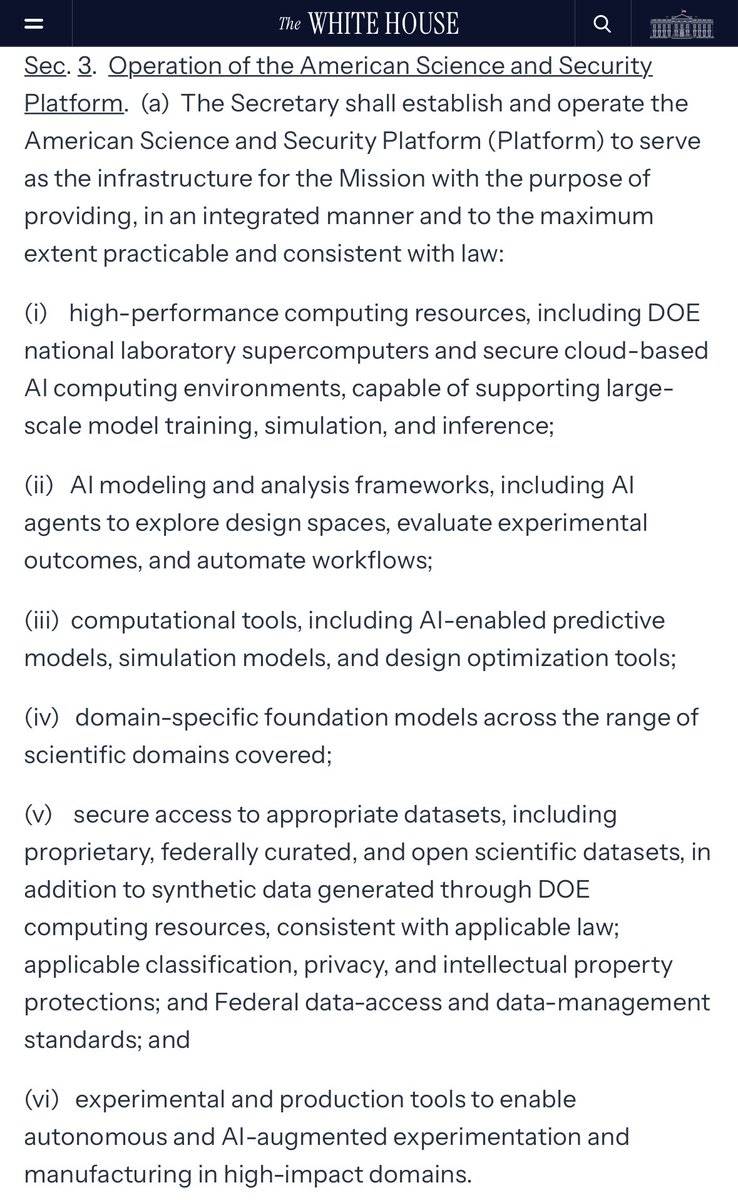
Core: A New "U.S. Science and Security Platform"
The Department of Energy (DOE) is tasked with transforming its national laboratory system into an integrated technological architecture providing the following capabilities:
-
High-Performance Computing (HPC): Supporting large-scale model training, simulation, and inference
-
Domain-Specific Foundational Models: Covering disciplines such as physics, materials, biology, and energy
-
AI Agents: For exploring design spaces, evaluating experiments, and automating workflows
-
Robotic/Automated Laboratories and Production Tools: Enabling AI-driven experimentation and manufacturing
This means building "national AI scientists" and "AI lab technologies" as part of the infrastructure.
Clear and Highly Strategic Objectives
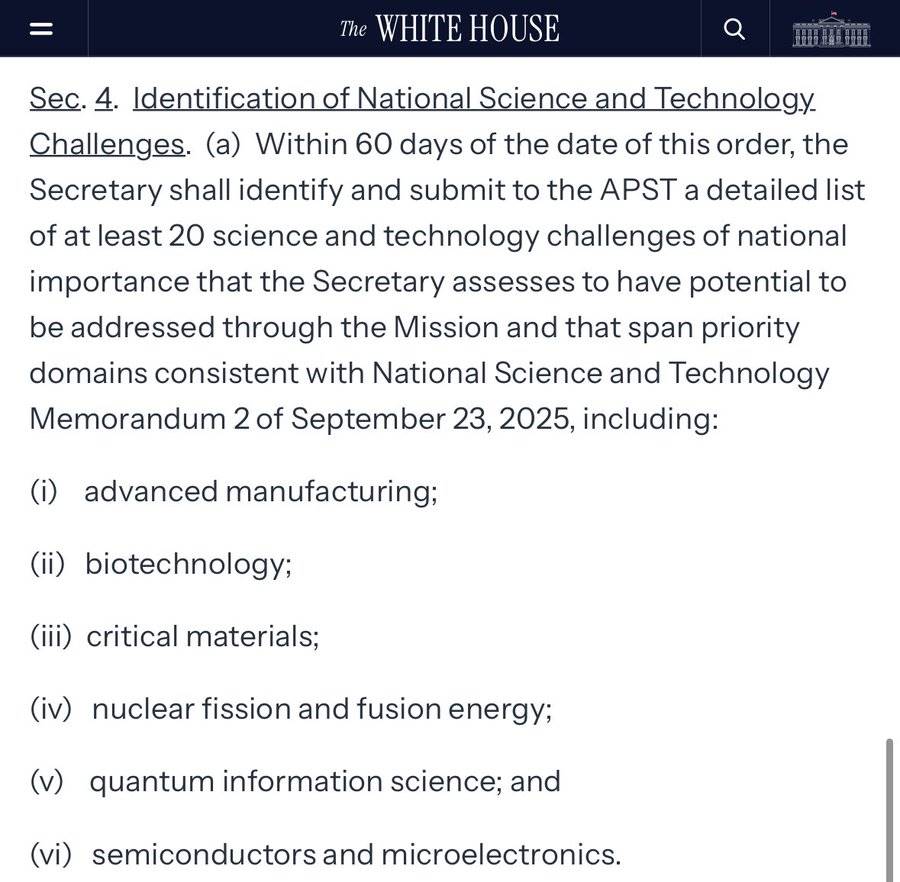
Within 60 days, the Department of Energy must propose at least 20 "National Challenges" covering the following areas:
-
Advanced Manufacturing
-
Biotechnology
-
Critical Materials
-
Nuclear Fission and Fusion
-
Quantum Information Science
-
Semiconductors and Microelectronics
This initiative aims to ensure energy dominance, supply chain security, and defense capabilities.
Aggressive timeline to ensure execution:
-
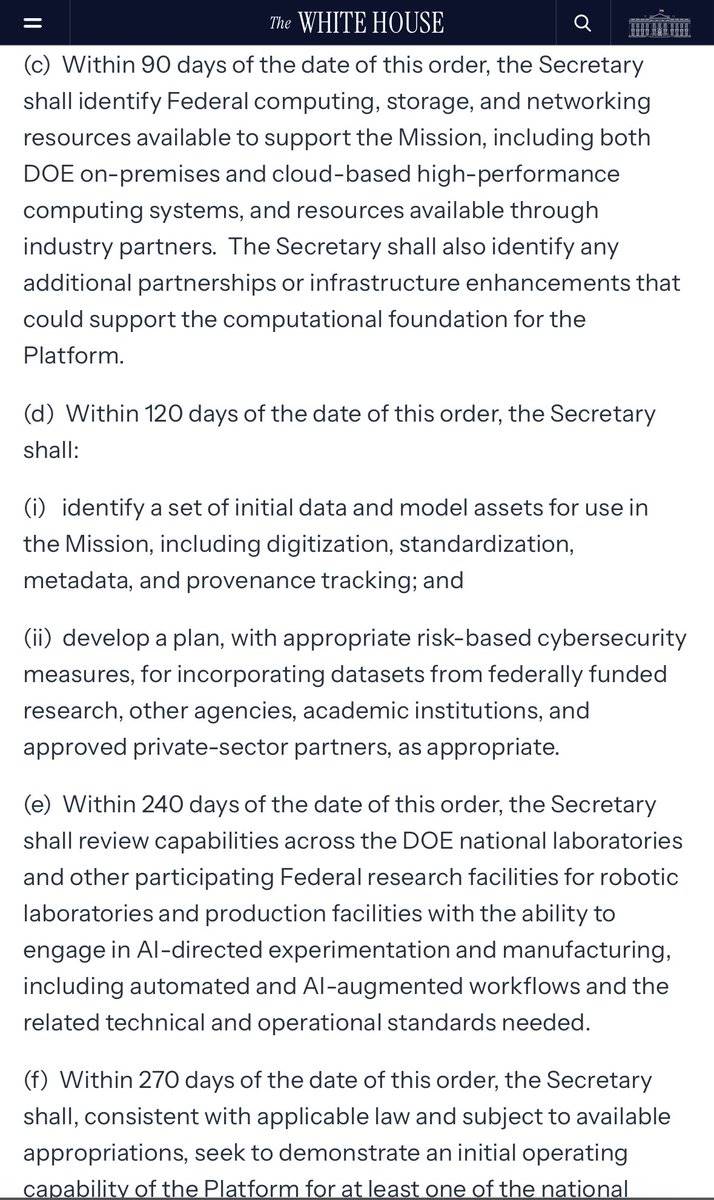
Within 60 days → Propose a list of "National Challenges"
-
Within 90 days → Complete a full inventory of federal computing, networking, and storage resources required for Mission Genesis
-
Within 120 days → Provide initial models and data assets, and develop a plan to incorporate additional datasets (including data from other government agencies, academia, and the private sector)
-
Within 240 days → Map all robotic and automated facilities across national laboratories
-
Within 270 days → Demonstrate initial operational capability in at least one National Challenge
Goal: Deploy a complete AI-powered scientific cycle within nine months.
Building a Federal AI Technology Stack Parallel to Commercial AI
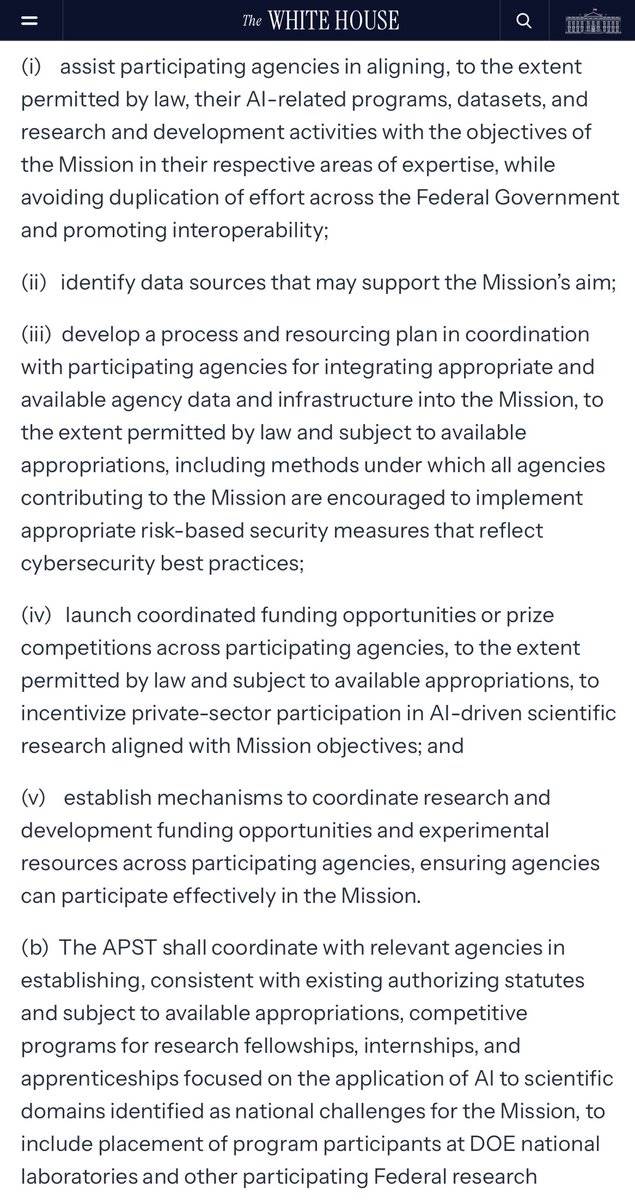
The executive order explicitly directs the Department of Energy (DOE) and the White House Office of Science and Technology Policy to:
-
Integrate AI projects and datasets from various agencies into this platform
-
Launch joint funding programs and incentive initiatives
-
Establish collaboration frameworks with external partners (including co-development agreements, shared user facilities, data/model sharing, and intellectual property rules)
Nvidia, OpenAI, Anthropic, xAI, Google, cloud service providers, biotech firms, and chip companies are expected to become potential suppliers and co-developers of the DOE AI system.
Mission Genesis Marks a Definitive Shift
To date, cutting-edge AI development has been primarily driven by private labs. With the launch of Mission Genesis, the United States is now clearly building a state-led AI backbone network dedicated to science, energy, and national security:
-
The Department of Energy (DOE) will coordinate the creation of a national "AI Science Platform"
-
National laboratories and supercomputers will become integral components of a unified AI technology stack
-
Models, AI agents, and robotic labs are treated as strategic infrastructure—not just tools
The key questions now are: Who will supply the computing power and models? How will intellectual property and data be shared? And how quickly will other nations respond with their own versions of Mission Genesis?
Join TechFlow official community to stay tuned
Telegram:https://t.me/TechFlowDaily
X (Twitter):https://x.com/TechFlowPost
X (Twitter) EN:https://x.com/BlockFlow_News
 @AskPerplexity