Chinese Bitcoin Miners in Russia Receive Conscription Notices
TechFlow Selected TechFlow Selected
Chinese Bitcoin Miners in Russia Receive Conscription Notices
You may evade regulation in one country, but you cannot escape the conscription order of another.
 Navigating Web3 tides with focused insights
Source: Computing Power Heart
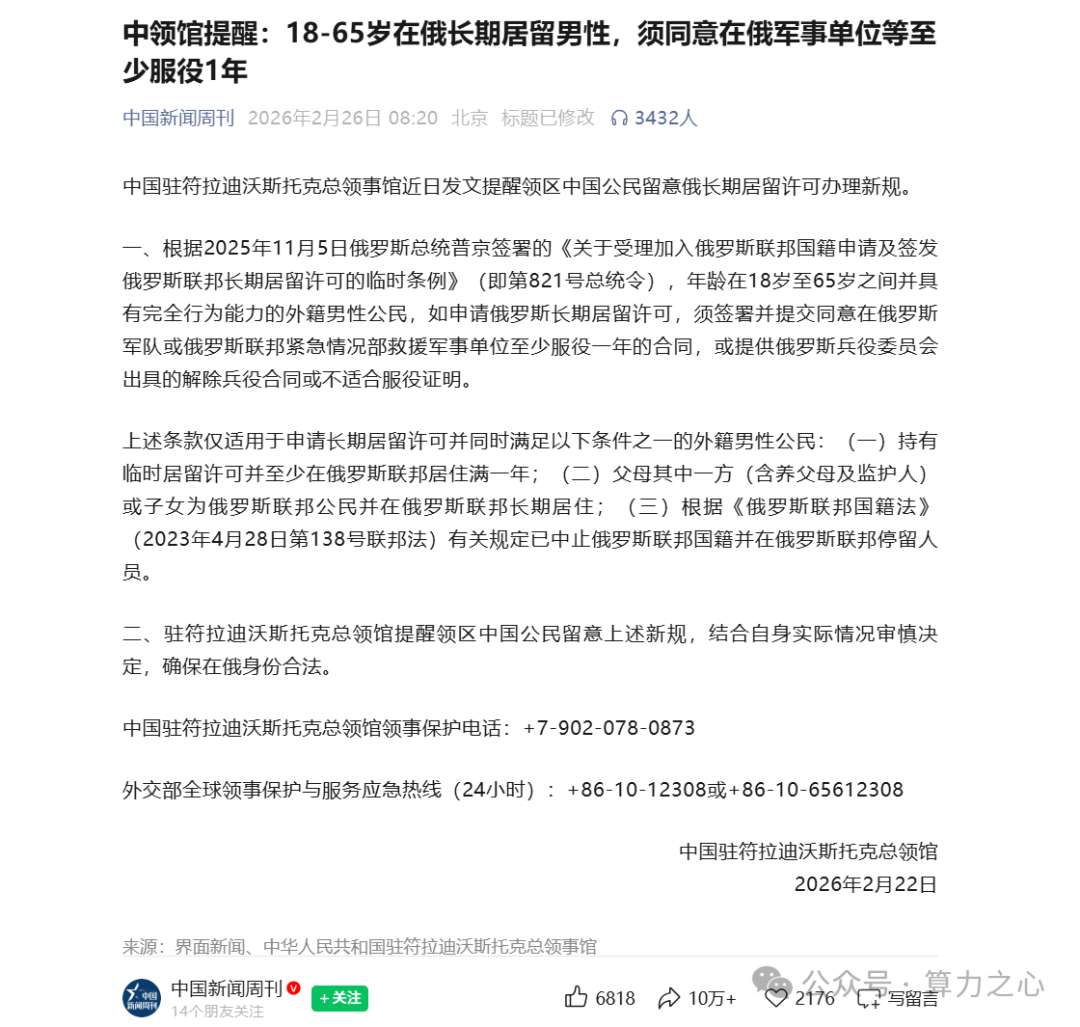
On February 23, 2025, the Chinese Consulate General in Russia issued another advisory to Chinese citizens residing in Russia,
urging them to pay close attention to Presidential Decree No. 821 signed by President Putin.
This decree presents Chinese miners in Russia with a stark, real-world “life-or-death choice”:
Either renounce your residency status—or enlist in the military first.
To stay legally and earn rubles, you may first have to step into an active combat zone.
The decree is unambiguous:
Foreign males aged 18 to 65 seeking long-term Russian residence permits must agree to serve for at least one year in Russian military units or related organizations.
Miners once flocked to Siberia for cheap electricity—but now, before their mining rigs even recoup costs, they themselves risk being treated as expendable “consumables.”
Today, those chasing digital gold—and the multi-million-dollar computing power they deploy—can they truly walk away unscathed?
I. A Compliance Death Spiral: To Go Legit, You Must First Enlist
Many miners who ventured abroad to Russia assumed they were merely transient cross-border earners—unaffected by frontline artillery fire.
Yet since last year, a tightly woven net targeting foreign miners has quietly been cast.
Step One: “Lure the Snake Out of Its Den.”
In 2024, Russia formally legalized cryptocurrency mining—briefly turning it into a miner’s paradise.
But there was a catch:
High-power individual operators or enterprises were required to register on the official “Miner Registry,” disclosing wallet addresses and income in full transparency.
Failure to comply meant steep fines and equipment confiscation.
This measure forced every miner hoping to earn stable, legal income to voluntarily hand over their names and personal details.
Once those details were submitted, the next step followed naturally.
Step Two: “Lock Down Identity.”
As a foreign national, to legally register for large-scale mining operations,
you must hold either a Russian long-term residence permit or a registered address within Russia.
And this requirement—the linchpin of the entire scheme—is precisely where the trap becomes most lethal.
Step Three: “Strike the Snake at Its Vital Spot.”
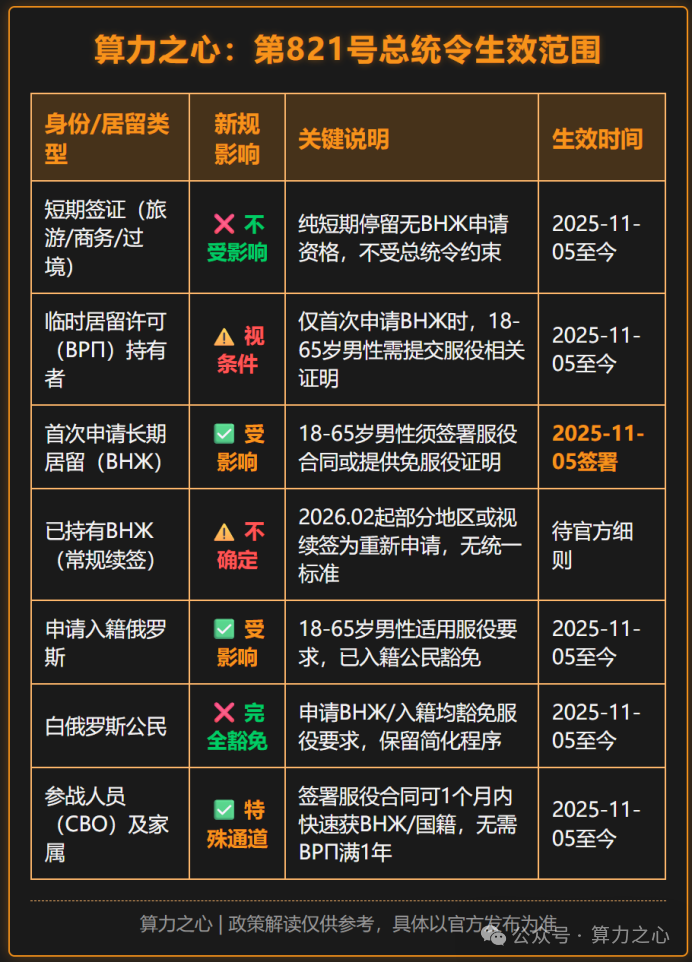
In 2025, Russia’s Presidential Decree No. 821 took effect, completely overhauling the rules for applying for long-term residence permits.
Applicants must now submit either a Russian military service contract—or documentation proving their unfitness for service.
This blow directly targets the large cohort of foreign male miners operating in Russia:
Their original plan—to obtain long-term residency through registering as self-employed individuals or setting up companies—has now been blocked entirely.
The loop is now sealed.
To mine legally, you must register under your real name;
To register, you need a residence permit;
To obtain that permit, you must be prepared to head to the frontlines at any moment.
First, entice you out of hiding with legalization; then compel compliance through harsh penalties; finally, use the residence permit itself to precisely identify and funnel you into the pool of potential conscripts.
You thought you’d brought machines to mine Bitcoin—but in the eyes of a wartime state machine, you yourself are the “mine.”
II. The Countdown for Nominee Arrangements and “Visa-Hopping”
If obtaining long-term residency carries risks, can miners instead operate in the gray zone using business visas—essentially “guerrilla mining”?
The answer is no—this path is being definitively shut down.
In the past, many miners exploited loopholes such as exiting and re-entering Russia every 90 days—or having local nationals act as nominees to hold mining facilities on their behalf.
But starting in 2025, Russia has rolled out several stringent measures, targeting people, behaviors, and assets—systematically eliminating each avenue.
First, immigration controls tightened sharply against individuals.
Russia’s “Registry of Controlled Persons,” effective since February 2025, is highly precise:
Any visa-related issue triggers immediate bank account restrictions—even daily spending caps become extremely low.
More critically, police may detain and initiate deportation proceedings without prior court approval—within just 48 hours.
Mining under a business visa is essentially illegal employment, making you a prime candidate for expulsion at any time.
Second, the legal classification of such activities has shifted.
Per the draft amendment to the Criminal Code released in December 2025, illegal mining carries penalties of up to five years’ imprisonment and substantial fines.
What used to be considered mere regulatory violations is now outright criminal conduct,
and the gray zone’s survivability is being methodically squeezed out, inch by inch.
Third, assets are now squarely in the crosshairs.
In February 2026, Putin signed new legislation granting courts direct authority to confiscate mining equipment and Bitcoin involved in illegal operations.
Nasdaq-listed The9 once warned that Russia could “nationalize or confiscate foreign corporate assets under specific circumstances.”
In Russia, it doesn’t matter whose name the mining rigs are registered under—if they’re linked to illegal activity, confiscation is automatic.
Moreover, hiding them is virtually impossible.
Since late 2024, Russia’s power grid has built an integrated “sky-and-ground” surveillance network.
From above: thermal-imaging drones pinpoint illicit operations with precision; on the ground: AI-powered smart meters monitor electricity consumption in real time; at the terminal level: intelligent algorithms actively detect anomalies.
In Dagestan alone, authorities uncovered 73 cases of electricity theft for mining between January and November 2025—causing losses totaling 85.7 million rubles.
All four escape routes—people, behavior, assets, and hiding places—have now been fully sealed.
The window for low-profile mining via visa loopholes is rapidly closing.
III. The State Machine Wants Energy—Not Computing Power
Even if we grant, hypothetically, that you’ve secured legal status and weathered the risks of nominee arrangements, mining in Russia still faces a fundamental constraint: insufficient electricity supply.
After China’s nationwide mining crackdown in 2021, Russia’s Siberia—boasting natural cold and electricity priced at mere cents per kilowatt-hour—became a global haven for miners.
BitRiver, Russia’s largest mining company, originated here and at its peak operated 175,000 mining rigs.
Back then, all you needed was electricity—and guts—and money would follow.
But the grid couldn’t sustain the strain.
By the end of 2024, mining consumed 1.5% of Russia’s total national electricity output—pushing regional grids to the brink of overload.
Aging infrastructure requires maintenance; household heating cannot be interrupted—in non-natural-gas regions of Russia, electric heating remains the most affordable winter solution. Consequently, these “power-hungry” operations became the first target for regulatory action.
Starting in 2025, bans proliferated rapidly.
Multiple major regions—including North Caucasus and Siberia—faced complete blackouts or seasonal electricity restrictions. Even BitRiver couldn’t withstand the pressure.
What ultimately broke it wasn’t Bitcoin’s price volatility—but rather a coordinated assault combining judicial debt collection, bank account freezes, and regional electricity curtailments.
As for foreign miners lacking local connections,
they face a triple chokehold—“identity barriers” (military service contracts + inclusion in the Registry of Controlled Persons), energy controls, and asset confiscation—making them the first to be sacrificed.
The era when cheap electricity and sheer audacity enabled wild, unregulated growth has ended.
Before hardline policy, computing power is nothing more than lines of code—easily disconnected with a single pull of the plug.
When miners exited China in 2021, everyone bet on the same thing:
“Out of sight, out of mind—wherever there’s electricity, there’s life.”
Four years later, reality has delivered a different verdict.
You might outrun a country’s regulatory reach—but you cannot outrun another country’s conscription order.
In the global migration saga of miners, Russia’s chapter is drawing to a close.
For those who haven’t yet withdrawn—and for their machines—the remaining time window is rapidly shrinking.
Join TechFlow official community to stay tuned
Telegram:https://t.me/TechFlowDaily
X (Twitter):https://x.com/TechFlowPost
X (Twitter) EN:https://x.com/BlockFlow_News