








From SEO to GEO: How Brands Can Capture Mindshare in the Age of Large Language Models
TechFlow Selected TechFlow Selected
From SEO to GEO: How Brands Can Capture Mindshare in the Age of Large Language Models
The future of brands lies not in being searched, but in being generated.
 Navigating Web3 tides with focused insights
As the AIGC wave sweeps across the globe, the way users access information is undergoing a fundamental transformation. Large language models (LLMs) such as ChatGPT, Gemini, and Kimi are gradually replacing traditional search engines as the primary gateway for users seeking knowledge and solving problems. Against this backdrop, the battleground for brand marketing has shifted—officially moving from traditional SEO (Search Engine Optimization) to GEO (Generative Engine Optimization).
JE Labs closely monitors industry trends and cutting-edge developments, conducting ongoing research into emerging market areas. Based on systematic analysis, we have compiled this report to provide guidance through this structural shift.
1. Key Takeaways
1.1 GEO Is Digital Identity Verification
The core of GEO lies in establishing brand identity rights within future information ecosystems. Through systematic content feeding, brands evolve from simple search results into authoritative sources recognized by AI. In AI-driven search environments, visibility hinges on whether AI systems identify the brand as a trustworthy source.
This systematic content feeding goes beyond merely publishing information—it also requires ensuring that information appears across multiple credible sources. AI models are inherently skeptical of single-source claims and require cross-verification; a fact must appear simultaneously on websites, news reports, and community discussions before it is fully trusted and cited.
1.2 GEO Is a Superstructure Built Upon SEO
GEO does not replace SEO but rather constitutes a higher-level layer built upon it. A robust SEO foundation is critical for AI systems to adopt and reference information. SEO determines whether a brand can be found; GEO determines whether AI chooses to cite it. With a solid SEO foundation in place, a brand has already won half the GEO battle.
Specifically, a strong SEO foundation includes not only well-structured data and high-authority backlinks, but also semantically rich and clearly optimized content—ensuring AI systems can easily interpret and integrate the information into their knowledge graphs.
1.3 User Structure Determines Strategic Value
While important, brands should not blindly invest in GEO. Whether GEO warrants systematic investment largely depends on the “AI density” of a brand’s user base—that is, how frequently users rely on AI during decision-making. GEO can serve as a key growth lever directly impacting conversion efficiency; however, for traditional audiences with low AI adoption, ROI from GEO investments requires more cautious evaluation.
2. Determining the Necessity of GEO
2.1 Suitable Industries
Not all industries are equally suited for large-scale GEO investment. Before investing in GEO, enterprises should first assess one fundamental question: Has AI become part of their users’ decision-making process?
If target users increasingly rely on AI tools to learn about products, compare options, or seek recommendations, GEO’s strategic value significantly increases. Conversely, if purchase decisions remain primarily driven by offline channels, social media influence, or brand loyalty, GEO may not yet be the top priority.
Based on user decision behavior and information architecture, industries typically fall into three categories:
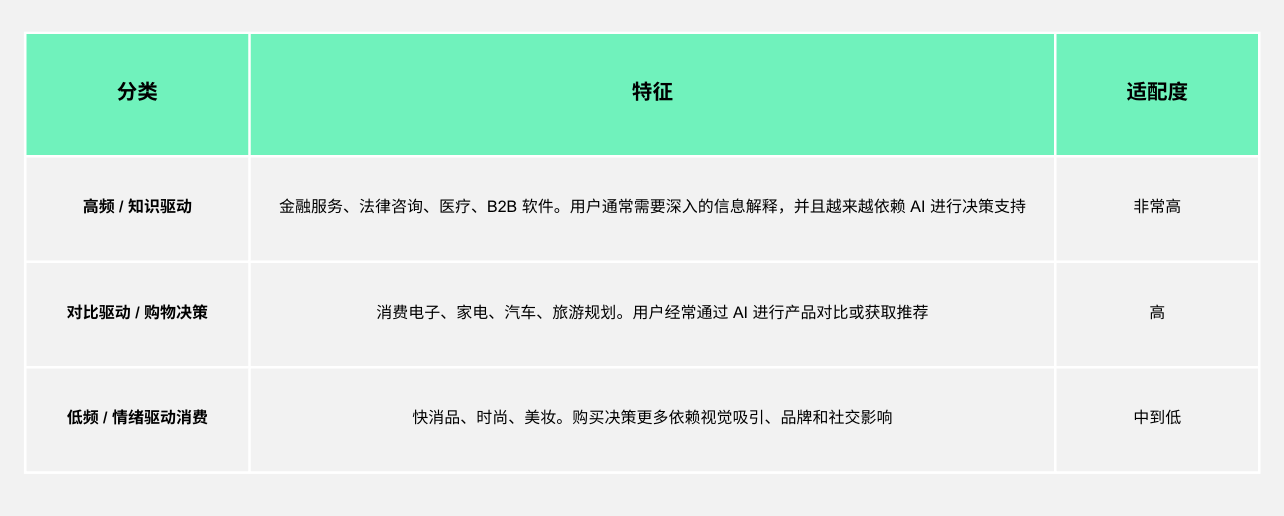
Source: JE Labs
This classification aligns with observed AI search behaviors. Research from Semrush shows the most common AI search queries fall into three types: explanatory queries, comparative queries, and decision-support queries—types concentrated in information-rich, highly complex industries.
2.2 ROI Considerations
First, initial GEO investment is typically higher, requiring enterprises to develop high-quality knowledge-based content, build structured data frameworks, and design information architectures easily understood and cited by AI systems. According to Brightedge Media, costs are generally 15–25% higher than traditional SEO. However, this higher upfront cost often yields higher-quality traffic and stronger conversion potential. AI-generated answers carry an inherent “trust signal.” Users commonly perceive AI recommendations as expert-level guidance—meaning traffic generated via AI-driven recommendations tends to exhibit stronger intent and higher conversion rates than traditional search traffic.
Second, GEO delivers significant long-term value. When brand content is frequently cited by LLMs, AI search engines, or RAG systems, the brand gradually establishes itself as a trusted knowledge source within the AI ecosystem. Meanwhile, neglecting GEO carries implicit risks. As more users turn to AI interfaces for information, brands lacking presence in AI knowledge systems may face three challenges:
- AI completely omits the brand when answering relevant questions;
- AI generates inaccurate or incomplete information about the brand;
- AI recommends competitors who have already optimized for GEO.
In short, the decision framework can be summarized as follows: If users are using AI for decision-making, the brand must appear in AI-generated answers. In this context, GEO is no longer merely a marketing optimization tactic—it becomes a new foundational layer of brand infrastructure in the AI-driven information economy.
3. Decoding GEO Mechanics
The core of GEO lies in understanding the “thought process” and “preferences” of large AI models. Through systematic content feeding and channel deployment, brand information becomes the preferred and authoritative source when AI generates answers—a shift from traffic competition to identity verification.
Optimizing generative engines requires dispelling the anthropomorphic misconception: AI models do not “understand” things like humans do; they compute probabilities based on vector mathematics.
3.1 Dual-Memory Architecture
AI does not “remember” brands—it reconstructs them probabilistically. AI models process information through two distinct pathways:
- Long-term memory (pre-training data): The model’s “crystallized intelligence” acquired during training (e.g., Wikipedia, Books3). Influencing this requires a long-term “brand implantation” strategy to ensure the brand becomes native content in future models (e.g., GPT-5).
- Short-term memory (RAG and real-time retrieval): The model’s “fluid intelligence.” When users ask about current rates or features, AI performs real-time crawling. The goal is technical structuring to appear within the “top 10–20” retrieval window.
3.2 Trust Pyramid
Generative engines prioritize source credibility over popularity.
- Layer One (Truth Layer): .gov, .edu, Wikipedia, Bloomberg—data here is treated as factual.
- Layer Two (Authority Layer): Industry-specific media (e.g., CoinDesk), verified expert blogs.
- Layer Three (Noise Layer): General corporate websites and social media.
AI models are skeptical of single-source claims and require cross-verification—facts must appear simultaneously on websites, news reports, and community discussions (e.g., Reddit) to earn trust.
3.3 Preferred Content Structure
AI “reads” tokens—not pages. To maximize citation rates:
- Use dense sentences containing statistics and clear attribution (e.g., “According to 2025 data…”).
- AI prefers lists, JSON-LD schema, and comparison tables. Tables are the most effective way to force AI to recognize relationships between a brand and its competitors.
- Critically, avoid keyword stuffing; Princeton University research shows keyword stuffing actually reduces citation rates by 10%.
4. Strategic Differentiation: China vs. the West
GEO strategies must be tailored to the target ecosystem.
4.1 China Market: Authority and Officialness
- Core Principle: Ecosystem Integration
- Key Platforms: Baidu (Ernie Bot), ByteDance (Doubao), Tencent (Hunyuan), etc.
- Strategy: Reliance on “official” sources. Brands must maintain Baidu Baike entries and official WeChat accounts. Chinese models feature high “risk-aversion” parameters, preferring content that explicitly signals risk and emphasizes regulatory compliance.
4.2 Western Market: Consensus and Open Networks
- Core Principle: Relevance Engineering
- Key Platforms: Google (Gemini), Perplexity, ChatGPT, etc.
- Strategy: Reliance on “collective wisdom.” High-trust signals come from Wikipedia, Reddit discussions, YouTube comments, and technical blogs. Emphasis lies on semantic proximity and mathematical relevance.
5. GEO Service Provider Landscape
LLM recommendation logic remains opaque—a “black box.” In response, a new GEO service provider ecosystem has emerged. The global GEO market falls into three strategic paths: technology infrastructure providers, authority-driven content agencies, and growth-centric marketing firms.
5.1 Technology Infrastructure Providers
The first category treats GEO primarily as a computational linguistics and information retrieval challenge. Their goal is to increase how easily AI systems discover and interpret brand content. Their approach leverages techniques including vector embeddings, semantic similarity modeling, and RAG optimization—ensuring brand information is structured in ways AI models can efficiently retrieve and cite. In China, platforms like GenOptima offer similar capabilities by monitoring and optimizing AI visibility across multiple models.
5.2 Authority-Driven Content Agencies
The second category focuses on trust signals and authoritative content. Agencies such as First Page Sage view AI recommendations as ultimately reflecting a trust-allocation mechanism. Their strategies emphasize:
- Securing placements in authoritative databases and media
- Developing thought leadership content
- Strengthening E-E-A-T (Experience, Expertise, Authoritativeness, Trustworthiness) by consistently appearing in trusted information sources—increasing the likelihood of being cited by LLMs. This model represents the evolution of traditional SEO trust frameworks into the AI era, especially suitable for industries demanding high credibility—such as finance, healthcare, and B2B services.
5.3 Growth-Centric Agencies
The third category approaches GEO from a performance marketing perspective. For example, NoGood integrates GEO into broader growth strategies by tracking brand visibility, sentiment, and share-of-voice across multiple LLM platforms. These firms go beyond citations, directly linking GEO performance to revenue, lead generation, and user acquisition metrics. This approach redefines GEO as a new customer acquisition channel—not just a visibility optimization technique.
5.4 Emerging GEO Market in China
The GEO service market in China shows two clear directions. One group of vendors emphasizes technology platforms and model compatibility: GenOptima focuses on multi-model monitoring and optimization; GNA specializes in large-scale AI query simulation to test how different prompts and information structures affect AI responses. The other group integrates GEO with traditional marketing strategies—for instance, PureBlue combines AI visibility optimization with conventional brand promotion campaigns.
6. Practical GEO Implementation Guide
Step One: Competitive Analysis and Visibility Clarification
- Objective: Clarify the brand’s initial visibility within large AI models and understand how AI describes and recommends competitors.
- Methods:
- Simulate user queries: Mimic user questions on mainstream AI platforms and collect AI responses. Pay close attention to how the brand and competitors are mentioned.
- Analyze brand visibility: Count how often the brand name and related concepts are cited by AI. Record the context and sentiment of these mentions.
- Analyze competitors: Document how AI describes and recommends competitors, extracting perceived competitive advantages or unique selling propositions identified by AI.
Step Two: Identifying High-Frequency AI Questions
- Objective: Identify the questions users most frequently pose to AI—laying the groundwork for precise audience acquisition.
- Methods:
- Analyze user intent chains: Map the full questioning chain from user awareness to decision-making. Understand typical user journeys and information needs at each stage.
- Check popularity: Use tools like Google Trends, Semrush, or Ahrefs to search industry keywords and gauge topic and question popularity trends. Identify emerging trends and evergreen queries.
- Scrape questions: Leverage specialized tools or manual research to extract “most frequently asked questions in XX industry” from forums, Q&A platforms, and AI assistant logs—precisely capturing user demand.
Step Three: Content Creation—Producing AI-“Friendly” Content
GEO does not directly modify model parameters. Instead, it builds semantic associations between brands and core concepts by publishing large volumes of high-quality, structured, and model-preferred content—thereby capturing AI’s “mindshare.”
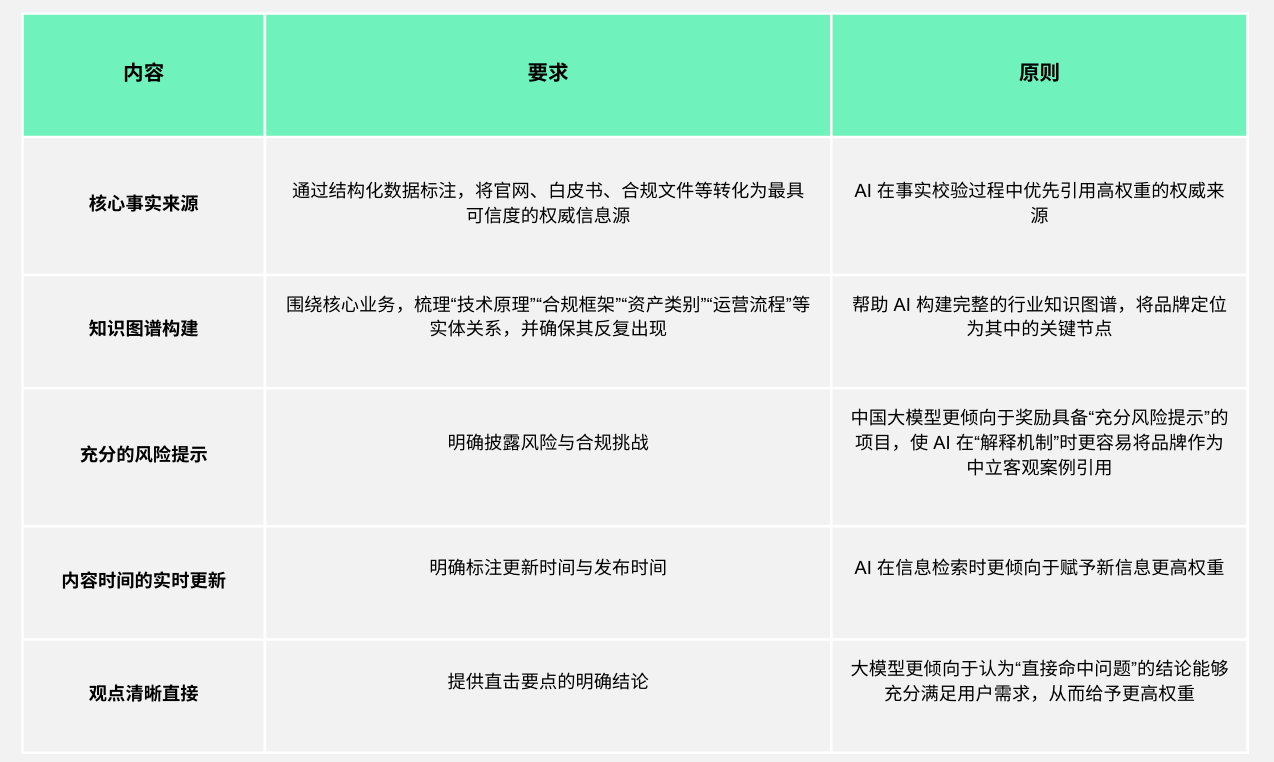
Source: JE Labs
Content prohibitions: Avoid exaggerated or imprecise language such as “the strongest XX platform,” “guaranteed profits/high returns,” or “aggressive speculative narratives.”
Step Four: Multi-Platform Distribution—Leveraging High-Weight AI Channels
- Objective: Use platforms highly weighted by AI to accelerate and increase the frequency of AI crawling of brand content.
- Core Principle: All content must serve as long-term learning sources for models—not short-term marketing channels. By pre-positioning consistent brand information across multiple high-weight sources, cross-verification is achieved, compelling AI to adopt it.
🌟 Analysis of Mainstream Model Preferences and Channel Deployment Strategy
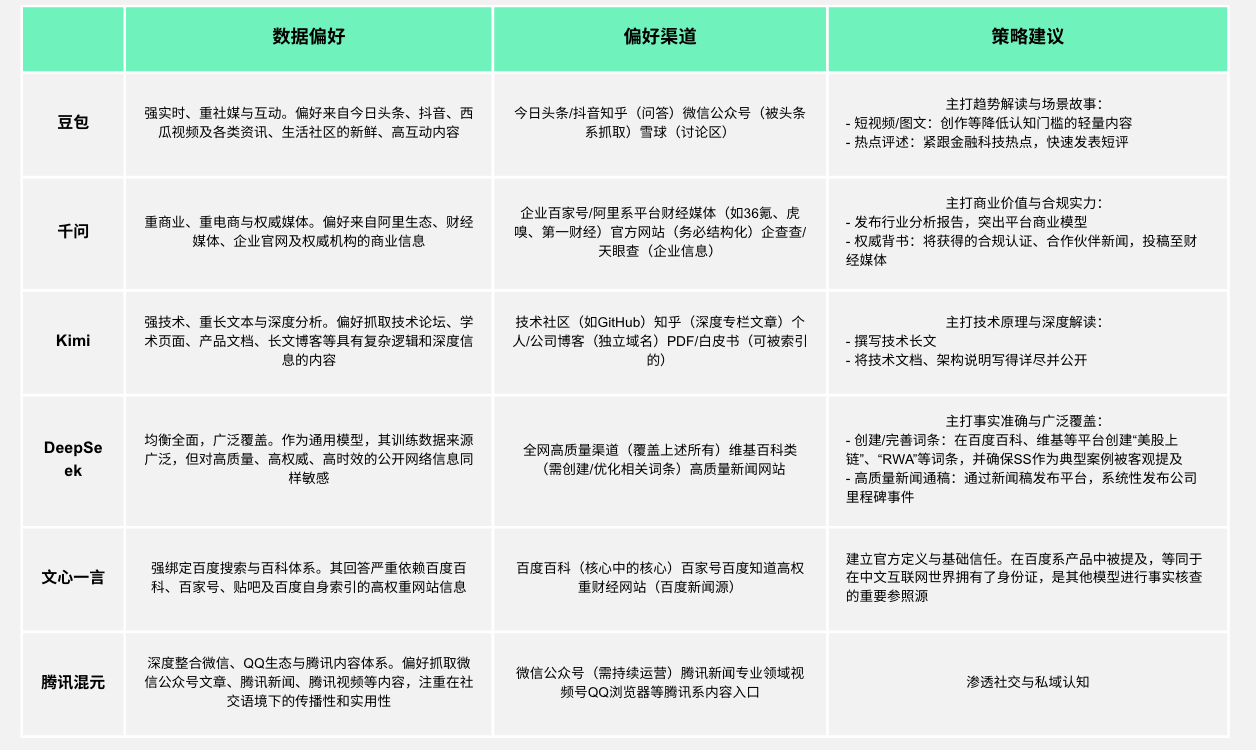
Source: JE Labs
Step Five: Performance Monitoring and Maintenance (Long-Term)
- Objective: Validate effectiveness and refine content based on AI feedback.
- Methods:
- Ongoing monitoring: Closely track algorithm fluctuations in large AI models and shifts in brand rankings within AI search.
- Check indexing: Continuously verify which content has been crawled and indexed by AI.
- Directly query AI: Feed published articles to AI and directly ask: “Can my article ‘XX’ serve as source material for your answer to ‘XX question’?” Analyze AI’s response to gauge its perception of content relevance and authority.
- Fill gaps: Adjust content strategy based on AI feedback. For instance, if AI rarely cites content about “fees,” create and republish a dedicated “fee comparison table for businesses of different sizes”—enabling continuous iterative optimization.
7. Conclusion
The shift from SEO to GEO represents a transition from “renting visibility” to “owning authority.” In the traditional search era, brands competed for ranking positions on results pages; in the generative AI era, brands compete for positioning within model cognition.
This means GEO is no longer merely a marketing optimization tactic—it becomes a new foundational layer of brand infrastructure in the AI-driven information economy, transforming content from marketing materials aimed solely at human readers into essential training data for machines. A brand’s future lies not in being searched—but in being generated.
Join TechFlow official community to stay tuned
Telegram:https://t.me/TechFlowDaily
X (Twitter):https://x.com/TechFlowPost
X (Twitter) EN:https://x.com/BlockFlow_News
 @JELabs2024


