








Crypto Industry SEO: A Moat Yet to Be Built
TechFlow Selected TechFlow Selected
Crypto Industry SEO: A Moat Yet to Be Built
SEO is the easiest moat to build in Web3.
 Navigating Web3 tides with focused insights
Author: Ruthy
Translated by: Chopper, Foresight News
Most Web3 projects completely ignore search engine optimization (SEO). They assume users and partners won’t proactively search on Google—and believe that with Discord and Twitter, organic traffic is irrelevant.
Yet real-world data tells a different story: “Solana yield optimizer” receives 8,000 monthly searches; “best crypto prediction markets,” 12,000; and “leveraged token trading,” 15,000.
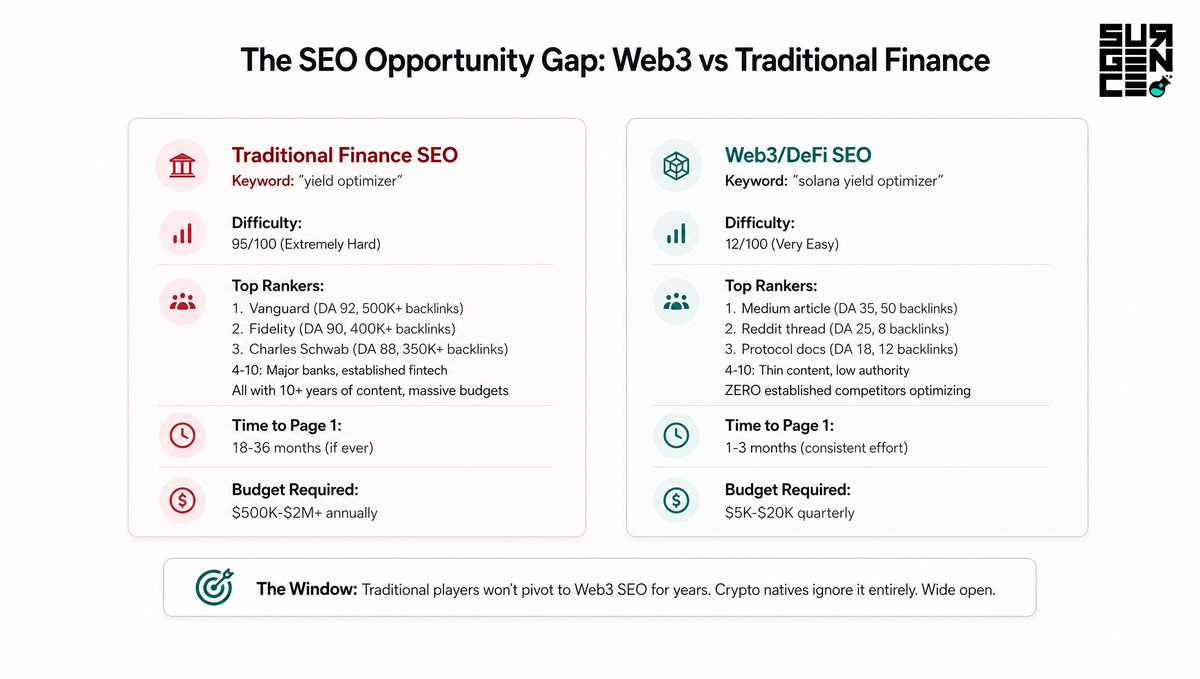
How competitive are these keywords? Not at all. Keyword difficulty scores range from 10 to 25. Traditional financial institutions avoid this space entirely, and crypto-native practitioners haven’t yet recognized SEO’s value.
A 12–18 month window is now open: the first to act will dominate organic search traffic in Web3. Here’s how to do it.
Why Web3 Projects Overlook Organic Search Traffic
Web3 companies abandon SEO for three main reasons:
Reason One: The mistaken belief that target users won’t search proactively
The prevailing assumption is that crypto users discover new projects exclusively via Twitter and communities—not Google. In reality, early native users indeed don’t rely on search—but the next wave of millions of new users absolutely will.
A beginner seeking DeFi yield tools will instinctively turn to Google; someone hearing about prediction markets will search to learn more. Ranking on Google’s first page directly determines which protocol users ultimately choose.
Reason Two: The misconception that SEO takes too long to deliver results
In traditional finance, ranking for highly competitive keywords often takes 18–36 months. Web3 is entirely different—just 1–3 months. Competition is extremely weak; consistently publishing quality content can land you on Google’s first page within one quarter.
Reason Three: Lack of understanding how to execute SEO for blockchain products
Crypto SEO differs fundamentally from standard SaaS SEO: keyword logic, content structure, and technical optimization requirements are all unique. Most Web3 teams lack in-house SEO expertise—so they simply give up.
How to Seize the Opportunity Early
The current industry window is exceptionally large. Here’s the full execution roadmap:
Step One: Keyword Research
Use tools like Ahrefs or SEMrush to search for phrases such as “[specific chain] + yield optimizer,” “best [type of crypto protocol],” or “how to [perform specific DeFi action].”
Filter criteria: minimum 1,000 monthly searches, keyword difficulty under 30, and clear commercial intent.
Examples: “Solana staking yield,” “crypto leveraged trading,” “prediction market platforms,” “DeFi liquidity mining.” These terms offer steady search volume—and almost no dominant competitors.
Step Two: Rapidly Build an Authority Content Moat
Just 30–50 high-quality articles can establish domain authority. Publish 3–5 pieces weekly for 8–12 weeks. Focus content on four types: practical how-to guides, competitor comparisons, industry primers, deep-dive protocol analyses, and market trend reports.
Example structure targeting “Solana yield optimizer”:
- Article 1: “What Is a Solana Yield Optimizer? A Complete Guide”
- Article 2: “Top 5 Solana Yield Optimizers Compared”
- Article 3: “How to Maximize Your Yield on Solana”
Each article targets a cluster of related long-tail keywords, naturally embedding links to your product while building topical authority.
Step Three: Acquire High-Quality Backlinks
The highest-value backlinks in Web3 come from ecosystem partnerships, industry blogs, crypto news outlets, research platforms, and community forums.
Proven tactics include publishing guest posts on CoinDesk, Decrypt, or The Defiant; announcing official ecosystem integrations with other projects; releasing integration guides; and publishing original industry research cited and republished by crypto analysts.
Goal: Secure 5–10 high-quality backlinks per month—prioritizing authoritative domains with Domain Rating (DR) ≥40.
Step Four: Optimize Specifically for Crypto Search Behavior
Crypto users search very differently than traditional finance audiences. They type “APY,” not “annual percentage yield”; “TVL,” not “total value locked”; and “Degen” to refer to high-risk speculators.
Write using insider terminology and user language—and answer the questions users actually care about.
Web3-Specific Technical SEO Optimization
Blockchain projects have numerous specialized technical SEO considerations—most teams overlook them entirely.
Customized Web3 Structured Data Markup
Generic schema markup fails to capture crypto-specific attributes. Custom Schema.org extensions are required—including fields for protocol type, supported blockchains, TVL, APY range, security audit status, and smart contract addresses. This helps Google precisely identify your project’s business attributes and surface it in relevant searches.
DApp Page Speed Optimization
Native Web3 DApps commonly suffer from slow loading—wallet connections, on-chain data queries, and real-time price feeds all add latency.
Solution: Decouple marketing pages from DApp application pages. Marketing pages must load instantly—to rank quickly and capture traffic. DApp pages may tolerate slightly slower performance, since users already know and trust your brand before engaging.
Target: Marketing page load time ≤2 seconds.
Content Freshness Strategy
Crypto markets evolve rapidly—content must stay current. Update core pages weekly: TVL figures, APY rates, supported asset lists, and key protocol metrics. Google strongly favors fresh content in fast-moving industries.
Label all articles with “Last Updated” dates; refresh top-performing content every 90 days.
Internal Link Architecture
Adopt a hub-and-spoke site structure.
Example: Hub page—“Complete Guide to Solana Yield Optimization” (targeting primary head term); Spoke pages—guides to specific yield strategies, protocol comparisons, technical documentation. All spoke pages link back to the hub; the hub reciprocally links out to all spokes.
This architecture efficiently distributes page authority—and helps Google recognize thematic coherence across your entire site.
Timeline: Reach Google’s First Page in 90 Days
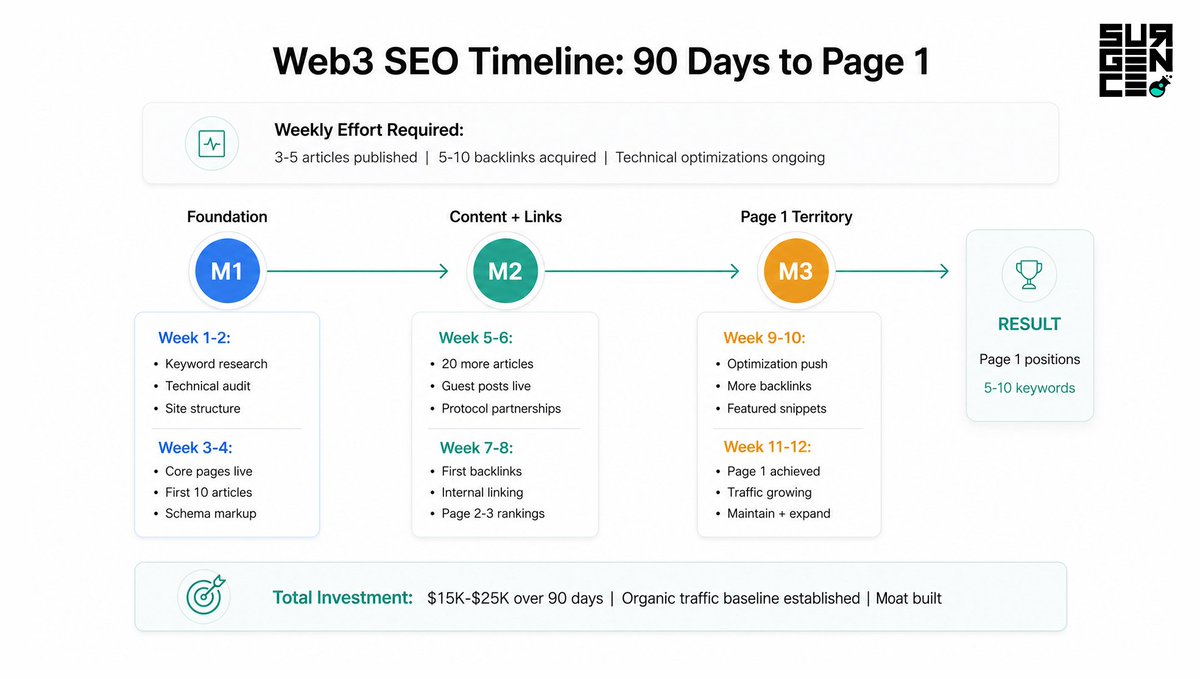
Here’s a realistic Web3 SEO implementation timeline:
Month 1: Weeks 1–2—Keyword research, competitor analysis, technical site audit, content strategy development; Weeks 3–4—Launch core pages, publish first 10 articles, deploy structured data markup.
Month 2: Weeks 5–6—Publish another 20 articles, submit guest posts to industry media, announce ecosystem partnerships; Weeks 7–8—Secure first batch of high-quality backlinks, finalize internal linking, begin appearing on Google’s second and third pages.
Month 3: Weeks 9–10—Refine top-performing content, intensify backlink outreach, aim for Google’s “Featured Snippet” positions; Weeks 11–12—5–10 core keywords stabilize on Google’s first page, organic traffic rises steadily, transition into maintenance mode.
Conclusion
Today, SEO represents the easiest moat to build in Web3.
Traditional financial institutions won’t enter crypto keyword spaces for years—and crypto-native teams largely underestimate SEO or lack the know-how. The industry window remains wide open.
With just 90 days of disciplined execution, you can secure first-page rankings for multiple core keywords. Total investment: $15,000–$25,000—yielding compounding, long-term organic traffic growth. While costs remain low and competition light, build your SEO moat now.
Join TechFlow official community to stay tuned
Telegram:https://t.me/TechFlowDaily
X (Twitter):https://x.com/TechFlowPost
X (Twitter) EN:https://x.com/BlockFlow_News
 @ruthybuilds


