








Is the NFT market experiencing a resurgence? A beginner-friendly explanation of Slonks—up 60x in just 6 days
TechFlow Selected TechFlow Selected
Is the NFT market experiencing a resurgence? A beginner-friendly explanation of Slonks—up 60x in just 6 days
An AI-generated NFT project with a mind-bending mechanism—why did it sell 586 ETH in just one week?
 Navigating Web3 tides with focused insights
Author: Kuli, TechFlow
Recently, the crypto market appears to be recovering, and some established players are rolling out innovative concepts—such as the long-dormant NFT space.
On May 1, an NFT collection named Slonks launched on Ethereum, with a mint price of less than 0.004 ETH—under RMB 70.
Six days later, its floor price stands at 0.123 ETH—a roughly 60x increase. Its 7-day trading volume on OpenSea is 586 ETH, across over 23,000 transactions. The total supply is 10,000; 1,348 have already been permanently burned, leaving 8,642 in circulation.
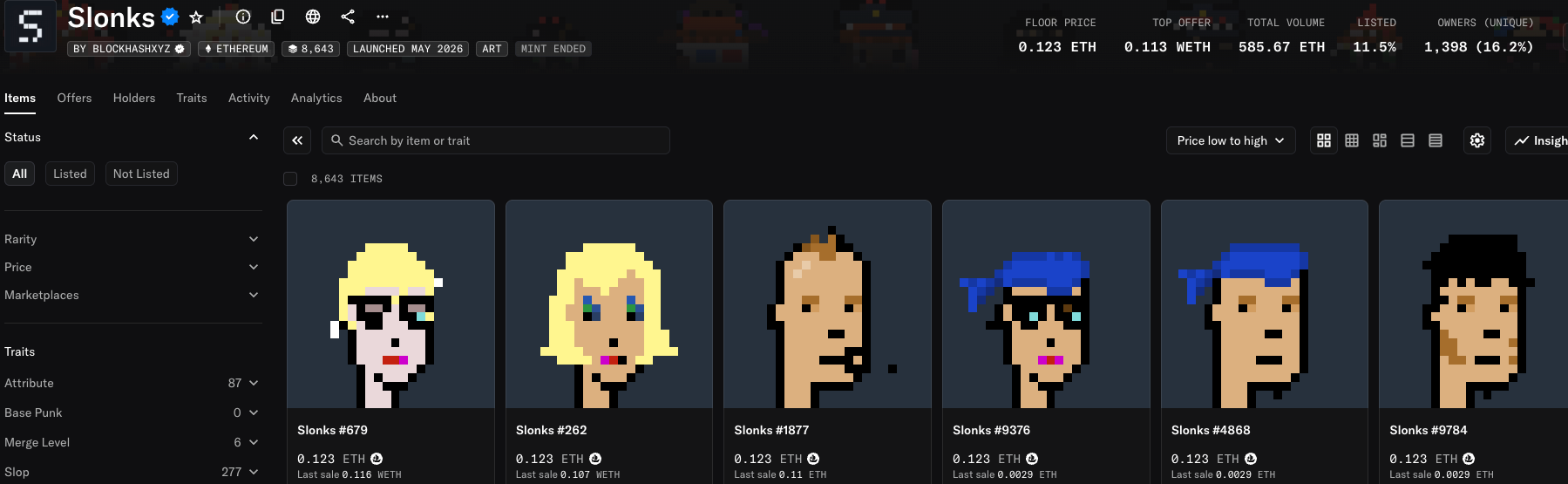
How do these numbers stack up in the 2026 NFT market? In the same week, CryptoPunks—the eight-year-old blue-chip NFT project—recorded only 20 trades. Slonks recorded over 23,000.
And tonight at 9 p.m., the project will launch its native token: $SLOP.
If you search “Slonks” on X (formerly Twitter), you’ll notice something interesting: almost everyone describes the project as “mechanically elegant” or “internally consistent,” yet when asked to explain how it actually works, most people stall after saying “images can be swapped for tokens, and tokens for images…”
Some call it GameFi, an on-chain AI art experiment, or even an evolution of CryptoPunks; others liken it to the “spirit beast fusion” mechanic from the classic Chinese MMORPG *Jade Dynasty*.
After a quick dive, I’d say all those descriptions are partially right—but none quite hit the core.
What truly makes Slonks fascinating is that it has turned a deeply counterintuitive idea into a viable business model. That idea is:
Mistakes made by AI are more valuable than its correct outputs.
Why are AI’s “wrong pixels” valuable?
One key way Slonks differs from earlier NFT projects is that its NFTs aren’t image files.
Traditional NFTs usually store a pre-rendered image off-chain (e.g., on IPFS or a centralized server), with only a URI pointing to it embedded in the smart contract. Slonks does something different: it embeds an entire AI image-generation model directly into its Ethereum smart contract—just 214 KB in size, roughly equivalent to a low-resolution smartphone wallpaper.
Every time someone views a Slonk, the contract runs the model inference on-the-fly to generate the image in real time.
No image is stored—only the ability to draw is encoded. This represents a subtle but meaningful innovation in NFT design.
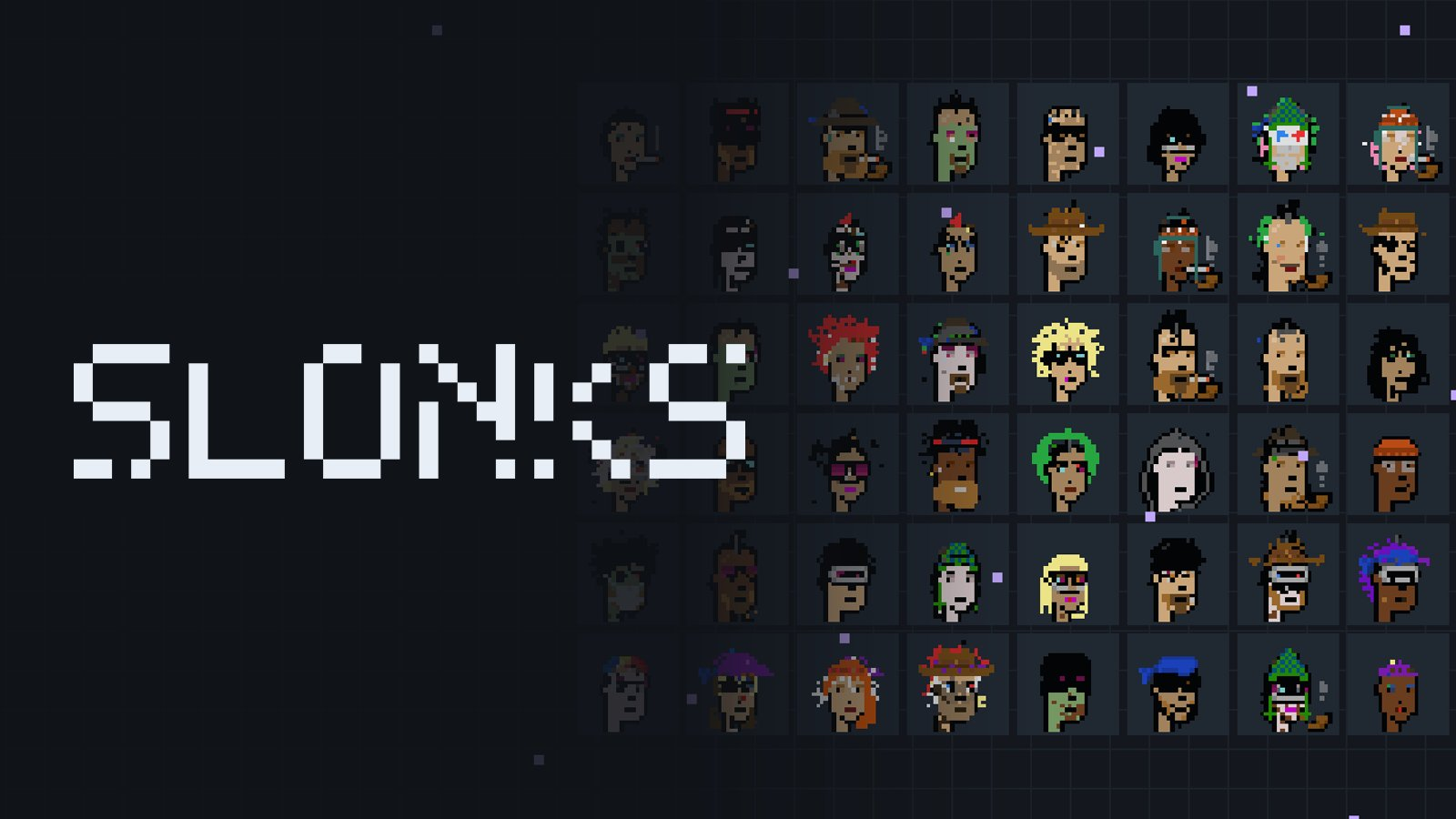
So what exactly is this model drawing?
It’s doing something akin to copying… The model’s task is to produce one replica for each of CryptoPunks’ original 10,000 images. Each CryptoPunk corresponds to one Slonk: the model looks at the original and attempts to redraw it using the same palette.
But fitting memory for 10,000 distinct faces into just 214 KB is a tall order.
Each image contains 576 pixels. On average, the model misrenders about 24 pixels per image—roughly 4% deviation from the original. Only 32 of the 10,000 images are perfectly replicated; the rest all contain varying degrees of “distortion.”
The project calls these distorted, misrendered pixels “slop.”
A perfect match yields slop = 0; a completely wrong output yields slop = 576. Project creator Hirsch captured the ethos in a single tweet:
“The slop is not a bug. It is the medium.”
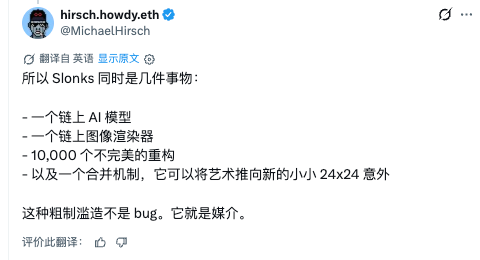
In effect, Slonks uses an AI model to re-interpret an iconic legacy NFT project—but because the AI inevitably makes mistakes, and because those mistakes differ across images, it creates new layers of scarcity and speculative value.
Hence, the entire economic model rests on this logic: the more slop, the more valuable.
Slonk holders can perform a “Merge” operation: take two Slonks of the same tier, keep one, and burn the other. The contract blends features from both images and reruns the model to generate a new one.
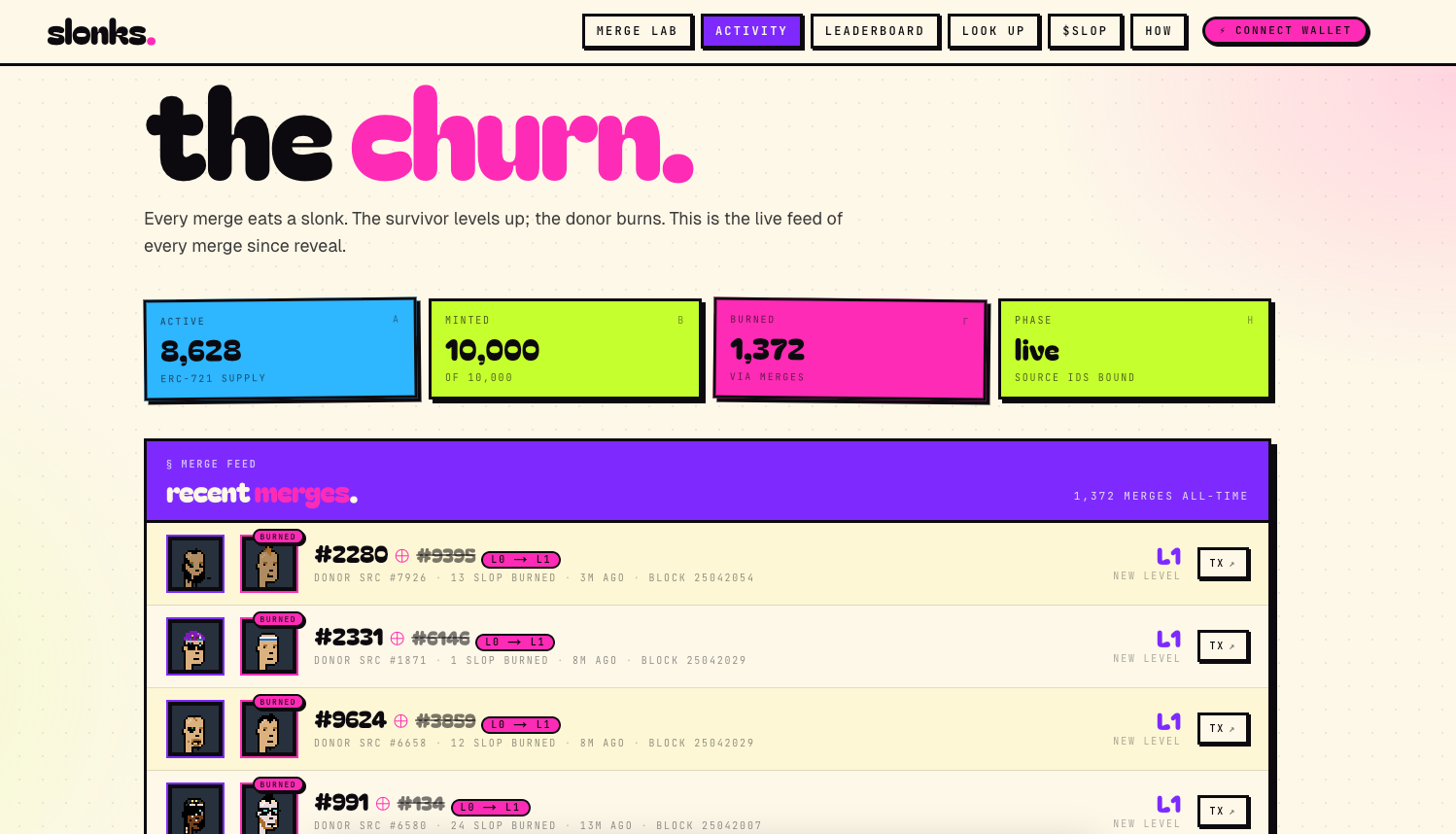
Because two distinct images are merged, the resulting output diverges even further from the original CryptoPunk—never closer.
Each Merge increases slop—and slop never decreases. Moreover, the burned Slonk is gone forever, reducing total supply by one.
This explains why, just six days after launch, over 1,300 of the 10,000 Slonks have already been burned. Players continuously merge to create higher-slop variants while simultaneously shrinking circulating supply.
At this point, Slonks already qualifies as a compelling on-chain art experiment—one that leverages AI algorithms to engineer artificial scarcity.
$SLOP: Pricing every “wrong pixel”
What transforms Slonks from an artistic experiment into a full-fledged business may well be the official token $SLOP, launching tonight.
Its purpose is simple: turn the numeric “slop count” on each image into a tradable asset.
How? Through an operation called Void (“The Void”).
Holders can “send” their Slonk into the Void—removing it from circulation—after which the contract mints an equivalent number of $SLOP tokens (1:1) and sends them to the user.
For example, if your Slonk’s slop value is 287, you receive 287 $SLOP; if it’s 450, you get 450 $SLOP.
This isn’t self-reported. The contract requires you to first generate a ZK proof verifying that the on-chain model’s rendering result for that Slonk matches your claimed slop value. Only upon successful verification is minting permitted.
In plain terms: you must first “inspect the goods”—prove your Slonk really contains that many misrendered pixels—before the contract honors the claim.
A Slonk sent into the Void isn’t destroyed—it remains stored within the contract. This leads to the second operation: Revival.
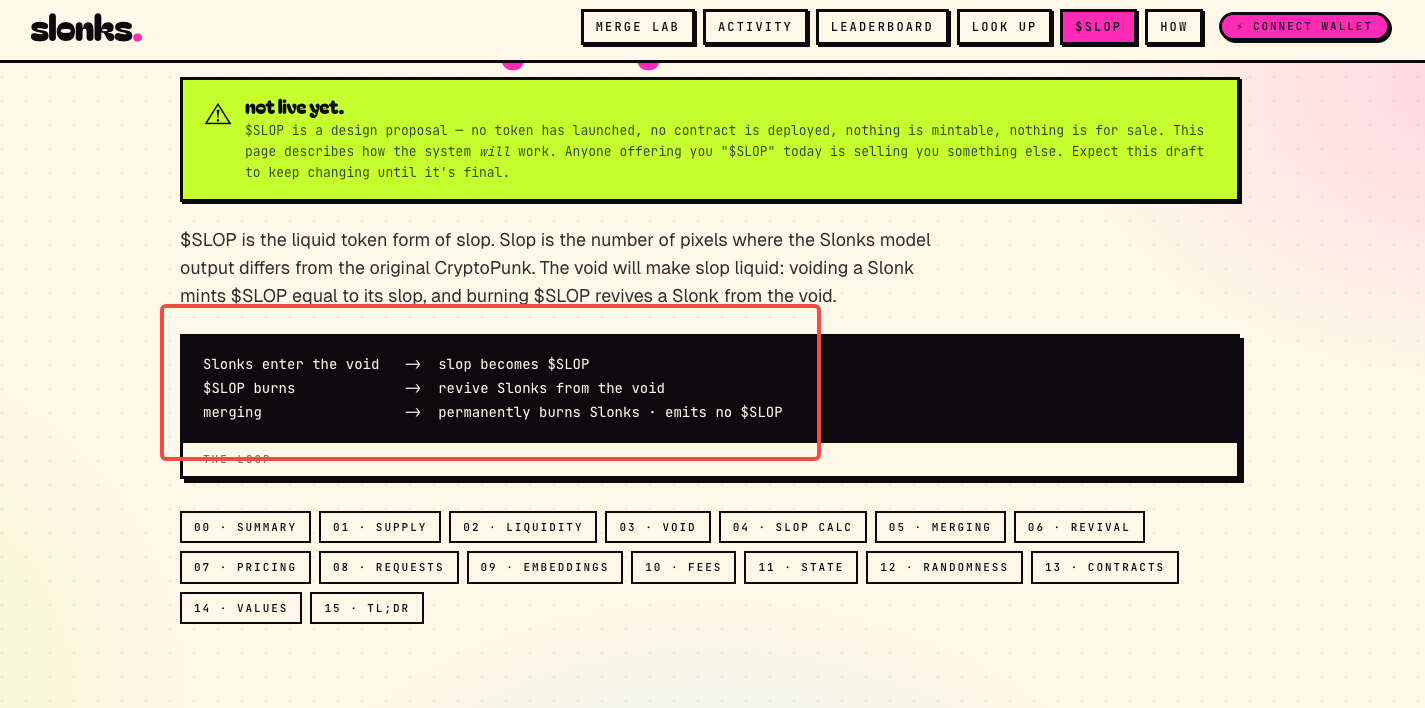
By spending a certain amount of $SLOP, you can randomly pull one Slonk back out of the Void. You cannot choose which one—and once revived, the image is regenerated by the model, so its appearance will likely differ significantly from before.
Revival pricing follows a Dutch auction: starting at 576 $SLOP, decreasing by 1 $SLOP per block, down to a floor of 100. However, whenever someone purchases, the price resets instantly to 576 and begins declining again. To score a cheap revival, you must wait—but risk being preempted at any moment.
Most revived Slonks will closely resemble their original CryptoPunk counterparts, with relatively low slop. But there’s a 1% chance the model goes “fully unhinged,” producing an extreme variant with slop exceeding 400. That 1% is the lottery.
You’ve probably already noticed: Void and Revival together form a “image-token conversion loop”:
- Buy a high-slop Slonk cheaply, send it to the Void, and convert it into $SLOP.
- Wait for $SLOP’s price to rise, then spend it to revive a new Slonk.
- If lucky, revive a high-slop Slonk—and send it back to the Void for even more $SLOP.
- Images become tokens; tokens become images—round and round.
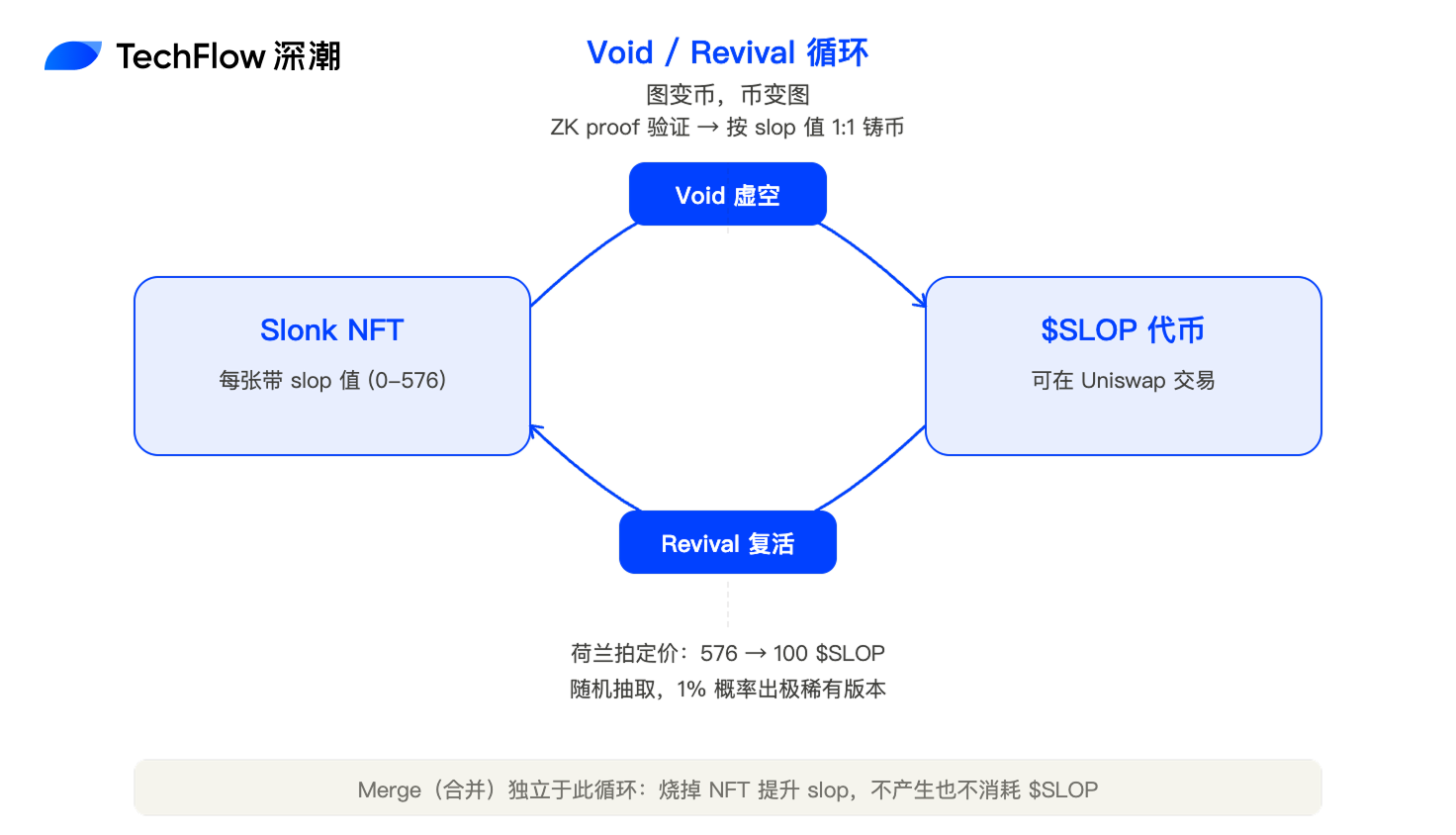
The project also introduces an automatic flywheel: the $SLOP trading pool charges a 2% fee, half of which is used to automatically purchase floor-priced Slonks from OpenSea and send them into the Void—building inventory for future revivals.
The more active the trading, the larger the Void’s inventory—and thus the richer the pool of Slonks available for revival.
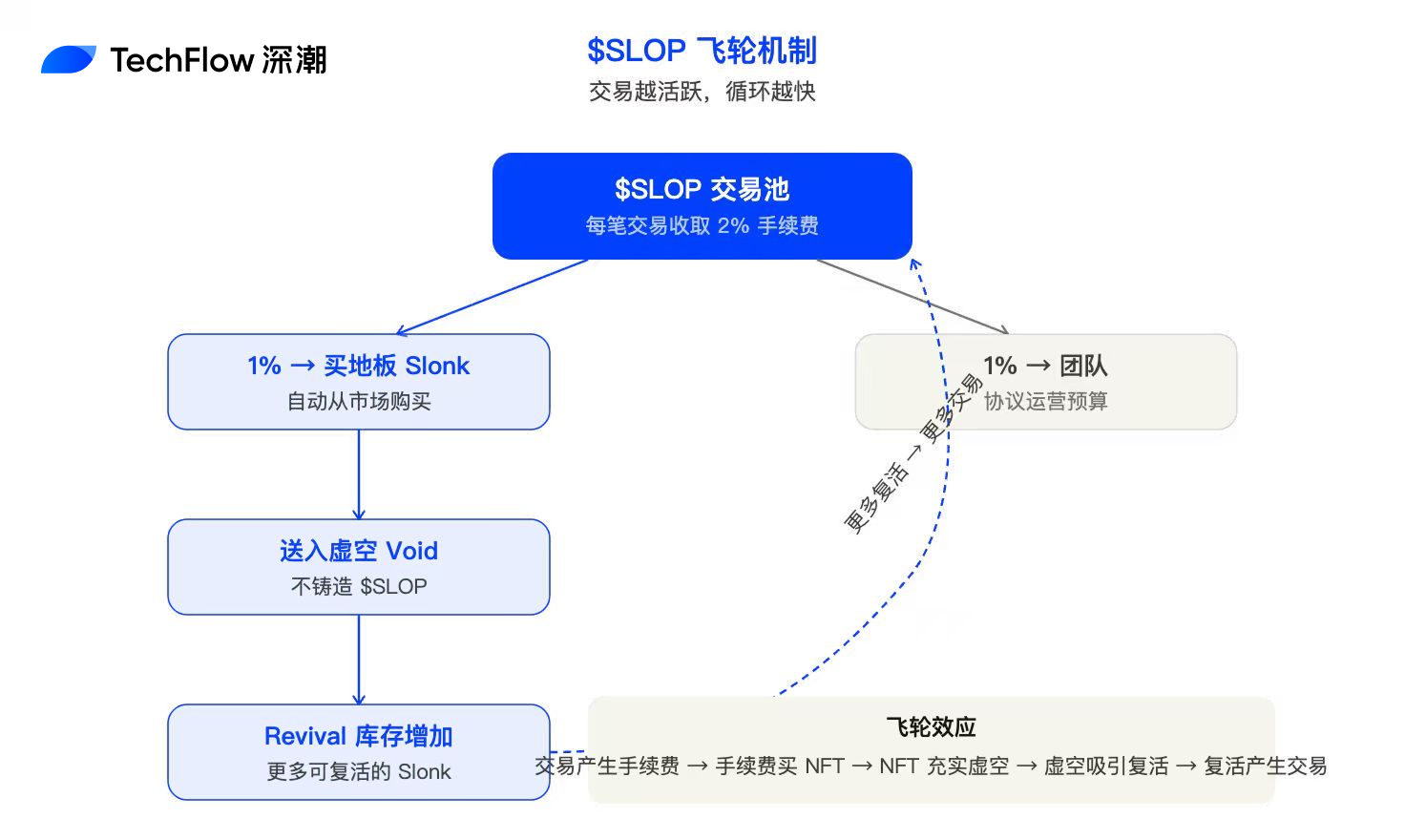
Regarding tonight’s token launch, Hirsch revealed the specifics just hours ago. A total of 576,000 $SLOP will be deposited into a one-sided liquidity pool, giving it an initial market cap of roughly $50,000.
Buyers must bring their own ETH to trade. For the first six hours post-launch, only token buying and selling will be allowed—no Void operations. In other words, these first six hours constitute a pure price discovery phase: the market must first establish a fair price for $SLOP before opening the Void channel and enabling true two-way conversion between NFTs and tokens.
The hard cap for $SLOP is 5,760,000 tokens—exactly 10,000 Slonks × 576 pixels each. Yet this cap will never be fully reached: Slonks burned via Merge generate no tokens, and the 1,300+ already burned represent permanently locked slop values.
In my view, the system’s greatest brilliance lies in binding “speculation” and “creation” into a single action.
When you Merge two Slonks, you’re speculating—higher slop means greater potential token yield—but you’re also creating, as the model generates a wholly new, never-before-seen 24×24-pixel image. Profit-making and on-chain artistry share the same button—and reinforce each other in a virtuous cycle.
Thus, this mechanism can be viewed as a micro-innovative Ponzi-style economic structure built atop three pillars: scarcity generation, image-token convertibility, and deflationary design.
Veteran of the Ordinals Era, Reinventing the Old Playbook
Little is known in the community about Michael Hirsch, Slonks’ creator—but he’s no newcomer.
Recall ETHS, the Ethereum-based Ordinals project that surged during the early ordinals boom? At its peak, ETHS commanded a market cap of ~$420 million—and Hirsch was its founder.
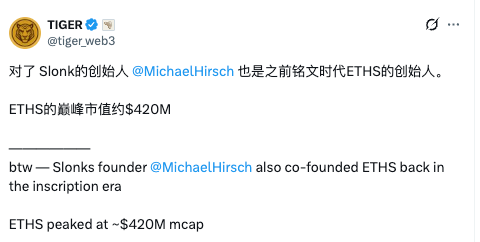
After the ordinals wave cooled, Hirsch founded Blockhash—a small studio focused on on-chain products—building DEXes, NFT marketplaces, token-gated chat tools, and various experiments he himself describes as “odd crypto toys.”
Slonks is the studio’s latest release.
A founder who’s lived through the boom-and-bust cycles of the ordinals era has now launched an extremely high-barrier-to-understanding project. That itself is a noteworthy signal: Is on-chain liquidity and market sentiment truly warming up again, paving the way for micro-innovations to ignite hype?
I think it’s still too early to tell.
As noted above, $SLOP launches tonight at 9 p.m. For the first six hours, only token trading is permitted—no Void conversions. This is a pure price博弈 period, with zero new supply entering the market; buyers negotiate price among themselves.
After six hours, the Void channel opens, activating true two-way conversion between Slonks and $SLOP.
A $50,000 initial market cap implies extremely thin liquidity—and early price volatility will be intense. The whitepaper still bears the label “v1 · draft.”
The project boasts technical ingenuity, a battle-tested founder, and a logically coherent economic loop. Yet fundamentally, it’s still an exercise in micro-innovation—focused squarely on economic design and artificially engineered scarcity.
Veteran participants who’ve weathered multiple market cycles will surely recognize—and perhaps chuckle at—this playbook. Still, the fact that something genuinely new is emerging amid current market conditions feels like a positive sign.
DYOR.
Join TechFlow official community to stay tuned
Telegram:https://t.me/TechFlowDaily
X (Twitter):https://x.com/TechFlowPost
X (Twitter) EN:https://x.com/BlockFlow_News
 深潮TechFlow


