








NVIDIA’s “Major Exam” on Wednesday: A Battle That Will Decide the Fate of the AI Bull Market!
TechFlow Selected TechFlow Selected
NVIDIA’s “Major Exam” on Wednesday: A Battle That Will Decide the Fate of the AI Bull Market!
Nvidia’s earnings report will test the resilience of the AI bull market, while the semiconductor sector faces amplified two-way risks against a backdrop of overbought conditions and high volatility.
 Navigating Web3 tides with focused insights
NVIDIA will release its quarterly earnings after market close on Wednesday, May 20 (U.S. Eastern Time)—a critical stress test for the current AI bull market cycle.
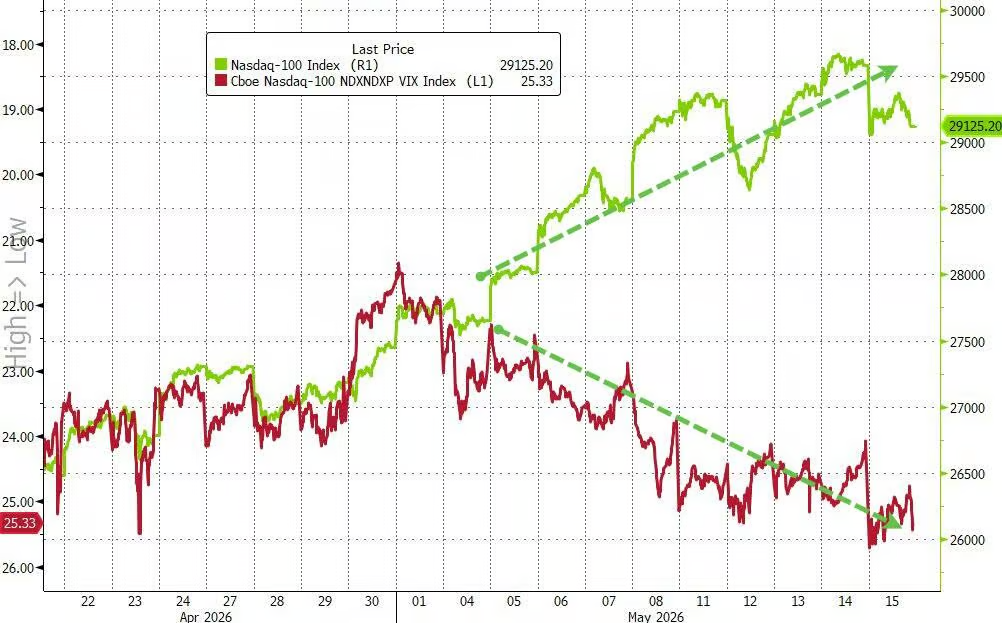
The semiconductor sector is technically severely overbought; options positioning is heavily skewed bullish; and the rare signal of “stock price rising in tandem with implied volatility” has significantly amplified two-way risk around this earnings window relative to prior periods.
Goldman Sachs’ TMT Chief Analyst Peter Callahan issued a briefing titled “Yellow Light” on Monday, noting that both the Nasdaq-100 Index (NDX) and the Philadelphia Semiconductor Index (SOX) posted their first down week of the quarter last week; the 10-year U.S. Treasury yield rose to approximately 4.60%, marking its largest weekly gain in over a year; oil prices rebounded to roughly $109 per barrel; and the VIX rose concurrently.
He pointed out thatthe core tension facing the AI and semiconductor themes today is this: fundamentals remain robust, while technical pressure continues to mount.
Options analytics firm SpotGamma noted in a recent report that markets are exhibiting the rare phenomenon of “rising stock price alongside climbing volatility”—a pattern that typically exhibits an inverse relationship. This signal indicates traders are chasing gains while simultaneously paying elevated premiums for protection against large moves.
NVIDIA’s earnings-implied volatility range currently stands at 6%, with market attention intensely focused on this event.
The earnings results and forward guidance will directly test the market’s conviction in the AI compute supercycle. Given NVIDIA’s high correlation with the broader semiconductor and technology sectors, its earnings performance—whether positive or negative—will trigger widespread ripple effects across markets.

1. Technical Indicators Flash Most Extreme Warning Since 1999/2000
The magnitude and pace of the current semiconductor rally have pushed technical indicators to historically overbought levels.
According to Goldman Sachs data, the SOX index has surged approximately 70% from its late-March low, adding over $5 trillion in market capitalization along the way.
Drivers include a temporary easing of geopolitical tensions, better-than-expected corporate earnings—for example, Applied Materials (AMAT) raised its full-year guidance by more than anticipated, and Cisco (CSCO) reported a 35% year-on-year increase in product orders—as well as strengthened investor confidence in AI compute demand; semiconductor sector earnings expectations have been revised upward by over 25% year-to-date.
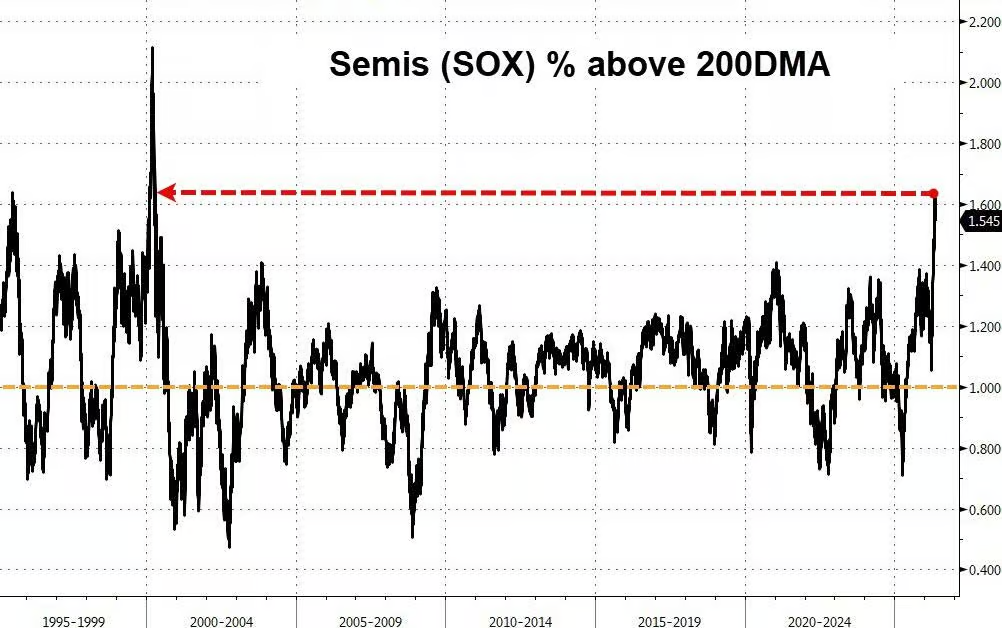
However, Peter Callahan specifically highlighted thatthe SOX index is now trading approximately 60% above its 200-day moving average—a deviation unprecedented since the peak of the 1999/2000 internet bubble.
He also noted that Goldman Sachs’ high-momentum factor portfolio has experienced single-day moves of ±5% or more on 12 trading days this year—nearly 15% of all trading days—and the rapid expansion of leveraged ETFs and options products has further amplified this two-way elasticity.
“It is worth remembering these tactical dynamics ahead of this week’s earnings season (NVIDIA on May 20) and before entering summer trading,” Callahan wrote. While Goldman Sachs’ trading desk maintains a constructive medium-term stance on AI and semiconductors overall, it advises investors to remain cautious tactically given mounting technical challenges.
2. NVIDIA Earnings: Forward Guidance May Matter More Than Quarterly Results
Market sentiment toward NVIDIA’s fundamentals remains optimistic, yet recent price action has already priced in some of those expectations.
Per Goldman Sachs’ NVIDIA earnings preview, analysts broadly expect the company’s quarterly revenue to exceed consensus by approximately $2 billion—historically, NVIDIA’s beat magnitude has typically ranged between 2% and 3%.
Markets are focusing more closely on forward guidance for the next quarter,with current analyst consensus at approximately $86 billion, representing a roughly 9% sequential increase.
Other key areas of focus include whether NVIDIA’s cumulative data center revenue guidance of approximately $1 trillion still holds upside potential, and the accelerating narrative around Agentic AI inference demand—particularly its CPU-only rack systems slated to begin shipping in the second half of 2026.
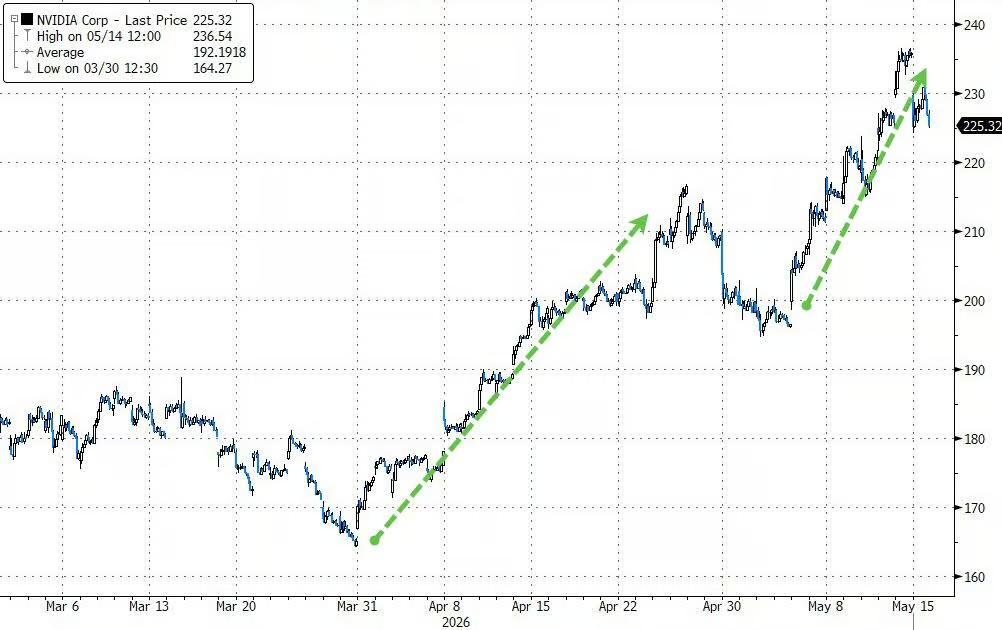
From a recent price perspective, NVIDIA has posted seven consecutive days of gains, with a total advance of 20%—its longest streak of consecutive gains in nearly two years; since its late-March low, it has added roughly $1.7 trillion in market capitalization.
However,Goldman Sachs data also shows that in four of NVIDIA’s past five earnings announcements, the stock declined on the following trading day (T+1), and since May 2022, no earnings-driven massive single-day rally has occurred.
3. Options Market: Extreme Bullish Bets Coexist with Tail-Risk Hedging
Options positioning reveals a set of inherently contradictory signals.
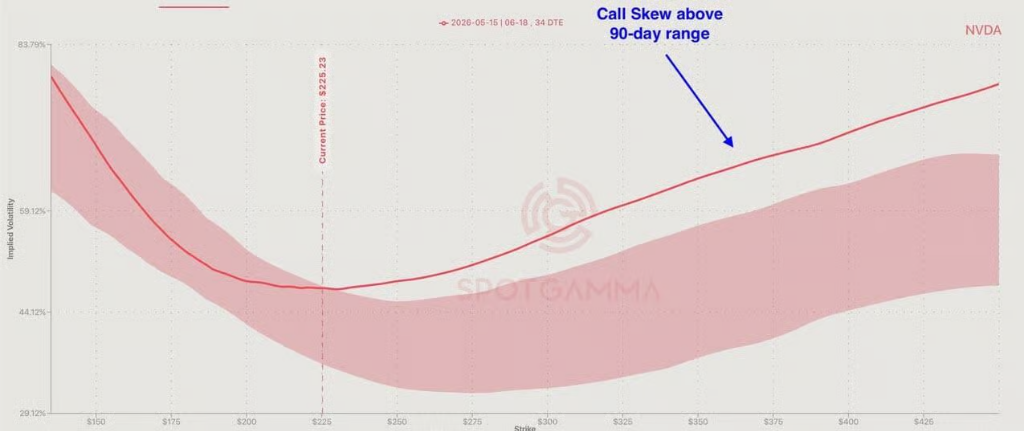
Per SpotGamma data, overall positioning remains extremely bullish, with traders persistently rolling NVIDIA call options to higher strike prices;call skew remains near the top of its 90-day historical range, while downside protection demand is extremely limited.
Citing data from 22V Research, last Friday’s nominal notional value of S&P 500 call option volume hit a record $2.6 trillion, with calls accounting for 60% of total options volume; the SOX RSI also climbed to its highest level since March 2000.
At the same time, hedging activity targeting downside risk is quietly unfolding.
SpotGamma notes that large-scale put option structures and purchases—focused on the S&P 500 (SPY), semiconductor ETFs (SMH), and DRAM-related assets—have notably increased, concentrated in deep out-of-the-money strike ranges, suggesting their function leans more toward tail-risk hedging rather than directional bets. “Market participants aren’t bearish on NVIDIA, but their preparation for downside scenarios is far from trivial,” SpotGamma wrote in its report. “Any directional shift would almost certainly ripple rapidly across broader markets.”
SpotGamma added thatNVIDIA has rallied over 35% from its March low, and the scale of current call positioning means a disappointing earnings outcome—or broad-based profit-taking—could trigger a sharp directional reversal.
4. Market Breadth Concern: Rally Supported by a Narrow Group of Stocks
Beneath the strength of semiconductors and mega-cap tech stocks lies a structural concern: the narrow breadth of participation across U.S. equities.
In his report, Peter Callahan pointed out that although the S&P 500 is up approximately 8% year-to-date, only about 52% of its constituents are posting positive returns. Laggard sectors this year include residential real estate, medical devices, engineering & construction firms without government exposure, federal IT services, software & services, independent power producers, restaurant chains, commercial real estate brokerage, and insurance brokerage.
Callahan candidly admitted that reviewing charts of these underperforming sectorsled him to question whether current market performance reflects genuine “health,” or merely a “funding source” effect—where investors are forced to concentrate capital in a handful of large-cap AI stocks.
Oppenheimer’s equity derivatives team similarly noted that over the past month, only about one-fifth of S&P 500 constituents outperformed the index, while dispersion reached its highest level in over a year and implied correlation touched its lowest point year-to-date.
Goldman Sachs’ Prime Brokerage (PB) division’s latest data also shows clear signs of “risk reduction” within the technology sector recently.
Join TechFlow official community to stay tuned
Telegram:https://t.me/TechFlowDaily
X (Twitter):https://x.com/TechFlowPost
X (Twitter) EN:https://x.com/BlockFlow_News












