Understanding the New Model of Token Economics in One Article
TechFlow Selected TechFlow Selected
Understanding the New Model of Token Economics in One Article
A token distribution intermediary layer connecting large model vendors and developers is emerging, with real profits lying in inference acceleration, enterprise integration, and scenario-specific deployment.
 Navigating Web3 tides with focused insights
By: Zhao Ying
Source: WallStreetCN
The commercialization of AI applications is evolving—from selling software and subscriptions to selling token-based API access. Here, “token” refers to the smallest unit of information processed by large language models (LLMs), and forms the basis for API billing, settlement, and consumption. As call volumes surge, tokens themselves are increasingly treated like inventory—procured, routed, split, and resold.
Chen Liangdong, an analyst at Huayuan Securities, summarized this core shift in a recent media industry special report: “Token operations are giving rise to a new intermediary market—exploring token distribution models that connect upstream LLM vendors with downstream developers, enterprises, and individual users. At its heart, this is a global liquidity infrastructure spanning wholesale-to-retail token networks.”
The emergence of this business is not complicated: On one side, China’s daily token call volume has surged rapidly—from 100 billion in early 2024 to 100 trillion by end-2025, and surpassing 140 trillion in March 2026. On the other, domestic LLMs have significantly improved in capability—ranking among the world’s top tier on several benchmark leaderboards and in actual usage metrics. Demand is rising, and model options are multiplying—but bottlenecks now lie in payment systems, network connectivity, APIs, compliance, distribution channels, and real-world deployment.
Yet token distribution cannot be simplistically understood as “reselling API quotas.” The thinnest profit layer comes from markup arbitrage; deeper margins stem from inference acceleration, unified API interfaces, enterprise-grade prompt engineering, agent orchestration, model selection, and integration into business systems. Precisely because entry barriers are relatively low, risks in this market are equally direct: intensifying competition, working capital requirements and bad debt, and policy shifts by upstream model vendors—all of which can compress margins for intermediaries.
Tokens Now Have “Wholesalers” and “Retailers”
The basic token distribution chain involves three types of players.
Upstream are model providers—including ByteDance’s Seedance series, Alibaba’s Qwen series, Zhipu’s GLM series, Moonshot’s Kimi series, and DeepSeek’s series—which serve as the original source of tokens.
Midstream are proxy platforms responsible for aggregating upstream model resources and distributing them to end users. Their role extends beyond simple quota resale: they convert disparate model interface protocols into a unified API format, enabling downstream users to access multiple models via a single API key.
Downstream are the actual token consumers—including individual users, developers, enterprise customers, and even sub-distributors.
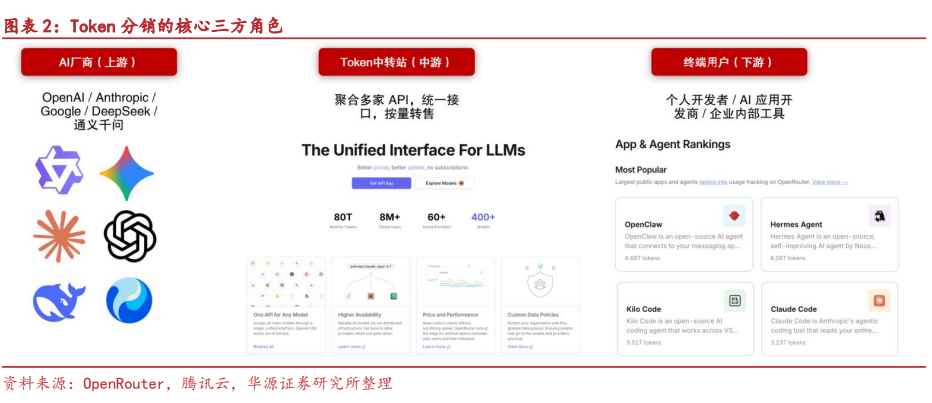
This intermediary layer delivers value in several key areas: domestic direct connectivity lowers network barriers; one codebase adapts to multiple models; support for both individual and corporate payments; bulk procurement may yield lower costs; and aggregation of models such as GPT, Claude, DeepSeek, and Kimi on a single platform reduces developer overhead from repeated integrations.
Thus, token distribution appears asset-light—requiring no in-house LLM training or large-scale server clusters. Core assets instead comprise API routing and orchestration systems, upstream model resources, distribution channels, customer relationships, and service capabilities.
Surging Call Volumes Are the Direct Fuel for This Business
A viable token operations model first requires sufficiently large consumption volumes.
China’s daily token call volume has grown over 1,000-fold in two years—from 100 billion to over 140 trillion. This expansion stems from vertical AI agents entering production use and enterprises embedding generative AI across more business processes.
IDC offers an even more aggressive projection: the number of active enterprise AI agents in China is expected to exceed 350 million by 2031, with a compound annual growth rate (CAGR) exceeding 135%; as agent task density and complexity increase, annual token consumption per agent is projected to grow over 30-fold.
Execution-oriented agents already reflect this trend. OpenClaw’s weekly token consumption on OpenRouter rose from 0.81T during February 2–March 16, 2026, to 4.97T—its share of total platform consumption climbing from 8.31% to 24.36%.
Once tokens become high-volume consumables, procurement, pricing, routing, and settlement naturally stratify. Model providers may not serve every customer directly, nor may end users wish to integrate with each model individually—creating space for intermediaries.
Domestic Models’ Cost-Effectiveness Opens the Door to Token Export
The improving capability of domestic LLMs is the pivotal factor driving token distribution from domestic to cross-border markets.
According to SuperCLUE data, domestic models—including ByteDance’s Doubao and DeepSeek’s series—have achieved comprehensive scores above 70, narrowing the gap with leading overseas models such as GPT-5.4 and Gemini. Tongyi Qwen, Kimi, and Zhipu’s GLM series have also established clearly defined performance tiers.
Per OpenRouter data, during the week ending May 10, 2026, Tencent’s Hy3 Preview (free) ranked first in call volume. Among the top five, top ten, and top twenty models, domestic LLMs accounted for 2, 6, and 9 models respectively.
A more symbolic shift occurred in Q1 2026. From February 9–15, Chinese models generated 41.2 trillion tokens on OpenRouter—surpassing U.S. models’ 29.4 trillion for the same period. From February 16–22, weekly call volume for Chinese models further rose to 51.6 trillion tokens; four of the top five models were from Chinese vendors—MiniMax M2.5, Kimi K2.5, Zhipu GLM-5, and DeepSeek V3.2—collectively contributing 85.7% of total Top 5 call volume.
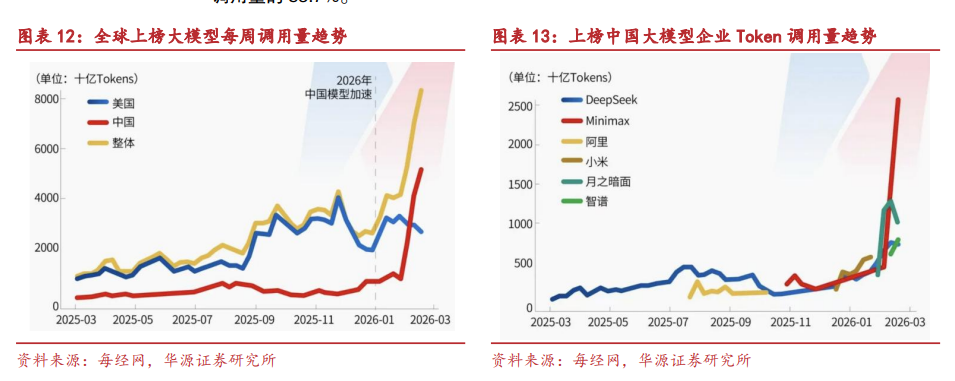
Price advantages are also pronounced. MiniMax M2.5 and GLM-5 charge $0.30 per million input tokens—versus $5.00 for Claude Opus 4.6. For output tokens, MiniMax M2.5 charges $1.10, GLM-5 charges $2.55, and Claude Opus 4.6 charges $25.00. In high-token-consumption scenarios—such as AI agents and code development—the cost-effectiveness differential of domestic models continues to widen.
Global AI Resource Imbalances Make Routing Platforms “Transit Hubs”
Token distribution solves not only price inefficiencies but also resource mismatches.
Leading overseas LLMs face geographic access restrictions, regulatory compliance hurdles, and payment barriers—preventing direct reach to certain user groups, including mainland Chinese developers. Meanwhile, high-quality domestic LLMs entering overseas markets encounter challenges in localization, channel establishment, and user acquisition.
Such imbalances drive demand for cross-border token circulation, aggregated routing, and tiered distribution.
OpenRouter already serves as a canonical example. Its weekly token processing volume grew from 5–7 trillion in 2025 to over 20 trillion per week by April 2026; its annualized revenue exceeded $50 million in 2026—roughly five times its $10+ million annualized revenue disclosed in October 2025.
Similar platforms exist domestically. SiliconFlow is an all-in-one cloud platform for large models, delivering efficient inference acceleration via its proprietary inference engine while offering enterprise-grade LLM services. As of December 2025, it had registered over 9 million users—including more than 10,000 enterprise clients—and hosted over 150 models.
Even U.S.-based political capital has entered this space. On May 5, 2026, WLFI—a cryptocurrency firm closely linked to Donald Trump and his family—partnered with WorldClaw to launch WorldRouter, integrating over 300 models including Claude, GPT, and Gemini, settling exclusively in USD1, and pricing approximately 30% below official public rates.
Real Profits Don’t Necessarily Come From “Markup Arbitrage”
Token distribution yields profits through three primary models.
First is resale markup: platforms procure API quotas in bulk from upstream model vendors and sell them to downstream customers at a premium. OpenRouter’s ~5.5% markup over supplier costs exemplifies this model.
Second is technology-driven premium: platforms leverage proprietary inference acceleration engines to reduce per-token operational costs—generating gross margins even when selling near or below official list prices. SiliconFlow’s SiliconLLM and OneDiff technologies accelerate language model inference tenfold and text-to-image generation threefold—reducing large-model API call costs to one-tenth the industry average.
Third is enterprise value-added services. Enterprise AI deployment costs extend far beyond token unit pricing—to include prompt engineering, multi-model selection, business system integration, workflow orchestration, operational scheduling, and employee AI upskilling. As base token prices decline, these latent costs increasingly become monetizable touchpoints.
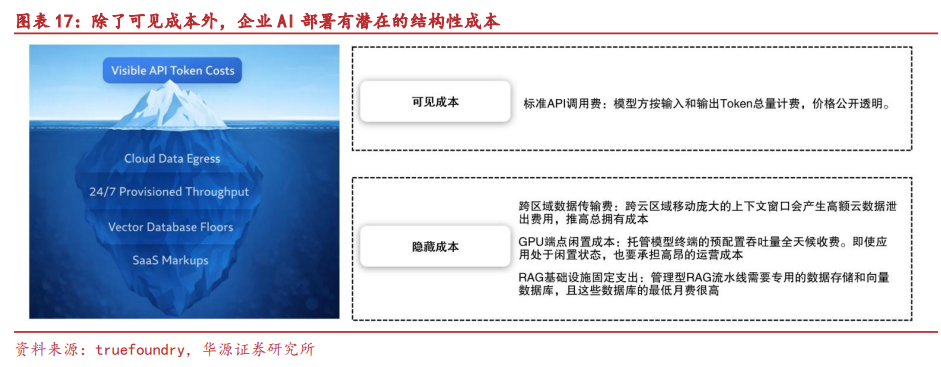
SiliconFlow’s enterprise-grade MaaS platform embodies this approach: offering enterprises three-tiered capabilities—model training & fine-tuning, deployment & inference, and application development support—covering data processing, model fine-tuning, prompt engineering, RAG, and delivering standardized APIs to industries including energy, finance, and government.
Marketing, Short Dramas, Gaming, and E-Commerce Are High-Token-Consumption Scenarios
For token distribution to generate sustainable revenue, it must ultimately anchor in real-world use cases.
Generative AI applications are penetrating healthcare, transportation, industrial manufacturing, enterprise decision support, and strategic management. Yet many enterprises lack foundational digital maturity—insufficient data assets, limited compute investment—making direct AI deployment challenging.
In contrast, marketing agencies already possess clients and proven use cases—particularly in short dramas, manhua dramas, gaming, and e-commerce—where token consumption needs are both immediate and recurring. For such firms, opportunities go beyond reselling model capacity: embedding tokens directly into client workflows—content generation, ad delivery, creative asset production, video creation—offers deeper value capture.
Investment themes unfold along two main axes:
One comprises companies with strong native model capabilities—including Alibaba, Tencent Holdings, Kuaishou, Kunlun Tech, Zhipu, and MiniMax.
The other comprises firms with robust token-integrated use cases and high-quality client portfolios—especially those possessing overseas client resources and marketing expertise, and actively investing in AI-powered marketing and AI video generation—including Yidian Tianxia and BlueFocus.
Risks Are Real: Low Barriers, Working Capital Requirements, and Upstream Control
While the token distribution business model is lightweight, its moat is not inherently deep.
Competitive pressure is the first risk layer. With relatively low technical barriers, leading distributors—backed by capital, customers, and channel advantages—can quickly replicate the model, squeezing margins.
Working capital requirements and bad debt constitute the second risk layer. Distributors typically offer monthly or quarterly billing to downstream customers, yet must pre-fund API quota purchases from upstream vendors. Larger token consumption volumes magnify working capital pressure; customer payment delays directly amplify bad-debt risk.
Policy shifts by upstream model vendors represent the third risk layer. LLM vendors control API pricing and access rules—and may adjust pricing or tighten third-party integration policies. For intermediaries, this remains the most difficult variable to manage.
Join TechFlow official community to stay tuned
Telegram:https://t.me/TechFlowDaily
X (Twitter):https://x.com/TechFlowPost
X (Twitter) EN:https://x.com/BlockFlow_News