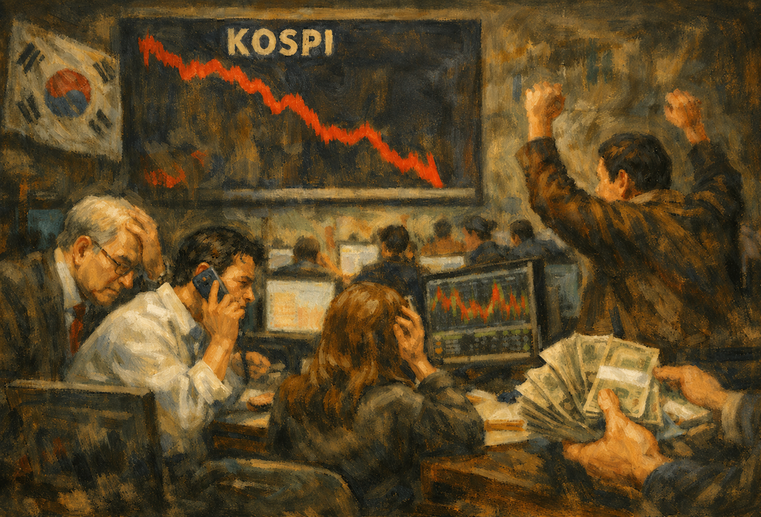
May 19 Market Recap: BTC Drops to $77,000; 10-Year U.S. Treasury Yield Hits Nearly One-Year High; Rate Hike Probability Soars from 1% to 45%
TechFlow Selected TechFlow Selected
May 19 Market Recap: BTC Drops to $77,000; 10-Year U.S. Treasury Yield Hits Nearly One-Year High; Rate Hike Probability Soars from 1% to 45%
Wednesday is the “dual-fuse day” of this week.
 Navigating Web3 tides with focused insights
Author: TechFlow
Monday was a brutal day:
- Dow Jones: +0.32%, closing at 49,686.12 (the only index in the green)
- S&P 500: -0.07%, closing at 7,403.05
- Nasdaq: -0.51%, closing at 26,090.73 (tech stocks fell as much as 2.3% intraday)
- Bitcoin: intraday low of $76,690; closed near $77,300
- Ethereum: dropped to $2,113—the lowest since April 7
- WTI Crude Oil: swung violently between $102 and $108, ultimately settling near $102
- 10-Year U.S. Treasury Yield: hit a near-one-year high
- CME Fed Funds Futures: priced in a 45% probability of a rate hike this year—up from just 1% one month ago
- Crypto long liquidations: $563 million within 24 hours
If you look only at index closes on Friday and Monday, you might think “it’s just a 2% drop.” But the devil is in three details: Treasury yields, rate-hike expectations, and crypto liquidations.
To help you understand where markets stand today, here’s a recap of this week’s key developments:
- May 14 (Thursday): The “Trump-Xi Beijing Summit” narrative triggered a relief rally—Dow reclaimed 50,000, BTC surged toward $82,000, and Cerebras’ IPO soared 75% on its first trading day. Market sentiment flipped from panic to euphoria—in a single session.
- May 15 (Friday): A sharp reversal. Dow fell 1.07% (-537 points), S&P 500 dropped 1.2%, and Nasdaq slid 1.5%. Cerebras lost 4% in one day—a classic “one-day wonder.” Trump returned to the U.S., but brought back no tangible progress on Iran peace talks.
- May 16–17 (Weekend): Iran tensions escalated further. Pakistan delivered Iran’s new peace proposal to the U.S., but the White House deemed it “insufficient.” Trump posted a threat on Truth Social: “For Iran, the clock is ticking. They better move fast—or they’ll have nothing left. Time is critical!”
- May 18: Crypto had already collapsed over the weekend—BTC touched $76,690 intraday. At the U.S. market open, Nasdaq continued to be dragged down by tech stocks; S&P 500 ended flat, while the Dow scraped out a gain thanks to defensive stocks.
Linking these four days together reveals a crucial insight: Thursday’s rally wasn’t the start of a new bull market—it was an overextended political pulse. When politics fails to deliver substance, markets rapidly unwind “all-in” positions.
U.S. Equities: Dow Holds Up Again—Tech Leads the Decline
Today’s action eerily mirrored May 12—the day CPI data shocked markets. Back then, the Dow rose against the tide while S&P and Nasdaq fell; Walmart, UnitedHealth, and JPMorgan Chase—the defensive stalwarts—propped up the Dow. Today’s script was virtually identical.
Intraday, the S&P 500 tech sector plunged as much as 2.3%, narrowing slightly to a 1.1% loss by close. This V-shaped recovery signals equal anxiety among both buyers scrambling to catch the dip and sellers rushing for the exits. Chip stocks bore the brunt: NVIDIA extended Friday’s weakness (down 4.4%—Dow’s biggest loser), while AMD, Micron, and Intel all faced pressure.
But what matters most today isn’t how much any single stock fell—it’s two broader indicators:
First, the 10-year U.S. Treasury yield hit a near-one-year high. Historically, the last time it reached this level was in Q3 2024. This implies markets have re-priced for “higher-for-longer” interest rates. And high rates hit hardest those assets whose valuations rely heavily on discounting future cash flows—namely, tech stocks.
Second, CME Fed Funds Futures now imply a 45% chance of a rate hike this year. One month ago, that number stood at just 1%.
From 1% to 45%—in just one month.
This reflects a directional pivot in market expectations for the Fed: from “Will the Fed cut once this year?” to “Will the Fed hike once this year?” Though “hike” and “cut” differ by only one verb, their implications for risk-asset valuation frameworks are diametrically opposed.
Even more sobering: According to Schwab, the PHLX Semiconductor Index (SOX) has risen 143% over the past year—versus just 15% for the S&P 500 Equal Weight Index (SPXEW). SOX currently trades 32% above its 50-day moving average—a deviation historically associated with an imminent “forced consolidation phase.”
In other words, even without Iran, the semiconductor sector had technically reached a point where it needed to pause and digest gains. Iran simply provided the final nudge off the ledge.
Crypto: $563M in Long Liquidations—Leverage-Fueled Rally Reversed
Crypto’s story today was simple—and brutal.
Bitcoin slid from Thursday’s $82,000 peak to the $77,000 zone today, hitting an intraday low of $76,690. Ethereum fell to $2,113—the lowest since April 7. Global crypto long liquidations totaled $563 million in 24 hours, with BTC and ETH accounting for most losses.
The immediate catalyst? Trump’s Sunday Truth Social post: “For Iran, the clock is ticking.” Asian-session crypto began selling immediately—crypto trades 24/7 and is always the first responder to geopolitical risk.
But the deeper cause was flagged in last week’s Daily Report: Thursday’s BTC surge to $82,000 was driven primarily by derivatives positioning—not spot demand. Per Wintermute data, Bitcoin perpetual contract open interest (OI) jumped from $48 billion to $58 billion in one month. Most of that $10 billion increase came from newly added leveraged longs.
Leverage is a double-edged sword—it never picks sides. It amplifies gains on good news—and losses on bad news. One Trump Truth Social post wiped out nearly all the leveraged longs accumulated during Thursday’s “good-news” rally.
Notable details:
- Total open interest in WTI and Brent perpetual contracts on Hyperliquid exceeded $481 million over the weekend. This is an emerging phenomenon in 2026’s crypto ecosystem: Traditional oil futures trade only during exchange hours, but Middle East conflicts unfold 24/7—so more traders are turning to on-chain, 24/7 oil perps to hedge exposure. Hyperliquid’s native token $HYPE rose 8.36% amid broad crypto weakness—an authentic case of infrastructure benefiting from geopolitical turmoil.
- Ethereum’s weakness outpaced Bitcoin’s. As BTC fell from $82K to $77K (-6%), ETH dropped from $2,300 to $2,113 (-8%)—its weakest ETH/BTC ratio in a month.
- Crypto analyst Aralez’s Q2–Q4 forecast began circulating: He projects BTC may fall to $58,000 and ETH to $1,700 in Q2–Q3, rebounding to $90,000–$109,000 in Q4. While I don’t fully endorse the $58K figure, his timing call—“panic selling peaks in Q3”—is worth noting and tracking.
Oil: Wild Swings—Markets Caught Between “Peace Illusion” and “Military Escalation”
WTI crude swung violently today between two extremes:
- Intraday high near $108.70—the highest since April 30
- Intraday low near $102
- Closed near $102—roughly 6% daily range
Such volatility has become the norm in oil markets over the past month. Today’s swings were driven by two opposing narratives:
Bullish catalyst: Over the weekend, the Barakah nuclear power plant was struck by drones (the first-ever attack on a nuclear facility), with simultaneous strikes hitting both the UAE and Saudi Arabia—instantly widening the geopolitical risk premium.
Bearish catalyst: Iran’s semi-official Tasnim News Agency reported the U.S. had “accepted a temporary waiver of Iranian oil sanctions during negotiations” in the latest draft text. That rumor sent oil tumbling from ~$108 to ~$102—but critically, no U.S. official has confirmed the report.
In essence, today’s oil volatility reflected trading on rumors—not facts.
IEA Executive Director Fatih Birol issued another stark warning today: Global commercial oil inventories are depleting rapidly—supply coverage stands at just a few weeks. This is as dire a warning as possible: Even if the Strait of Hormuz reopens tomorrow, the market won’t restore supply-demand balance until Q4.
The real wildcard: Per Axios, Trump will convene a National Security Council meeting Tuesday (May 19—today, U.S. Eastern Time) to discuss military strike options against Iran.
The significance of this cannot be overstated. The outcome of Trump’s NSC meeting may determine whether oil prices head toward $90—or rocket toward $120 over the next two weeks.
Gold & Silver: Panic Didn’t Materialize
Logically, rising geopolitical risk + falling equities + collapsing crypto should make gold the undisputed winner. Yet gold edged lower today—and silver weakened further.
Why?
Because both the U.S. dollar and the 10-year Treasury yield rose simultaneously. When real yields hit a near-one-year high, gold’s zero-yield appeal as a hedge gets suppressed. This is textbook “safe-haven paradox”: When inflation fears and geopolitical anxieties coexist, markets rush first for dollars and short-term Treasuries—not gold.
Silver remains trapped under technical selling pressure. After plunging 4.1% last Thursday, it saw no meaningful buying support today. Its industrial narrative (AI data centers, solar panel demand) is temporarily drowned out by the broad retreat in risk appetite.
Today’s Summary: Wednesday Is the “Dual-Fuse Day”
May 18 sent a restrained but unambiguous message: Thursday’s rally is officially over.
U.S. Equities: Dow eked out +0.32% on defensive stocks; S&P 500 and Nasdaq declined further. SOX sits deep in historical bubble territory; the 10-year Treasury yield hit a near-one-year high; and the probability of a 2025 rate hike surged from 1% to 45%.
Crypto: BTC fell from $82,000 to $76,690; ETH hit its lowest level since April 7; $563 million in long liquidations occurred. Thursday’s “leverage-fueled rally” was fully reversed.
Oil: WTI swung 6% intraday between $102 and $108—markets oscillating violently between rumors of “U.S. sanction waivers for Iran” and the reality of “Barakah nuclear plant attacks.”
Precious Metals: Gold was flat; silver weakened further. When real yields rise, safe-haven assets take a backseat to the dollar.
Markets now focus on one thing: Two major events occur Wednesday (May 20, U.S. Eastern Time)—Trump’s NSC meeting on military action against Iran, and NVIDIA’s Q1 earnings release.
Either event could set the tone for the rest of the week:
- If Trump opts for military escalation → oil surges toward $120, S&P 500 drops to ~7,200, BTC tests $72,000;
- If Trump issues an ultimatum but delays action → current levels may stabilize, though any rebound would likely await NVIDIA’s earnings as a catalyst;
- If NVIDIA’s earnings beat expectations → the SOX bubble gets temporarily justified by “earnings delivery,” extending the AI narrative for another quarter;
- If NVIDIA’s guidance disappoints → SOX’s 32% deviation from its 50-day MA will correct in the most painful way possible, and rate-hike expectations will climb further.
This is a market waiting for a verdict. Any position taken now is effectively a bet on politics and corporate guidance—not fundamentals.
When Trump says “the clock is ticking,” he may not realize the same phrase applies—equally—to every trader.
Join TechFlow official community to stay tuned
Telegram:https://t.me/TechFlowDaily
X (Twitter):https://x.com/TechFlowPost
X (Twitter) EN:https://x.com/BlockFlow_News
 深潮TechFlow