“The Robot Version of Saylor”: This Company Buys Figure AI at a Premium to Bring the MSTR Flywheel into Embodied AI
TechFlow Selected TechFlow Selected
“The Robot Version of Saylor”: This Company Buys Figure AI at a Premium to Bring the MSTR Flywheel into Embodied AI
Replicating pure-robot equity, the company issued shares at a premium to acquire Figure AI—emulating Saylor’s strategy to bet on “2027: The Dawn of the Robotics Era.”
 Navigating Web3 tides with focused insights
Author: Jason
Translated and edited by TechFlow
TechFlow Intro: RoboStrategy ($BOT), fresh off its IPO, has already sparked intense debate—some call it an “exit liquidity scam,” others compare it to a venture capital fund. At its core, however, it replicates Michael Saylor’s MicroStrategy (MSTR) flywheel: issuing shares at a premium to acquire private robotics equity, where each share issuance increases—not dilutes—net asset value (NAV). With heavy positions in top-tier, hard-to-access companies like Figure AI and Apptronik, $BOT may be the only pure-play robotics exposure available to retail investors on the eve of AI’s capabilities spilling over into the physical world.
The newly IPO’d $BOT (RoboStrategy) has triggered diverse interpretations—some label it an “exit liquidity scam,” others see it as the next $DRAM, while still others draw comparisons to Fundrise’s $VCX. My view differs:
As its name suggests, $BOT closely mirrors MicroStrategy ($MSTR)’s strategy. If you’re bullish on the robotics sector over the next few years, this is a compelling allocation. It is neither a traditional VC fund nor an industry ETF—it features structural distinctions.
Recap of the Strategy Flywheel
Each $MSTR share represents a proportional claim on the company’s Bitcoin holdings.
Saylor issues new shares at a NAV premium (1.5x–3x mNAV premium).
Because of the premium, the sale price of new shares exceeds the underlying asset value, enabling proceeds to be used to purchase additional Bitcoin—a NAV-thickening effect.
Owing to premium issuance, per-share NAV rises, causing the implied “BTC per share” to increase accordingly.
But why does a NAV premium exist?
Are investors irrational—willing to pay more than the intrinsic value of the underlying assets?
Simple answer: Reflexive speculation + access scarcity.
Most institutional allocation tools cannot directly place Bitcoin on their balance sheets; MSTR serves as an excellent proxy exposure.
Saylor’s narrative and brand credibility—markets believe he can consistently raise capital to sustain the flywheel.
The reflexive nature of increasing BTC per share: So long as mNAV remains above 1x, every share issuance thickens rather than dilutes NAV—because even though the number of shares increases, BTC per share continues rising.
Leverage and convertible debt: Due to its Bitcoin-proxy nature, MSTR exhibits extremely high volatility. The company has issued large volumes of convertible debt to buy Bitcoin. The convertible bond market eagerly purchases these instruments, attracted by the combination of bond yield plus upside optionality tied to MSTR’s stock appreciation—and all at exceptionally low interest rates. Saylor thus secures near-zero-cost financing to acquire Bitcoin.
Mapping to $BOT
RoboStrategy’s underlying assets are not Bitcoin but private robotics equity. Roth recently announced a $2 billion equity financing facility for $BOT, acting as an ATM (At-The-Market) mechanism. Shares can be issued at a premium to Roth, thickening $BOT’s NAV while efficiently allocating capital to top-tier robotics companies.
RoboStrategy’s current portfolio holds significant positions in Figure AI, Apptronik, and Dyna—leading U.S. robotics firms. From first principles, there’s no reason these companies shouldn’t thrive over the next 3–5 years. Human labor represents the world’s largest total addressable market (TAM), and demand for additional labor is demonstrably growing exponentially—especially in Western industrial and manufacturing capacity reshoring. An obvious yet underappreciated link: robotics stands to benefit most from AI’s advancing capabilities; embodied intelligence represents the next logical frontier—where cutting-edge labs scale demand and physically instantiate digital intelligence. RoboStrategy is the only widely accessible, pure-play private robotics exposure tool.
Bull Case Mechanisms
Access scarcity: Retail investors cannot access these private placements. Robotics is even earlier-stage than AI labs, with more selective funding rounds—even institutional allocators struggle to gain entry. The RoboStrategy team has a proven track record of securing top-tier allocations and conducting rigorous due diligence.
NAV mechanics: Private robotics equity reflects operational execution—product launches, contract signings, AI improvements, and valuation uplifts across financing rounds. Bitcoin, by contrast, behaves more like a pure commodity. Here, multiple engines drive NAV growth—pushing $BOT’s price higher.
Meme appeal: Its ticker is $BOT. If memecoins and certain meme stocks have demonstrated anything, it’s that ticker symbols themselves generate organic attention.
Reflexivity: Should RoboStrategy continue scaling into a dominant allocator within robotics, its value will reflexively compound—solidifying its position as the best-in-class public exposure to the sector while remaining open to retail investors.
Counterbalancing Bear Case Mechanisms
NAV subjectivity: If robotics valuations don’t rise unidirectionally—and down rounds occur—it could compress $BOT’s NAV, especially if concentrated in large portfolio positions.
Liquidity events eroding access premiums: When Figure or Apptronik go public, that portion of NAV converts into publicly traded stock, reducing the associated “packaging premium.” This assumes no new private positions are added on the private side—but Figure and Apptronik are unlikely to IPO in the near term.
No convertible debt market or leverage: $BOT lacks MSTR’s convertible-debt-fueled leverage loop. However, I expect further developments in this area.
SpaceX usurping top robotics proxy status: SpaceX’s IPO looms, and Optimus/humanoid robots form a key part of Elon Musk’s pitch. If narrative momentum shifts toward SpaceXAI, other players may lose steam. That said, SpaceX is a diversified conglomerate—not a pure-play robotics vehicle—and its implied IPO valuation exceeds $1 trillion. Alternatively, its listing could trigger multi-fold positive re-ratings for private robotics firms.
2027: The Year of Robotics and World Models
Jim Fan, NVIDIA’s Director of Robotics, summarized “The Great Parallel” unfolding in robotics just two weeks ago:
Large language models (LLMs) have reached maturity.
Robotics will replicate LLMs’ exact developmental trajectory—accelerating robotics toward the same endpoint.
This is not the time to nitpick Figure AI’s livestreams or dismiss robotics as “not ready yet.” Everything is happening—and faster than most anticipate.
If we apply a simple but illustrative growth-valuation model to top U.S. robotics firms—drawing parallels to Anthropic or OpenAI’s trajectories and varying mNAV assumptions—the following price projections emerge:
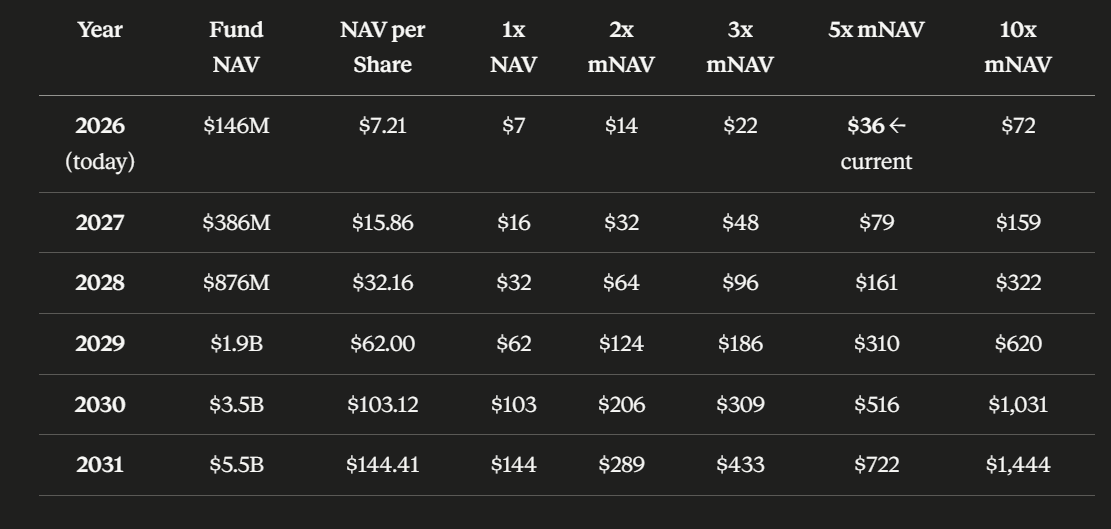
Caption: Claude generated this model. Even the conservative 2x mNAV scenario implies an ~8x price increase from current levels within five years.
Right now, RoboStrategy is the best publicly available tool for long-term exposure to this sector.
Disclaimer: This is clearly not financial advice.
Disclosure: I hold $BOT.
Join TechFlow official community to stay tuned
Telegram:https://t.me/TechFlowDaily
X (Twitter):https://x.com/TechFlowPost
X (Twitter) EN:https://x.com/BlockFlow_News
 @latent0x