$SPCX Listed on Hyperliquid: SpaceX Hasn’t Gone Public Yet, but Its On-Chain Valuation Is Already $2.4 Trillion
TechFlow Selected TechFlow Selected
$SPCX Listed on Hyperliquid: SpaceX Hasn’t Gone Public Yet, but Its On-Chain Valuation Is Already $2.4 Trillion
The on-chain pricing for the largest IPO in human history has begun.
 Navigating Web3 tides with focused insights
Author: Kuli, TechFlow
Just as the hype around $CBRS hasn’t fully subsided, Trade.xyz launched its second Pre-IPO perpetual contract on Hyperliquid this morning—this time, for SpaceX.
The underlying asset is SpaceX.
According to Bloomberg and Reuters, SpaceX secretly filed its S-1 registration statement with the SEC on April 1, targeting a valuation of $1.75 trillion and aiming to raise up to $75 billion. If successful, this would be 2.5 times larger than Saudi Aramco’s $29 billion IPO in 2019—the largest single public offering ever recorded in global capital markets.
The entire world is waiting for this stock. Now, onchain, you don’t have to wait anymore.
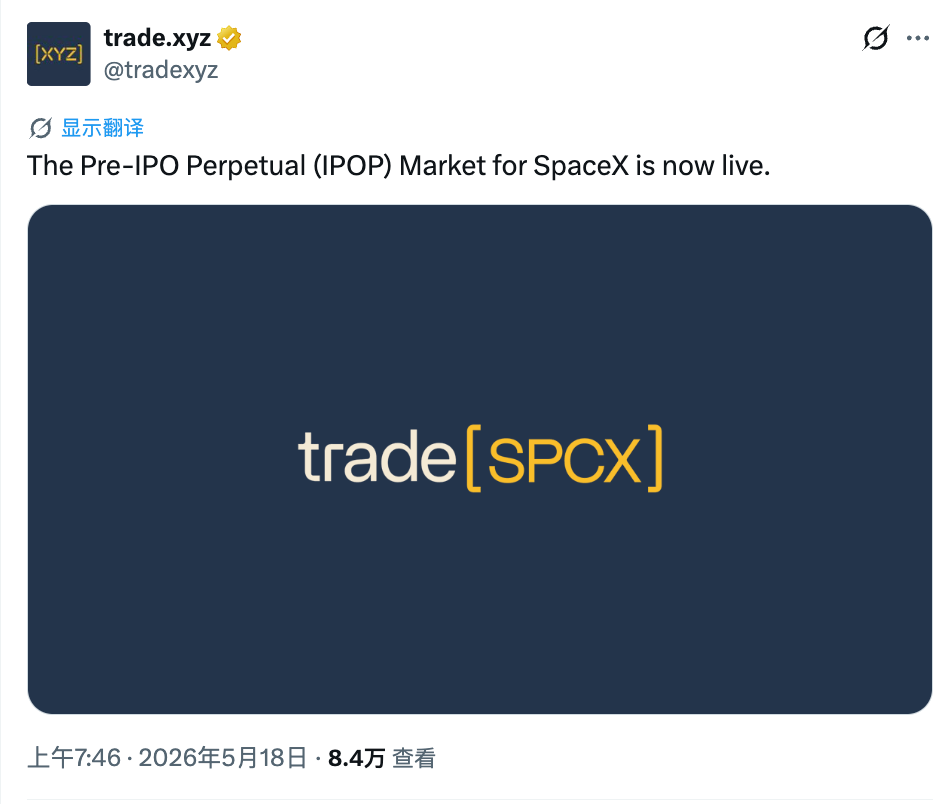
Per Trade.xyz’s announcement, $SPCX is priced based on a fully diluted share count of 11.87 billion, with an initial price of $150.
Based on SpaceX’s S-1 filing with the SEC—which targets a $1.75 trillion valuation—the implied share price works out to approximately $147. In other words, Trade.xyz set the starting price for $SPCX very close to SpaceX’s own stated valuation.
Yet onchain sentiment clearly believes that price is too low.
Within hours of listing, $SPCX surged from $150 to $216—a 44% jump. At the same fully diluted share count, $216 implies a valuation of roughly $2.56 trillion—nearly 50% higher than SpaceX’s target valuation.
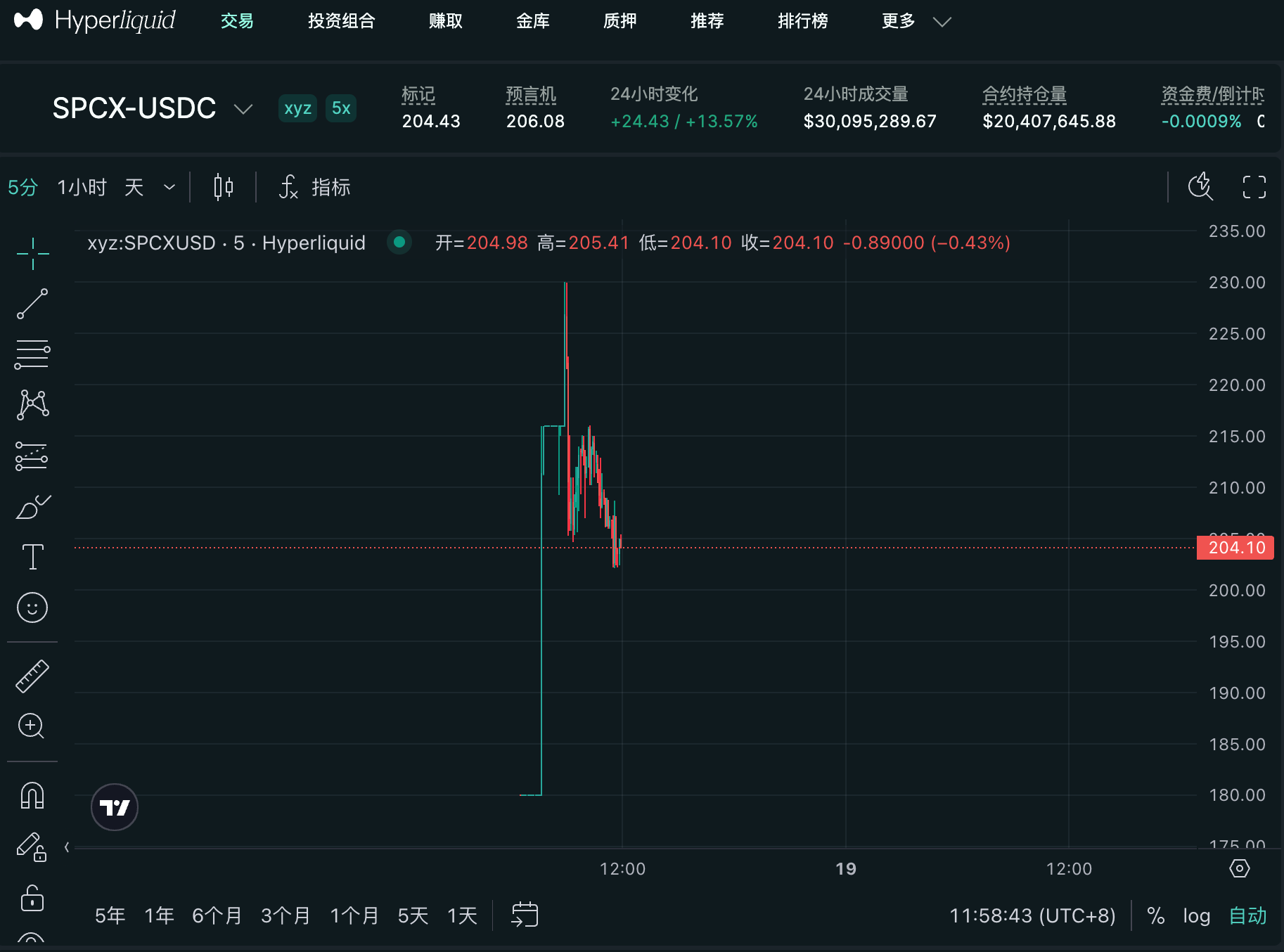
So, is $SPCX overvalued or undervalued in pre-market trading?
Stepwise Price Controls Keep $SPCX Volatility in Check Onchain
The last time we saw a Pre-IPO contract establish pricing was three weeks ago with $CBRS.
According to Hyperliquid News data, CBRS traded stably around $277 onchain before its IPO—about 50% above Cerebras’ final offering price of $185.
Many at the time thought the onchain price was inflated. Yet Cerebras opened at $350—26% higher than the onchain price.
Onchain traders correctly anticipated the direction and offered a more aggressive valuation than underwriters—but even so, they still underestimated the actual opening-day frenzy.
The current situation with $SPCX feels familiar: the onchain price sits nearly 50% above the valuation indicated in SpaceX’s S-1 filing—almost identical to the premium CBRS commanded onchain.
But the author cautions against directly extrapolating from CBRS. Cerebras raised $5.5 billion; SpaceX plans to raise $75 billion—one is a mid-sized tech IPO, the other the largest public offering in history. The larger the scale, the greater institutional influence over pricing—and how far ahead retail onchain sentiment can lead institutions remains uncertain.
There’s also a new variable absent during CBRS: per Trade.xyz’s documentation, the $SPCX pre-market incorporates a stepwise price control mechanism:
The deviation between the oracle price and the market price cannot exceed 20%. Once triggered, trading freezes until the oracle catches up, after which the next round opens. There are up to seven steps upward and seven downward. After seven upward steps, the price caps; after seven downward steps, it floors—remaining in effect until the IPO officially launches or until the contract expires on August 29.
This design confines $SPCX’s price within a calculable range.Unlike $CBRS, which allowed completely free pricing, $SPCX has both a ceiling and a floor.
For traders, the nature of the game has changed—upside potential and downside risk are now bounded.
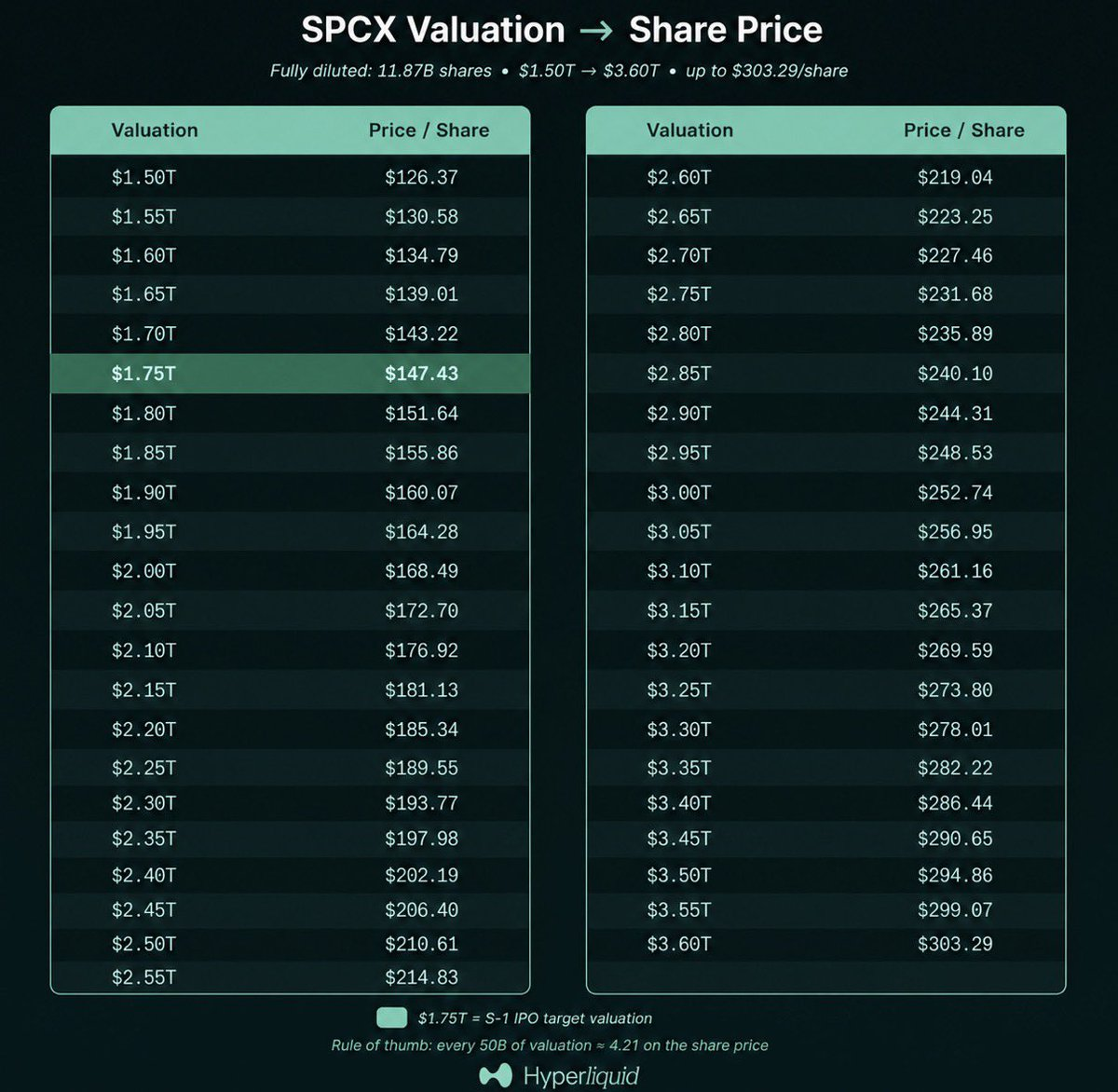
Is there an offchain benchmark to assess whether the onchain pricing is unreasonable? According to Bloomberg, Brookfield disclosed on May 14 holding $2 billion worth of SpaceX Pre-IPO shares—implying a valuation exceeding $2 trillion.
In other words, institutional investors in the private market have already assigned SpaceX a valuation significantly above the $1.75 trillion cited in the S-1 filing. The current onchain valuation of ~$2.5 trillion is about 25% higher than that private-market valuation.
Whether this premium is justified remains an open question. But at least two reference points exist: private-market participants have already valued SpaceX above $2 trillion; and CBRS’s experience shows that a 50% onchain premium ultimately proved insufficient.
We may not know for sure until $SPCX officially lists on June 12.
CEXs Enter the Fray: Battling for U.S. Equity Pre-Market Dominance
Three weeks ago, when $CBRS launched, Pre-IPO perpetual contracts were essentially Hyperliquid’s exclusive domain.
SpaceX is different—everyone’s here. Per BitMart’s tally, OKX quotes its SpaceX perpetual around $2,000; Gate at ~$1,908; Bitget’s preSPAX at ~$680; and Binance Wallet at ~$720. Meanwhile, Hyperliquid’s $SPCX trades at $216…
Same SpaceX—yet prices range from $216 to $2,000? That’s nearly a 10x difference.
This isn’t due to mispricing. Platforms use entirely different share bases: Hyperliquid’s $SPCX is priced on the post-split 11.87 billion shares, while many CEXs use the pre-split share count—naturally yielding much higher unit prices.
Per Bitget’s announcement, preSPAX claims backing by real equity issued via Republic; most other platforms offer purely synthetic derivatives—different underlying asset types altogether.
For newcomers unfamiliar with these mechanics, there’s an easy trap: seeing $216 on Hyperliquid versus $2,000 on OKX might instinctively suggest Hyperliquid is ten times cheaper—yet once normalized to valuation, they may be quite similar, differing only in share base and product structure.
Trading without first normalizing to valuation is arguably the fastest way to lose money.
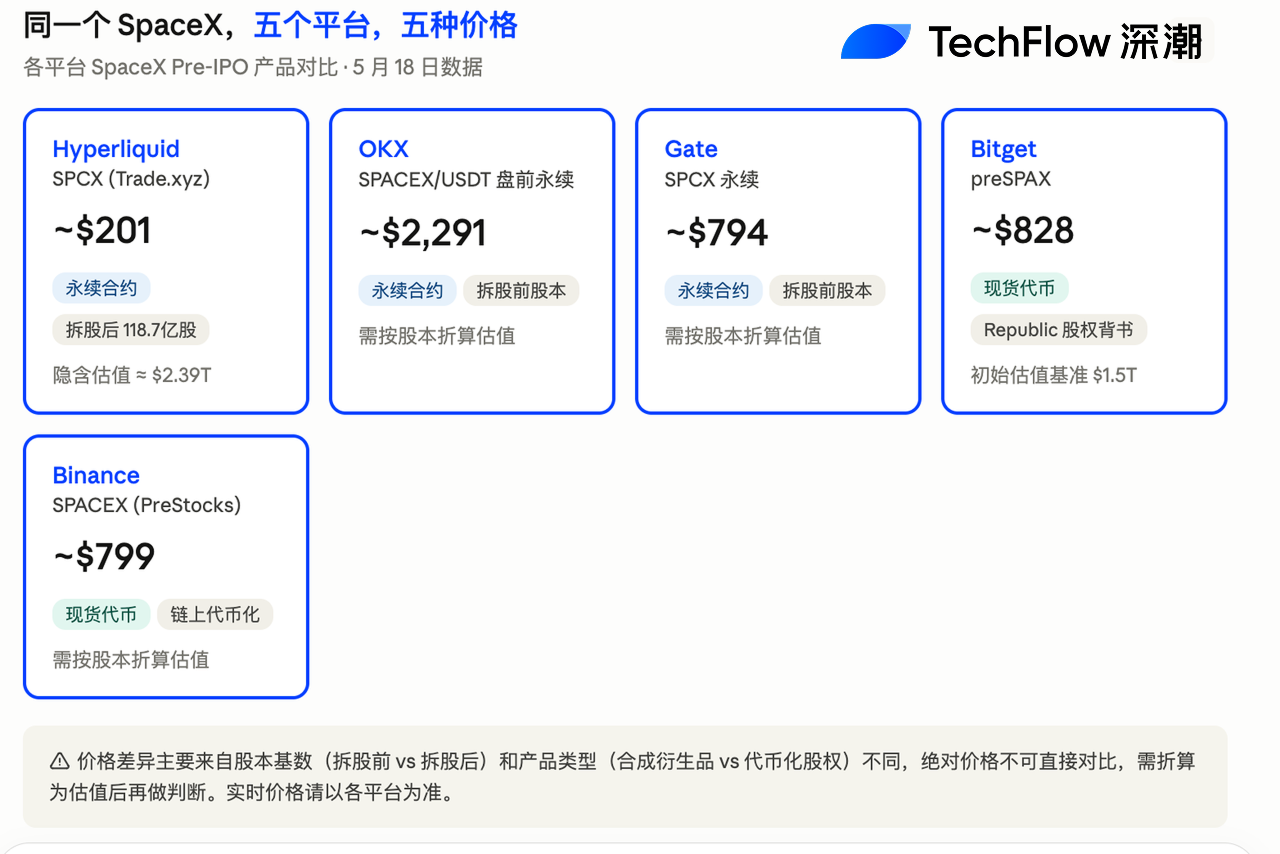
Price fragmentation itself signals one thing: whereas only Hyperliquid offered Pre-IPO contracts during the $CBRS launch, less than a month later, SpaceX Pre-IPO products now span major exchanges. This category is rapidly evolving from a single platform’s experiment into industry-wide infrastructure.
For Hyperliquid, the good news is that it pioneered and validated the category. The bad news? Anyone can replicate it.
Everyone is rushing in—not just for the product itself, but for something deeper worth examining.
Over the past several months, native crypto narratives have weakened. Meme coin hype cycles have grown shorter; altcoins lack fresh stories; onchain trading volume is shrinking; and many platforms are already seeing declines in active users. All are searching for the next driver of genuine trading volume.
U.S. star IPOs happen to fill that gap perfectly. SpaceX, OpenAI, Anthropic—these companies command global attention without needing any platform promotion; attention is inherently drawn to them.
More crucially, unlike meme coins, these assets generate real revenue, follow established valuation frameworks, and have clear listing timelines. Traders aren’t speculating on nebulous narratives—though sentiment plays a role, the underlying assets themselves are verifiable and tangible.
This level of certainty is scarce in today’s crypto market.
That’s why exchanges are racing to list SpaceX Pre-IPO products—not merely launching another product, but competing for the next gateway to trading activity.When native crypto narratives stall, integrating the world’s hottest traditional assets ontochain—enabling them to be priced, traded, and contested there—may well be the new path the industry is forging.
U.S. Pre-IPO trading is becoming crypto’s newest battleground—and embracing change is the most pragmatic choice.
Join TechFlow official community to stay tuned
Telegram:https://t.me/TechFlowDaily
X (Twitter):https://x.com/TechFlowPost
X (Twitter) EN:https://x.com/BlockFlow_News
 深潮TechFlow