$CBRS surges 90%: The largest tech IPO since Uber, priced two weeks early by Hyperliquid
TechFlow Selected TechFlow Selected
$CBRS surges 90%: The largest tech IPO since Uber, priced two weeks early by Hyperliquid
Quotations for on-chain contracts are now being treated as a leading indicator for U.S. IPOs—a scenario unimaginable in the past.
 Navigating Web3 tides with focused insights
Author: David, TechFlow
Over the past two days, both Chinese and English crypto Twitter feeds have been flooded with a single U.S. stock ticker: $CBRS.
Some users remarked, “The momentum is overwhelming,” while others said, “Finally, I truly feel the onchain advantage.” The IPO of an AI chip company has triggered a wave of FOMO among crypto traders.
Cerebras is NVIDIA’s most direct competitor in the AI chip space, with clients including OpenAI and Amazon.
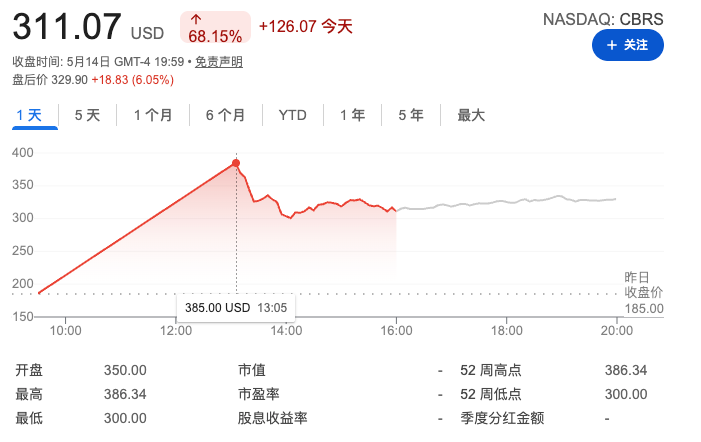
On May 14, it listed on the Nasdaq at a pricing of $185 per share—oversubscribed by 20x. Underwriters even raised the pricing range twice. At market open, its share price jumped directly to $350, peaked at $386 intraday, and closed at $311—reaching a peak gain of nearly 90%.
According to CNBC, this marks the largest U.S. tech IPO since Uber in 2019, raising a total of $5.55 billion.
Yet what excites crypto traders isn’t the stock’s price surge itself. Some of them had already participated in CBRS’s price discovery two weeks before the Nasdaq listing—via Trade.xyz’s Pre-IPO perpetual contracts launched on Hyperliquid.
According to Hyperliquid News, $CBRS’s Pre-IPO contract broke all records ahead of the IPO, achieving $127 million in trading volume and $66 million in open interest.
Just hours before the IPO, Arthur Hayes—co-founder of BitMEX and fund manager at Maelstrom—posted on X, stating he’d reviewed CBRS’s onchain quotes on Hyperliquid and estimated an opening price around $277. The actual opening price was $350—26% higher than his onchain estimate. While directionally correct, the magnitude was underestimated.
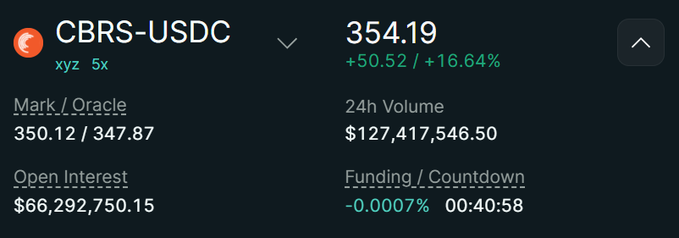
The onchain quote stood ~50% above the official IPO pricing—though still falling short of fully capturing the AI chip frenzy. Yet one trend has clearly emerged: thanks to Hyperliquid, onchain contract pricing is increasingly serving as a leading indicator for U.S. IPOs—a notion previously unimaginable.
Onchain Pre-IPO: Price Discovery Before Market Open
Many people see the term “Pre-IPO” and instinctively think of IPO subscription (i.e., “new share allocation”).
But this has nothing to do with traditional U.S. IPO subscriptions.
Per Trade.xyz’s official documentation, Pre-IPO perpetual contracts (IPOP) are cash-settled derivative instruments that confer no equity stake, provide no IPO allocation rights, and do not represent tokenized shares in any form. They carry no ownership rights, voting rights, or dividend entitlements. In short, they merely allow speculation on a company’s post-listing stock price direction.
The pricing mechanism also differs from standard perpetuals. With no external oracle available pre-listing, these contracts rely entirely on Hyperliquid’s internal, market-driven pricing—where prices are determined solely by traders’ buy/sell orders. Funding rates are calculated based on an exponentially weighted moving average of the prior day’s mark price.
In simple terms: there is no “correct price”—the market decides what something is worth.
This explains why Arthur Hayes’s observed onchain price of $277 diverged so significantly from the actual $350 opening price. Onchain traders set a price—but without access to roadshow materials, institutional subscription multiples, or underwriter book-building data, their pricing relies on sentiment and博弈 rather than information.
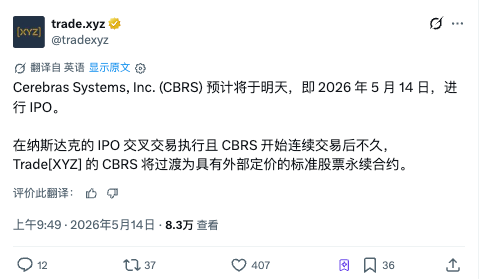
Once the company completes its listing and sufficient external market data becomes available, Pre-IPO contracts automatically convert into standard stock perpetuals, integrating real-time stock price oracles. Positions remain unchanged—no need to close and reopen.
For users accustomed to onchain trading, the operational barrier is virtually zero: just connect a wallet with USDC to Hyperliquid and start trading. As the largest HIP-3 deployer within the Hyperliquid ecosystem, Trade.xyz secured official authorization from S&P Dow Jones Indices in March and launched its S&P 500 perpetual contract. Its Pre-IPO product represents its latest innovation—with CBRS as the first test case.
According to Trade.xyz’s risk disclaimer, when transitioning from Pre-IPO to standard perpetuals, the mark price may experience a discontinuous jump. If positions are near the maintenance margin level, such jumps could trigger immediate liquidation. Additionally, liquidity is inherently limited pre-IPO, resulting in substantial slippage for large orders.
Hence, this is definitively not IPO subscription—it’s placing bets on an unlisted stock within a venue with no price limits, no circuit breakers, and 24/7 operation. The upside? The market never closes. The downside? The market never closes.
A New Catalyst for HYPE?
While CBRS’s Pre-IPO contract generated significant buzz, focusing solely on this one product would underestimate the scale of what’s unfolding. Over the past week, Hyperliquid has seen a concentrated wave of positive developments—and CBRS is merely the most visible among them.
On May 12, asset management firm 21Shares launched THYP on the Nasdaq—the first HYPE spot ETF in the U.S. market. According to Bloomberg analyst James Seyffart, it recorded $1.8 million in first-day trading volume and $1.2 million in net inflows, with a management fee of just 0.3%—the lowest among comparable products.
Two days later, on May 14—the same day CBRS listed on the Nasdaq—Coinbase announced it would serve as Hyperliquid’s official USDC treasury deployer, directly managing onchain stablecoin liquidity, and acquired the USDH brand assets formerly operated by Hyperliquid’s Native Market.
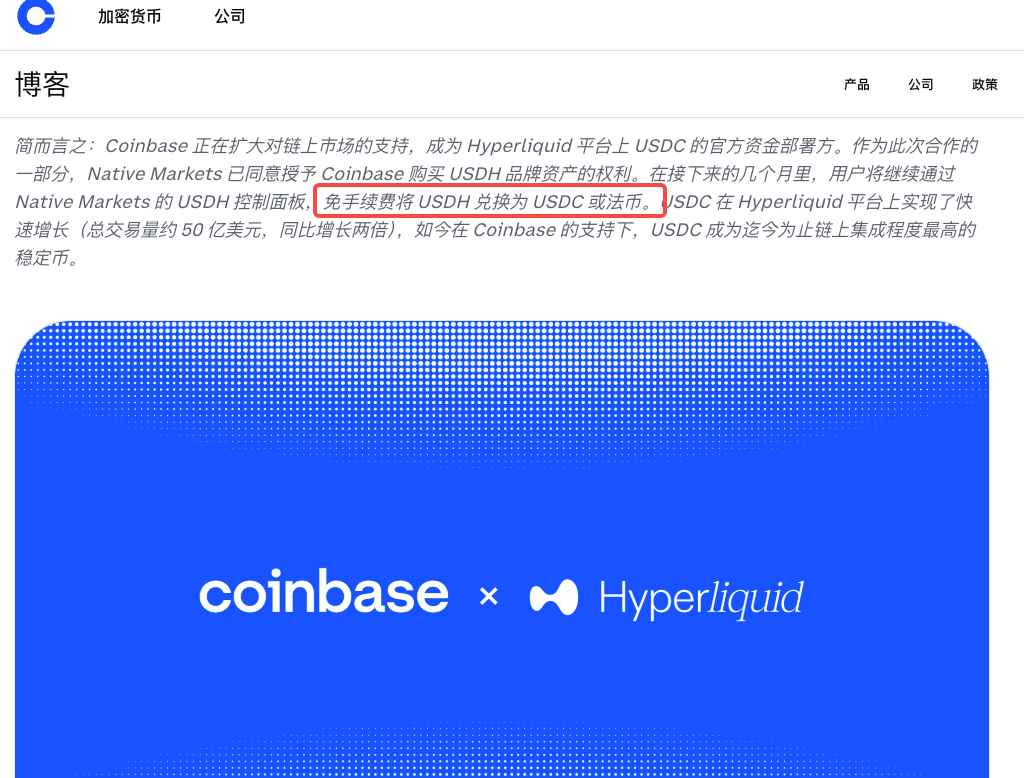
USDC supply on Hyperliquid has now reached approximately $5 billion—doubling year-on-year. On the same day, Circle expanded its infrastructure role for USDC on Hyperliquid and staked an additional 500,000 HYPE tokens, advancing toward validator node status. Meanwhile, Hong Kong–based HashKey Exchange launched OTC trading for HYPE on the same day.
(See also: How Hyperliquid Tapped Into Circle’s Treasury—By Taxing Issuers at the Distribution Channel?)
Historically, Hyperliquid has been perceived as a top-tier onchain perpetuals exchange—fast at launching new tokens, aggressive in whale trading—but ultimately still a crypto-native trading venue.
This week’s developments point in another direction: Traditional capital now has an entry point via ETFs; stablecoin infrastructure is being taken over by institutional players like Coinbase; and tradable assets have expanded beyond crypto into traditional equities. Taken together, these changes signal a broader identity shift.
Turning back to HYPE itself:
Over the past 18 months, HYPE’s narrative has centered on “the best onchain perpetuals exchange.” It’s a solid story—Hyperliquid indeed commands over half the onchain derivatives market share, generating over $56 million in monthly fees (per DeFiLlama), with over 95% of those fees used to buy back and burn HYPE—a top-tier cash flow engine in the DeFi world.
Following the $CBRS launch, however, its positioning may be evolving.
If you explain Hyperliquid to someone by saying, “It’s the place where you can trade U.S. IPOs two weeks before they list,” that framing likely resonates more broadly than purely crypto-native narratives.
An onchain protocol’s contract pricing is gradually influencing the core pricing process of traditional finance—even if liquidity and actual trading volumes remain uncertain, this phenomenon is undeniably happening.
The author believes this matters for HYPE because it now possesses something it lacked before: a story that requires no five-minute explanation for outsiders to grasp.
In crypto markets, such instantly understandable narratives are rarer—and often more undervalued—than commonly assumed.
Recall: in every market cycle, the tokens that surged most aggressively typically possessed a one-sentence narrative core. Pre-IPO contracts have given HYPE exactly that—and currently, it’s the only token with such a narrative.
Hyperliquid’s biggest current obstacle is its U.S. user ban, effectively excluding the world’s largest capital market from accessing the platform. Yet simply opening up the world’s hottest asset class—the U.S. equity market—to non-U.S. users via onchain perpetuals constitutes a distinct and powerful niche.
As for how badly “the rest of the world” wants exposure to U.S. equities—just look at the intensity of FOMO across crypto Twitter over the past two days.
There will likely be further opportunities to validate this narrative.
SpaceX, OpenAI, and Anthropic are all rumored to be planning IPOs this year. If their Pre-IPO contracts also appear on Hyperliquid, each launch would reinforce this story anew—though that remains conditional.
Join TechFlow official community to stay tuned
Telegram:https://t.me/TechFlowDaily
X (Twitter):https://x.com/TechFlowPost
X (Twitter) EN:https://x.com/BlockFlow_News
 深潮TechFlow