Trump Conducted 3,600 Stock Trades in Q1; “Shouted Out” Nvidia and Dell After Buying—Conflict-of-Interest Controversy Erupts
TechFlow Selected TechFlow Selected
Trump Conducted 3,600 Stock Trades in Q1; “Shouted Out” Nvidia and Dell After Buying—Conflict-of-Interest Controversy Erupts
An average of about 60 transactions per day, breaking the precedent set by all U.S. presidents since Johnson of using “blind trusts.”
 Navigating Web3 tides with focused insights
Author: Claude, TechFlow
TechFlow Intro: Donald Trump’s newly disclosed OGE Form 278-T reveals he executed 3,642 stock trades in Q1 2026—roughly 60 per day—breaking the long-standing precedent of “blind trusts” used by U.S. presidents since Lyndon B. Johnson.
The disclosure shows that after buying $1–5 million worth of Dell stock on February 10, Trump publicly urged Americans to “buy Dell” during a White House event on May 8—a statement followed by a 96% surge in Dell’s share price. Multiple other trades—including in NVIDIA and Intel—occurred shortly before relevant policy actions, fueling rapid escalation of conflict-of-interest concerns.
Trump’s personal stock trading ledger is fast becoming one of Washington’s most controversial documents.
According to Benzinga, Office of Government Ethics (OGE) filings released this week show Trump executed 3,642 securities transactions in Q1 2026—averaging about 58 per day. The 113-page OGE Form 278-T was signed and certified by Trump on May 8 and delivered to the OGE on May 12. A handwritten note on the cover page reads, “Filer has paid late-filing fees,” indicating Trump missed the federal regulatory filing window of 30 to 45 days.
This volume of trading breaks the near-continuous tradition of blind trust arrangements adopted by presidents since Lyndon B. Johnson. Most prior presidents placed their personal assets into qualified blind trusts to mitigate conflicts of interest: Jimmy Carter liquidated his peanut farm; Barack Obama held only Treasury bonds and index funds; and Joe Biden likewise used a blind trust during his presidency.
Massive Tech Giant Sell-offs, Heavy Bets on AI Chip Supply Chain
The disclosure shows Trump significantly reduced holdings in Amazon, Meta, and Microsoft—all listed in the $5–25 million valuation range. Yet while selling aggressively, he retained smaller positions in all three via new purchases.
More striking is the direction of his new positions. In the $1–5 million range, Trump opened new stakes in NVIDIA (NVDA), Broadcom (AVGO), Synopsys (SNPS), Cadence Design Systems (CDNS), and Texas Instruments (TXN)—covering nearly every core segment of the U.S. AI chip supply chain. Large purchases in Apple, Oracle, ServiceNow, Adobe, and Workday also fell within the same valuation bracket.
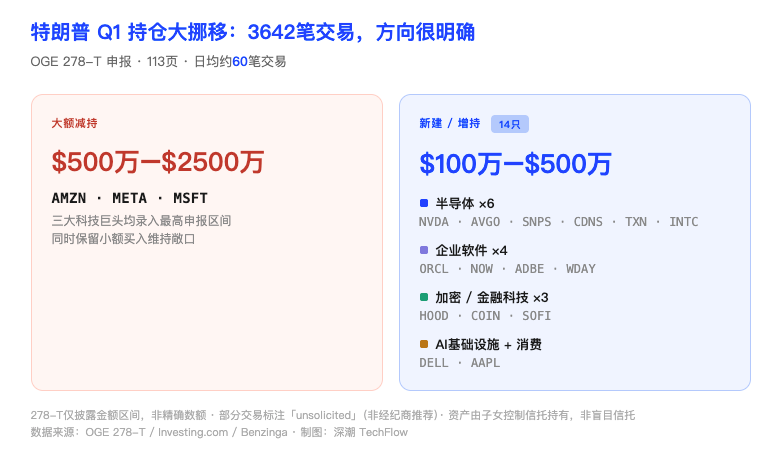
His semiconductor holdings closely align with White House policies promoting domestic chip manufacturing capacity. According to Quiver Quantitative analysis, Trump’s NVIDIA purchase occurred just before CEO Jensen Huang accompanied Trump on a trip to China—an anticipated visit focused on AI chip exports and semiconductor policy discussions.
“Buy Dell” Endorsement Three Months After Purchase—Stock Up 96%
The conflict-of-interest controversy centers squarely on Dell.
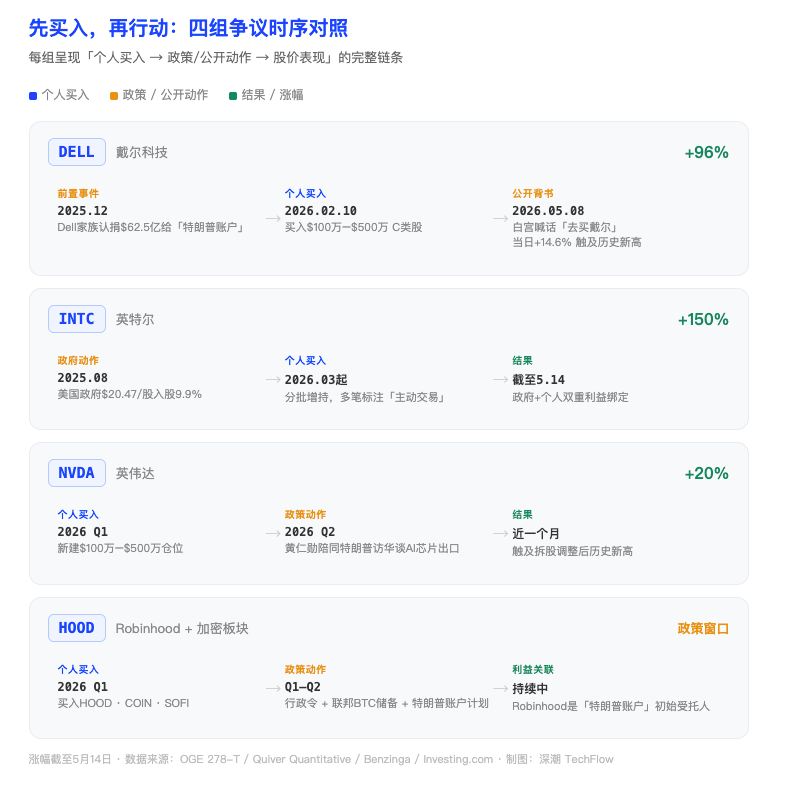
The filing shows Trump bought $1–5 million worth of Dell Technologies Class C stock on February 10, 2026. On May 8—three months later—at a Mother’s Day event at the White House, Trump publicly thanked Michael Dell and Susan Dell and told attendees, “Go buy Dell”—a remark that triggered widespread backlash.
Dell’s stock surged as much as 14.6% intraday, hitting an all-time high of $263.99. Since Trump’s purchase, its share price has risen 96%.
Another timeline detail intensifies the controversy: On December 2, 2025, Michael and Susan Dell donated $6.25 billion to the “Trump Accounts”—one of the largest private donations ever made to an incumbent president’s signature initiative. The White House has not responded to questions about whether coordination existed between the president’s public endorsement and the Dells’ donation.
Intel Purchase Followed by 150% Surge—U.S. Government Holds 9.9% Stake
Trump’s Intel trade also warrants scrutiny.
Starting in early March 2026, Trump began accumulating Intel shares in multiple tranches, many labeled “unsolicited”—i.e., not recommended by brokers. Since his first purchase on March 2, Intel’s stock has surged 150%.
Prior to that, in August 2025, the U.S. government purchased 433.3 million Intel shares at $20.47 per share, acquiring a 9.9% stake. In other words, Trump simultaneously advanced government investment in Intel as president—and bought Intel stock personally on the open market.
Meanwhile, purchases of Coinbase, Robinhood, and SoFi occurred during a window when the administration actively advanced crypto-friendly policies—including executive orders, a federal Bitcoin reserve, and the “Trump Accounts” retirement plan. Robinhood serves as the initial trustee for that plan.
Non-Blind Trust Sparks Constitutional Debate—White House Declares Compliance
Critics view the temporal overlap among these trades as evidence of heightened conflict-of-interest risk. The White House counters that the disclosures fully comply with the requirements of the STOCK Act.
Trump’s assets are held in a trust controlled by his children—but the latest filing shows numerous trades were executed by brokers acting as agents. The document does not specify which accounts hold the positions or who issued the trade instructions.
An OGE spokesperson declined to comment on whether the trades reflect Trump’s direct activity or transactions conducted through managed accounts, stating only that “the OGE is committed to transparency and citizen oversight of government.”
According to Quiver Quantitative analysis, to their knowledge, this marks Trump’s first time actively trading individual stocks while in office. His prior 278-T filings—dominated by conservative bond allocations—have been completely upended.
Join TechFlow official community to stay tuned
Telegram:https://t.me/TechFlowDaily
X (Twitter):https://x.com/TechFlowPost
X (Twitter) EN:https://x.com/BlockFlow_News
 深潮TechFlow