








Trump, the World’s Largest Oil Trader
TechFlow Selected TechFlow Selected
Trump, the World’s Largest Oil Trader
Regardless of the outcome, he will not lose money.
 Navigating Web3 tides with focused insights
Author: David, TechFlow
How much is a single social media post worth?
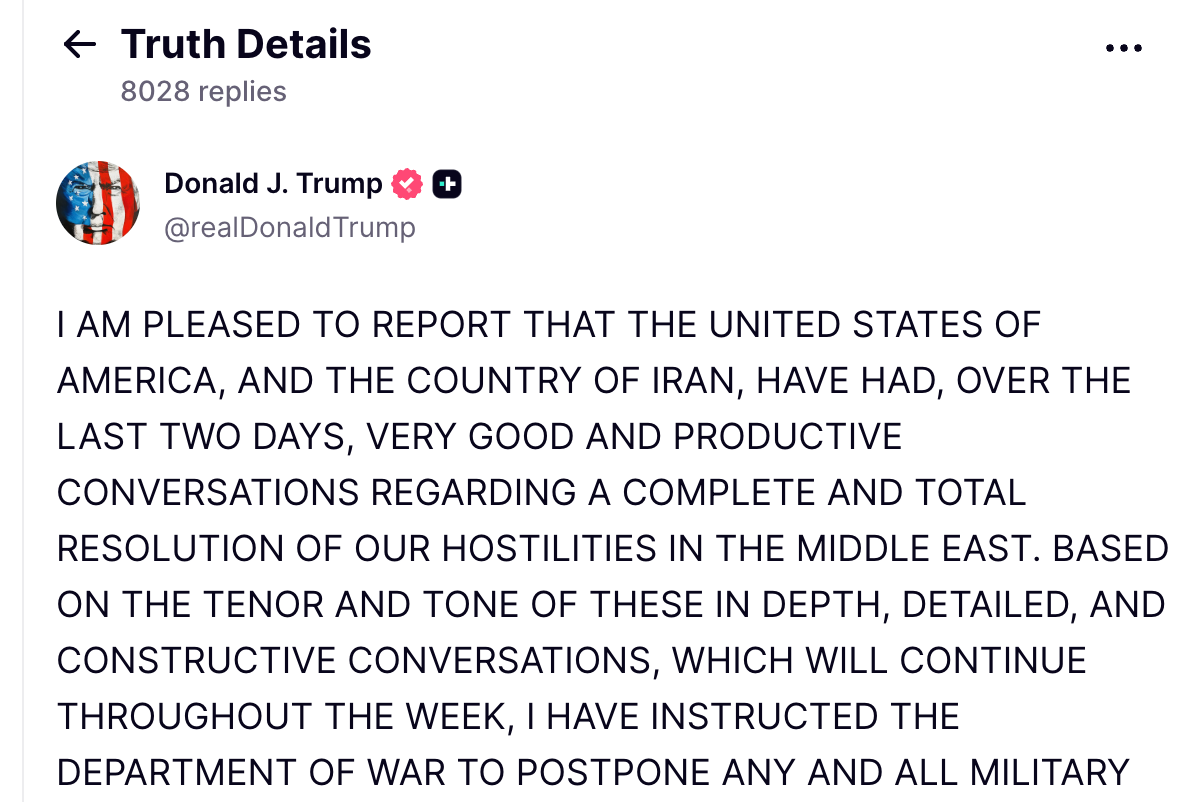
At 7:05 a.m. Eastern Time on March 23, Donald Trump posted an all-caps message on Truth Social stating that the U.S. and Iran had held “very good, productive talks” over the past two days—and that he had ordered a five-day pause in strikes against Iranian power plants and energy infrastructure.
The post went live before U.S. stock markets opened—but futures markets operate in real time.
Within minutes, Dow Jones futures surged over 1,000 points, and S&P 500 futures jumped 2.7%. Brent crude plummeted from $113 to $98 per barrel—a drop exceeding 13%.
According to Fortune magazine, by the time markets fully digested the news, the total market capitalization of U.S. equities had increased by roughly $1.7 trillion.
If you were an ordinary trader and posted a message about oil supply on social media that triggered a 13% global oil price collapse, regulators would likely knock on your door within 24 hours.
But if you’re the President of the United States, it’s called diplomacy.
Then Iran said: We never spoke with him.
Iran’s state-run news agency quoted a security official saying there had been no direct or indirect dialogue between Tehran and Washington. Iranian scholar Seyed Mohammad Marandi wrote even more bluntly on X:
“Every week at market open, Trump issues such statements to suppress oil prices. This time, he even timed the five-day pause precisely to coincide with the close of the energy trading week.”
When the news reached U.S. markets, nearly half the earlier gains evaporated. Yet by market close, the Dow still rose 631 points, and Brent crude settled at $99.94—the first time since March 11 it had fallen below $100. In other words, markets chose to believe Trump’s version—at least halfway.
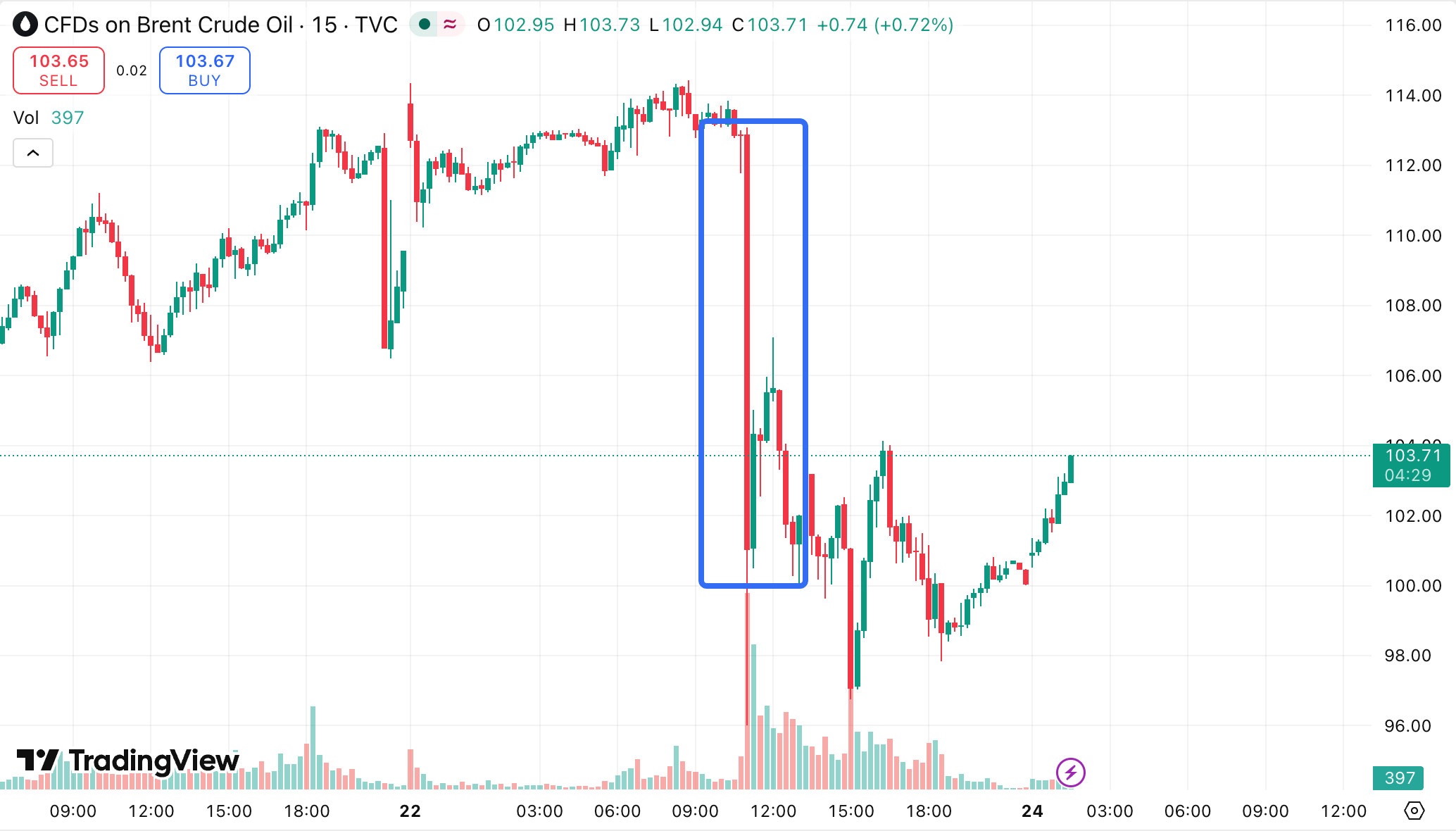
A single post. One hour. Trillions of dollars swinging back and forth.
This isn’t so much a presidential diplomatic statement—it’s the world’s largest oil trader placing an order.
And his tools aren’t futures contracts. They’re the U.S. military and Truth Social. Other traders go long or short with money; he flips the switch on war.
According to CNBC, approximately 15 minutes before the post—around 6:50 a.m. New York time—both S&P 500 and crude oil futures experienced an unusual, simultaneous spike in trading volume.
In the thin pre-market liquidity environment, such an isolated, sudden surge stands out sharply.
Fifteen minutes later, the post dropped—oil crashed, and equity indices soared. Whoever traded at 6:50 a.m. made money after 7:05 a.m. In commodities markets, precisely establishing positions ahead of major news is one of the most classic forms of insider trading.
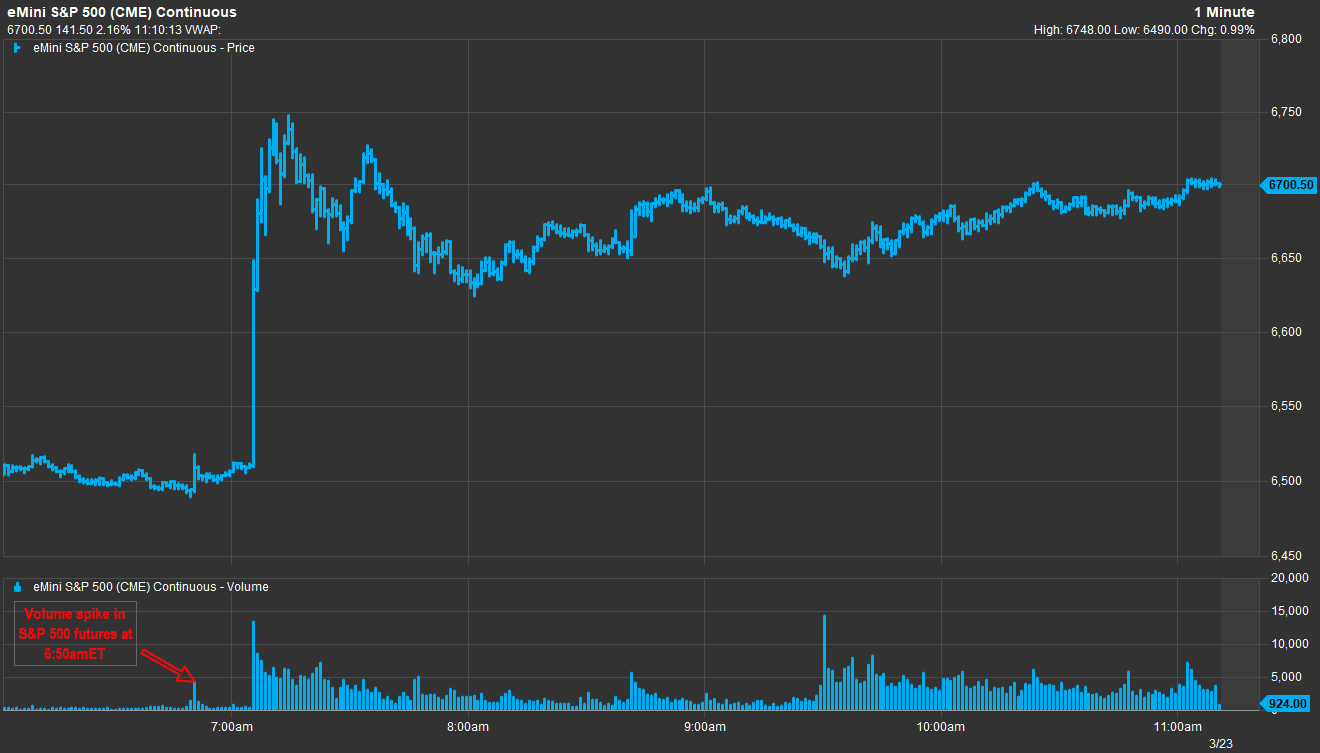
Source: CNBC, S&P 500 pre-market volume surge
Last April, when Trump’s erratic tariff policy announcements caused severe market volatility, Senator Adam Schiff publicly asked: Who knew what the president was going to post—before he posted it? That time, no answer was given.
This time, CNBC contacted both the SEC and the Chicago Mercantile Exchange—their responses were identical: “No comment.”
And this isn’t the first time. Looking back, Trump’s ability to move oil prices with his mouth has spanned nearly a decade.
The Mouth Business
Trump began discussing oil prices on social media as early as 2011—long before becoming president. Railing against OPEC for market manipulation was routine. But ranting on Twitter as a real estate developer is fundamentally different from manipulating oil prices.
What truly transformed him from “commentator” to “trader” was a deal in 2020.
Early that year, the pandemic brought the global economy to a standstill, triggering a cliff-edge collapse in oil demand. Compounding the crisis, Saudi Arabia and Russia launched a price war—flooding the market with supply to seize market share—sending oil prices plunging to just over $20 per barrel. U.S. shale companies collapsed en masse, and the entire industry fell into despair.
Under normal logic, low oil prices benefit consumers—gasoline gets cheaper. A president concerned with voter welfare should welcome that.
Trump did the opposite.
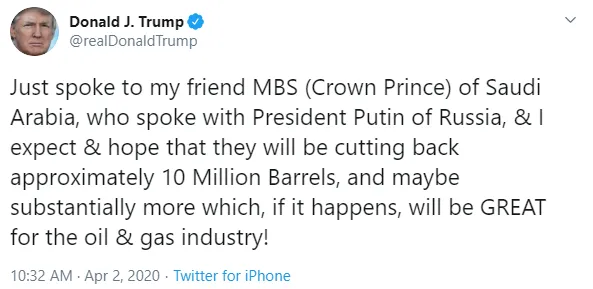
He summoned a room full of oil company CEOs to the White House. Then he personally called Saudi Crown Prince Mohammed bin Salman and Russian President Vladimir Putin—persuading them, along with OPEC, to enact massive production cuts. The sole objective:
To push oil prices back up.
He then tweeted a hint that a production-cut agreement was imminent—prompting WTI crude to surge 25% that day, its largest single-day gain ever.
Why rescue oil prices? Because the shale executives on the brink of bankruptcy were among his largest political donors.
Public reports noted that oil billionaire Harold Hamm lost $3 billion in personal wealth during the crash—and immediately lobbied Trump for intervention. NBC’s headline was stark: “Trump wanted lower oil prices—now he’s negotiating price hikes with oil executives.”
The essence of this deal was simple: Global consumers pay for higher oil prices, the proceeds flow to his political donors, and he collects campaign funding for his next run.
If it ended there, it could be classified as “political quid pro quo.” But Trump did something no politician ever does—he openly admitted it.
At subsequent campaign rallies, he repeatedly told cheering crowds:
“We drove oil prices too low, and had to bail out oil companies. I called OPEC—I called Russia and Saudi Arabia—and told them, ‘Prices need to go up.’”
The crowd roared.
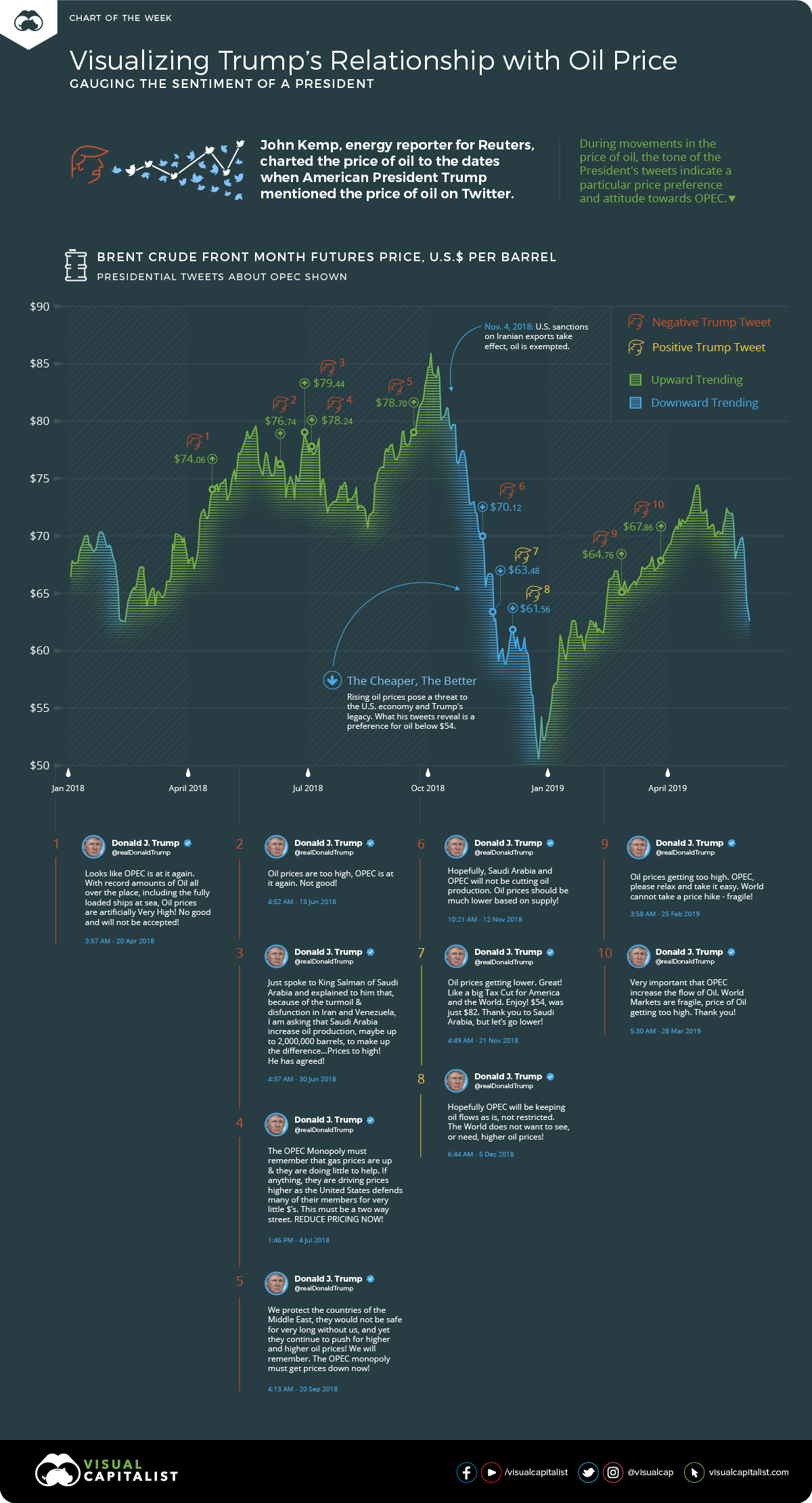
Source: Visual Capitalist
In 2023, the academic journal Energy Policy published a study analyzing every Trump social media post related to oil—from his 2015 presidential announcement through his account suspension in 2021.
The conclusion: His tweets demonstrably impacted WTI crude futures prices—and significantly amplified speculative activity in the market.
In other words, academia confirmed—with data—what every trader already knew: This man’s mouth moves global oil prices. And the 2020 episode proved he doesn’t just *can* do it—he *will*, and his motivation isn’t national interest, but his own network of interests.
From his first term to now, Trump’s oil-trading toolkit has upgraded: Twitter became Truth Social; railing against OPEC evolved into pausing airstrikes on Iran…
But the logic remains unchanged: Leverage the president’s unique informational advantage and policymaking authority to engineer price volatility in the world’s largest commodity market.
From Mouth to Hand
Over the past decade, Trump earned money in oil markets purely through “influence.”
One utterance—and others profited or lost. He himself collected political capital. But in 2026, the nature of this business began shifting.
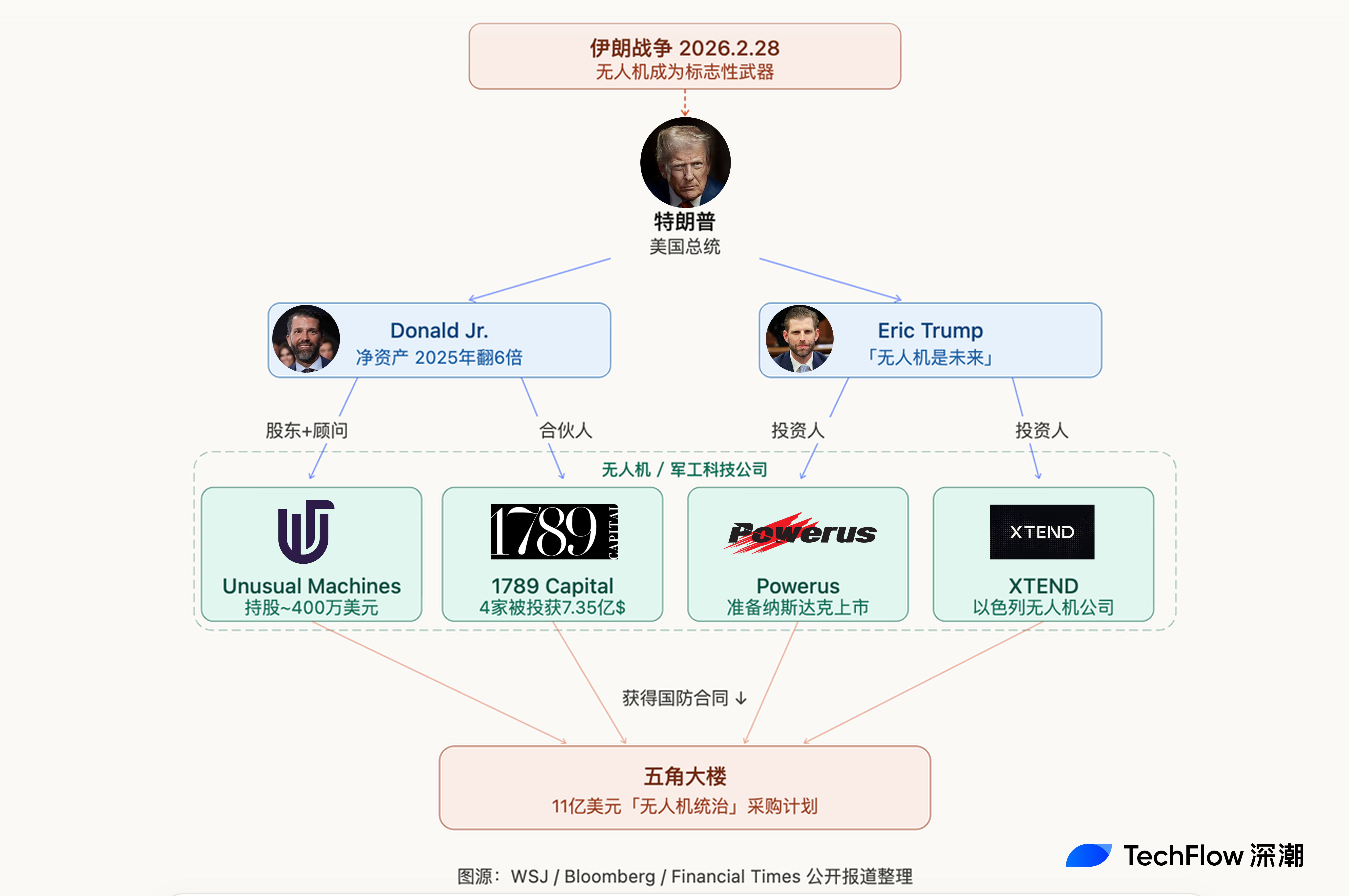
Early this March, both The Wall Street Journal and Bloomberg reported the same story: Trump’s two sons—Donald Jr. and Eric Trump—are investing in Powerus, a military drone company.
Donald Jr. is also a shareholder and member of the advisory board at Unusual Machines, a drone components firm, holding approximately 330,000 shares valued at around $4 million.
He joined the company in November 2024—just weeks after his father won the election—and had zero prior experience in drones or defense industries.
Unusual Machines subsequently secured a U.S. Army contract to produce 3,500 drone motors—and the military indicated plans to order an additional 20,000 parts in 2026.
Donald Jr. is also a partner at venture capital firm 1789 Capital. According to the Financial Times, in 2025 alone, at least four portfolio companies under 1789 Capital received defense contracts from the Trump administration—totaling over $735 million.
Forbes estimates Donald Jr.’s personal net worth stood at roughly $50 million when he assumed office in January 2025—and had multiplied sixfold by year-end.
Then, on February 28, 2026, his father launched war against Iran.
Drones were the signature weapon of this conflict. As reported by The New York Times, both sides deployed drones extensively—each costing only a fraction of traditional missiles. The Pentagon is advancing an $1.1 billion procurement program aiming to deploy over 200,000 U.S.-made attack drones by 2027.
Days into the war, Eric Trump posted on X: “Drones are the future.”
The conflict of interest is glaring. A president’s son enters the defense industry after his father takes office, invests in firms awarded contracts by his father’s administration—and his father wages a war consuming massive quantities of those very products.
It’s no longer just oil. The Trump family business has expanded into war itself. Oil is money Trump earns with his mouth; drones are money his son earns with his hands.
Today marks Day One of the strike pause. In five days, either negotiations yield results—reopening the Strait of Hormuz and sending oil prices lower—or nothing materializes, Iran maintains its blockade, and everything reverts to square one.
The world’s largest oil trader has issued the market a five-day option. Its strike price? War—or peace. No one knows.
But one thing is certain: If oil prices rise, his son’s drone company lands more orders. If oil prices fall, he wins again on Truth Social.
No matter the outcome—he doesn’t lose.
Join TechFlow official community to stay tuned
Telegram:https://t.me/TechFlowDaily
X (Twitter):https://x.com/TechFlowPost
X (Twitter) EN:https://x.com/BlockFlow_News
 深潮TechFlow


