








The “Trump-Bessent-Wash” combination leaves us extremely optimistic about 2026.
TechFlow Selected TechFlow Selected
The “Trump-Bessent-Wash” combination leaves us extremely optimistic about 2026.
Now is not the time to give up—the liquidity cavalry is about to arrive.
 Navigating Web3 tides with focused insights
By Raoul Pal
Translated by AididiaoJP, Foresight News
The Core Narrative
The prevailing mainstream narrative right now is that BTC and crypto have collapsed—and the cycle is over. Crypto has “decoupled” from other assets; people blame CZ, BlackRock, or even the heavens and earth. This narrative is indeed highly persuasive—especially when we watch prices plummet day after day.
But yesterday, a hedge fund client asked me: “SaaS stocks are on sale—should I buy? Or is it true, as widely rumored, that Claude Code has already sentenced SaaS to death?”
So I dug deeper…
And discovered that neither narrative holds up. The price charts for SaaS and BTC are virtually identical—strange, isn’t it?
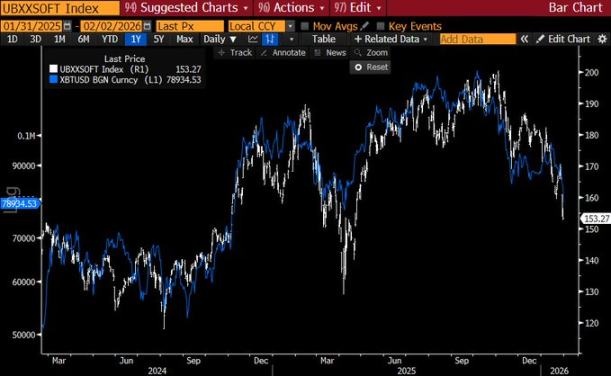
UBS SaaS Index vs. BTC
This suggests another critical factor—previously overlooked—is at work behind the scenes.
That factor is U.S. liquidity, which has been persistently constrained due to two government shutdowns and internal issues within the U.S. financial system (the reverse repo program effectively ended in 2024). When the Treasury General Account (TGA) was replenished in July and August, no currency hedging occurred—effectively draining liquidity.
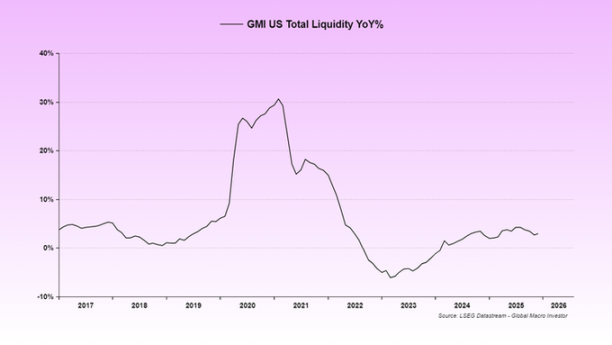
Given such persistently weak liquidity, it’s unsurprising that ISM data remains depressed.
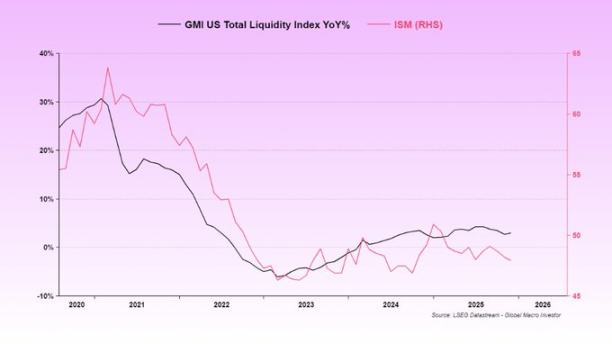
We usually focus more on global aggregate liquidity, since its long-term correlation with BTC and the Nasdaq is strongest. But at this stage, U.S. aggregate liquidity appears to matter more—after all, the U.S. is the world’s primary source of liquidity.
In this cycle, global liquidity leads U.S. liquidity: once it rebounds, U.S. liquidity—and ISM—will follow.
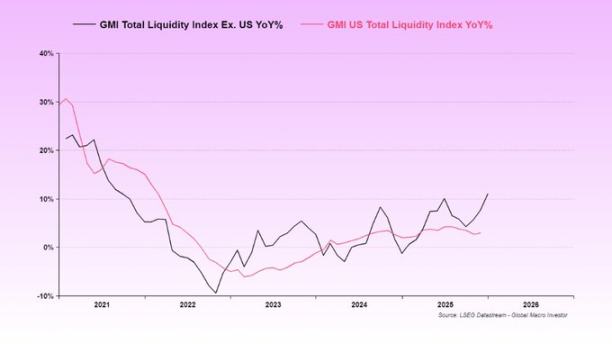
And this is precisely what’s affecting both SaaS and BTC: temporary liquidity tightening hits them first.
Gold’s rally has further siphoned off marginal liquidity that might otherwise have flowed into BTC and SaaS. With insufficient liquidity to go around, the riskiest assets suffer first—a harsh reality.
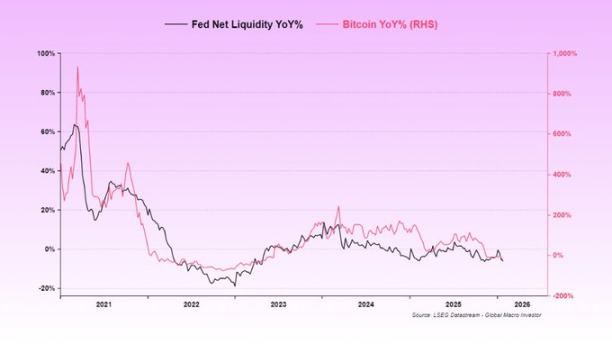
Now, the U.S. government has shut down again… The Treasury anticipated this: after the last shutdown, it didn’t draw down the TGA at all—in fact, it deposited even more funds into it (effectively withdrawing yet another round of liquidity).
This is the liquidity “fault line” we’re currently facing—explaining why prices look so ugly. Our beloved crypto assets won’t see fresh liquidity just yet.
However, signs indicate the shutdown will be resolved within this week—marking the final liquidity hurdle.
I’ve flagged shutdown risks multiple times before. It will soon become history—and the liquidity we expect will follow: eSLR adjustments, TGA drawdowns, fiscal stimulus, rate cuts… all tied to the midterm elections.
For full-cycle investing, timing often matters more than price. Prices may fall sharply—but as long as the cycle continues, given enough time, everything reverts to its proper place.
That’s why I always say: “Be patient!” Things take time to unfold. Obsessing over daily P&L only tortures you—not your portfolio.
The Fed’s False Narrative
Speaking of rate cuts, there’s also a rumor that Kevin Warsh is a hawk—but those views date back twenty years.
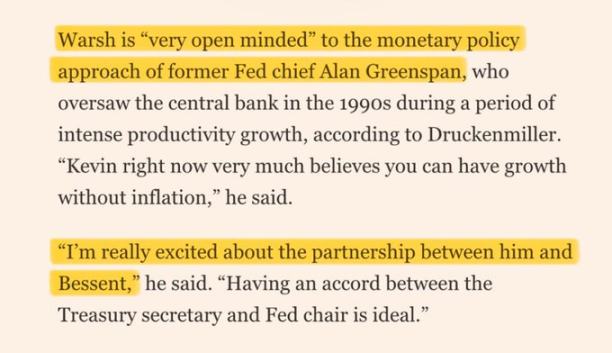
Warsh’s mandate is to execute Greenspan-era strategy: cut rates to heat up the economy, trusting AI-driven productivity gains to contain core inflation—just like between 1995 and 2000.
He does dislike the bloated balance sheet—but system reserves have already hit rock bottom, making it unlikely he’ll change course. He dares not—otherwise, credit markets would collapse.
Warsh will do just one thing: cut rates. Everything else—he’ll defer to Trump and Bessent, letting them unleash liquidity through the banking system. Milan will likely push aggressively for an eSLR reduction to accelerate this process.
I know things look dire right now—and sounding bullish feels especially jarring. Our Sui positions feel worthless, and it’s hard to know whom or what to believe.
First, we’ve seen this many times before. When BTC falls 30%, smaller tokens can drop 70%. But if the underlying projects are strong, they rebound faster.
My Question
We failed to recognize that U.S. liquidity is the dominant current driver—normally, global aggregate liquidity takes center stage across the full cycle. But now it’s clear: “Everything is connected” remains in full effect.
There’s no “decoupling”—just a cascade of events we either failed to predict or underestimated: reverse repo exhaustion → TGA replenishment → government shutdown → gold surge → another shutdown.
Yet this phase is finally nearing its end—and normalcy will soon return.
We can’t perfectly forecast every variable—but we understand much better now. We remain extremely optimistic about 2026 because we clearly see the “Trump-Bessent-Warsh” playbook.
They’ve stated it repeatedly. All we need to do is listen—and wait patiently.
Full-cycle investing is about time—not price.
If you’re not a full-cycle investor—and can’t stomach that volatility—that’s perfectly fine. Everyone has their own approach.
Now is not the time to give up. Wishing you all good luck.
Liquidity’s reinforcements are on the way.
Join TechFlow official community to stay tuned
Telegram:https://t.me/TechFlowDaily
X (Twitter):https://x.com/TechFlowPost
X (Twitter) EN:https://x.com/BlockFlow_News
 @RaoulGMI


