








This week, everyone is helping AI open bank accounts.
TechFlow Selected TechFlow Selected
This week, everyone is helping AI open bank accounts.
AI hasn’t yet learned how to spend money, but the people building banks for it have already assembled.
 Navigating Web3 tides with focused insights
Author: David, TechFlow
On March 18, yet another blockchain mainnet went live.
It’s called Tempo—and it’s backed by Stripe and Paradigm. Stripe is one of the world’s largest online payment companies, having processed $1.9 trillion in transactions last year. Paradigm is one of crypto’s largest venture capital firms. Last year, the two jointly invested $500 million into Tempo—valuing the project at:
$5 billion.
A $5-billion blockchain that doesn’t trade tokens, doesn’t build DeFi, and doesn’t launch memes. On its mainnet launch day, Tempo’s highest-profile product announcement was:
Enabling machines to pay other machines.
This may sound abstract—but think of it this way: AI now incurs costs at every step. Calling an API costs money; buying compute resources costs money; pulling a batch of data from a database also costs money…
Yet today’s payment systems are all built for humans: bank accounts require government-issued IDs; credit cards require facial recognition; Alipay demands SMS verification codes.
AI can’t pass any of these checks.
It can complete entire workflows—except when it comes to paying, where it must pause and wait for a human to click “confirm.”

So, alongside the mainnet launch, Tempo introduced an open protocol called MPP (Machine Payments Protocol), co-developed with Stripe.
In simple terms, MPP establishes standardized rules for machine-to-machine transactions—including how to request payments, authorize them, and settle them.
The envisioned use case is that AI agents can spend autonomously within predefined budget limits—no human signature required per transaction. On launch day, over 100 service providers had already integrated, including OpenAI, Anthropic, and Shopify.
But Tempo wasn’t the only player making this move this week.
Within five days, Visa launched a new division and released an AI payment tool; Coinbase upgraded its payment protocol; Mastercard acquired a stablecoin infrastructure company for $1.8 billion; and Sam Altman’s World unveiled a toolkit designed specifically for AI identity verification.
Five industry giants converged on the same door in one week—racing to open bank accounts for AI.
Two Paths, One Door
Tempo focuses on settlement for AI. But settlement is just one component of the full payment stack. For an AI agent to truly spend autonomously, it also needs payment tools, funding rails, and identity verification.
Traditional payment firms and crypto-native companies are both racing to claim this space—using their respective strengths.
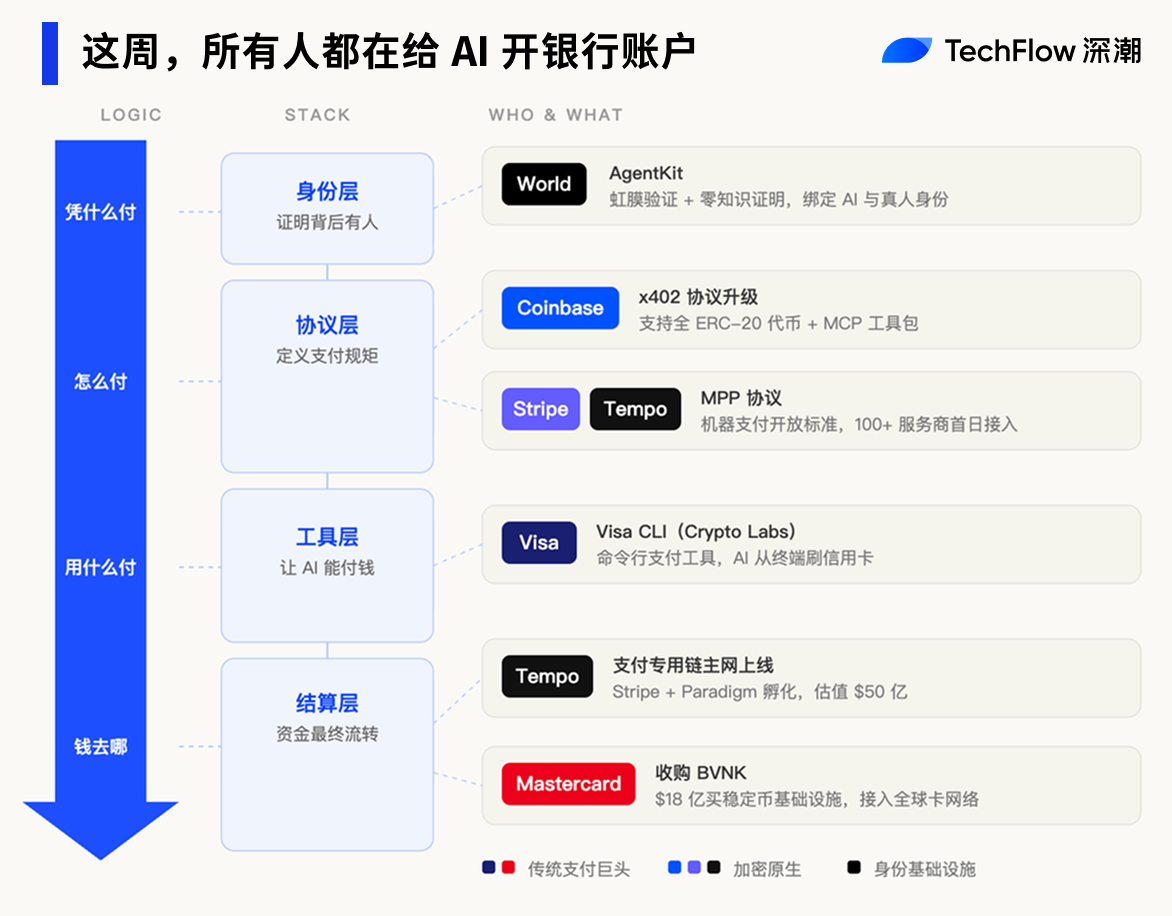
On March 18—the same day Tempo launched its mainnet—payment giant Visa also moved. Its newly formed Crypto Labs division released its first product: Visa CLI, a tool enabling AI agents to initiate credit card payments directly from the terminal.
No API keys. No pre-registration. When an AI running a task needs to purchase a service, it simply executes one command to pay. Visa calls this “command-line commerce.”

Visa’s global card network connects billions of cards and millions of merchants. If AI payments can run atop this existing infrastructure, no new foundational systems need to mature first.
Visa is extending the old road. Its rival Mastercard chose a different route: buying a road outright.
On March 17, Mastercard announced its $1.8 billion acquisition of London-based stablecoin infrastructure firm BVNK—the largest stablecoin acquisition in crypto history.
The intent is straightforward: if AI payments flow through stablecoins, then stablecoins will flow through Mastercard’s pipes.
Crypto-native firms are moving just as aggressively.
Coinbase’s x402 protocol underwent a major upgrade, expanding supported payment assets from a few stablecoins to all ERC-20 tokens—and simultaneously launching the MCP toolkit, enabling developers to integrate AI tools with monetization networks in one click.

At first glance, the two camps appear to be starting from different places—but their actions point toward the same destination: traditional payment firms embracing crypto, and crypto firms embracing AI. Ultimately, crypto infrastructure is becoming the foundational rail for AI payments.
One piece remains. AI can now spend—but how do merchants know whether the AI spending money has a responsible human behind it?
On March 17, Sam Altman’s co-founded company World launched AgentKit, integrated with Coinbase’s x402. Its sole purpose: enabling AI to prove, at the moment of payment, that it is backed by a verified human. Merchants can confirm someone stands behind the transaction—without learning that person’s identity.
In five days, five companies claimed positions across settlement, rails, tools, protocols, and identity.
The AI Cake Is Sliced—Only the Cash Register Remains
Over the past three years, most strategic positions along the AI value chain have been taken.
The model layer belongs to OpenAI, Anthropic, Google, and a host of Chinese firms; compute is locked down by NVIDIA; the application layer—from coding assistants to search engines—is a blood-red sea of competition…
Every layer is crowded—and competitive barriers are rising rapidly.
But the payments layer remains relatively open.
It’s not that no one thought of it—it’s that the timing wasn’t right. AI agent payments require one prerequisite: AI must first be capable of independently completing an end-to-end task chain. If it can only chat, with no need to call APIs, buy compute, or hire other agents, payments aren’t essential.
Over the past year, that prerequisite has begun to materialize.
OpenClaw enables AI to directly operate computers; the MCP protocol allows AI to connect to external services; and large-model agent capabilities saw concentrated breakthroughs in late 2025. AI has evolved from a “conversational tool” into a “working tool”—and working requires spending…
The demand to spend has arrived—but the infrastructure to enable it does not yet exist.
That’s why Stripe, Visa, Mastercard, and Coinbase all moved simultaneously. For traditional payment firms, this is their first home-field advantage in the entire AI wave. They can’t build models. They can’t fabricate chips. But payments? That’s what they’ve done for decades.
Visa’s global card network links billions of cards and millions of merchants; Mastercard operates in over 200 countries; Stripe processed $1.9 trillion in transactions last year. If every AI expenditure flows through these pipes, the more AI works—the more they earn.
For crypto firms, the logic differs.
Coinbase CEO Brian Armstrong once stated bluntly: “AI can own a crypto wallet—but it cannot open a bank account.”
Every step in the traditional financial system verifies “who you are”: opening a bank account requires ID; applying for a credit card requires facial recognition; each transaction demands SMS verification. AI is software—not a person—and fails every one of these gates.
But crypto wallets require none of this. A private key is an account—and for AI agents, on-chain payments represent the path of least resistance.
Whether crypto-native or not, AI payments will constitute a new infrastructure-scale market. The only question is whose rails suit machines best.
The Road Is Built—But the Cars Haven’t Arrived
By this point in the story, everything seems ready—five giants are in position.
Yet one number warrants attention.
Coinbase’s x402 protocol is currently the earliest-deployed and most widely adopted AI payment protocol. According to x402scan data, the ecosystem’s total transaction volume over the past 24 hours stood at $65,400—across 150,000 transactions, averaging less than $0.50 per transaction.
What infrastructure supports this volume? Tempo’s $5-billion valuation; Mastercard’s $1.8-billion BVNK acquisition; Visa’s newly established division; Stripe’s hands-on protocol development.
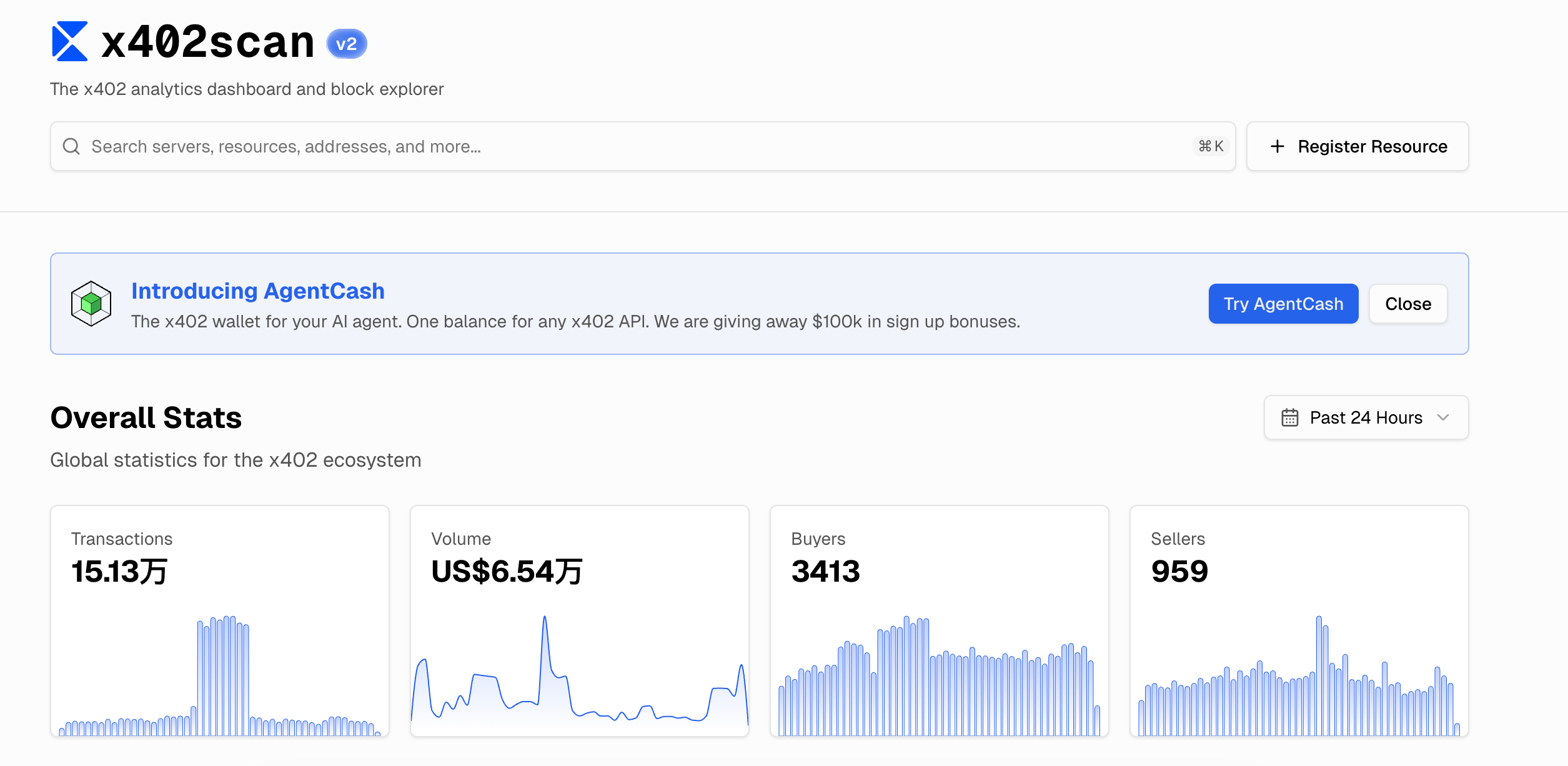
Infrastructure valued in the billions serves a market whose daily transaction volume rivals that of a corner bubble-tea shop.
All infrastructure plays follow this pattern.
On the eve of the 2000 dot-com bubble, telecom companies laid millions of kilometers of fiber-optic cable across ocean floors. After completion, they discovered global internet traffic used only 5% of that capacity. Most of those firms went bankrupt—but the fiber remained.
Ten years later, video streaming and mobile internet filled those pipes. The road-builders didn’t profit—but the roads were real.
AI payments sit at precisely this stage. The underlying logic holds: AI agents are indeed growing more capable; they genuinely need autonomous spending power; and they truly require a new financial infrastructure.
Everyone has lined up at the starting block—but when the starting gun fires, the track appears empty but for oneself.
As for whose road ultimately emerges—or when your first truly autonomous AI transaction arrives in your daily life—that moment may arrive faster—or slower—than anyone expects.
The only certainty is that the race has begun—and your wallet will likely be the last to know.
Join TechFlow official community to stay tuned
Telegram:https://t.me/TechFlowDaily
X (Twitter):https://x.com/TechFlowPost
X (Twitter) EN:https://x.com/BlockFlow_News
 深潮TechFlow


