








Why Are Bitcoin Treasury Companies—Which Once Vowed Not to Sell—Now Selling Their Bitcoin?
TechFlow Selected TechFlow Selected
Why Are Bitcoin Treasury Companies—Which Once Vowed Not to Sell—Now Selling Their Bitcoin?
When the coin price falls, triggering more selling, and the increased selling further depresses the coin price, a downward spiral begins.
 Navigating Web3 tides with focused insights
Author: Gino Matos, CryptoSlate
Translated by: TechFlow
TechFlow Insight: Strategy has publicly signaled it may sell Bitcoin to pay dividends; MARA sold 15,000 BTC to repay debt; Sequans used Bitcoin to settle convertible bonds for two consecutive quarters. The narrative of “never selling” Bitcoin from corporate treasuries is unraveling—these companies are shifting Bitcoin from a “faith-based reserve” to a “liquidity tool.” When falling prices trigger more selling, and selling further depresses prices, a downward spiral begins.
Saylor Softens His Stance: Selling BTC Can Be More Cost-Effective Than Equity Issuance
On its May 5 earnings call, Strategy CEO Phong Le stated outright: “We will sell Bitcoin when it benefits the company.” Michael Saylor added emphasis: Strategy may sell some Bitcoin to fund dividend payments—“to help the market adjust in advance.”
As of May 3, Strategy held 818,334 BTC—an increase of 22% year-to-date—with a market value of $64.14 billion.
What this call truly established is that BTC sales have been formally incorporated into the company’s financial toolkit—and backed by a quantitative framework.
Management set a threshold: when mNAV (market value / net asset value) falls below 1.22x, selling Bitcoin to pay dividends enhances per-share value more than issuing common stock. Saylor’s calculation shows that as long as Bitcoin’s annualized appreciation exceeds 2.3%, Strategy’s current BTC reserves can cover dividends “indefinitely”; even with zero BTC price growth, reserves would suffice for 43 years of dividends.
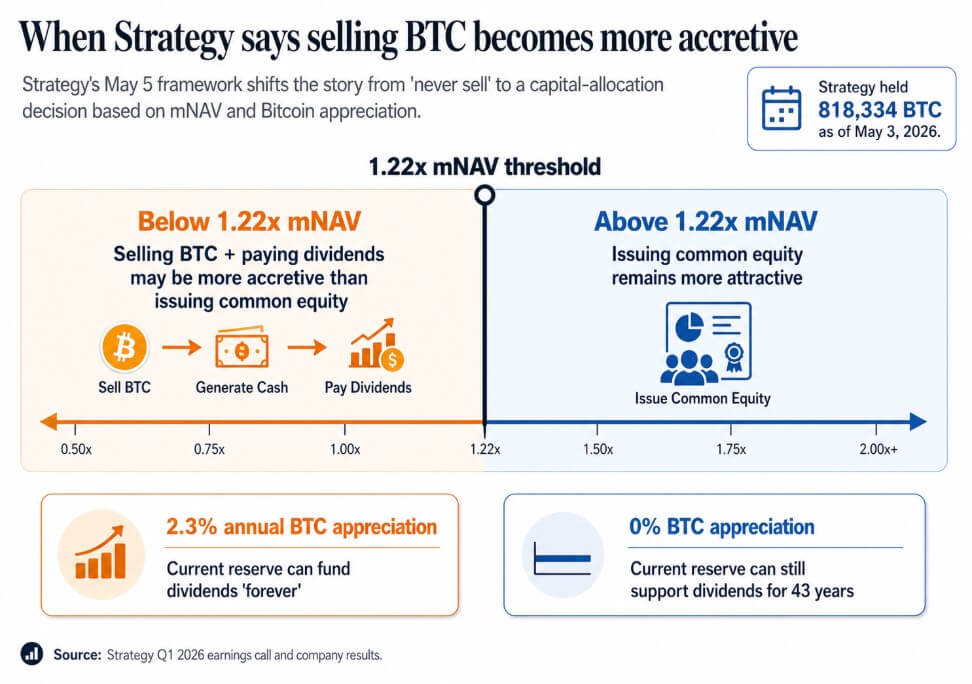
Caption: Strategy’s 1.22x mNAV threshold—when mNAV falls below this line, selling BTC for dividends creates greater per-share value than equity issuance.
The slogan “never sell” has given way to a model: buy when accretive, issue common shares when accretive, issue preferred shares when accretive, sell BTC when accretive. These firms are, in essence, leveraged treasury + credit vehicles.
Investors originally bought these stocks as proxies for Bitcoin—built on scarcity and a promise of permanent holding. The 1.22x mNAV threshold and 2.3% breakeven appreciation rate represent a more honest—and more complex—version of that proposition.
When Bitcoin Becomes Working Capital
Sequans’ Q1 report was even more direct. Revenue declined 24.8% year-on-year to $6.1 million, while operating losses reached $50.5 million. Realized net losses from Bitcoin sales in Q1 totaled $11.7 million; proceeds were primarily used to repay convertible bonds and repurchase ADSs.
As of March 31, Sequans held 1,514 BTC, of which 1,217 BTC served as collateral for $66.2 million in convertible bonds. By April 30, its holdings dropped to 1,114 BTC, with 817 BTC securing $35.9 million in debt (maturing June 1).
This mirrors exactly what Sequans did in November 2025—selling 970 BTC to redeem 50% of its convertible bonds, reducing debt from $189 million to $94.5 million.
For two consecutive quarters, the same pattern: declining revenue, maturing debt, Bitcoin converted into working capital. BTC pledged as collateral was effectively locked into debt obligations well before any active sale decision.
Sequans operates at a completely different scale than Strategy—its underlying business is weaker, its treasury position more fragile. Once Bitcoin must be deployed to service debt, “inventory management” logic takes over entirely.
MARA executed the same move in March—but on a larger scale: selling 15,133 BTC for ~$1.1 billion to repurchase convertible notes, cutting its convertible debt balance by 30% and locking in ~$88.1 million in spread gains.
MARA branded this action “balance sheet optimization,” driven by debt structure and financing terms. This sets a precedent: BTC sales can be capital allocation decisions independent of Bitcoin ideology. The real question becomes—under what conditions is selling the highest-return option?

Bull vs. Bear Divergence: Financing Conditions Rule Everything
If Bitcoin rebounds to Citi’s 12-month base-case target of $112,000—or its bull-case scenario of $165,000—equity premiums for treasury companies will expand, reopening equity issuance windows. Large new purchases could easily absorb tactical BTC sales.
Strategy’s 1.22x mNAV threshold would become a technical detail. Companies like Sequans—facing debt pressure during Bitcoin weakness—could resolve their debt burdens and enter the next cycle with unrestricted BTC holdings.
If Bitcoin falls toward Citi’s downside case of $58,000 (Standard Chartered has flagged a potential path down to $50,000), companies trading near or below NAV would lose the accretive effect of equity issuance.
In that scenario, accumulating preferred share dividend obligations would force BTC sales to shift from capital management to balance sheet defense. Sequans’ model could spread across all treasury companies operating on “thin margins + BTC-collateralized borrowing”—making BTC sales to repay debt, shrinking collateral, and reduced free float the only viable option.
At that point, corporate Bitcoin buying becomes cyclical: falling prices trigger more selling, and more selling drives prices lower.
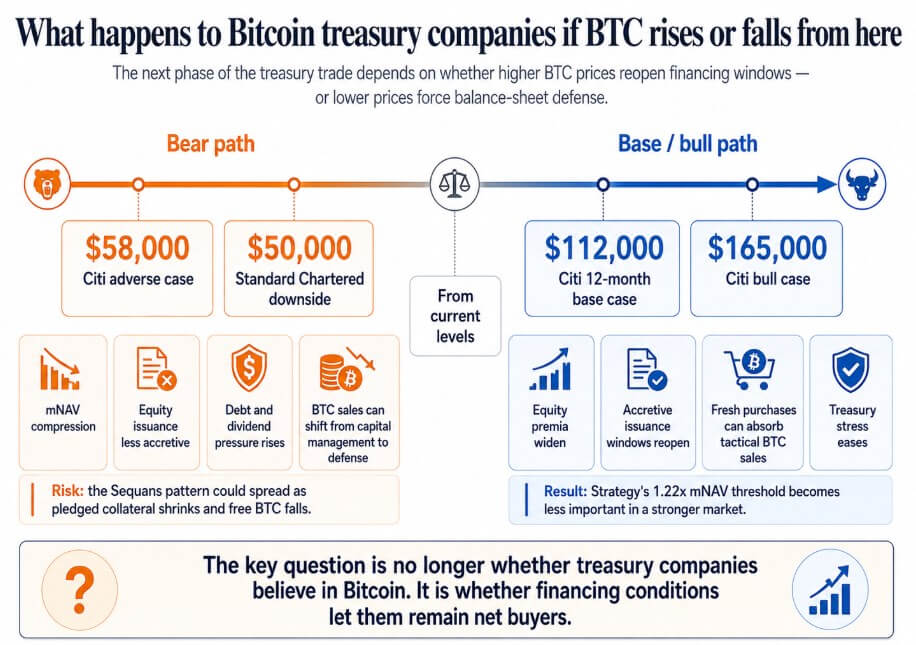
Caption: Two paths for Bitcoin treasury companies—bearish scenario ($50,000–$58,000) brings balance sheet stress; bullish scenario ($112,000+) eases financing pressure.
Corporate Bitcoin treasury strategies were built on the promise of “permanent holding,” allowing investors to price these firms as Bitcoin proxies. Once selling becomes an openly acknowledged tool within the model, investors must incorporate debt maturities, collateral requirements, dividend obligations, and management’s mNAV threshold for choosing BTC sales over equity issuance into their valuations.
Saylor’s 2.3% annualized breakeven and 1.22x mNAV threshold are more transparent. In the next phase of corporate Bitcoin treasury activity, financing conditions will carry no less weight than Bitcoin ideology.
Join TechFlow official community to stay tuned
Telegram:https://t.me/TechFlowDaily
X (Twitter):https://x.com/TechFlowPost
X (Twitter) EN:https://x.com/BlockFlow_News
 @CryptoSlate


