U.S. Military Confirms Operation of Bitcoin Node; Four-Star General Calls It a “Force Projection Tool”
TechFlow Selected TechFlow Selected
U.S. Military Confirms Operation of Bitcoin Node; Four-Star General Calls It a “Force Projection Tool”
This is the first time the U.S. military’s Combatant Command has publicly confirmed its direct involvement in the Bitcoin peer-to-peer network.
 Navigating Web3 tides with focused insights
Author: Thursday, TechFlow
TechFlow Summary: This week, Admiral Samuel Paparo, Commander of U.S. Indo-Pacific Command (INDOPACOM), testified consecutively before the Senate and House Armed Services Committees, confirming that the command is operating a Bitcoin network node and conducting cybersecurity “live-fire testing.”
He characterized Bitcoin as a “computer science tool” and a “tool of power projection,” not a financial asset. This marks the first time a U.S. combatant command has publicly confirmed direct participation in the Bitcoin peer-to-peer network; the Pentagon’s narrative around Bitcoin is shifting—from “combating illicit finance” to “national defense–grade technological asset.”
The U.S. military’s characterization of Bitcoin is undergoing a fundamental shift.
According to a Bitcoin Magazine report dated April 22, Admiral Samuel Paparo, Commander of U.S. Indo-Pacific Command (INDOPACOM), testified this week before both the Senate and House Armed Services Committees, confirming that INDOPACOM is currently running a full Bitcoin network node and conducting a series of military cybersecurity tests based on the Bitcoin protocol. Paparo is the top commander of the largest of the U.S. military’s six unified combatant commands, overseeing approximately 380,000 service members across the Indo-Pacific theater—a region covering half the Earth’s surface.
In his testimony, Paparo explicitly defined Bitcoin as a “computer science tool” and a “tool of power projection,” not a speculative financial asset. This is the first time a senior U.S. military officer has offered such a characterization of Bitcoin in a public congressional setting—and the first known instance of a U.S. combatant command confirming direct participation in the Bitcoin peer-to-peer network.
Senate Testimony: Bitcoin Is a “Tool of National Power”
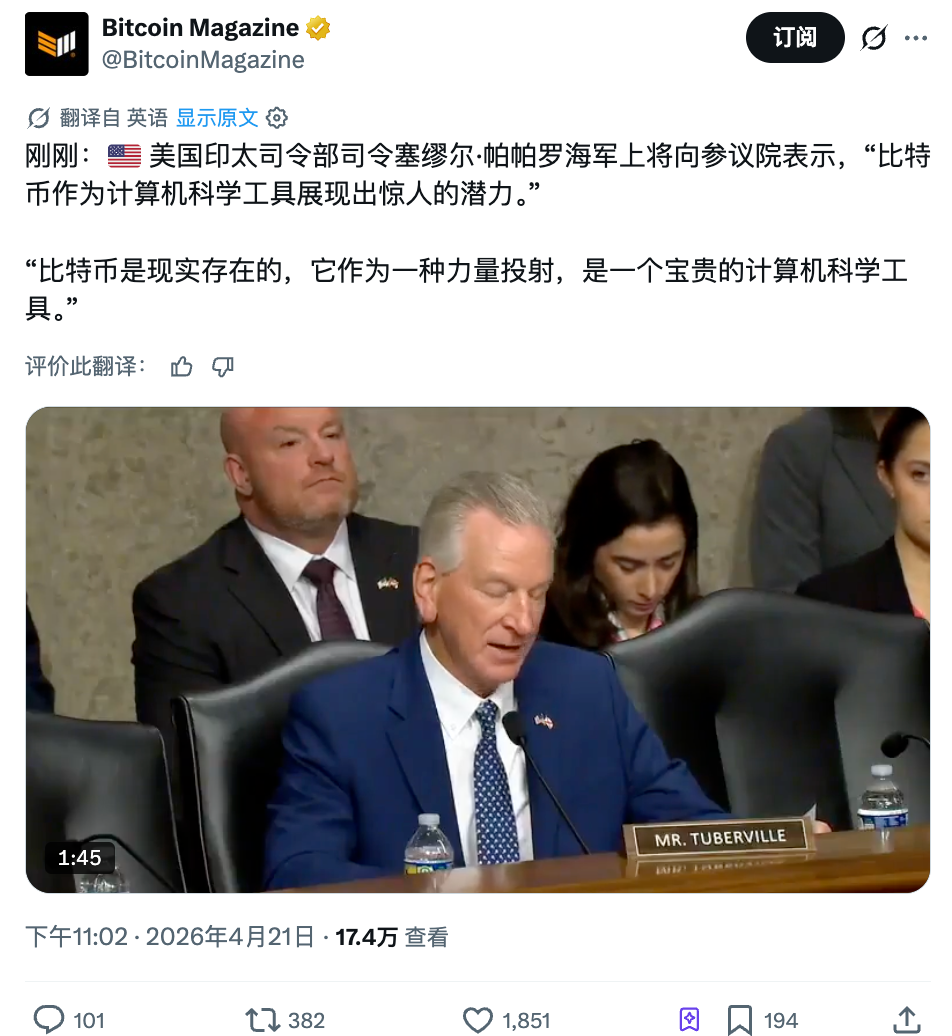
On April 21, Paparo appeared before the Senate Armed Services Committee’s fiscal year 2027 National Defense Authorization Act (NDAA) review hearing and responded to questions from Senator Tommy Tuberville (R-AL) regarding Bitcoin’s strategic value.
Tuberville asked directly whether U.S. leadership in Bitcoin could enhance deterrence against China. Paparo did not shy away. He told the committee that INDOPACOM’s research focuses on Bitcoin’s underlying computer science architecture—including the integration of cryptography, blockchain, and proof-of-work.
Paparo stated: “Bitcoin is real. It is a peer-to-peer, zero-trust value transmission system. Anything that supports all the tools of American national power is beneficial.” He added, “Beyond its economic attributes, Bitcoin has critically important computer science applications in cybersecurity.”
Paparo further elaborated on the military potential of the proof-of-work protocol. He noted that Bitcoin’s proof-of-work mechanism “imposes costs far exceeding those of conventional algorithmic network defenses,” with applications extending to both offensive and defensive cyber operations.
In other words, the Pentagon is not interested in Bitcoin’s price movements—but rather in its architecture as a computer security system that “makes attacks physically costly.”
House Hearing Confirmation: “We Have a Node on the Bitcoin Network”
On April 22, Paparo appeared before the House Armed Services Committee and responded to further questioning from Representative Lance Gooden (R-TX), revealing additional details.
According to an official press release issued the same day by Gooden’s office and the verbatim hearing transcript, Paparo stated clearly: “We are currently in the experimental phase. We now have a node on the Bitcoin network. We are not mining. We use it for monitoring and conduct a series of operational tests, leveraging the Bitcoin protocol to protect cybersecurity.”
During the hearing, Gooden also cited data from the Bitcoin Policy Institute indicating that China currently holds approximately 194,000 bitcoins, while the U.S. holds roughly 328,000. He then asked Paparo:
In this era of digital competition, should the United States maintain leadership in Bitcoin holdings—as it does with strategic resources like gold and oil?
Paparo responded that people are already using Bitcoin to protect their digital assets—precisely the functional outcome of combining proof-of-work with blockchain and cryptography. He expressed support for the GENIUS Act (a stablecoin legislative framework) as positively contributing to maintaining the U.S. dollar’s global dominance. However, he declined to comment publicly on a “strategic Bitcoin reserve,” stating he prefers to discuss such matters in classified settings.
A Shift in the Pentagon’s Narrative
A notable feature of Paparo’s testimony is what he *did not* say. He avoided describing Bitcoin as a reserve asset, a payment system, or a speculative instrument—instead consistently framing it as a computer science system with direct military relevance.
According to Bitcoin Magazine, prior U.S. military public statements about cryptocurrency were almost exclusively focused on combating illicit finance and sanctions enforcement. Paparo’s testimony marks a major pivot in that narrative framework: for the first time, a serving combatant commander has formally characterized Bitcoin’s protocol-layer architecture as a technology of national security significance.
Sam Lyman, Research Director at the Bitcoin Policy Institute, stated in a press release that Paparo’s testimony confirms Bitcoin is “an undeniable geopolitical asset.”
As of early 2026, there are approximately 15,000 to 20,000 publicly reachable full nodes on the Bitcoin network—with the actual number likely higher, as many nodes operate behind firewalls. INDOPACOM’s addition of a node means the U.S. military is no longer merely observing the Bitcoin network—it is now a direct participant.
Join TechFlow official community to stay tuned
Telegram:https://t.me/TechFlowDaily
X (Twitter):https://x.com/TechFlowPost
X (Twitter) EN:https://x.com/BlockFlow_News
 深潮TechFlow