








Conversation with Bitwise Advisor: Buying a Home Is Worse Than Renting; Investing in Real Estate Is Worse Than Buying Bitcoin
TechFlow Selected TechFlow Selected
Conversation with Bitwise Advisor: Buying a Home Is Worse Than Renting; Investing in Real Estate Is Worse Than Buying Bitcoin
Nothing is perfect—not even Bitcoin—but it’s improving.
 Navigating Web3 tides with focused insights
Compiled & Translated by TechFlow

Guest: Jeff Park, Advisor at Bitwise
Host: Kevin Follonier
Podcast Source: When Shift Happens
Original Title: Why Buying a House Is the Worst Investment You Can Make – Bitwise Advisor – Jeff Park | E167
Air Date: April 16, 2026
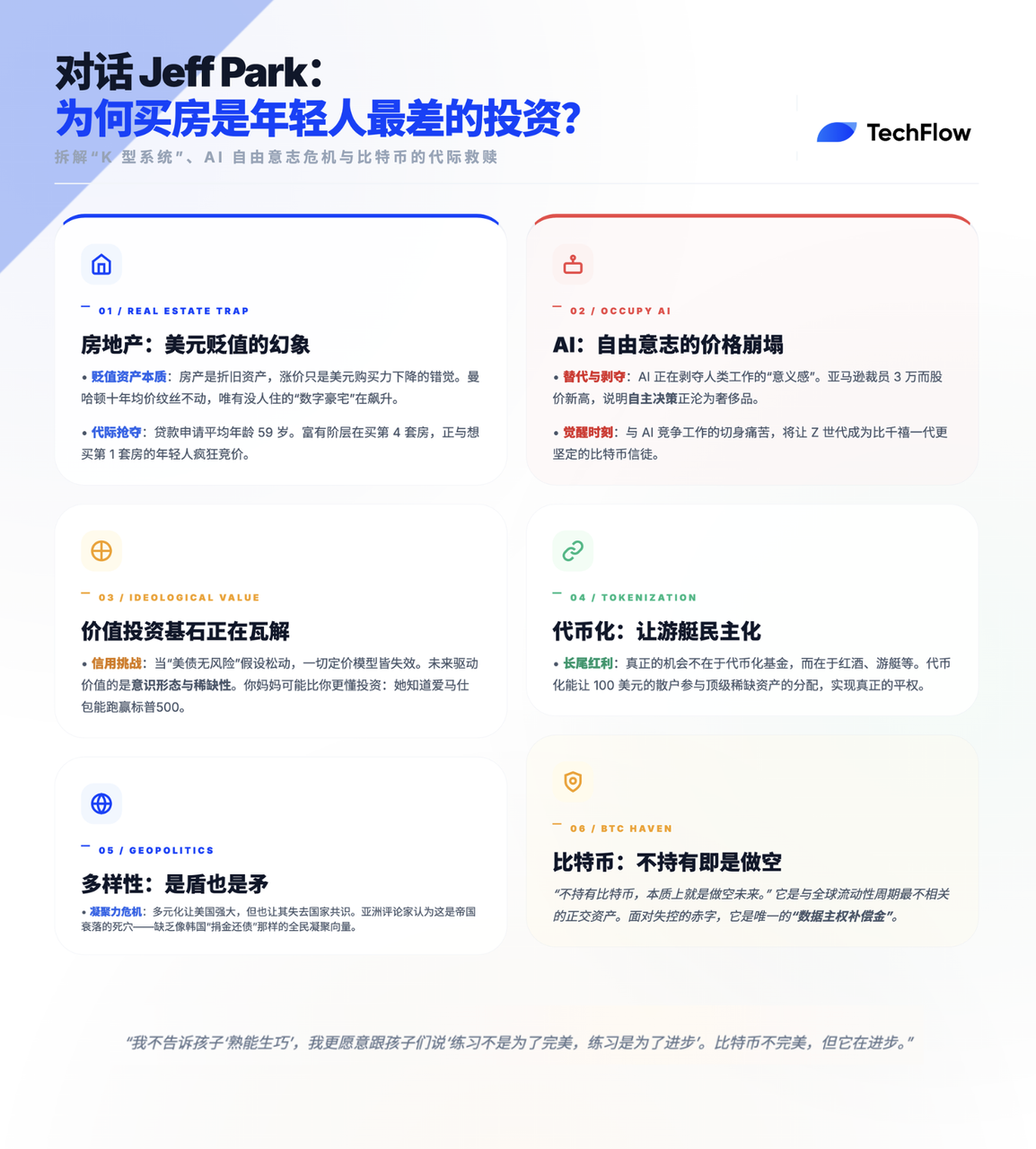
Key Takeaways
Jeff Park is a seasoned macro strategist and advisor to Bitwise. He firmly believes today’s financial system has lost relevance for young people—especially amid soaring housing costs and the looming threat of AI displacing an entire generation’s jobs. He argues real estate is, in fact, a depreciating asset, while Bitcoin represents the ultimate financial safe haven. Furthermore, he predicts that AI’s rapid advancement will trigger the largest global wave of Bitcoin adoption yet.
He proposes that “Occupy AI” will become a pivotal moment for Gen Z and Gen Alpha—the moment when these generations, much like Millennials during the Global Financial Crisis, experience their own “epiphany” about Bitcoin’s potential. Through this process, they will gain deeper insight into the nature of digital assets and investing.
Additionally, Jeff is highly optimistic about the potential of real estate tokenization. He believes tokenization holds transformative power to overhaul the existing financial system and deliver fairer investment opportunities for ordinary people.
This discussion explores how such pivotal moments reshape our understanding of digital assets and investing—and what profound implications they may hold for the future.
Highlights of Key Insights
The Truth About Real Estate and Wealth
- “Housing prices rise not because houses themselves become more valuable, but because the U.S. dollar continuously depreciates. Houses are depreciating assets—U.S. tax law explicitly states you can claim depreciation deductions over 20–30 years. We’ve known all along that houses depreciate.”
- “Manhattan’s average home price has actually remained flat over the past decade. What’s risen are ultra-luxury units treated as wealth storage vehicles—units no one lives in, merely entries on the balance sheets of the wealthy.”
- “This year, the average age of Americans applying for mortgages is 59. This isn’t a first home—it’s a third or fourth home. And these buyers are competing directly with 25-year-olds trying to buy their first home.”
- “In New York, renting is economically the rational choice. Owning means paying property taxes, maintenance fees, mortgage insurance, and property insurance—net yields often fall below 2%, sometimes even below 1%. You’d be better off putting that money into a money market fund.”
- “We now have a superior store of value—one that requires no upkeep, occupies no physical space, incurs no annual taxation, and carries no risk of government seizure after being placed on a watchlist: Bitcoin.”
On AI and ‘Occupy AI’
- “We’ve never seen a technology as disruptive as AI—one capable of fully replacing labor while delivering record corporate profits. Amazon lays off 30,000 workers, and the stock market hits an all-time high—that’s the most direct illustration of ‘free-will price collapse.’”
- “AI is eroding human autonomy in decision-making. Every prior technological revolution—electricity, aviation, mail—amplified human capability. AI, however, risks eliminating ‘work itself.’”
- “The essence of AI is ultimately centralizing all your data, harvesting it, and using it to replace you. If my data makes models smarter, I deserve compensation—and only cryptocurrency, in theory, can provide that mechanism.”
- “Each generation needs an awakening moment to discover Bitcoin. Millennials awakened during the financial crisis; Gen Z and Gen Alpha will awaken through Occupy AI—they’ll find Bitcoin through the visceral pain of competing with AI for jobs.”
- “AI and Bitcoin share a core logic: energy consumption. If you reject the negative externalities AI generates, then the flip side of that same energy—the production of a scarce asset—is Bitcoin. Choosing Bitcoin is casting a vote.”
On Investment Frameworks and Logic
- “The foundational assumption of value investing—that everything should be priced relative to the risk-free rate—is collapsing, because U.S. credit quality itself is under challenge. Remove that assumption, and the world becomes clearer: ideology—not cheapness—drives real value.”
- “Your mom actually understands investing better than you think. She knows some of the most valuable things exist in the physical world—a Hermès bag, for example, has consistently outperformed the S&P 500 over the past two decades.”
- “Diversification isn’t dead—it just demands broader vision: seek assets truly uncorrelated with global liquidity cycles—gold, fine art, premium wine… Their logic bears no relation to whether the S&P trades at 6,800 or 6,200.”
- “What excites me about tokenization isn’t BlackRock’s money-market fund tokenization—but long-tail assets: top-tier wine, yachts—where ordinary people can own fractional shares for $100. That’s where tokenization’s true opportunity lies.”
- “Rather than fixating on Bitcoin’s upside potential, consider this: what downside risk do you face without it? Not holding Bitcoin is, in essence, shorting Bitcoin.”
- “If forced to choose only two assets, Bitcoin must be one—it’s the most uncorrelated, orthogonal asset to everything else in global capital markets. The other would be income-generating assets denominated in U.S. dollars.”
On Society and the Future
- “America’s greatest strength—and its greatest weakness—is demographic diversity. In fact, this is a known attack vector from the East… Diversity will destroy this country.”
- “It feels strange realizing everyone upstairs, downstairs, and across the street is united under the same patriotic banner—yet none of us controls our fate.”
- “I don’t tell my kids ‘practice makes perfect.’ I tell them practice isn’t for perfection—it’s for progress. Nothing is perfect—not even Bitcoin—but it progresses. Everything we do chases that ideal direction.”
Jeff’s Early Exposure to Currency Devaluation
Host Kevin: You mentioned having early exposure to currency devaluation as a child. Could you elaborate?
Jeff Park:
I grew up between the U.S. and South Korea, spending part of elementary school in Korea. There, I lived through the 1997 Asian Financial Crisis—a shockwave that reverberated globally and left a deep imprint on me. Though only in second or third grade, I sensed the nation’s collective mood—an extraordinary unity among neighbors upstairs, downstairs, and across the street, bound together by patriotism in the face of an uncontrollable destiny. It felt surreal: to witness national sovereignty’s currency depreciation unite an entire population so profoundly. For most Americans, the closest analogy might be 9/11—a national trauma that brought together people across political divides to reflect on what America is and stands for. Currency devaluation can produce the same cohesion.
That 1997 experience deeply impacted me—but also revealed national resilience: when people mobilize with principle to confront sovereign crisis and defend public interest. Another vivid memory: the Korean government asked citizens to donate gold to replenish reserves and repay IMF bailout loans. To Americans, the IMF sounds neutral—but in many emerging markets, it’s a politically charged term, viewed with suspicion, disdain, and even perceived as having ulterior motives. I witnessed this early on—and sometimes wonder whether those experiences planted seeds for my eventual path into crypto two decades later.
Who Is Jeff Park?
Host Kevin: So who are you?
Jeff Park:
I’m Jeff Park—but in a sense, I represent a convergence of many forces. First, I’m a Korean-American raised in the U.S., grounded in Eastern thinking—so I serve as a bridge between Eastern and Western narratives, whether regarding globalization’s prosperity or its resulting social tensions. Second, generationally, I entered the workforce in 2008—my first job was at Morgan Stanley, right on the front lines of the Global Financial Crisis.
That quickly taught me: nothing is truly unbreakable; much of what schools teach lacks solidity. It’s humbling—but also energizing, fueling independent thinking. This experience made me emblematic of a generation: a Millennial entering adulthood amid crisis, developing deep distrust of institutions and intermediaries—and seeking non-custodial, autonomous solutions across social networks, careers, and daily life.
How America’s Diversity Is Both Strength and Weakness
Host Kevin: You experienced currency devaluation as a child, then watched the financial system’s illusion shatter in 2008. Now we’re in New York—the world’s financial capital—where prices feel absurdly high. I’m from Switzerland and live in Singapore—both expensive—but arriving here still shocks me. I simply can’t fathom how ordinary people survive. All this connects to your childhood experience—only now it’s more urgent. What are we seeing? What do we do?
Jeff Park:
America’s greatest strength—and its greatest weakness—is its demographic diversity, woven throughout its population structure and social fabric. You’ll often hear Asian commentators predict American imperial decline, centering on one core thesis: diversity will kill this country. I heard this frequently as a child. This theme subtly underlies Korea-China and Korea-U.S. geopolitical dynamics—and now manifests fully in domestic U.S. politics. The crux: with such diversity, forging genuine national cohesion is extraordinarily difficult. In Korea, it’s simpler—we’re all Koreans, sharing historical roots and colonial oppression, which provides a unifying vector. In America, history is too rich and complex to identify an obvious, universally felt “we suffered together” bond. Korea has mandatory conscription—every male, regardless of class or education, serves—creating powerful social homogeneity, as does Israel. In America, you ask: what shared American experience unites everyone? That’s hard to answer. U.S. politics usually draws dividing lines along left-right, class, or generational axes—but I believe these are distractions, evasions. The real issue is the lack of intergenerational national cohesion—the most precious—and hardest to build—social good.
What We See Today in a Fractured Financial System
Host Kevin: What’s wrong with today’s financial system?
Jeff Park:
We’re witnessing unmistakable symptoms of a system completely out of control and collapsing. People use “K-shaped economy” to describe societal developments: one group enjoys massive prosperity from asset inflation, while another descends—experiencing recession, unemployment, or joblessness. The gap widens relentlessly—the K shape: one line rising, one falling.
How the “K-Shaped System” Manifests in Real Estate
Jeff Park:
You see it clearly in New York’s real estate market. You might be surprised to learn Manhattan’s average home price has remained flat over the past decade. You’re surprised because prevailing narratives suggest incredible boom—tall towers, skyscrapers, reports of Chinese and Russian capital flooding residential development. That’s not entirely inaccurate.
Real estate exhibits the K-shaped economy too: ultra-luxury units—used purely as stores of value—perform exceptionally well. They aren’t occupied; they’re assets parked on balance sheets to preserve wealth. If you bought a $20 million penthouse seven years ago, you might now trade up to a $30 million one—you’re profiting.
But if you bought a typical home—intended for living, raising a family, contributing productively to city life—and priced closer to “affordable,” performance may be flat or negative.
Manhattan levies a “mansion tax”: any apartment sale above $1 million triggers it. Yet today in New York, $1 million might buy only a studio. Instituted three or four decades ago, when $1 million truly signaled luxury, the tax hasn’t been indexed to inflation—governments won’t voluntarily adjust a revenue-expanding tool. So nearly all secondary-market apartment transactions now get hit.
Homes contributing more meaningfully to urban economic life instead decline or stagnate. New York itself is a paradox: two life stories unfolding in one place. Arriving from Singapore or Switzerland, you’ll find radically different experiences. All this, to me, signals scarcity of quality assets.
Real estate’s problems aren’t new. Many blame capitalism’s decline on real estate—because land is definitionally scarce. Scarcity extends to communities built around physical space. Manhattan’s high prices stem from demand to work in commercially vibrant areas, near other people. Layer on these social components, and land values surge beyond historical norms due to converging social power. Human civilization repeatedly shows this: wherever activity concentrates, land thrives.
America’s problem lies in its privilege to run the global financial system. We say the dollar is America’s biggest export—and it is—but it carries costs. One cost is offshore capital eventually flowing back into U.S. assets. That’s the link between trade deficits and capital-account surpluses. To sustain trade deficits, by definition, we need continuous offshore capital inflows into U.S. assets. That’s how the dollar works.
You’re essentially creating an artificial market for U.S. assets. Offshore investors need places to park balances—creating a tough environment. Because that market bears no relation to whether you or I live in New York—or contribute productively to its economy. It’s not priced around residents’ cost structures—but around U.S. assets serving as sovereign stores of value. When motivations diverge in real estate, pricing inevitably breaks down.
How New Real Estate Investors Should Think
Host Kevin: For a 30- or 35-year-old with savings aiming for a sound investment—maybe barely affording a studio’s down payment in New York (now $1 million)—but you say studios are no longer ‘rare/luxury,’ whereas $20 million penthouses are. So does our parents’ advice—‘buy a home, buy real estate’—still apply to our generation?
Jeff Park:
Real estate perfectly illustrates what we truly need to rethink—not that home prices rise, but that the dollar’s value falls. Fundamentally, homes require maintenance: they’re capital expenditures—things break, repairs accrue, mortgage taxes, property taxes, upkeep fees pile up. Ownership demands continuous capital input. Homes don’t turn into gold over time—they depreciate, requiring constant repair—making them inherently depreciating assets. Indeed, U.S. tax law explicitly states homes depreciate over extended periods, allowing real estate investors to claim depreciation deductions over 20–30 years. So we’ve long known real estate is a depreciating asset.
Why do prices rise? First, the dollar depreciates. Second, people treat homes as primary savings vehicles, anchoring themselves in economic productivity—for example, wanting children in top schools, with public schools typically zoned by residence, requiring heavy property-tax payments for access. So homeownership bundles numerous social functions, continually pushing prices upward alongside inflation.
Problems arise from two dimensions: demographics and liquidity transformation. In the U.S. market, the average age of mortgage applicants this year is 59—a number demanding attention. At 59, people aren’t buying first homes—they’re buying second, third, or fourth. And they’re competing head-to-head with 25-year-olds seeking their first home.
The housing crisis reflects a uniquely intergenerational conflict: real estate’s role as a wealth-storage vehicle is now diametrically opposed to its social function—enabling families to settle and raise children. Many young adults’ life trajectories stall, as homeownership remains out of reach. A capital-control dimension emerges too: more New Yorkers relocate to Austin, Texas, fleeing high taxes—but locals there protest, as their home prices reset to New York’s economic benchmark—not local conditions—creating new affordability crises. This is both a capital-control issue and an intergenerational liquidity-transformation problem—policy levers governments could adjust. The U.S. proposed 50-year mortgages to test liquidity transformation. But this is just the tip of society’s biggest problem: young people simply cannot afford homes.
Host Kevin: As a rational man, I think: work a few years, get a girlfriend, marry, have kids—I’ll likely need a home. But I also want it to be a smart investment, since I’m pouring years of wages and hard work into it. Now you say most such investments aren’t smart—they’re bad. So if I’m 30 or 35, with $100,000, $200,000, or $500,000 saved—and qualify for a mortgage—what should I do?
Jeff Park:
That’s precisely the issue. I often tell newcomers to New York: it’s fundamentally a renter’s market—renting is economically smarter. Because owning means taxes, common charges, maintenance, mortgage insurance, property insurance—all eating into returns, yielding cap rates below 2% (lucky to hit 2%, sometimes under 1%), meaning you’d earn more in a money market fund at 3.5%. You accept sub-1% returns only because you bet on home-price appreciation—so the whole strategy hinges on that bet.
For young people—at least in New York—renting is the economically correct choice. My view shifts once you start a family. With kids, stability matters more—you need certainty about schools, planning for the next 15 years. That security carries a premium, demanding commitment. But this ceases to be an economic decision. You buy then not expecting price gains—but to build family stability and a social safety net. This explains why young people increasingly avoid children: economically, perpetual renting is optimal—until you must have kids. Then renting fails—and the cycle breaks: either skip kids, or bear crushing pressure.
Another common option: wait for older generations to pass and inherit wealth. Prevalent in Asia—especially acute in Japan, mirrored in Korea—massive wealth sits with Baby Boomers, destined to transfer—but with a time lag. They live longer, while Millennials grow up without corresponding asset-price declines. This time lag fuels massive friction between young and old.
How People Navigate Today’s Home-Investment Crisis
Host Kevin: So either I wait until my parents die at 60 or 70—or find alternatives. Are there options for 25-, 30-, or 35-year-olds?
Jeff Park:
Yes—there now exists a superior store of value versus real estate: one needing no maintenance, occupying no physical space, requiring no repairs, incurring no annual taxation, and facing zero risk of government seizure for any reason—Bitcoin. Bitcoin matters deeply to me because it directly alleviates real estate pressure points. Put differently, someone previously bought a $40 million Manhattan penthouse to preserve wealth—to move $50 million—historically lacking easy ways to shift $50 million. Now they can simply buy Bitcoin—no annual service taxes, no expropriation fears. Theoretically, U.S. property rights contain loopholes—if someday you appear on a government list, assets could be seized. Bitcoin eliminates such worries.
This means funds shift away from real estate. If capital stops flowing there, demand curves reset—prices may fall—enabling young buyers. Yet vast political machinery sustains ever-rising prices, because homeownership-as-wealth underpins the American Dream’s foundational social contract. Bitcoin challenges this foundation directly.
I see this as Bitcoin’s greatest test: widespread adoption as the primary store of value relative to real estate and other assets—leading to the same conclusion: a net win for society. Short-term pain may include falling home prices—but as a store of value, Bitcoin is more efficient and far less discriminatory than today’s property regime.
Home prices rise not because houses gain intrinsic value, but because the dollar depreciates—and humans naturally congregate where productivity is highest—capitalism’s natural law: the strong get stronger. Without exports, this tension eventually snaps. We’ve already seen it in New York—the capitalist world’s lighthouse—electing a mayor with pronounced leftist leanings, unforeseen by anyone.
Deconstructing the Smart Investor Framework
Host Kevin: Let’s discuss your article—‘The Fall of the Smart Investor and the Rise of the Ideological Investor.’ Who is the ‘smart investor’? Why did he fall?
Jeff Park:
“Smart investor” is a framework I borrow to describe approaches like Warren Buffett’s or Benjamin Graham’s. When people discuss value investing, it once meant something precise: buy stocks cheap relative to cash flow, buy lower-multiple stocks than growth peers, focus on dividends over reinvested profits. In sum: cheap.
My thesis: that era ended long ago—because today’s best-performing global assets reward scarcity, not cheapness—like those ultra-luxury penthouses. The smart-investor framework rests on assumptions taught in schools—but those assumptions have now fully collapsed.
A core assumption: all assets must be priced relative to the risk-free rate. The risk-free rate is Treasury yields—the bedrock of capital asset pricing models (CAPM), discounted cash flow (DCF), and equity risk premiums. Yet our understanding of the risk-free rate is shifting—explaining why 60/40 portfolios increasingly fail: Treasury and stock correlations rise as the “risk-free” concept itself faces challenge. Why? Because U.S. credit quality is under scrutiny.
Remove “risk-free rate as anchor for all asset pricing,” and the world clarifies: what do people truly buy today—imbued with ideological weight? What drives value beyond “cheap”? That’s the “ideological investor.” Culture, AI’s impact on investment ideology, geopolitics—these are real value-creation mechanisms, not noise to hedge away.
What Ideological Investors Do
Host Kevin: What do ideological investors specifically do?
Jeff Park:
Ideological investors spend extensive time contemplating the future—models from the past can’t guide this, because their premises are being rewritten—so you look outward. How do you gain advantage? You deeply analyze capital flows, liquidity paradigm shifts, and where asset buyers originate. You assess asset manipulation risks—and how to position yourself outside them. So you build an investment framework letting you exit certain dynamics in ways most never consider.
Take a simple example: mothers possess innate intuition about value. They know the most valuable things sometimes reside in the physical world—like a unique piece of jewelry or a Hermès bag, which has outperformed the S&P 500 for over two decades. Top-tier art is another non-traditional stock investment offering wealth diversification. Mothers’ insights into this paradigm vastly exceed those of traditionally trained financial advisors.
Your financial advisor says: 60/40, stocks and bonds—then private equity, private credit, venture capital if you have extra. But these are essentially the same thing—they all tie to the risk-free rate and macro-cycle arbitrage. What you truly want is a wholly uncorrelated asset pool—that’s real diversification.
In this framework, crypto and Bitcoin serve as useful proxies—because, at least before Bitcoin ETFs launched, these investors operated independently of stock markets—Bitcoin’s price moved irrespective of equities. I believe individuals still have many such opportunities ahead—crypto, gold, Hermès bags, Pokémon cards, sneakers—all examples.
Data’s Critical Role in Wealth Creation
Jeff Park:
Another critical asset class lacking product-market fit is data. Your data is highly valuable—but most give it away free, unaware how to monetize it. My Millennial generation naively surrendered data during Facebook’s rise, blind to the cost. Younger generations are more aware—they understand creator economies, knowing how to benefit from data circulation. So I believe data can become an asset class, where every individual recognizes what they own—and how to monetize it.
Prediction markets exemplify this—likely an explosive upcoming asset class. No J.P. Morgan advisor will sit down to explain prediction-market betting—they deem it unprofessional. But I guarantee, ten years hence, someone will. Because prediction-market profits rely on hyper-personalized data—unlike other financial markets—and returns are uncorrelated. More young people head this way, recognizing other markets are rife with manipulation—and refusing to play in that rigged game. That’s why crypto exists, why Bitcoin succeeded, why DeFi emerged, why prediction markets thrive, why sports betting became a DraftKings and Robinhood priority, why 2x leveraged ETFs surged. It’s all one trend: individuals gravitating toward greater freedom and autonomy—away from a manipulated asset world governed by a single global arbitrage trade.
How Jeff Views His Own Portfolio Diversification
Host Kevin: Raoul Pal said on this show: ‘Diversification is dead—everything ties to monetary expansion and fiat devaluation, so I’m all-in on crypto.’ What’s your take? How do you construct your personal portfolio around this?
Jeff Park:
I agree—and disagree. I disagree because his worldview isn’t expansive enough. If he sees diversification as merely different facets of the same trade—all driven by global liquidity—then he’s absolutely right, and I fully concur. But widen your lens: imagine investable assets untouched by the same cross-border capital flows—and diversification regains value.
So in last year’s “Radical Portfolio Theory,” I listed 25 distinct assets—outside traditional stocks, bonds, private/public equity. Gold is one—I finally see gold’s opportunity this year. As Americans, we may mock gold bugs—but from my cultural lens—in Asia, gold is a massive asset class. My family still gifts me gold at reunions as expressions of love—rooted in Asia’s cultural understanding of wealth storage. Gold is the most primal, non-replicable store of value.
Beyond gold, top-tier art is superb diversification—scarce, culturally rich, compounding over time, utterly uncorrelated with stock indices. Some of the best deals in 2008–2009 occurred in art markets. Fine wine is similar—limited, consumable, finite—so people trade wine to store wealth. On tokenization, I’m extremely bullish. If tokenization works as hoped, I’m uninterested in Apollo Private Equity or BlackRock money-market fund tokenization—those already function decently, with tokenization offering marginal gains. Real opportunity lies in long-tail assets—top-tier wine, or fractional yacht ownership.
What Tokenization Brings to Investing
Host Kevin: So you tokenize a bottle of wine or a yacht—letting people without millions invest $100 or $1,000 for a fractional share?
Jeff Park:
Yes. Historically, people couldn’t access these assets—due to difficulty, extreme expertise, curation needs, and immature channels. But ask any billionaire how they invest—they do exactly this—there’s a reason. Yachts remain coveted because they’re excellent wealth stores. The barrier is simply too high for ordinary people. Tokenization can democratize alternative assets. I hope in my lifetime to see “radical portfolios” realized—you and I discussing that 40% unconventional allocation—not what Robinhood or E*TRADE recommends.
Is Investing Now Out of Reach for Ordinary People?
Host Kevin: What about ordinary people? My sister is 35, holds a regular job, wants to save and invest—but can’t navigate this complexity. What should she do?
Jeff Park:
I recently saw fascinating data: in 2005, only ~5–10% of U.S. college graduates opened stock accounts. Today, it’s nearly half. Over the past 20 years, young people have become more financially literate—or at least more motivated. Success is another matter—but interest exists, and they grasp finance earlier than our generation. That’s encouraging—I’m optimistic—as long as we equip them with proper tools and choices.
I also see many young people trading sneakers and Pokémon cards. Others may deem this fun or fringe—but culturally, I believe it’s precisely what young people need: thinking about wealth diversification differently—not chasing Nvidia and Palantir blindly. That “numbers-only-go-up” game is playable—but young people can play their own game. If they excel at their own game, that power is immense.
Why Jeff Proposed Occupy AI
Host Kevin: We discussed currency devaluation, its global and generational impacts, irrational asset pricing, and impossible home-buying. Now AI layers on top—astounding yet job-destroying. You wrote ‘Occupy AI.’ You entered the workforce in 2008, experienced the financial crisis, and witnessed Occupy Wall Street. Your article is ‘Occupy AI.’ Could you first explain Occupy Wall Street, then Occupy AI?
Jeff Park:
I have vivid memories of Occupy Wall Street—it was intensely physical, centered in downtown New York. Angry populists gathered, camped, demanded justice—feeling deceived and exploited by Wall Street. It stemmed from the subprime crisis and the belief banks bore no true accountability—legally or morally—for their errors. Ultimately, it was a moral movement: how can we let banks act thus without consequence?
Host Kevin: What specific actions did they take?
Jeff Park:
Subprime crisis: reckless gambling, astronomical bonuses, zero consequences when everything collapsed—‘profits privatized, losses socialized.’ Taxpayers bailed out distorted, misaligned incentives. Not just banks—rating agencies colluded, paid by issuers to grant high ratings—enabling unqualified, low-credit borrowers to obtain mortgages. Everyone looked away—but economics proved unsustainable, and the system collapsed.
The AI connection: this was class warfare; AI will be class warfare. Because, in my view, we’ve never seen technology as disruptive as AI—it could fully replace labor while delivering record corporate profits. We’ll see an even more extreme K-shaped economy: corporate profitability surges—not from rising revenue, but falling costs—i.e., unemployed people.
The Collapse of Free-Will Value
Host Kevin: In your article, you wrote: ‘Amazon cuts 30,000 jobs while the stock market hits an all-time high—that’s the most direct illustration of “free-will price collapse, self-determination value surge.”’
Jeff Park:
I believe most people work to earn money—but we harbor higher aspirations: to be productive, contribute to society, model for children, build meaningful community things—goals extending far beyond earning money.
Human existence fundamentally requires productivity—if lost, it’s not just economic but deeply psychological. The AI debate’s biggest blind spot is how the LLM wave erodes human autonomy in decision-making and active contribution—a loss of free will—many haven’t grasped. Historical tech revolutions—electricity, cars, trains—amplified human capability: you still worked, tech amplified you. But parts of AI may eliminate work itself—and most can’t all ascend to ‘AI implementation executives.’ We’ve long known society needs meaningful work—even if automatable—because that’s what makes society function. This accelerating displacement is the truly terrifying challenge.
More unsettling is the federal push to subsidize AI data centers—framed as existential: ‘If we don’t do this, China will—so we must invest regardless.’ When investment is framed this way, rational valuation vanishes. If global human labor is worth $35 trillion, and AI replaces 10%, is AI worth $3.5 trillion today? Numbers become absurd. Then government backs these investments—precisely replacing the people they represent. If government’s role is maintaining societal harmony, how could people support funding their own replacement? That’s why Occupy AI is inevitable. Occupy Wall Street’s challenge was clear: you knew your enemy—the man in the suit, Hermes tie. AI is, by definition, intangible—existing on platforms. You might link it to Meta or Nvidia—but no one truly “owns” the construct—they say, “We’re just platforms; what happens isn’t our responsibility.” AI faces the same issue—more severely—because this platform now has its own life.
How the ‘Occupy AI’ Moment Will Turn Gen Z and Gen Alpha Toward Bitcoin
Host Kevin: You wrote at your article’s end: ‘Occupy Wall Street turned a generation of Millennials into staunch Bitcoin supporters—you’re one. Occupy AI will be the moment turning Gen Z and Gen Alpha into Bitcoin believers.’ Could you briefly explain?
Jeff Park:
Everyone needs an awakening moment to discover Bitcoin. I don’t believe Bitcoin seeps silently into life—perhaps it does, but usually requires epiphany. For many Millennials, that epiphany came during the financial crisis—fundamentally realizing: money isn’t what it seems. We lived through decades of QE, QT, re-QE—this spoke directly to our generation.
Host Kevin: First, Bitcoin’s invention during the financial crisis—brilliant minds, or one person/group, saying: ‘We need something new—the system is broken.’ Second, COVID—printing money wildly, making more people realize it’s utterly irrational. Now you say for Gen Z and Gen Alpha, it’ll be Occupy AI.
Jeff Park:
From my experience, Gen Z and Gen Alpha care less about currency devaluation. Not that they’re indifferent—but they’re already in dire straits, verging on despair. Some Millennials still believe Social Security might be salvaged—though unlikely, we connect it to Baby Boomers. Gen Z and Gen Alpha know everything’s broken—and they’ll never benefit. They know it’s unsolvable by them.
So currency devaluation won’t awaken them. Worse, with BlackRock and Bridgewater adopting Bitcoin, it grows suspicious to them. They’ll say, “Now it’s not even our game—it’s the elders’ game, not our money.” So Bitcoin grows more oppositional for this cohort.
I believe AI will catalyze awakening—just as I was the first generation truly living within Facebook, grasping its pros and cons, these kids will graduate into AI—and compete with it for jobs. It must be deeply personal to awaken them to society’s systemic flaws. I believe the AI movement will largely emerge from young opposition—and become a conduit not just to understand Bitcoin, but to rediscover crypto’s spirit.
When Everything Fails, Bitcoin Is the Answer
Host Kevin: I grasp Occupy Wall Street, currency devaluation, Bitcoin as fiat-hedge. But why will this generation grasp Bitcoin via Occupy AI or AI—and see it as solving problems? Or as the industry says: Bitcoin is the lifeboat—Bitcoin helps me when I abandon everything else?
Jeff Park:
Because they’ll realize Bitcoin is a superior store of value compared to legacy assets Millennials competed for post-Occupy Wall Street. Occupy Wall Street remained a housing crisis—a home-value crisis. That substitution effect wasn’t easily absorbed by youth.
Also, if you believe AI and Bitcoin share a bond—energy consumption—because both are energy assets. If you vote with your feet against AI’s negative social dynamics and externalities, the flip side is energy producing scarcity—Bitcoin.
Though we speak of Bitcoin, I hope young generations revive and reinvigorate crypto’s cypherpunk-money ethos. So it’s not just a store of value—this generation can truly embrace the peer-to-peer monetary mission. Its utility extends beyond value storage—they’ll reactivate decentralization’s necessity in fighting AI. Even for Millennials, decentralization was more talk than native reality—we live in centralized intermediaries, benefiting from them. But the next investor cohort will oppose these from day one. Decentralization won’t be talk—it’ll be their fundamental right to livelihood.
Why Decentralization Is Crucial in the AI Era
Host Kevin: Why is decentralization so vital in the AI age?
Jeff Park:
Because AI’s core is ultimately centralizing all your data, harvesting it, and using it to replace you. If you believe decentralization efforts can grant attribution rights—compensation for contributing information—then this is part of the decentralization puzzle.
I’m not pessimistic about AI—I believe it offers huge societal benefits. The key is ensuring mechanisms exist for contributors to share in technological gains. The problem is profits concentrate intensely, while costs hit every individual—with zero compensation. Solving data attribution makes AI’s future bright. If my data makes models smarter, I deserve compensation—and only cryptocurrency, theoretically, enables attribution-based compensation.
Host Kevin: That’s why decentralized AI companies and decentralized compute projects exist—they may be riding AI hype, but the ideal shouldn’t be dismissed—it may genuinely solve this massive problem.
Jeff Park:
From critics’ views, crypto indeed hosts dishonest actors—but we must retain faith the ideal is achievable, because it’s how we align with a greater mission.
Is It Too Late to Invest in Bitcoin Today?
Host Kevin: What does this mean for Bitcoin today? Many—perhaps Gen Z or Millennials—see Bitcoin fluctuating between $120,000, $100,000, $70,000—and to ordinary people, it feels prohibitively expensive. They say, ‘Bitcoin’s too expensive—I missed the boat. It’s my sole lifeboat.’ What would you say?
Jeff Park:
I believe more people must ask: what happens if you don’t own Bitcoin? Rather than fixating on upside, seriously consider the downside risk exposure of excluding Bitcoin from your portfolio. In other words, not holding Bitcoin is effectively shorting Bitcoin. Regardless of wealth-appreciation effects, holding Bitcoin is advantageous—even simply because fiat devaluation accelerates unprecedentedly, and history repeatedly shows monetary resets are cyclical.
If you study dollar hegemony’s history—from Bretton Woods to 1971’s Nixon Shock—all indicate our current dollar-hegemony illusion depends on fiscal deficits being effectively managed—and we’re veering off-track. In such circumstances, you need assets resilient to global arbitrage cycles—Bitcoin is among the most compelling candidates.
People Should Actively Integrate Bitcoin Into Portfolios
Host Kevin: You emphasized downside risk. But as a CIO, you discuss diversification and investment frameworks. For an individual, allocating a large portion of their portfolio to Bitcoin—taking a more aggressive, not just defensive, approach—does it make sense?
Jeff Park:
I know many in crypto—Bitcoin comprises large portions of their wealth. They use a “barbell” strategy: one end is heavy Bitcoin allocation, the other is money market funds—with minimal exposure to middle-risk tiers. I still believe some diversification between them expands capital-allocation freedom. People should pursue broader diversification than a simple two-asset barbell. But if forced to choose only two assets, Bitcoin must be one—it’s the most uncorrelated, orthogonal asset to everything else in global capital markets. The second asset I’d choose is income-generating assets denominated in U.S. dollars. For instance, I lean toward believing we’ll return to zero interest rates.
I know many doubt this—but if the global arbitrage trade continues, only falling rates can sustain the system. If so, 30-year Treasuries present excellent speculative opportunity—falling rates boost bond prices. This is my bet on America. I believe America ultimately wins—finding creative solutions. Dollars, stablecoins, dollar-denominated assets remain global reserve anchors. So I’m long 30-year Treasuries—my bet on America.
How Jeff Prepares His Children for an ‘Occupy AI’ Future
Host Kevin: You have two children—and a Bitcoin mindset. In an ‘Occupy AI’ future, how do you raise and prepare them?
Jeff Park:
Bitcoin taught me—and many—you can never know enough, never fully grasp anything. We must stay open and humble to all possible attack vectors—because this issue dwarfs any individual, model, or paper—technically or socially.
So it’s a living experiment—success demands open-mindedness. I strive to instill this spirit in my children, contextualized by money and Bitcoin’s evolution, building resilience. The phrase “practice makes perfect” exists—but I prefer telling my kids: practice isn’t for perfection—it’s for progress.
Nothing is perfect—not even Bitcoin. These things never achieve empirically measurable perfection—but they progress. All our life’s practice chases that ideal direction. I try weaving Bitcoin’s mission into my children’s daily lives—not debating nodes and forks yet—but perhaps when they’re older.
Join TechFlow official community to stay tuned
Telegram:https://t.me/TechFlowDaily
X (Twitter):https://x.com/TechFlowPost
X (Twitter) EN:https://x.com/BlockFlow_News
 深潮TechFlow


