Interview with Cobie: The Crypto Industry Is Delivering on Its Promises—So Why Aren’t You Making Money?
TechFlow Selected TechFlow Selected
Interview with Cobie: The Crypto Industry Is Delivering on Its Promises—So Why Aren’t You Making Money?
“Every genuine large-scale market entry shares the same characteristic: ordinary people make money within a short period.”
 Navigating Web3 tides with focused insights
Compiled & Translated by TechFlow
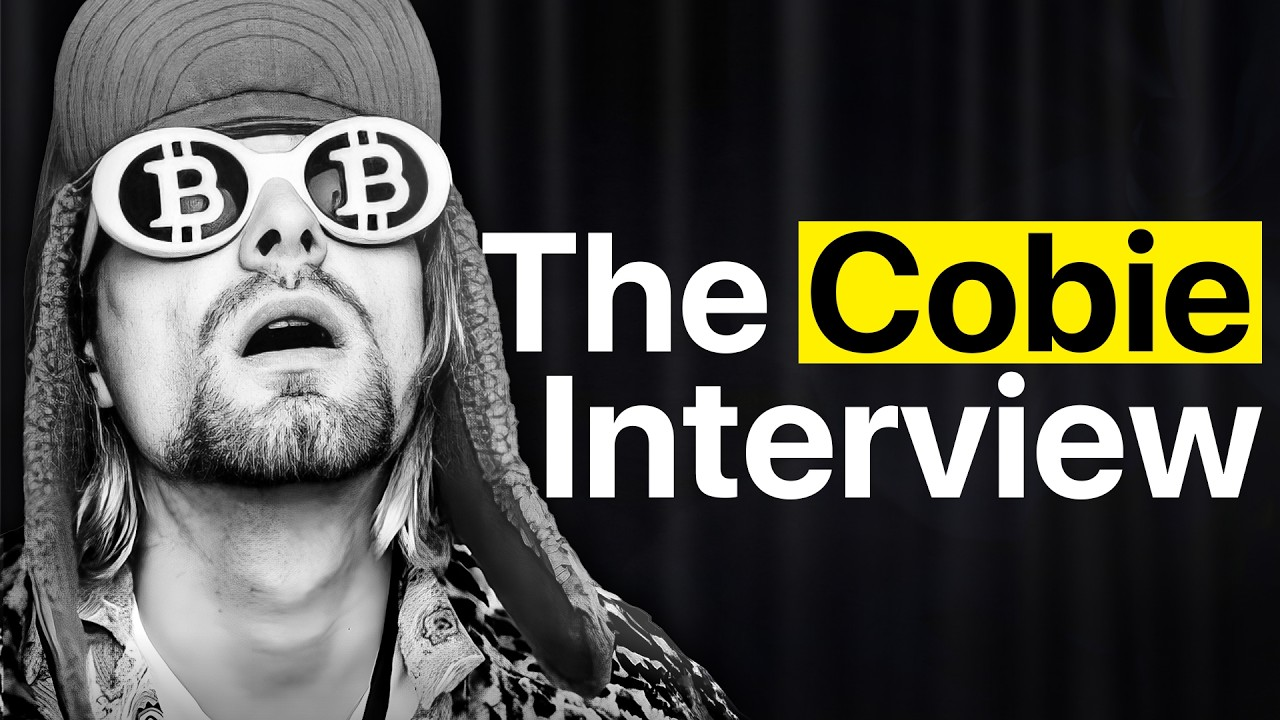
Guest: cobie
Host: threadguy
Podcast Source: threadguy
Original Title: An Unfiltered Conversation with Cobie
Air Date: April 22, 2026
Key Takeaways
In this episode, Cobie and threadguy begin with Cobie’s recent work at Coinbase and expand into discussions on DeFi, AI, Bitcoin, memes, tokenized equities, private markets, and the future of financial media. Cobie’s central thesis is that the crypto industry is undergoing a “K-shaped divergence”: real-world progress is being made in areas like stablecoins, prediction markets, and onchain trading infrastructure—but ordinary investors struggle to capture these gains via publicly traded tokens. He also argues that AI will dramatically reshape entrepreneurship and market participation—and exacerbate wealth inequality—but crypto may still redistribute some value through airdrops, onchain ownership, and open finance. For those enduring an industry downturn, his advice is direct: if you truly believe something will matter in the future, allocate capital accordingly; if you’ve lost all conviction and are merely chasing past thrills, it’s time to find a new hobby.
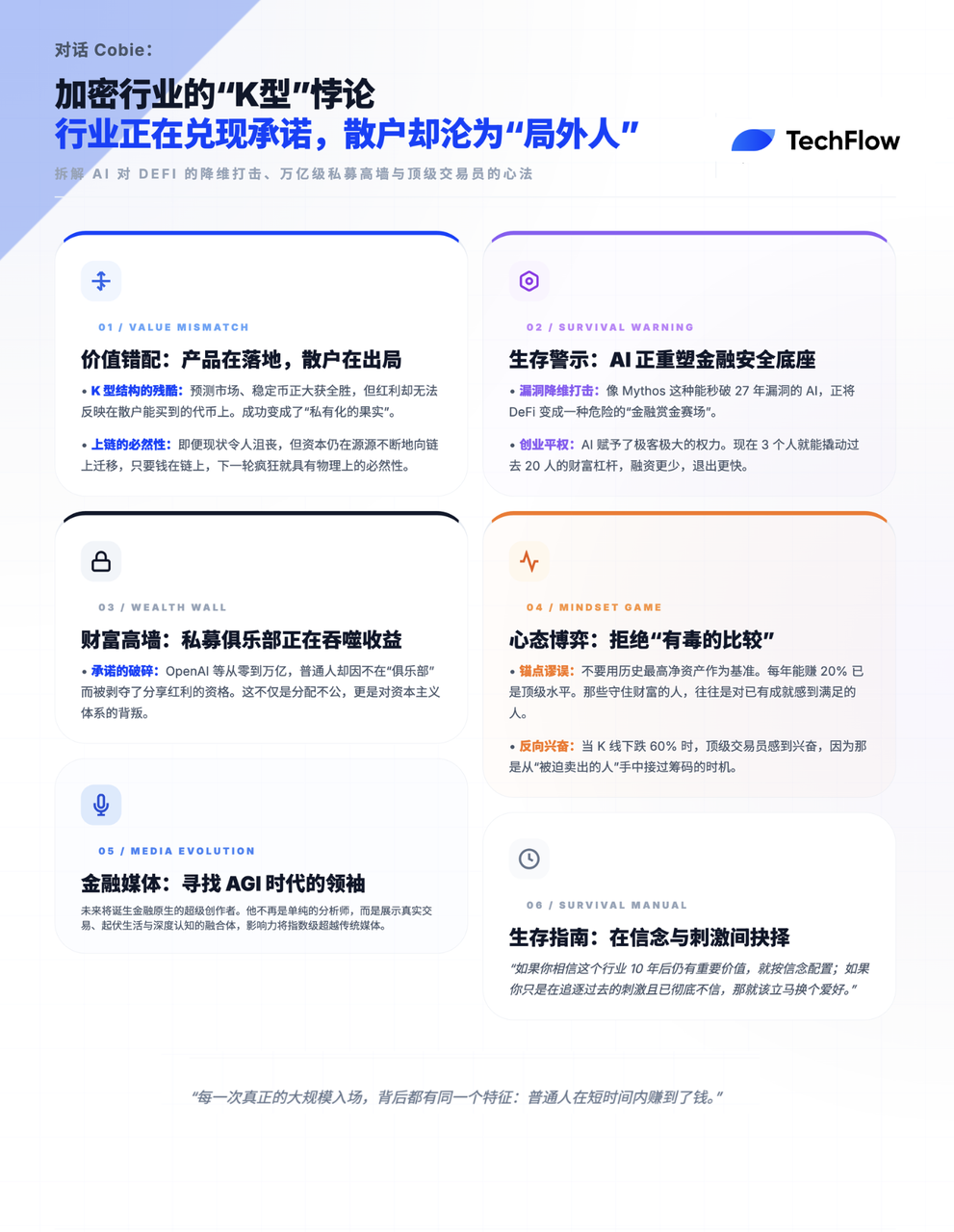
Highlights of Key Insights
On Crypto’s “K-Shaped Divergence” and Distribution Challenges
- “A strange K-shaped structure has emerged in crypto: on one hand, we see highly successful cases (e.g., Polymarket, stablecoins); on the other, those successes aren’t reflected in asset prices accessible to ordinary people.”
- “Crypto is delivering on many of its original promises… yet for the average crypto investor, this reality is deeply frustrating. You ask yourself: ‘How do I invest in these successful projects?’”
- “It’s extremely hard to gain exposure to the projects that are truly excelling—even I face the same challenge. Still, I believe crypto has a societal bull case: it’s bringing more and more capital onchain.”
- “Every major wave of mass adoption shares one feature: ordinary people make money quickly.”
On AI’s Impact on DeFi and Industry Barriers
- “The thing that worries me most about DeFi is AI models like Anthropic’s Mythos—it could turn DeFi into a financial bounty system.”
- “Today, a single person can launch a startup and achieve extraordinary results within six months—like someone building OpenClaw in roughly one month and hitting billions in valuation.”
- “AI has reshaped the economics for early employees. Previously, joining early felt like a scam… Now companies need fewer people, raise less capital, dilute less, and exit faster.”
- “Applying crypto’s airdrop model to consumer companies could return value created by users back to them—akin to capitalism’s response to universal basic income.”
On Private Markets’ “Unfairness” and Societal Promises
- “SpaceX, Anthropic, and OpenAI grew from zero to trillion-dollar valuations—but almost no ordinary person shared in that wealth creation. It feels like capitalism’s promise has been broken.”
- “The state of private markets is already a betrayal of the capitalist system: if you’re inside the ‘club,’ you get access; if not, you’re locked out.”
- “Public markets are increasingly becoming a ‘last-resort liquidity provider’—much like crypto markets.”
- “Fifty years from now, people might say: ‘You didn’t buy it at $1T? Why didn’t you buy God?’ And I’ll probably just reply: ‘I was buying a meme coin.’”
On Trading, Risk, and Top-Tier Traders
- “Truly elite traders are intensely self-driven… They document their judgments and outcomes, constantly updating their mental models with training data.”
- “Don’t compare yourself to your ‘perfect version’ who makes every right decision—or measure yourself against your historical net worth peak.”
- “When the market suddenly drops 50% or 60% on a single candle, I get genuinely excited—because it means you can acquire assets from people who never intended to sell.”
- “Many who preserve wealth long-term are those content with what they already have. In financial markets, it’s easy to fall into a toxic comparison mindset.”
On Bitcoin, Saylor, and Emotion
- “The first time I realized MicroStrategy had truly gone mainstream was when my dentist told me he held 80% of his portfolio in MicroStrategy and 20% in Palantir.”
- “What surprises me most about crypto is how intensely you live in the present—the emotions feel utterly real, yet three months ago, you likely felt the exact opposite.”
- “GCR is like an ‘intelligent asset,’ skilled at psychological games. He once claimed to have insider sources—but that may have been purely to deter competitors from reverse-engineering his actual API or data paths.”
On Industry Mindset and the Future
- “If you believe this industry will contain important things five or ten years from now, allocate capital according to that belief; if you believe nothing, and are only chasing past thrills, it’s time to pick a new hobby.”
- “Within the next three to five years, a financially native content creator will emerge—someone who documents their life and market ups and downs. One great year of compelling content could make them ten times bigger than Roaring Kitty.”
- “Helping people I don’t even know enriches and enlivens my life. Staying optimistic, hopeful, and connected to others is a fantastic way to live.”
Volunteering to Join Coinbase for Free
Host threadguy: You’ve been quiet lately—everyone’s wondering when UpOnly will return and when you’ll be back. What have you been up to over the past month or few months?
Cobie:
I’ve been working—and my workload right now may be heavier than in any of the past several years. A few years ago, I actually volunteered to join Coinbase for free—even offered to work for $0 salary—but ultimately failed; they basically turned me down.
I’ve always believed there are very few levers in this industry capable of meaningfully shifting its trajectory—and doing Coinbase well is one of them. So I really wanted to give it a shot. After all, I’ve spent ten years on Twitter—anything that engages my brain more than writing boring jokes is deeply appealing to me.
AI Is DeFi’s Greatest Threat
Host threadguy: Arbitrum and LayerZero recently hit turbulence, following Drift’s earlier issues—DeFi sentiment has plunged again. How do you view the current state of crypto, especially DeFi? Where do we go from here?
Cobie:
I think we’re standing at the edge of DeFi 2.0. For me, the most worrying thing about DeFi is AI models like Anthropic’s Mythos. That kind of technology scares me—it could transform DeFi into a financial bounty system.
Once these AI models become widely distributed, not only attackers but also builders will confront the same capabilities. This means DeFi may undergo a transformation into a completely new version—an exciting prospect, yet laden with immense challenges. Right now, DeFi sentiment is indeed at a low point—aside from projects like Hyperliquid and Trade XYZ, there’s little that sparks excitement.
The K-Shaped Crypto Thesis
Host threadguy: You mentioned DeFi 2.0 and said Mythos is frightening. So why remain interested in Coinbase and crypto overall? Aren’t you disappointed by crypto’s future—or by its current state?
Cobie:
What you’re trading today isn’t always traditional crypto assets—it’s often conventional assets transacted via crypto infrastructure. So crypto has developed a strange K-shaped structure: on one side, we see exceptionally successful cases—more than ever before; on the other, those successes aren’t reflected in asset prices accessible to ordinary people, except for a handful of tokens. For example, Polymarket is thriving. Prediction markets are natively crypto-native, and Kalshi and Polymarket now form a duopoly. Stablecoins have matured into real, critical infrastructure, deployed across increasing use cases.
Yet for ordinary crypto investors, this situation is deeply frustrating. You ask: “How do I invest in these successful projects? Do I buy Stripe equity? But it’s still private. Can I buy Tempo or Polymarket shares? No.” These projects are doing exceptionally well—but you can’t profit from them, while demand for crypto assets and investor interest decline sharply.
So this is indeed a fascinating inflection point. Crypto is delivering on many of its original promises, such as Hyperliquid, Trade XYZ, and HIP-3—all genuinely cool projects.
I think we must separate two things: what’s genuinely advancing in crypto versus the frustration caused by stagnant meme and governance token prices. Because it’s extremely hard to gain exposure to the projects that are truly excelling. Still, I believe crypto has a societal bull case: it’s bringing more and more capital onchain. As long as capital continues flowing onchain, the next wave of excitement, frenzy—even foolishness—becomes increasingly inevitable.
I’ve remained optimistic lately. I’ve been pessimistic about many things in life, but pessimism has never benefited me. Maybe I should’ve been more pessimistic about FTX—I wouldn’t have held positions there. Maybe I should’ve been more pessimistic about the NFTs lingering from 2021. But overall, pessimism has never paid off.
Now, I’m striving harder to adopt a long-term perspective, moving steadily while staying positive and optimistic. Perhaps I’m wrong—but if so, there’s nothing I can do.
Thoughts on Saylor
Host threadguy: Bitcoin’s performance relative to gold and other assets isn’t ideal right now. In such conditions, one would expect renewed debate around Bitcoin’s value proposition—but instead, discussion centers on Saylor, Strategy, STREK, and how much supply he holds. Could Michael Saylor and his Strategy experiment become a bearish argument for crypto?
Cobie:
I wasn’t worried at all—until I visited my dentist. My dentist asked me, “Do you own stocks?” I replied, “I’m not really into investing.” He then said, “Have you heard of MicroStrategy?” At that moment, I thought: “Bro!” He’s in his 70s and holds just two stocks: 80% in MicroStrategy, 20% in Palantir.
That was my first realization that this had truly “gone mainstream.” I’d assumed only crypto Twitter users—or those who changed their profile pictures to laser eyes—cared about MicroStrategy. But my dentist is an ordinary person in the real world. Sometimes I even feel crypto is virtual—a hallucination I conjure sitting at home—but that conversation reminded me Bitcoin is real, and people outside know it exists.
I’m not sure if I’m starting to worry about Strategy—but it’s certainly begun to feel like a looming presence. Previously, hearing Saylor planned to buy Bitcoin felt bullish; now, price drops trigger cautionary signals. Of course, when prices rise, sentiment instantly flips to “Great! Saylor is amazing!”
What surprises me most about crypto is how intensely you live in the present—the emotions feel utterly real, as though you can’t imagine feeling otherwise. Yet looking back three months, your feelings were likely the exact opposite—so I try to maintain a long-term lens on these matters.
Why UpOnly Hasn’t Returned
Host threadguy: Is your reluctance to leave home why UpOnly hasn’t returned?
Cobie:
There’s a phenomenon called “sophomore album syndrome.” Many artists have hugely popular debuts but mess up their second albums—and I think I suffer from this too. Every time I consider reviving UpOnly, I start doubting myself: Can I still be funny? What should I talk about? Am I still plugged into what’s happening in crypto? Who should I invite as guests? Plus, many past guests later ended up in prison—and some even blamed us for their crimes after appearing on our show.
More importantly, UpOnly was born during the pandemic—when everyone was stuck at home staring at screens. Bitcoin surged from $4,000; Ethereum rose from $80 to $4,000. DeFi Summer arrived, followed by the NFT boom—everyone made money, and sentiment soared.
So many people viewed UpOnly as a great show largely because it coincided with their best investment returns. Everything they did felt right—and our show happened to be what they watched every Thursday. Today’s market feels gloomier, angrier, and more prone to mutual attacks. I think waiting for a better timing makes sense—and honestly, I feel quite old now.
Host threadguy: I understand your “sophomore album syndrome,” but your absence leaves a void in crypto Twitter’s social layer. Whenever bad news hits, people want to hear Cobie’s take—you’re practically crypto Twitter’s spokesperson.
Cobie:
We’re all too old. You say people want to hear Cobie’s take—but often, I genuinely don’t know what to say. That role eventually grew larger than me, amplifying pressure. People overinterpret casual remarks, making you hesitant to speak. For instance, I once posted a meme version of John Brown’s quote about “the easy path and the hard path.” Bitcoin was around $70,000 then—and some sent furious, even threatening messages because that half-joking tweet didn’t pan out.
If you review all my tweets, maybe only 5% ultimately proved correct—the other 95% were wrong. People used to tolerate those errors, but now negativity runs higher. I see this as a symptom of our era: markets have grown harder to profit from, polarizing people further—making them unhappier, even desperate. All this makes me less inclined to speak up.
Crypto’s Last Decade
Host threadguy: In 2020–2021, when I started trading Top Shot and NFTs, it felt natural for independent e-commerce sellers and sneaker flippers to migrate to crypto—drawn by top talent, electric energy, and the latest “game.” But now, the brightest young minds seem drawn to AI, fintech, or platforms outside crypto proper. In 2026, how do we re-attract the next generation of young talent to crypto?
Cobie:
Looking back at crypto’s major entry waves over the past decade, you’ll notice a common thread. 2013 marked the first major altcoin cycle—my first cycle. There were only ~100 coins then, and that first altcoin season attracted both capital and attention. Back then, you needed Bitcoin to trade alts, since stablecoins didn’t exist and centralized exchanges’ base pairs were all Bitcoin-denominated.
2017 was the ICO (initial coin offering) peak, requiring Ethereum holdings as the primary base pair. 2021 brought DeFi Summer and the NFT boom. Since 2023, we’ve seen the meme cycle. The shared trait across all these entry moments is ordinary people making money quickly—and opportunities accessible to them.
Now, AI evokes similar feelings. People believe they can buy a Mac Mini, install OpenClaw, run a business via machines, and earn $100 million. This “financial hobby done in spare time” will only grow more popular. Will crypto see a similar resurgence? Has its brand been damaged? Will it take five or ten years? I don’t know—but I lean optimistic. History has no reason to stop repeating itself, and human creativity remains formidable.
We’ve witnessed waves of wild innovation—and new ones will surely follow. As long as novel inventions emerge and let many earn money, followers will flood in. Branding, sentiment, and positioning shift rapidly. NFTs exemplify this. Some friends bought ICOs in 2017, then wrote off all crypto as scams when one project failed to deliver. But when NFTs appeared, they flipped: “No, this is different—I’m collecting art.” Complaints like “never buying crypto again” vanished overnight thanks to Art Blocks. Price rises bring joy—and joy makes crypto “cool” again.
Host threadguy: NFTs succeeded by attracting entirely new participants—artists, collectors, and traders. The 2024 AI season briefly sparked similar energy, with AI developers believing launching on Solana would yield higher profits.
Could onchain equities, tokenized stocks, Hyperliquid’s perpetuals, or Trade XYZ replicate that effect?
Cobie:
I like Trade XYZ and Hyperliquid because they bring substantial new capital onchain—helping people who previously wouldn’t touch blockchain grow comfortable using it. If large capital pools concentrate onchain while traditional assets grow less volatile, that capital will seek new opportunities. Then people may invent new DeFi protocols—or other innovations.
I don’t think the people who built DeFi and NFTs will settle for merely buying stocks—but tokenized equities are attractive because they draw more people and wealth into blockchain, anchoring the tech in real-world economics—not just a self-referential leveraged sandbox.
As for what’ll trend next, I never know. If you’d told me in 2020 that ape pictures would dominate, I’d have dismissed it. So my approach is: isolate risk and experiment with all new things. Not chase every novelty—but when something genuinely novel appears, resist the instinct to mock or dismiss it. Instead, ask: if it succeeds, would it be cool? If yes, I might give it a try.
For example, doing that with Hyperliquid could’ve made you a millionaire via its airdrop. Friend.tech or buying ape pictures worked similarly. Each time I spot a bizarre new thing, I try to understand it—asking whether it could evolve into a meaningful innovation.
Host threadguy: If you entered years ago, nearly every condition needed to fuel a crypto bull market has materialized: Trump openly supporting Bitcoin mining, strategic Bitcoin reserves, Gensler’s departure, Bitcoin ETF approval, institutional inflows, and traditional finance discussing onchain equities and tokenization.
Barring speculation itself, all bullish catalysts are in place. Could crypto ultimately be just a tool for traditional finance to tokenize its own assets? Does Bitcoin hold intrinsic value, while altcoins, memes, NFTs, and DeFi are merely wasted experiments?
Cobie:
This circles back to my K-shaped thesis. We built these technologies, created a self-referential leveraged sandbox, and endured regulatory suppression for a decade. Then suddenly, they became “cool” and compliant—big corporations rushed in, captured value, and privatized it. I see this as a real risk—and part of it has already occurred.
Crypto-native projects have struggled recently. Pursuing revenue increased their risks. Counterintuitively, when all conditions improve, it may be an excellent time to exit. Suppose you’ve held $10 billion in Bitcoin long-term—then see a crypto-supportive president, ETF approvals, and all the bullish catalysts you listed. You might wonder: “Can it get better from here? Maybe it’s time to sell.”
Crypto often performs best precisely when people ask, ‘Can it get worse?’ During hardship, true believers feel opportunity knocks. When good times arrive, newcomers fear missing out—and veterans ponder: “Have we achieved everything we hoped for?” So crypto, in some ways, needs an “opponent.” Past anti-crypto voices ironically united the community and strengthened optimism.
I have no profound analysis. I just think crypto is cool—and I’m optimistic about its future. I’ve been bullish since 2012.
Host threadguy: You keep referencing the K-shaped structure. If you’re a young person facing late-stage capitalist America—where the most powerful people stand to benefit most—what should you do?
Cobie:
The coolest thing now is a single person can launch a startup and achieve astonishing results in just six months. Take OpenClaw: one person delivered billion-dollar results in roughly one month. For creators and builders, constraints once included lack of teams, connections, capital, or location outside Silicon Valley. Now, massive democratization is underway—many formerly impossible feats are now achievable.
In coming years, AI-driven firms will spawn unprecedented numbers of unicorns. It’s also reshaping early employee economics. Previously, joining early felt like a scam—you bore near-founder risk but earned only 1/20th or 1/150th of founder returns. Now companies need fewer people, raise less capital, dilute less, and exit faster. As a founding engineer or early employee, risk-reward improves—you learn faster whether the company will succeed.
If I were your age today, I’d do one of two things: either build—with a few friends—a project that once required 10–20 people but now needs just three; or find the smartest person I know and do whatever it takes to join their company and help it run.
Financial markets are growing more like crypto markets. I used to think crypto would resemble traditional markets—but the reverse happened. Traditional markets now mirror crypto, remaining inefficient and full of opportunity for those willing to think critically.
The Trillion-Dollar IPO
Host threadguy: Nearly everything trades like crypto assets now: oil, silver, gold—even a Trump tweet can swing markets violently. How do you view this evolution since you began trading?
Cobie:
I mostly avoid these markets—I don’t consider myself “smart money” there. Unless it’s long-term allocation—like my early gold purchases or non-crypto long-term investments—I steer clear when these assets trade frenziedly.
Markets have personalities. I know Bitcoin’s personality well enough to anticipate its next moves. But a new market’s personality is unknown—it could behave bizarrely—so I prefer familiar terrain. If I feel FOMO-driven to enter another market, I strictly cap risk—usually taking tiny positions to avoid impulsive large bets.
For full-time traders deeply immersed in markets, current conditions may suit them well—but I focus on the “unfairness” in private markets. Companies like SpaceX, Anthropic, and OpenAI grew from zero to trillion-dollar-plus valuations—but no ordinary person shared in that wealth creation. This crony capitalism means: if you’re in the “club,” you invest; if not, you’re excluded. Gains are privatized; losses are partly socialized.
Public markets are increasingly acting as a ‘last-resort liquidity provider’—just like crypto markets. Crypto saw similar dynamics: VC rounds ballooned, tokens launched at $16B FDV (fully diluted valuation), while their prior funding round may have valued them at just $100M two days earlier.
This breaks a societal promise. The old promise: work hard, earn money, invest in companies you love, and share their wealth creation. In the 1970s, if you loved Apple, you bought its stock—and if right, shared its growth. Today? You buy a potentially fictional Anthropic derivative on PreStocks—or open a perpetual contract on some platform? Ordinary people have virtually no access to genuine wealth-creation events.
I believe this could spark social revolution. Historically, each era features peaceful periods where wealth inequality grows until instability erupts—and elites get toppled. To me, the state of private markets is already a betrayal of capitalism.
Host threadguy: If you’re an ordinary person limited to liquid markets—knowing the best assets stay private as long as possible, and you’ll only get leveraged exposure at $1.5T valuations—what do you do?
Cobie:
I probably wouldn’t participate. Especially with companies like Anthropic—its product is so exceptional, it’s almost exhilarating. It creates a wholly new way of working, unlike existing corporate models. Fifty years from now, people might say: “You didn’t buy it at $1T? Why not?” And I’d reply: “I was buying Truth Terminal tokens—I thought Dogwifhat would rebound.”
So Anthropic is the only thing that truly gives me pause. Maybe I’d take a tiny position—just to prevent FOMO-driven overexposure.
Host threadguy: What about the societal level? If we’re at the bottom of a K-shaped economy, what do we do?
Cobie:
Historically, this pattern repeats: peaceful periods breed wealth inequality, driving unrest—eventually toppling elites. Its recurrence seems inevitable—only timing is uncertain. I believe AI accelerates this—not slows it. Of course, AI could also drive broad prosperity—but equally, it could steepen the K-shape, widening gaps between elites and the rest.
Here’s another oddly bullish crypto thesis. Today’s airdrops often seem absurd: people pretend to use products they don’t care about—just to claim tokens they’ll sell later. But exceptions like Hyperliquid occur—users genuinely love the product, so they hold tokens despite upside potential.
Extending this model to real-world startups and consumer businesses gets fascinating. Early Facebook users delivered massive value: bootstrapping the product, providing feedback, generating network effects. Yet beyond usage rights, they earned no upside. Applying crypto airdrops to consumer firms could return user-created value upon IPO or monetization.
This resembles capitalism’s answer to universal basic income: you participate in the economy—if you’re a ‘superuser,’ you reclaim some value. Crypto enables this globally. The first company to attempt this needs courage. Would Hyperliquid have succeeded without its airdrop? Perhaps—the product alone may have sufficed—but the airdrop secured top-tier traders, maximum capital, and fiercely loyal supporters. I consider Hyperliquid among the most successful airdrop flagships.
Why haven’t I done this? Many reasons. Token revenue models are sharp-edged—not suited for all projects. We considered onchain IPOs—converting airdrops to real equity distributed onchain. But companies may need greater maturity first; later, acquisition opportunities arose, yielding a favorable outcome for that stage. If I launch again, I’ll seriously consider embedding this mechanism from day one. Still, I suspect it suits non-crypto consumer businesses better than crypto-native ones.
Cobie’s Legendary Buy Wall
Host threadguy: I’ve always wondered about the story behind your “Buy Wall” tweet. Can you walk us through it?
Cobie:
The real version may be less glamorous than the legend. Here’s what happened: I was at home in London when markets crashed violently. I was still an active trader then, so I set numerous price alerts—designed to wake me if prices plunged sharply. Around 1 a.m., an alert roused me—the chart showed a massive red candle, price dropping off-screen. I thought: “This looks like a bottom.”
So I placed a buy order ~2–3% below the current price—roughly $4,600. That was essentially my entire stablecoin balance—the total funds I could deploy in crypto at that moment. I placed it as a “buy wall” and went back to sleep.
The next morning, only a sliver of the order had filled—the rest never executed, and price never approached that level again. I missed most of the opportunity and had to chase the remainder later.
I tweeted about the order right after placing it—then slept. The order began filling roughly two minutes post-tweet—but I wasn’t watching. When markets drop 50% or 60% on a single candle, I get genuinely excited—because that’s not someone calmly clicking “sell.” It’s forced selling. You’re acquiring assets from people who never intended to sell—so it’s a prime opportunity.
I held relatively high conviction in the macro bottom. Even if prices fell further, I deemed that level acceptable. My tweet landed near the precise bottom—and my order likely sat near it too. But people’s fixation on this story is overblown. It was mostly luck—and my net worth wasn’t huge then. That wasn’t a market-rescuing buy wall. It was simply all the money I had onchain—and it didn’t fully execute.
Top Five Crypto Traders of All Time
Host threadguy: Many early crypto Twitter (CT) figures have vanished—GCR stopped posting, Light rarely speaks, and much early history remains unrecorded. Who, in your view, is crypto’s greatest trader—or who are the top five CT-native traders?
Cobie:
This echoes my earlier “album problem.” Each trader has their “peak season”—some shine brilliantly in one phase but fade in the next.
Take Su Zhu: his 2021 performance easily ranks top five. He executed heroically for a stretch—even sold near the top. The issue? He re-entered too early with excessive leverage and got liquidated on the downside. GCR is clearly top five. He’s like an “intelligent asset,” masterful at psychological games. Often, you know his statements aren’t literal truths—but he deliberately spreads rumors about himself to serve other ends. Many GCR rumors originate from him—to divert competitors from his real alpha. For instance, claiming Binance insider sources may simply deter rivals from reverse-engineering his actual API or data paths. AAB BTC is also exceptionally strong—he consistently amasses wealth, then gets liquidated. Light is undoubtedly top-tier too. Based on what I know, 2025 may be Light’s strongest year.
Top traders share one trait: they’re intensely self-driven. They don’t just scroll crypto Twitter asking what strategies others share. They reason from first principles—how will this affect markets, and why? They document their thinking, reflect on outcomes, and constantly update their models—adding training data to learn what worked and what didn’t.
Those who blow up often over-leverage. Those who both earn and preserve wealth usually feel satisfied with what they have. I lean toward the latter—perhaps overly cautious. I’ve gone fully risk-on only four or five times in my life—and haven’t used leverage in years.
Financial and crypto markets easily foster toxic comparison mindsets. Even as a millionaire, multimillionaire, or six-figure holder, you may feel inadequate because someone else earned more. In 2021, I felt this too. Three Arrows Capital seemingly exploded from 2019–2020—surpassing my net worth manyfold in one year. Though I’d traded crypto since 2012, I questioned: “Am I too dumb? Did I take insufficient risk? Am I not smart enough?”
This comparison is deeply toxic. 2021 may have been my best year—but my mind fixated on others outperforming me. Later, I was glad to escape that trap quickly. Don’t compare yourself to your “perfect version” who makes every right decision—or measure yourself against your historical net worth peak. Earning 20% annually places you among the world’s elite investors. Many who preserve wealth long-term are simply content with what they have.
Host threadguy: Do you reflect on becoming Cobie? Regret it? You’re now easily recognizable in real life—and a single tweet can sway others’ perceptions and financial decisions.
Cobie:
I don’t regret it much—many parts of my life exist solely because of this ‘silly’ Twitter account. Saying I regret it would be ungrateful. I occasionally regret doing podcasts—the upside is unclear, but the downside is significant. Strange people—including near-stalkers—have shown up near my former residence.
Still, I’ve been recognized in real life only three or four times—and I rarely go out, spending much time in countries where few read my content. I’ve also cut my hair short, making recognition even harder.
I don’t regret becoming Cobie. Occasionally, I regret specific posts—but there’s no undoing them. After all, people in their mid-twenties inevitably do things they’ll later regret. I was deeply confused then—new to crypto, randomly launching startups and projects, unsure what I wanted or why.
What excites me about crypto is its nature as an engaging financial hobby—like a game. I can learn it, strive to master it, and channel restless energy into something fun.
Reasons to Be Bullish on Crypto
Host threadguy: Many feel lost, unsure what comes next. Any final thoughts on crypto’s future?
Cobie:
This sounds like you’re asking me to write crypto’s obituary. Over recent years—especially post-FTX—lack of sustained, simple, strongly trending investment opportunities has made people increasingly short-sighted, desperate, and anxious. When markets fall, they assume it’s over; when they rise, they can’t enjoy it—always thinking about selling at the top.
That mindset may work for some—but my advice is: think longer term—five or ten years ahead. If you believe certain things in crypto will matter five or ten years from now, allocate capital accordingly. If you’re bearish on the whole industry—and only stick around chasing past thrills—you should pick a new hobby: Pokémon cards, sports cards, One Piece cards, or learning AI agent development.
If you truly believe this industry has no future—yet still trade daily, torturing yourself—why stay? If you believe these things will matter, allocate capital based on your conviction. Crypto is a marathon—not a sprint. Many newcomers think they’ll strike it rich in three months—but wealth accumulation isn’t that fast. You might spend four or five years before breaking through. If you don’t believe in what you’re doing, those years will be agonizing—every day, you’ll doubt yourself.
So don’t constantly listen to others online—especially those with owl avatars, broccoli-like hair, or pretending to be Cobie.
Host threadguy: Few achieve lasting success, preserve wealth, and maintain integrity in crypto. You’ve also helped me immensely. Any personal advice? And what’s your view on financial media, livestreaming, and publicly disclosing personal positions?
Cobie:
First, helping others is profoundly rewarding. A core flaw in my life is being like a golden retriever—instinctively assuming others share my intentions, wanting to do right, do good, or simply befriend me because they like me. This lifestyle has led to betrayals and poor outcomes.
Yet I still believe: if someone faces circumstances I once did—and wished someone had helped me—then proactively helping others, staying optimistic and hopeful, and connecting with people I don’t even know enriches and enlivens my life. I think staying optimistic, hopeful, and connected is a fantastic way to live.
Regarding financial media and livestreaming, it’s a fascinating space. Media may develop another K-shaped structure. Podcasts like Call Her Daddy or Joe Rogan attract millions—but incremental value per user is low. You might sell them perfume or creatine—worth maybe $3 per user.
But niche financial media—like the startup podcast acquired by OpenAI—has fewer listeners but vastly higher-value users. Per-user economic contribution may be $10,000—not $3. This is intriguing because these high-value users are often earliest trend adopters—ideal partners for growth.
I predict within three to five years, a financially native content creator will emerge—a defining figure of a trend. This person may publicly disclose positions, document life and market swings, and express shared experiences in a cooler way. They’ll likely possess strong charisma and market mastery—like Magnus Carlsen in finance.
I’m unsure whether media companies will capture such figures—interviewing them in news-style formats—or whether the compelling individual becomes the content hub. But one thing is certain: people’s desire to earn uniquely will only intensify—and such individuals naturally attract like-minded communities. With timing, one great year of content could create a figure ten times bigger than Roaring Kitty. Of course, such a person might also severely disrupt markets—or end up in jail. So if you interview them, add a disclaimer—you’re not endorsing or vouching for them.
Join TechFlow official community to stay tuned
Telegram:https://t.me/TechFlowDaily
X (Twitter):https://x.com/TechFlowPost
X (Twitter) EN:https://x.com/BlockFlow_News
 深潮TechFlow