








Crypto Morning Brief: OpenAI Launches Images 2.0; GSR Unveils Its First Multi-Asset Crypto ETF
TechFlow Selected TechFlow Selected
Crypto Morning Brief: OpenAI Launches Images 2.0; GSR Unveils Its First Multi-Asset Crypto ETF
Robinhood Ventures invests $75 million in OpenAI.
 Navigating Web3 tides with focused insights
Author: TechFlow
Yesterday’s Market Updates
Thailand SEC Proposes Opening Digital Asset Derivatives Licenses—No New Entity Required for Application
According to an official announcement by the Securities and Exchange Commission (SEC) of Thailand, the SEC is soliciting public comments on proposed amendments to its futures contract business licensing rules. The key proposal permits existing digital asset service providers to directly apply for futures contract business licenses without establishing a new legal entity. Additionally, digital assets are formally included as underlying reference assets for futures contracts.
Aave Founder: Multiple Resolution Pathways Underway; $70 Million in ETH Recovered
Stani, Aave’s founder, stated that the team has been actively managing the incident, with safeguarding user interests as the top priority. All decisions aim to restore orderly market conditions and achieve optimal outcomes for all stakeholders. He noted that the team is advancing multiple resolution pathways in collaboration with several partners. Meanwhile, the Arbitrum Security Council has recovered $70 million worth of ETH, which could significantly reduce potential exposure risk. Several discussions and proposals remain under evaluation. Stani emphasized the importance of post-incident review and learning from experience—but stressed that the immediate focus remains on users and protocol recovery. Further updates will be shared as they become available.
Pyth Powers Contract Settlement Data for Kalshi’s Commodity Markets
Per an official announcement, Kalshi—a prediction market regulated by the U.S. Commodity Futures Trading Commission (CFTC)—has integrated Pyth as the contract settlement data source for its newly launched Commodity Center. This integration covers gold, silver, Brent crude oil, natural gas, copper, corn, soybeans, and wheat markets. Concurrently, Pyth Pro will provide Kalshi’s market makers with direct access to real-time market data. Kalshi stated this move aims to support continuous trading and reliable settlement of commodity-related event contracts. Pyth Pro will later expand coverage to indices, equities, and foreign exchange assets.
Gensyn (Backed by a16z) Launches Delphi—An AI-Powered Decentralized Information Market Platform
According to The Block, Gensyn—a decentralized AI infrastructure network backed by a16z crypto—has launched Delphi, its flagship product. Delphi is a decentralized information market platform powered by AI-based settlement, enabling creators to launch markets and earn a 1.5% fee on trading volume upon successful settlement. The platform is currently open to all users for trading, but only invited creators may launch new markets. Mainnet launch is expected within the coming weeks. Built on Gensyn’s Ethereum Layer 2 network, Delphi uses verifiable smart oracles for settlement. Gensyn reports that since its testnet launch in December 2025, Delphi has already processed millions of dollars in trading volume.
Dan Finlay, Co-Founder of MetaMask, Announces Departure from Parent Company Consensys
Dan Finlay, co-founder of MetaMask, announced today (April 23) his formal departure from Consensys, concluding over a decade of building MetaMask. He cited professional burnout and the need to spend more time with family as reasons for stepping down, while expressing warm wishes for the team’s future development.
Finlay also expressed satisfaction with MetaMask’s recent official launch of its Advanced Permissions feature (ERC-7715), calling it a long-awaited addition that fills a critical product gap—and said he looks forward to experiencing the feature as an ordinary user.
Traditional Finance Giant Mastercard Joins Blockchain Security Standards Committee (BSSC)
According to BeInCrypto, Mastercard—the traditional finance giant—has joined the Blockchain Security Standards Committee (BSSC) as a founding member. It will participate in developing security frameworks for blockchain networks and tokenized assets, and join BSSC’s working group focused on security and privacy guidelines.
The BSSC is a nonprofit consortium whose current members include Coinbase, Fireblocks, Anchorage Digital, BitGo, Figment, and Ribbit Capital. Claire Le Gal of Mastercard will represent the company on the BSSC Board. Reports note that Mastercard previously launched its Multi-Token Network and Crypto Credential products.
GSR Enters Crypto ETF Space with First Multi-Asset Crypto ETF
According to The Block, cryptocurrency market maker GSR has launched its first multi-asset crypto ETF—the GSR Crypto Core3 ETF (ticker: BESO)—listed on Nasdaq. The fund invests in BTC, ETH, and SOL, and includes staking rewards where applicable. Employing an active management strategy, the ETF plans weekly rebalancing and carries a 1% management fee. The report states this is the first actively managed multi-asset crypto ETF in the U.S. capable of accessing staking functionality. This launch marks GSR’s latest step in expanding its crypto ETF and asset management business.
North Korean Lazarus Group Launches macOS Malware Campaign
According to CoinDesk, the North Korean hacker group Lazarus Group has initiated a new macOS-targeted campaign dubbed “Mach-O Man,” aimed at executives and institutions in high-value sectors including cryptocurrency and fintech.
The attack uses the “ClickFix” social engineering technique to trick victims into pasting malicious commands into their Mac terminal, thereby granting attackers access to corporate systems, SaaS platforms, and financial resources. CertiK researchers describe “Mach-O Man” as a modular macOS malware toolkit developed by Lazarus Group—now also adopted by other cybercriminal groups. It often self-deletes before victims detect it, complicating attribution and detection. In some cases, attackers have hijacked DeFi project domains and replaced them with fake Cloudflare error messages to carry out the attack.
OpenAI Releases ChatGPT Images 2.0—First Image Model with “Thinking” Capability
Per OpenAI’s official release, ChatGPT Images 2.0 has officially launched and is now available to all ChatGPT and Codex users. This is the first image model capable of “thinking”: when the thinking model is selected, it can perform real-time web searches, generate multiple distinct images from a single prompt, self-verify outputs, and produce functional QR codes. The update also brings significant improvements in multilingual text rendering, visual style fidelity—including photorealism, cinematic aesthetics, pixel art, and comics—and flexible aspect ratios (ranging from 3:1 to 1:3). Its knowledge cutoff date has been updated to December 2025. The image-thinking feature is currently available only to Plus, Pro, and Business users, with Enterprise access forthcoming. The underlying model is gpt-image-2, now also available to developers.
Robinhood Ventures Invests $75 Million in OpenAI
According to The New York Times, Robinhood Ventures has invested $75 million in OpenAI.
Crypto VC Blockchain Capital Targets $700 Million Across Two New Funds
According to Bloomberg, cryptocurrency venture capital firm Blockchain Capital is concurrently raising two new funds totaling $700 million—its seventh early-stage fund and its second growth fund. Sources indicate the firm has already begun deploying portions of the newly raised capital, with the full fundraising round expected to conclude within five to six months.
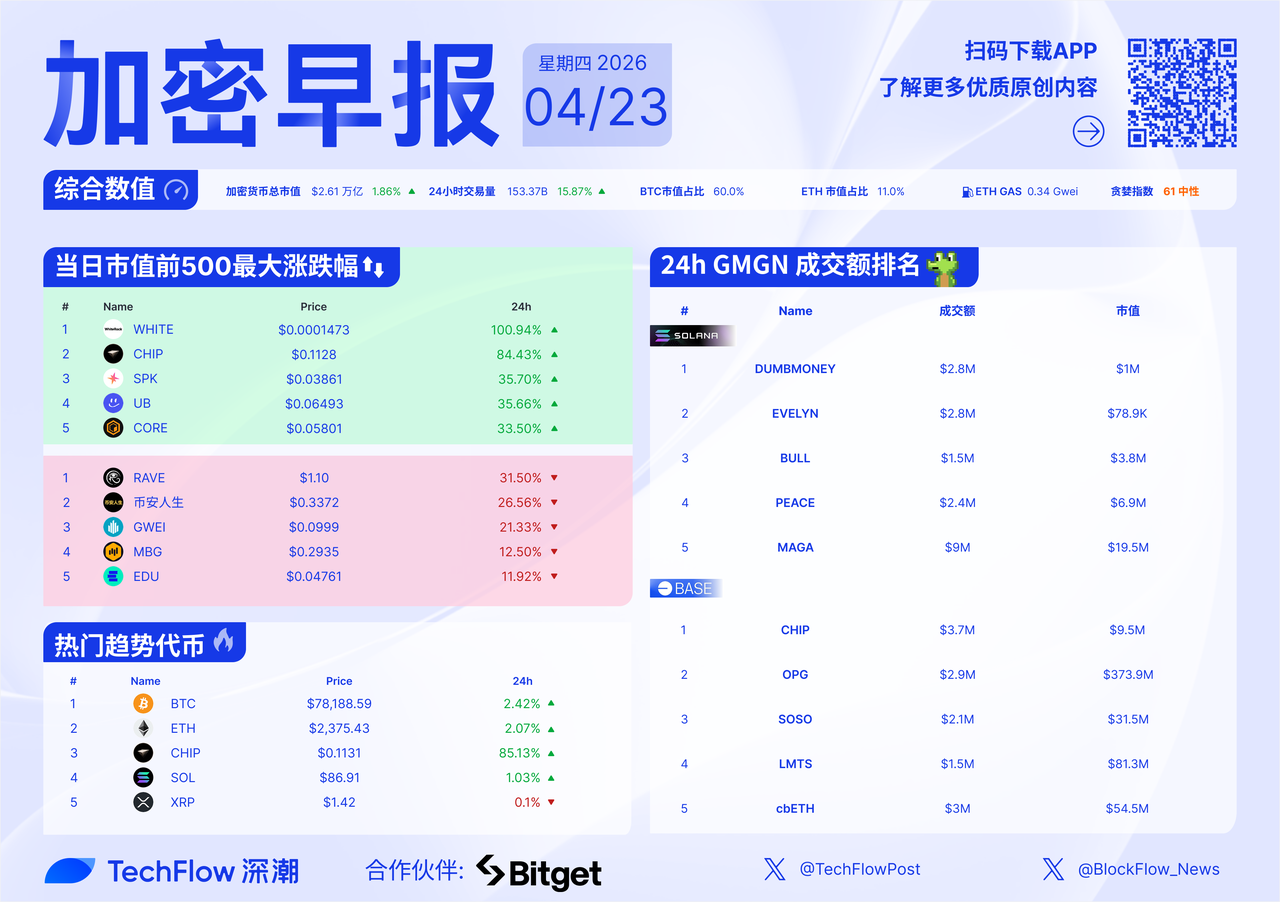
Market Data
Recommended Reading
Anthropic Removes Claude Code from Pro Plan, Sparking Developer Backlash—OpenAI Seizes Opportunity to Counter
https://www.techflowpost.com/zh-CN/article/31254
This article discusses Anthropic’s decision to remove its programming agent Claude Code from its $20/month Pro plan, restricting access to the higher-priced Max plan. The change triggered strong backlash across the developer community. Meanwhile, competitor OpenAI capitalized on the situation by announcing that its Codex service remains accessible via both free and Plus plans—further intensifying competitive pressure. The article also addresses AI industry challenges related to compute costs, as well as the rise of open-source models and local deployment tools.
The Next-Generation DEX Entry Battle: Byreal Bets on “Agent-Native” Design
https://www.techflowpost.com/zh-CN/article/31255
This article details Byreal’s innovative path toward an “agent-native DEX,” covering its core strategy, product features, and future roadmap. It highlights how Byreal leverages AI Agent technology to simplify on-chain trading and make complex DeFi operations more efficient and accessible.
On the Eve of X Money’s Launch, Musk Takes Down the Referee First
https://www.techflowpost.com/zh-CN/article/31256
This article explores regulatory challenges and unfair competition in the crypto industry—particularly the conflict between Elon Musk’s X Money and the Consumer Financial Protection Bureau (CFPB), as well as potential backdoor provisions in the GENIUS Act stablecoin regulation bill that could reshape industry rules. It compares compliance efforts and associated costs borne by Coinbase and PayPal, and analyzes how regulatory frameworks impact fair competition.
Interview with Bitwise Advisor: Renting Beats Buying Homes—Investing in Bitcoin Beats Real Estate
https://www.techflowpost.com/zh-CN/article/31257
This article analyzes Bitcoin versus real estate investment, the impact of artificial intelligence (AI) on labor markets, and the significance of decentralized technologies in shaping future societies. Through comparative analysis of traditional and emerging asset classes, it examines current financial system challenges, explores AI’s potential socioeconomic disruptions, and positions Bitcoin and cryptocurrencies as viable responses to those challenges.
Iran Fires on Oil Tanker That Paid Bitcoin “Toll Fee” to Scammers
https://www.techflowpost.com/zh-CN/article/31259
This article recounts how, following Iran’s announcement of a Bitcoin “toll fee” for vessels passing through the Strait of Hormuz, scammers impersonated Iranian officials to demand cryptocurrency payments from stranded ships. One tanker that paid the fraudulent fee was fired upon by the Islamic Revolutionary Guard Corps while attempting passage. Although Iran’s Bitcoin toll plan may never have been implemented, fraudsters exploited the news to profit. The incident exposed Bitcoin’s irreversible payment flaw and sparked broader discussions about cryptocurrency compliance amid sanctions regimes.
Join TechFlow official community to stay tuned
Telegram:https://t.me/TechFlowDaily
X (Twitter):https://x.com/TechFlowPost
X (Twitter) EN:https://x.com/BlockFlow_News
 深潮TechFlow


