OpenAI Sets Record for Largest Funding Round in History, Valuation Nears $1 Trillion
TechFlow Selected TechFlow Selected
OpenAI Sets Record for Largest Funding Round in History, Valuation Nears $1 Trillion
OpenAI can no longer return to what it once was—but perhaps it never intended to.
 Navigating Web3 tides with focused insights
Source: APPSO

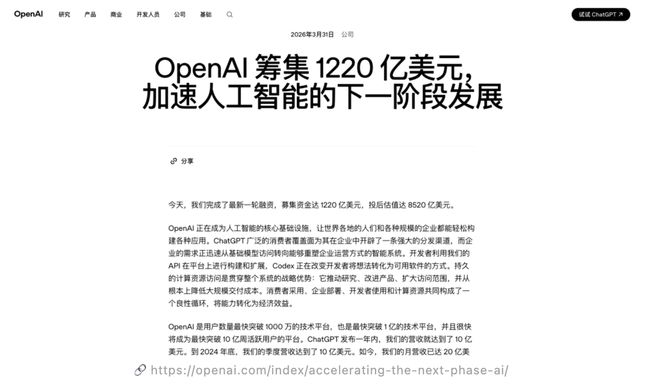
While the world is still digesting the Claude Code source-code leak incident, OpenAI has once again grabbed headlines. Just now, OpenAI officially announced the completion of a $122 billion funding round.
A single private round raising $122 billion—unprecedented in human commercial history. Following this round, OpenAI’s valuation stands at $852 billion, just shy of the $1 trillion mark—and the company is only ten years old.
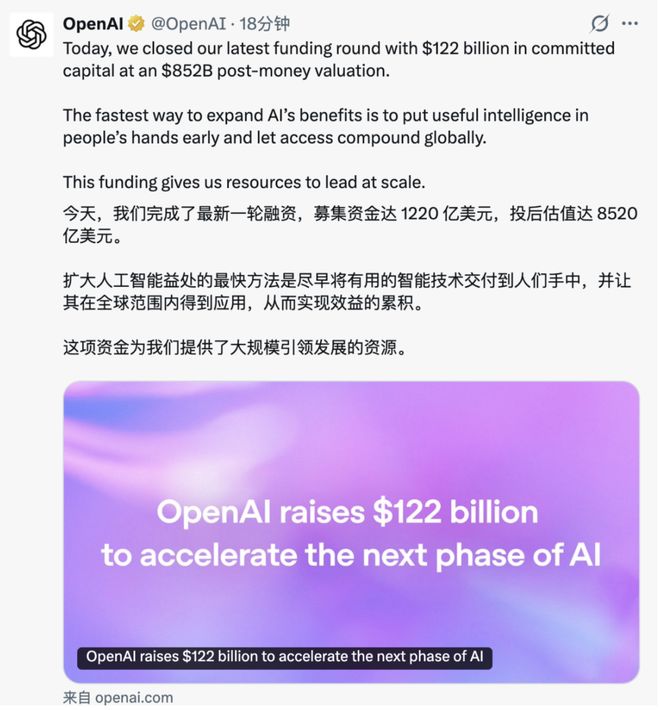
Notably, when this round was first announced in February this year, the committed amount stood at $110 billion; it ultimately closed $12 billion higher, indicating more institutions joined than initially anticipated.
The broader market widely views this as OpenAI’s final large-scale private fundraising before its planned IPO by year-end—the public listing timeline is becoming increasingly clear.
Where Did the Money Come From?
The primary investors in this round are Amazon ($50 billion), NVIDIA ($30 billion), and SoftBank ($30 billion); SoftBank co-led the round alongside firms including a16z and D.E. Shaw.
Microsoft, OpenAI’s long-standing partner, also participated—but did not disclose its investment amount. As of end-2023, Microsoft’s cumulative investment in OpenAI exceeded $13 billion.
Additionally, OpenAI opened this round to affluent individual investors via banking channels for the first time, raising approximately $3 billion through this channel. ARK Invest’s flagship $6-billion Innovation ETF also announced it would include OpenAI, with an approximate 3% allocation—the fund’s first-ever investment in a private company.
In fact, certain funds managed by T. Rowe Price and Fidelity have already held small stakes in OpenAI; ARK’s entry further broadens accessibility for retail investors.
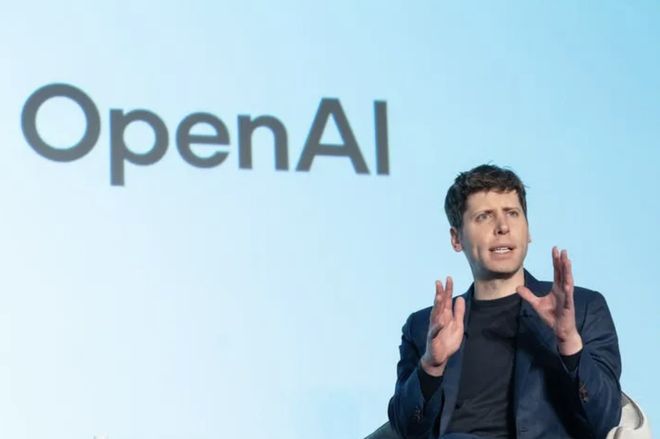
In short, virtually the entire tech ecosystem is backing OpenAI.
Yet upon closer inspection, the logic is straightforward: OpenAI will use these funds to purchase NVIDIA chips and lease servers from Amazon and Microsoft. By investing early, these giants effectively secure the world’s largest AI compute customer in advance. This funding round is less about betting on OpenAI’s future—and more about locking in a reliably profitable business.
For OpenAI, this capital infusion functions more like a final pre-IPO “boost.”
The financial metrics certainly look impressive: nearly 900 million weekly active users, over 50 million paying users, $13.1 billion in annual revenue last year, peak monthly revenue of $2 billion—and growth rates four times those of internet giants like Google and Meta at comparable stages.
However, OpenAI remains unprofitable, and its cash burn rate shows no signs of slowing.
Why Was Sora Shut Down?
Amidst this funding round, OpenAI’s product development has not stalled.
It launched GPT-5.4—the strongest version to date—with notable improvements in multitasking and workflow performance. Its code-generation tool Codex has evolved from a feature into a standalone programming agent, now boasting over 2 million weekly active users—a fivefold increase over the past three months, with monthly growth consistently around 70%.
Enterprise adoption is equally noteworthy: enterprise services now account for over 40% of OpenAI’s total revenue, projected to reach parity with consumer revenue by end-2026.
Its API processes over 15 billion tokens per minute; search usage has nearly tripled over the past year; and its ad pilot program generated over $100 million in annualized revenue within six weeks of launch. This signals OpenAI’s diversifying revenue streams—ChatGPT subscriptions represent only one component.
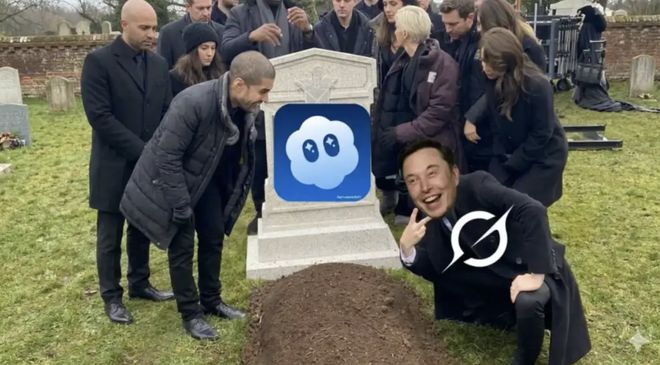
Yet juxtaposed against these glowing metrics, Sora quietly went offline.
Upon launch, Sora indeed sent ripples across film and creative industries. Generating video from a single prompt—with remarkably realistic visuals—it struck many as the most exciting frontier of AI technology.
But video generation demands exponentially more compute power than text generation. Every AI inference, every text output, every rendered video frame consumes expensive GPU cycles and electricity. Intelligence isn’t free—every API call incurs real monetary cost.
On the user side, while many find it fun, few are willing to pay premium prices for it.
According to The Wall Street Journal, one reason OpenAI chose to shut down Sora is that it burned roughly $1 million daily—yet user numbers plummeted from 1 million at launch to under 500,000.
When retention metrics falter and monetization paths remain unclear, continuing such a capital-intensive venture becomes indefensible. Reality hadn’t yet been disrupted—yet Sora had already ceased to exist.
Shutting down Sora is merely the beginning. OpenAI is reviewing other high-cost, low-return initiatives and preparing further cutbacks—reallocating compute resources toward text models, code generation, and enterprise services with stable cash flows. This signals OpenAI’s message to Wall Street: “We understand—and need—to generate revenue.”
From “Changing the World” to “Electricity, Water, and Gas”
Founded in 2015, OpenAI’s original mission was to ensure artificial general intelligence benefits all humanity.
In 2019, to secure sufficient R&D funding, the company shifted to a “capped-profit” model, establishing a for-profit subsidiary and accepting a $1 billion investment from Microsoft. While operations became commercialized, the nonprofit OpenAI Foundation retained ~26% equity—symbolically upholding its original public-benefit mission.
OpenAI’s official funding announcement includes a telling phrase: “building the infrastructure layer for intelligence itself.”
These few words encapsulate OpenAI’s evolving self-perception. Previously, it prioritized dazzling demos to redefine public perception of AI. Now, it aims to recede into the background—becoming an indispensable foundational tool for enterprises and individuals alike.
It calls this vision the “super app,” integrating ChatGPT, Codex, search, and browser capabilities into a unified interface—primarily targeting developers and enterprise users, eliminating the need to toggle between disparate tools.

This strategy hinges on consumer adoption naturally driving enterprise procurement—creating mutual reinforcement between both segments.
An average consumer may subscribe today and cancel tomorrow—but an enterprise running core operations on OpenAI models won’t abruptly sever ties. That kind of stickiness is precisely what Wall Street values.
Over the past few years, the AI industry has delivered wave after wave of breakthroughs: new models, new products, new possibilities—all captivating and inspiring.
Yet this funding round—and Sora’s shutdown—suggest that era of constant surprise may truly be ending. What follows may resemble a mature business: some manage compute, others handle data or sales—each guarding their domain, emphasizing cost control and commercial execution.
OpenAI can’t return to its earlier days—but perhaps it never intended to.
Join TechFlow official community to stay tuned
Telegram:https://t.me/TechFlowDaily
X (Twitter):https://x.com/TechFlowPost
X (Twitter) EN:https://x.com/BlockFlow_News