








We Scraped OpenAI’s and Anthropic’s Job Postings and Uncovered Their Secret Plans
TechFlow Selected TechFlow Selected
We Scraped OpenAI’s and Anthropic’s Job Postings and Uncovered Their Secret Plans
The recruitment page is one of the few publicly available strategic signal sources.
 Navigating Web3 tides with focused insights
Authors: Jean-Stanislas Denain, Campbell Hutcheson
Translated and edited by: TechFlow
TechFlow Introduction: Researchers at Epoch AI analyzed the public job postings of OpenAI, Anthropic, xAI, and Google DeepMind to reverse-engineer these companies’ strategic directions based on role distribution.
The findings are intriguing: Sales roles at OpenAI and Anthropic surged within the past year—especially technical sales roles focused on helping customers “learn how to use AI.”
OpenAI is developing a portable device equipped with a camera and powered by its own custom chip—and has seven open robotics positions.
Anthropic is not building chips but is aggressively negotiating data center contracts. Job postings are among the few publicly available strategic signals—and this analysis is exceptionally information-dense.
Full text below:
AI companies guard their strategies closely—but their job postings are public.
These listings contain clues about what products a company is developing, who it intends to sell them to, and which parts of the value chain it anticipates will become bottlenecks. A posting for a “Camera ISP Software Engineer,” for instance, hints at a camera-equipped device. A call for “Frontline Deployment Engineers” suggests that deploying AI in enterprises remains challenging. A cluster of robotics-related roles signals ambitions extending far beyond chatbots.
We analyzed publicly listed job openings at leading foundational model labs—including OpenAI, Anthropic, xAI, and Google DeepMind. Below are our findings.
Key Findings:
- Sales and sales-adjacent roles at OpenAI and Anthropic have grown sharply over the past year. Anthropic’s GTM (go-to-market) roles rose from 17% to 31% of its open positions; OpenAI’s rose from 18% to 28%. Growth is concentrated in technical roles focused on helping customers operationalize AI.
- Job postings offer glimpses into product roadmaps. For example, both OpenAI and DeepMind are investing in hardware products (robots and consumer devices), whereas Anthropic is more focused on refining its core offerings.
- Job postings also reveal differing strategies for securing critical resources—compute and data. For instance, OpenAI lists 21 roles related to custom silicon development; Anthropic lists none.
A few caveats: Job postings reflect what a company *wants* to hire—not necessarily its current team composition. For example, 20 open roles in one team could indicate expansion of an existing large team—or the formation of an entirely new team that doesn’t yet exist. A single “Research Engineer” listing may aim to fill one position, ten positions, or none at all.
GTM Has Become the Largest Hiring Category at OpenAI and Anthropic
Over the past year, sales and sales-adjacent roles at OpenAI and Anthropic have expanded significantly: Anthropic’s GTM roles increased from 17% to 31% of its open positions; OpenAI’s rose from 18% to 28%. This is unsurprising for companies experiencing rapid revenue growth while competing in a market far from saturation. Sales-adjacent roles now constitute the largest hiring category at both firms. In contrast, research roles account for only 12% of Anthropic’s open positions and 7% of OpenAI’s.
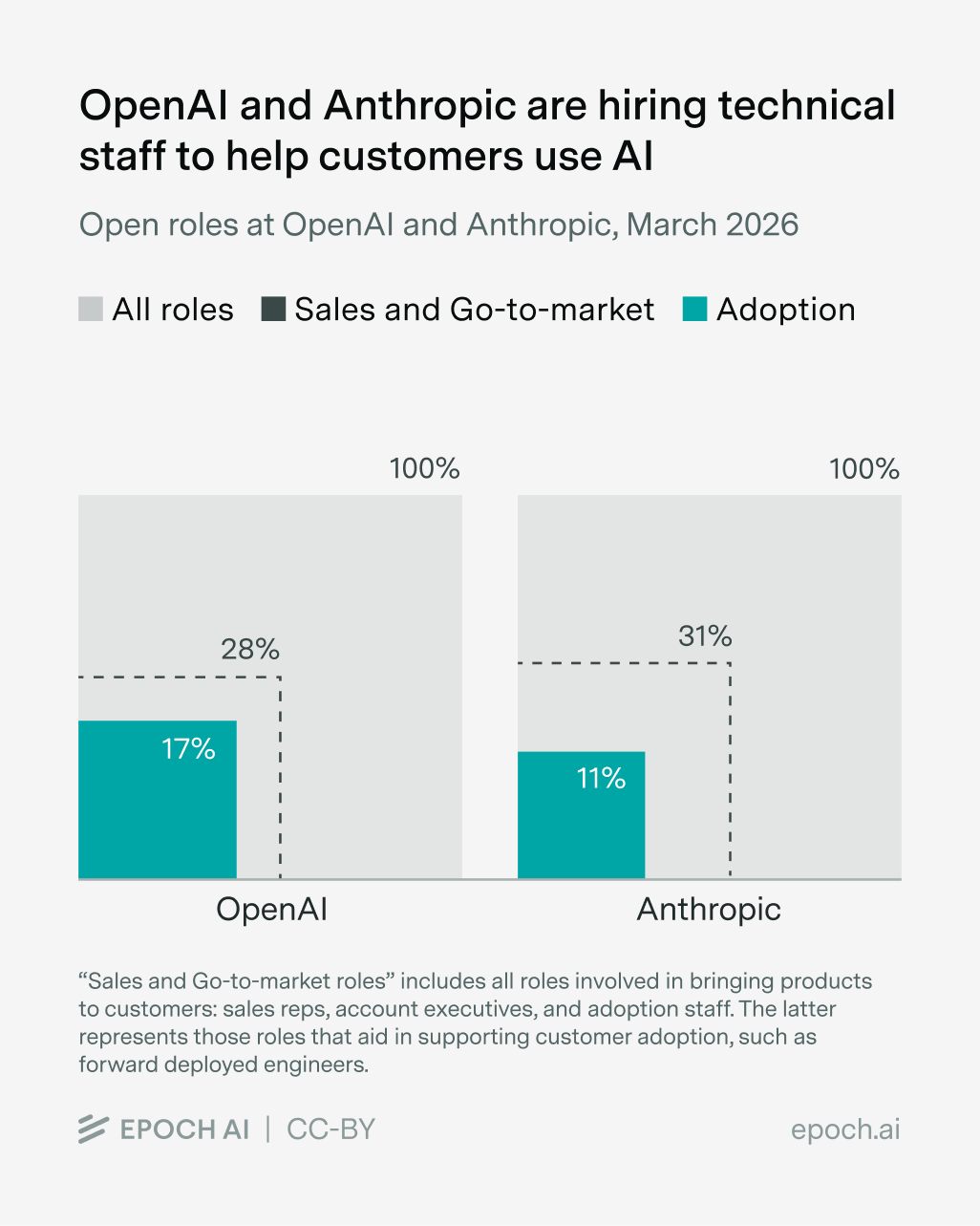
Figure: Shifts in job-category proportions at OpenAI and Anthropic
The fastest-growing subcategory is technical roles dedicated to helping customers actually adopt and deploy AI. Both companies are hiring “AI Success Engineers,” “Partner AI Deployment Engineers,” “Solutions Architects,” and “Frontline Deployment Engineers”—roles whose responsibilities include helping customers identify AI use cases and complete integrations. Over the past year, Anthropic’s “adoption and deployment” roles rose from 5% to 11% of its open positions; OpenAI’s rose from 11% to 17%. This indicates that customers face real difficulties fully leveraging AI products—and bridging that gap hinges on teaching customers “what AI can do.”
The geographic distribution of sales roles also reveals market priorities. More than half of both companies’ sales roles are based in the U.S. (Anthropic: 52%; OpenAI: 55%). Neither firm discloses regional revenue breakdowns, but this concentration strongly suggests the U.S. remains their dominant market.
Internationally, both are aggressively hiring across Europe and Asia-Pacific. Anthropic leans more toward Europe (29%, versus OpenAI’s 21%), while OpenAI leans more toward Asia-Pacific (24%, versus Anthropic’s 19%). Asia-Pacific growth centers on Japan, South Korea, India, Singapore, and Australia. Notably absent are China, the Middle East, Latin America, and Africa. The global hiring focus signals confidence that local competitors in Europe and Asia-Pacific won’t displace them.
Government sales are another key priority. OpenAI and Anthropic each list 10 government sales roles—covering federal civilian, defense, and state/local government sectors. OpenAI has one role specifically targeting national security; Anthropic has two. xAI lists two international government sales roles—one in London and one in Dubai—as well as one role targeting the U.S. government. These postings confirm that governments will be a major revenue source for foundational model labs.
In contrast to Anthropic, OpenAI, and xAI, DeepMind’s job board shows almost no sales activity—because Gemini distribution is handled by Google’s existing sales organization.
Job Postings Reveal New Product Directions at OpenAI and DeepMind
Job listings also hint at what each company is building. Anthropic has five product and engineering roles dedicated to improving Claude Code; OpenAI has ten similar roles focused on Codex. Each has one engineering role targeting financial services. OpenAI also has three roles supporting new features for ChatGPT Health and OpenAI for Healthcare.
However, job postings offer an imperfect lens into existing products. It’s often unclear whether a role expands an existing capability or builds something entirely new—and platform or infrastructure roles frequently span multiple product lines. Thus, job postings are most valuable when revealing “new bets.”
First, OpenAI is building a consumer hardware device. Fifteen open roles relate to this project. Several details emerge: A “Camera ISP Software Engineer” role describes building imaging systems for battery-powered portable devices; a “Research Engineer” role focuses on running Transformer models directly on-device; an “Operating Systems Engineer” role references custom silicon. Taken together, this points to a portable device featuring a camera, powered by proprietary AI chips, and capable of running AI models locally. Two additional hardware and operations roles based in Singapore suggest manufacturing is being prepared. DeepMind is also betting on hardware, with two open positions for XR glasses development—one of which implies voice commands will be the primary interaction modality.
Second, both OpenAI and DeepMind are betting on robotics. OpenAI has seven robotics roles—including positions focused on large-scale simulation training and enhancing simulation fidelity. Listings also suggest some robots may incorporate soft components or casings, and production is ramping up. DeepMind has nine robotics roles, targeting the development of a humanoid robot with dexterous hands.
Beyond hardware, OpenAI has two roles for early-stage social products and one for an “employment platform” designed to help users train skills, earn certifications, and connect with employers. Anthropic has one Research Product Manager role dedicated to exploring entirely new product categories—and another role focused on a new consumer-facing product.
Job Postings Also Reveal Differing Strategies for Securing Compute and Data
Job listings further highlight divergent approaches to securing core inputs—compute and data. The clearest divide lies between building compute infrastructure in-house versus outsourcing procurement.
OpenAI lists 21 roles related to custom silicon development (mostly engineering positions), accounting for 3% of its current openings. Anthropic has chosen a different path: multiple roles focus on collaborating with external partners to design and build data centers—including a “Data Center Mechanical Engineer” responsible for guiding external firms’ cooling and mechanical system designs, and a “Data Center Design Execution Lead” tasked with aligning Anthropic’s technical requirements with third-party delivery partners. Anthropic also has three legal roles dedicated exclusively to negotiating data center or co-location hosting contracts.
Another prominent direction highlighted in job postings is reinforcement learning (RL) training environments. Anthropic has several roles focused on building environments to train models in new capabilities—including an “Environment Expansion” team responsible for constructing RL environments and managing vendor relationships, and a “Universes” team building hyper-realistic, long-horizon agent training scenarios. OpenAI is also hiring researchers for its “Synthetic RL” team, developing RL training methods grounded in self-play, simulators, and synthetic feedback.
In contrast to OpenAI, Anthropic, and DeepMind—which list no dedicated human annotation roles—xAI’s job board reveals a distinct data strategy. It lists 27 human data annotation roles, indicating xAI prefers to keep data labeling in-house. It’s also notable that xAI openly advertises these roles. Other labs rely equally on large-scale human annotation—but typically outsource such work or avoid public postings altogether.
Conclusion
Job postings are an imperfect signal—but they remain one of the few publicly observable windows into how top AI labs evolve. The current picture is clear: These companies are heavily investing in sales and product deployment, expanding into new product categories, and competing fiercely for critical resources like compute and data. As these labs continue to scale and their strategies increasingly diverge, their job boards will remain among the best public windows into their trajectories.
Join TechFlow official community to stay tuned
Telegram:https://t.me/TechFlowDaily
X (Twitter):https://x.com/TechFlowPost
X (Twitter) EN:https://x.com/BlockFlow_News
 @EpochAIResearch


