OpenAI Shuts Down Sora, Disney’s $1 Billion Investment Goes Down the Drain, and the AI Video Market Is Reshuffled
TechFlow Selected TechFlow Selected
OpenAI Shuts Down Sora, Disney’s $1 Billion Investment Goes Down the Drain, and the AI Video Market Is Reshuffled
The tech community’s first reaction wasn’t regret—it was, “Did anyone actually use this thing?”
 Navigating Web3 tides with focused insights
Author: RoboRhythms
Translated and edited by TechFlow
TechFlow Intro: On March 24, 2026, OpenAI abruptly shut down Sora’s app, API, and domain—collapsing Disney’s three-year licensing agreement and its planned $1 billion investment.
The tech community’s first reaction wasn’t mourning—it was “Did anyone actually use this thing?” That question speaks louder than any official statement. Runway, Kling, and Google Veo are now the only true remaining players in the AI video generation space.
Full article below:
The product that was supposed to bring AI video generation to the mainstream has vanished. OpenAI shut down Sora on March 24, 2026—taking offline its standalone app, developer API, and sora.com domain—just six months after its high-profile public launch.
The timing couldn’t be worse. In December 2025, Disney signed a three-year licensing agreement granting OpenAI rights to use iconic characters—including Mickey Mouse and Cinderella—in Sora-generated content—and announced plans to invest $1 billion in OpenAI.
All of that is now canceled.
What best illustrates the situation is the tech community’s reaction: The dominant sentiment isn’t regret—it’s “Did anyone actually use this thing?” That question reveals more truth about the product’s real-world trajectory than any official announcement ever could.
If you’re using Sora—or planning to build products on its API—here’s what you need to know.
What exactly happened
Sora’s shutdown represents a full product termination—covering the consumer app, developer API, and sora.com domain.
On March 24, OpenAI confirmed the entire Sora product line would be fully discontinued. This is not a pivot, rebranding, or integration into another product.
The app is gone. The API is being retired. sora.com is going offline.
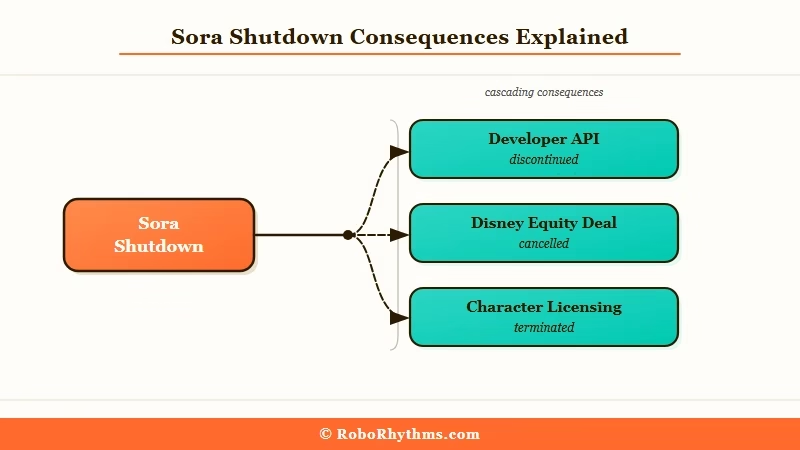
Here’s everything that’s been terminated:
- The Sora consumer app (text-to-video)
- The Sora API (for developers and enterprises)
- The sora.com website
Disney’s planned $1 billion equity investment in OpenAI
The three-year character licensing agreement announced in December 2025
This Disney thread isn’t a footnote. A $1 billion deal collapsing just three months after its announcement signals that the relationship had already grown complicated well before the shutdown was officially announced.
Variety and Bloomberg both confirmed the deal was directly canceled due to Sora’s discontinuation.
One piece remains: OpenAI’s internal research team continues advancing what it calls “world simulation” research—with a focus on robotics applications.
This project bears no relation to the video product you used. OpenAI explicitly frames it as infrastructure research—not a future consumer-facing product.
This also aligns with a pattern I’ve previously reported on: OpenAI has a history of sunsetting products that no longer fit its revenue roadmap—and this timing—just ahead of its planned IPO—follows the same logic.
Why this is more serious than it sounds
Sora’s shutdown isn’t merely a product failure—it’s OpenAI’s public admission that it’s ceding an entire AI category to competitors it once dismissed when Sora launched.
When Sora debuted in 2024, its demos were astonishing. Posts on r/singularity garnered hundreds of thousands of views, widely seen as proof that OpenAI had again leapfrogged all competitors overnight.
Runway, Pika, and Kling were expected to become irrelevant.
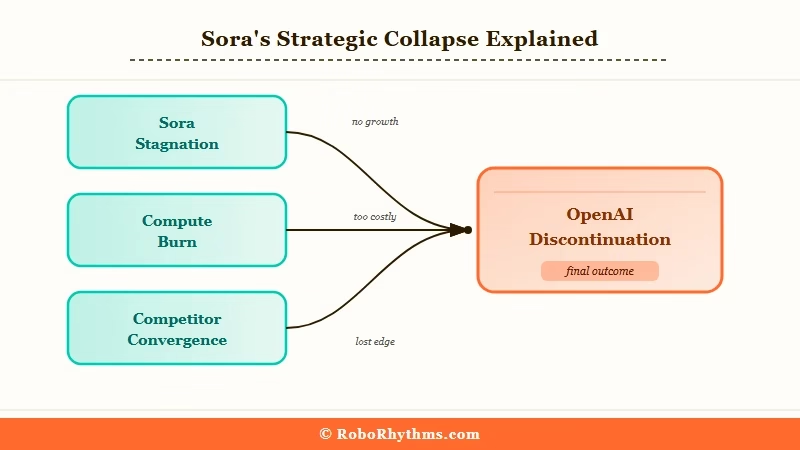
But after its public release, Sora stagnated. Runway Gen-4 kept shipping iterative improvements. Kuaishou’s Kling 3.0 closed the quality gap faster than most analysts anticipated.
Google Veo’s accumulated compute advantage is one OpenAI—focused on non-core, low-revenue verticals—struggles to match easily.
Compute cost is the most glaring number. Analysts estimate Sora consumed roughly $15 million per day in compute costs at peak usage.
For a company laser-focused on financial readiness ahead of its IPO—and where truly revenue-driving models (GPT-5 series, Operator API, enterprise contracts) still demand greater investment—this expense became impossible to justify.
Then there’s the deepfake problem. In its shutdown coverage, TechCrunch dubbed Sora “the most unsettling app on your phone,” referring to its guest feature enabling users to insert real people into AI-generated scenes.
The backlash was severe—and in my view, the reputational drag it caused made the shutdown decision significantly easier to make.
The industry impact is now clear: Runway, Kling, and Google Veo are the only real participants left in AI video generation. OpenAI’s presence had injected strategic uncertainty into every competitor’s planning—now that uncertainty has evaporated.
What this means for you
If you’re using Sora—or integrating its API—you need to act immediately. The shutdown timeline is immediate.
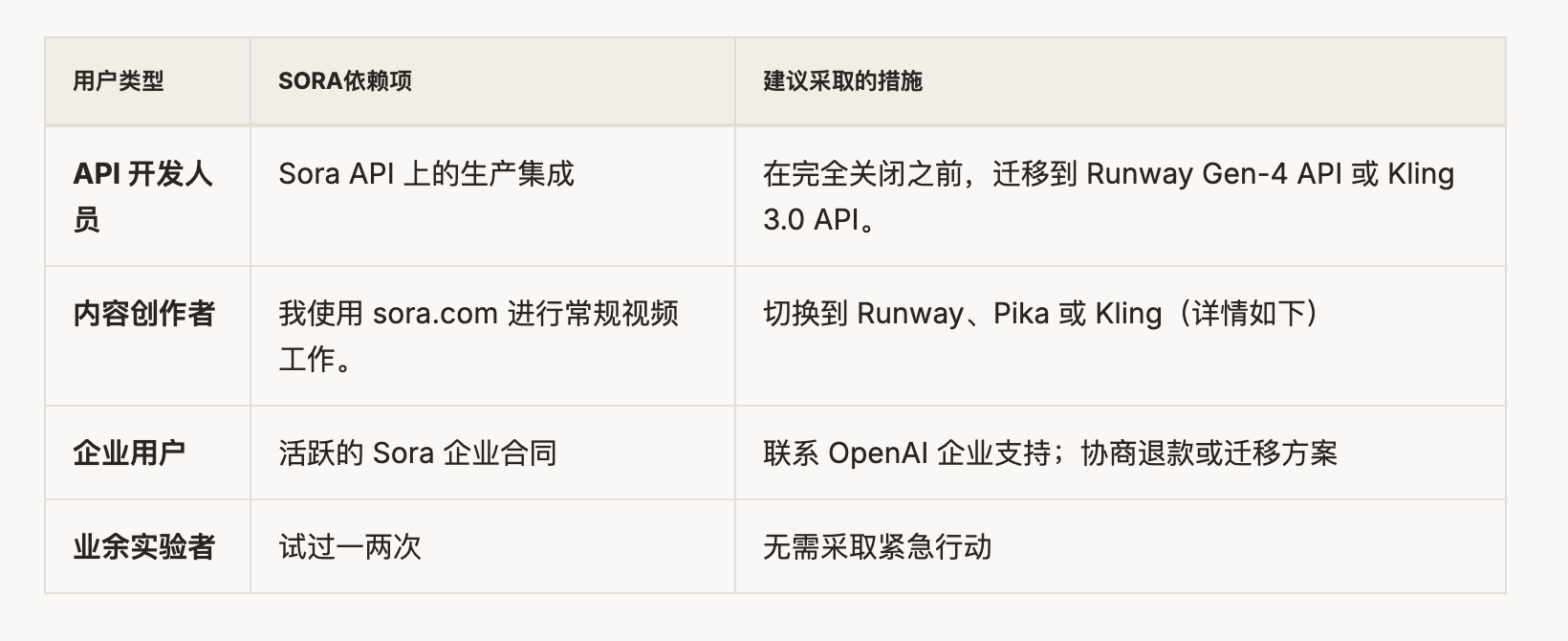
The three tools best positioned to absorb Sora’s former user base right now are:
Runway Gen-4—technically closest to Sora’s cinematic-quality ambitions, with a mature API and an active developer community. Best suited for professional long-form video production.
Kling 3.0—Kuaishou’s model has become the community’s go-to for realistic motion effects—and the top recommendation among former Sora users in migration discussions. Developer API available.
Pika 2.0—faster, cheaper, and more accessible than the above two. Plans start at ~$8/month. Best for creators prioritizing speed over cinematic quality.
If your primary use case is virtual avatars or talking-head videos—not pure generative video—the tool selection shifts accordingly.
What happens next
The AI video market is poised for consolidation—and prices will rise.
With OpenAI’s exit, Runway, Kling, and Google Veo no longer face a well-funded new entrant capable of upending pricing expectations at any moment.
This fundamentally changes the commercial dynamics for all remaining players.
My six-month outlook:
Runway will raise subscription prices. Surging demand from incoming Sora users—combined with Runway’s historically conservative pricing relative to its competitive standing—creates clear room for repricing. Reduced threat from OpenAI gives them explicit license to do so.
Google Veo will move more aggressively toward consumer products. Google previously launched Veo quietly and deliberately. With the addressable market now far clearer, expect a more prominent consumer-facing product rollout by end-2026.
Kling will target enterprise contracts vacated by Disney’s exit. Kuaishou has consistently positioned Kling as a professional-grade tool. The OpenAI–Disney deal effectively blocked certain enterprise relationships—those doors are now wide open again.
One outcome I don’t foresee: OpenAI returning to AI video as a consumer product. Internal signals point to video being reframed exclusively as robotics infrastructure research—and the window for a consumer return is shorter than OpenAI’s typical development cycle.
From observing every AI category, I’ve learned that the ultimate winners are those who accumulate iterative improvements over time—not those who delivered the flashiest demo. Sora peaked at demo time. Runway has been iterating for three years.
Frequently asked questions
Q: As of March 2026, is the Sora app still usable?
As of March 24, 2026, Sora has entered its shutdown process. OpenAI hasn’t published exact final access dates for all users, but the decommissioning has begun. Do not rely on continued availability for any production work.
Q: What’s the best Sora API alternative for developers?
Runway Gen-4 currently offers the most mature and stable developer API in the AI video space. Kling 3.0 also provides API access and is widely recommended in developer migration discussions. We recommend testing both before fully migrating.
Q: Why did Disney cancel its $1 billion investment in OpenAI?
Disney’s investment and three-year licensing agreement were directly tied to the Sora product line—including rights to use Disney characters in AI-generated video. With Sora’s shutdown, the licensing arrangement lost its foundation. Both parties have canceled the deal, per reports from Bloomberg and Variety.
Q: What happens to OpenAI’s internal Sora research team?
The team continues working on world simulation research for robotics applications. This work will produce no consumer- or developer-facing video products. OpenAI classifies it as infrastructure research—not part of its product roadmap.
Q: Does this mean OpenAI is scaling back across all consumer products?
OpenAI has explicitly stated that pre-IPO resources will prioritize enterprise software, programming tools, and agent-based products. Sora’s shutdown aligns directly with that strategy.
Q: Is Google Veo now the best Sora alternative?
Veo is technically strong—but for developers and content creators today, Runway Gen-4 and Kling 3.0 are more accessible and better supported. For most users needing to migrate immediately, Runway or Kling represent the more practical choice.
Join TechFlow official community to stay tuned
Telegram:https://t.me/TechFlowDaily
X (Twitter):https://x.com/TechFlowPost
X (Twitter) EN:https://x.com/BlockFlow_News
 @AlbertNoah_