








Crypto Morning Brief: U.S. Approves Sale of NVIDIA H200 Chips to 10 Chinese Companies; U.S. Senate Banking Committee Passes the Clarity Act
TechFlow Selected TechFlow Selected
Crypto Morning Brief: U.S. Approves Sale of NVIDIA H200 Chips to 10 Chinese Companies; U.S. Senate Banking Committee Passes the Clarity Act
CME plans to launch Nasdaq CME Cryptocurrency Index Futures on June 8.
 Navigating Web3 tides with focused insights
Author: TechFlow
Yesterday’s Market Updates
U.S. initial jobless claims for the week ending May 9 totaled 211,000, versus an expected 205,000.
U.S. initial jobless claims for the week ending May 9 totaled 211,000, versus an expected 205,000 and a prior figure revised downward from 200,000 to 199,000.
The Clarity Act cleared the U.S. Senate Banking Committee and advances to full Senate vote.
According to crypto journalist Eleanor Terrett, the Clarity Act passed the U.S. Senate Banking Committee by a vote of 15–9, with Democratic Senators Ruben Gallego and Angela Alsobrooks voting in favor. The bill now moves to a full Senate vote.
The U.S. approved sales of Nvidia H200 chips to 10 Chinese companies—but transactions remain stalled.
According to Reuters, the U.S. has approved exports of Nvidia H200 AI chips to 10 Chinese companies—including Alibaba, Tencent, and ByteDance—yet no chips have been delivered, and related transactions remain stalled.
The report notes that Nvidia CEO Jensen Huang joined the U.S. delegation during President Trump’s visit to China in an effort to advance H200 chip sales in China. The U.S. Department of Commerce also authorized select distributors—including Lenovo and Foxconn—to directly procure and resell the chips. However, strict U.S. security, end-use, revenue-sharing, and legal restrictions on H200 exports clash with China’s supply-chain security policies, leading to tighter order approvals.
TownSquare launches $100 million USD1 stablecoin liquidity program.
TownSquare—an infrastructure provider focused on institutional yield and cross-chain lending brokerage services—has announced a $100 million liquidity program for the USD1 token. This initiative aims to broaden access to institutional-grade yield strategies and cross-chain yield opportunities via USD1, a stablecoin issued by World Liberty Financial.
Previously, TownSquare partnered with the World Liberty Financial DeFi team to integrate USD1 onto Monad, a high-performance EVM-compatible chain, earning official incentives from the Monad Foundation. The team stated that this new liquidity program marks TownSquare’s continued commitment to expanding DeFi’s reach and delivering institutional yield strategies to broader asset classes.
Cross-chain lending functionality is now live on the project’s official website; the “yield vault” product is listed as “coming soon.”
According to official information, the project has previously completed a funding round backed by investors including Monad, a16z, Aptos, Solana Bonk, and other European and U.S.-based angel investors and VCs. The founding team includes alumni from Coinbase, Meta, Accenture, and market-making firms. Details of the next funding round have not yet been disclosed.
Aave updates its bug bounty program; Core Aave V3 and other modules to host separate bounty programs.
Aave announced an update to its bug bounty program to better align rewards with risk profiles across ecosystem components and streamline audit pathways. The reward cap for critical vulnerabilities in Aave V4 and Core Aave V3 has now increased fivefold.
CME plans to launch Nasdaq-CME Cryptocurrency Index Futures on June 8.
The Chicago Mercantile Exchange Group (CME Group) announced plans to launch Nasdaq-CME Cryptocurrency Index Futures on June 8, pending regulatory review. These futures will be CME’s first market-cap-weighted contracts and will be offered in both micro and standard contract sizes.
The contracts will provide market participants with a capital-efficient way to gain exposure to top-ranked cryptocurrencies through a single financially settled futures contract. At expiration, Nasdaq-CME Cryptocurrency Index Futures will settle against the Nasdaq-CME Cryptocurrency Settlement Price Index—a benchmark measuring the performance of the most actively traded and liquid cryptocurrencies, currently (as of May 14) including Bitcoin, Ethereum, SOL, XRP, ADA, LINK, and Lumens (XLM).
Hong Kong dollar-pegged stablecoin HKDAP completes transfer testing on Ethereum.
According to the Hong Kong Economic Journal, Anchorage Financial—the Hong Kong-based stablecoin issuer jointly founded by Standard Chartered Hong Kong, HKT, and Animoca Brands—announced completion of HKDAP transfer testing on the Ethereum blockchain. This test covered the process of converting fiat HKD into reserve assets. All HKDAP tokens were fully redeemed following the test, and phased issuance of HKDAP is expected later this year.
Coinbase becomes Hyperliquid’s official USDC treasury deployer; USDH officially exits.
According to Coinbase’s official blog, Coinbase has become the official Authorized Qualified Agent (AQA) for USDC deployment on Hyperliquid, further cementing USDC’s position as the preferred stablecoin for onchain capital markets. Total USDC on Hyperliquid has reached approximately $5 billion—tripling year-on-year. Meanwhile, Native Markets has agreed to sell the USDH brand assets to Coinbase, and the USDH market will gradually wind down. During the transition, users can freely redeem USDH for USDC or fiat via the USDH Dashboard, with ongoing support provided by Native Markets.
Moodys assigns AAA-mf rating to Fidelity and BlackRock’s tokenized money market funds.
According to CoinDesk, Moody’s assigned its highest possible rating—AAA-mf—to Fidelity and BlackRock’s tokenized money market funds, signifying excellence in credit quality, liquidity, and capital preservation. Fidelity’s FILQ fund launched on May 6 on Sygnum’s Desygnate tokenization platform, enabling real-time onchain cash settlement and supported by infrastructure from JPMorgan, Apex Group, and Chainlink. BlackRock’s BUIDL fund launched in March 2024 and currently accounts for roughly 15% of the tokenized Treasury market.
21Shares launches actively managed cryptocurrency ETF TKNS.
According to an official announcement, 21Shares has launched TKNS, a new actively managed cryptocurrency ETF. Managed by a professional team, the fund seeks to capture market opportunities and outperform passive index funds. Disclosures indicate TKNS will hold a diversified portfolio of digital assets selected by the management team, with positions dynamically adjusted to balance long-term objectives and short-term opportunities. Structured as a traditional equity-market ETF, TKNS offers relatively simplified tax reporting and is now available for trading on select brokerage platforms.
Anthropic and the Gates Foundation announce $200 million partnership focused on global health, education, and economic mobility.
Per Anthropic’s official website, Anthropic and the Bill & Melinda Gates Foundation have formally announced a $200 million, four-year partnership. Funding will be delivered via grants, Claude usage credits, and technical support across four domains: global health, life sciences, education, and economic mobility.
In global health, the partners will accelerate vaccine and therapy development for polio, HPV, and pre-eclampsia, and assist governments in leveraging health data to improve clinical decision-making. In education, AI-powered tutoring tools will be developed for K–12 students in the U.S., sub-Saharan Africa, and India. In economic mobility, initiatives will support smallholder agricultural productivity and vocational credentialing systems. Anthropic stated this collaboration forms a key pillar of its “Beneficial Deployment” strategy—extending AI benefits to areas underserved by conventional market mechanisms.
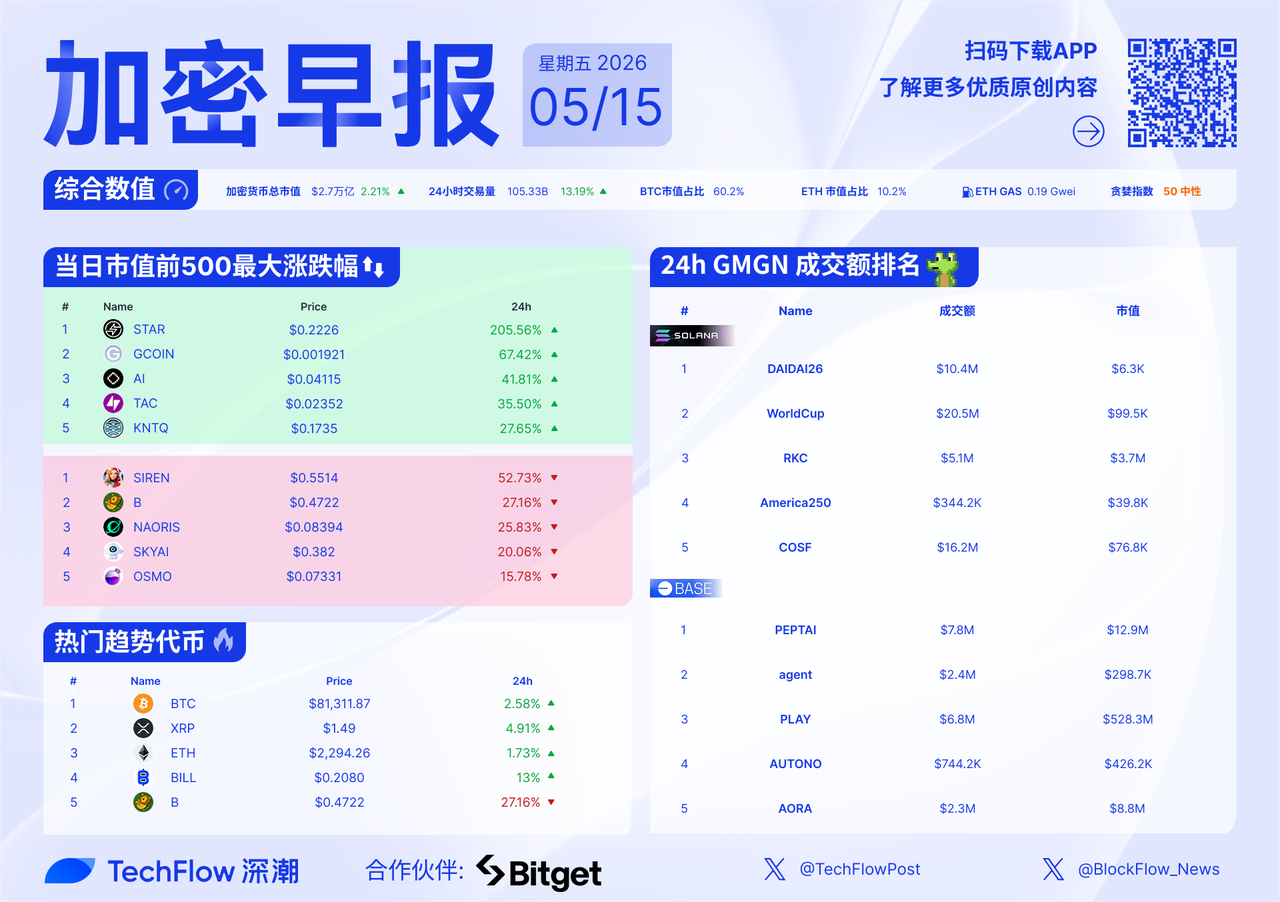
Market Data
Recommended Reading
Interview with He Yi: “My ambition is to build a world worthy of me. Life is either about gaining—or learning.”
https://www.techflowpost.com/zh-CN/article/31570
This article features an interview with He Yi, co-founder and co-CEO of Binance, exploring her journey from rural Sichuan to leadership of the world’s largest blockchain exchange, her worldview, and her deep insights on Bitcoin and financial decentralization. Through He Yi’s personal narrative, the piece shares her perspectives on ambition, self-awareness, execution, courage—and offers practical advice on breaking through personal limits and achieving goals.
Claude helps man recover 5 forgotten Bitcoins—worth nearly $400,000—after 11 years.
https://www.techflowpost.com/zh-CN/article/31571
This article recounts how a user successfully recovered a Bitcoin wallet forgotten for 11 years—containing 5 BTC worth ~$400,000—using Anthropic’s AI chatbot Claude. Claude located an early-version wallet file buried in old documents and fixed bugs in open-source recovery tools, ultimately decrypting the private key. The incident sparked broad discussion across crypto and AI communities—and serves as a stark reminder of data security risks and password loss.
Bezos, Schmidt, Powell Jobs: Three AI investment philosophies from Silicon Valley’s “old money.”
https://www.techflowpost.com/zh-CN/article/31574
This article examines the AI investment philosophies of three prominent Silicon Valley investors—Eric Schmidt, Jeff Bezos, and Laurene Powell Jobs—representing three distinct visions of the future: Schmidt focuses on geopolitics and infrastructure; Bezos pursues industrial-revolution-scale application expansion; and Powell Jobs prioritizes human–AI interaction and societal impact.
Kevin Warsh appointed Fed Chair—the first central bank chief publicly holding Bitcoin assets.
https://www.techflowpost.com/zh-CN/article/31575
This article reports Kevin Warsh’s confirmation as Federal Reserve Chair—the most politically divisive confirmation vote in modern history. Warsh is the first Fed chair to publicly disclose holdings of crypto assets, including Bitcoin and stakes in multiple crypto projects. He opposes central bank digital currencies (CBDCs) and supports private-sector stablecoin issuance. His appointment may profoundly influence crypto markets and Bitcoin’s price trajectory—particularly under a potential “quantitative tightening in exchange for rate cuts” policy framework.
“Buy BTC instead of the Nasdaq”—this claim has an expiration date.
https://www.techflowpost.com/zh-CN/article/31576
This article analyzes comparative returns between Bitcoin and the Nasdaq-100, revealing that outcome depends heavily on the chosen time window: Bitcoin outperformed in three of five windows tested, while the Nasdaq-100 led in two. As a cyclical asset, Bitcoin’s returns are highly sensitive to entry timing; the Nasdaq-100, as a trend-driven asset, delivers more consistent long-term performance. Investment conclusions cannot rely on a single timeframe—timing and profit-taking are essential.
Join TechFlow official community to stay tuned
Telegram:https://t.me/TechFlowDaily
X (Twitter):https://x.com/TechFlowPost
X (Twitter) EN:https://x.com/BlockFlow_News
 深潮TechFlow









