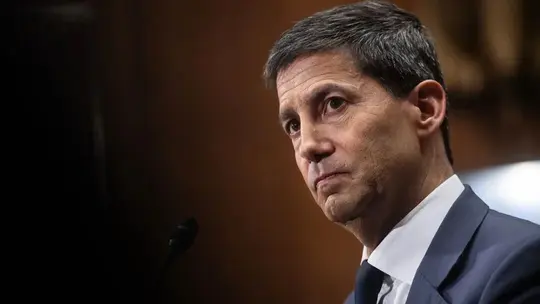
Kevin Warsh Appointed Federal Reserve Chair—First Central Bank Head to Hold Bitcoin Assets
TechFlow Selected TechFlow Selected
Kevin Warsh Appointed Federal Reserve Chair—First Central Bank Head to Hold Bitcoin Assets
Will the market improve just because crypto enthusiasts have arrived?
 Navigating Web3 tides with focused insights
Author: Claude, TechFlow
TechFlow Intro: On May 13, the U.S. Senate confirmed Kevin Warsh as the next Chair of the Federal Reserve by a vote of 54–45—the most politically divided Fed chair confirmation in modern history.
Warsh is the first Fed chair to publicly hold cryptocurrency assets. His financial disclosure reveals equity stakes in multiple crypto projects, including Flashnet, Bitwise, dYdX, and Polychain Capital. He has previously described Bitcoin as “the new gold for people under 40” and opposes central bank digital currencies (CBDCs) while supporting privately issued stablecoins. However, with inflation surging (April CPI rose to 3.8%) and the Iran war pushing oil prices higher, markets now expect interest rates to remain unchanged—or even rise—this year, rendering rate cuts nearly unthinkable.
Warsh’s appointment coincides with a pivotal moment for crypto regulation. The very next day—May 14—the Senate Banking Committee will hold a markup vote on the 309-page “Clarity for Digital Assets Markets Act” (CLARITY Act), marking the first time in U.S. history that a comprehensive crypto market structure bill undergoes committee-level voting.
The Most Controversial Fed Chair Confirmation in Modern History
According to CNBC’s May 13 report, the U.S. Senate confirmed Warsh as the 17th Chair of the Federal Reserve by a vote of 54–45. Pennsylvania Democratic Senator John Fetterman was the sole Democrat to cross party lines in support. This marks the most partisan Fed chair confirmation in the institution’s 111-year history.
The day before (May 12), the Senate had already confirmed Warsh’s appointment to the Federal Reserve Board by a vote of 51–45, granting him a full 14-year term.
The confirmation process spanned several months and encountered repeated setbacks. A major obstacle was the Trump administration’s Department of Justice criminal investigation—launched last year against then-Chair Jerome Powell over alleged cost overruns in the Fed’s headquarters renovation project. As reported by CNBC on April 24, North Carolina Republican Senator Thom Tillis cited this investigation as his reason for refusing to advance Warsh’s confirmation vote. It wasn’t until late April, when Washington, D.C. federal prosecutor Jeanine Pirro announced the investigation’s termination, that Tillis lifted his block.
Powell’s term officially expires on May 15. According to NPR, Powell has stated he will remain on the Board of Governors in his capacity as a governor and will not resign his seat; his governorship runs through January 2028. At his final press conference on April 29, Powell pledged to “keep a low profile” and pledged his support for Warsh’s work. This makes him the first Fed chair in nearly 80 years to remain on the Board after stepping down as chair.
The First Fed Chair to Hold Cryptocurrency Assets
Warsh’s ties to the crypto industry surpass those of any previous Fed chair.
Per financial disclosures compiled by CoinMarketCap and Bitcoin Magazine, Warsh holds crypto-related interests including equity in Bitcoin payments startup Flashnet, affiliations with crypto index firm Bitwise, positions in the stablecoin project Basis, and investments in decentralized derivatives exchange dYdX, decentralized trading protocol Lighter, venture capital firm Polychain Capital, and NFT company Dapper Labs. Under the Fed’s strict investment policy implemented in 2022, Warsh must divest all cryptocurrency holdings by May 15.
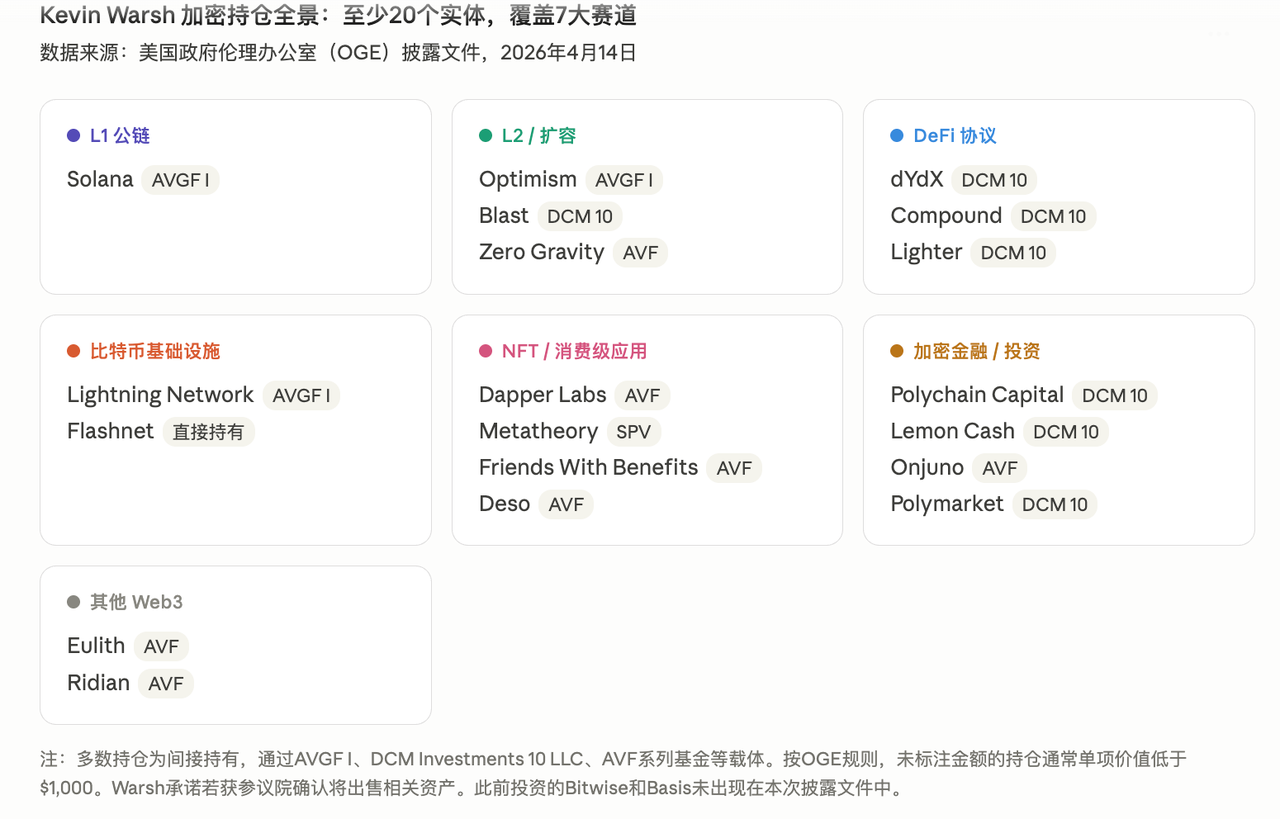
Warsh has consistently voiced positive views on Bitcoin. Speaking at an event hosted by Stanford University’s Hoover Institution in May 2025, he described Bitcoin as “an important asset” and “a good cop for policymakers,” arguing that its price reflects market confidence in the Fed’s ability to manage inflation—not a threat to the dollar’s status. Earlier, in a January 2021 interview on CNBC’s Squawk Box, he bluntly stated: “If you’re under 40, Bitcoin is your new gold.”
According to Blockhead, Warsh’s regulatory stance is equally clear: he opposes CBDCs and supports stablecoin issuance by the private sector. During his Senate Banking Committee hearing, when asked about CBDCs by Senator Bernie Moreno, Warsh directly labeled them a “poor policy choice”—a position closely aligned with the framework of the CLARITY Act currently under congressional review.
The Timing of Warsh’s Appointment
A significant gap exists between Warsh’s “crypto-friendly” label and actual monetary policy.
The timing of Warsh’s appointment is highly awkward. According to CNN, the April Consumer Price Index (CPI) rose year-on-year to 3.8%, the highest since 2023; and on May 13—the same day as the confirmation vote—the April Producer Price Index (PPI) surged 6% year-on-year, driven primarily by energy price increases stemming from the Iran war. Inflation has now exceeded the Fed’s 2% target for five consecutive years.
Trump has repeatedly called for rate cuts—even joking he would sue Warsh if he refused to cut rates. As reported by Yahoo Finance, Warsh had indeed expressed openness to rate cuts prior to his nomination, noting last year that AI-driven productivity gains could suppress inflation and create room for easing. But the Iran war has completely upended that premise.
At his confirmation hearing on April 21, Warsh stated that Trump never demanded precommitments on interest-rate decisions. When Senator Elizabeth Warren directly asked whether he would become Trump’s “puppet,” Warsh replied, “Absolutely not.”
Additionally, Warsh’s confirmation timing almost perfectly overlaps with another major crypto industry event.
At 10:30 a.m. ET on May 14, the Senate Banking Committee will hold a markup vote on the 309-page “Clarity for Digital Assets Markets Act” (CLARITY Act)—the first time in U.S. history that a comprehensive crypto market-structure bill undergoes committee-level voting.
According to CoinDesk’s May 13 report, the committee has received over 130 proposed amendments, including 44 submitted by Senator Elizabeth Warren alone—covering topics such as restricting the Fed’s provision of master accounts to crypto firms and tightening rules governing stablecoin yields. Yet CoinDesk analysis suggests the vast majority of Democratic amendments are unlikely to pass.
On Polymarket, the probability of the CLARITY Act passing this year stands at approximately 60%. Citi analysts have directly tied their $143,000 Bitcoin year-end 2026 base-case target price to passage of the CLARITY Act, estimating it would trigger $15 billion in net ETF inflows.
Bitcoin Stalls at $80,000 as Markets Await Direction
As of May 14, Bitcoin trades around $79,500, showing no significant movement following Warsh’s confirmation—reflecting the market’s strong prior expectation (Polymarket had priced in a 93.5% confirmation probability).
This spring, Bitcoin has largely traded within a $74,000–$80,000 range. Per CoinPedia analysis, the key resistance level lies near the $82,500 200-day moving average; a breakout above could open further upside, whereas failure to hold could see a retest of $76,000 support.
DL News cites Iggy Ioppe, former Credit Suisse banker and Chief Investment Officer at tokenization platform Theo, who notes that if Warsh implements a “quantitative tightening-for-rate-cuts” strategy in the second half of 2026—reducing the balance sheet while cutting rates—it could generate historically favorable high-liquidity conditions for risk assets, potentially pushing Bitcoin toward $100,000. In the short term, however, “this is a hawkish wait.”
Senator Cynthia Lummis posted on social media following Warsh’s confirmation: “American businesses and digital asset holders finally have a Fed leader ready to deliver results.”
Join TechFlow official community to stay tuned
Telegram:https://t.me/TechFlowDaily
X (Twitter):https://x.com/TechFlowPost
X (Twitter) EN:https://x.com/BlockFlow_News
 深潮TechFlow