Decoding Trump’s Fed Chair Nominee: Walsh’s Economics—from “Hawkish Veteran” to “Rate-Cut Standard-Bearer”
TechFlow Selected TechFlow Selected
Decoding Trump’s Fed Chair Nominee: Walsh’s Economics—from “Hawkish Veteran” to “Rate-Cut Standard-Bearer”
For Mr. Wosh to earn applause from everyone, he must deliver the most spectacular performance of his life.
 Navigating Web3 tides with focused insights
Source: JINSHI Data
Few people consider the Federal Reserve an all-powerful institution. Yet when Kevin Warsh attended his first Fed meeting in 2006, he successfully persuaded a fellow official to sing a song during the session. In the years since, Warsh has repeatedly hammered home a consistent theme: inflation is dangerous; monetary policy is often overly stimulative; and the Fed’s bond-buying programs lie at the root of many of America’s economic woes.
Lately, Warsh’s tone has shifted. The former inflation hawk appears to have grown new feathers. This transformation has helped him win favor with Donald Trump—who is eager to lower interest rates. After years as a dissenter, Warsh is poised to lead the world’s most important central bank. What he calls for goes beyond mere “institutional reform.” Its precise meaning remains hazy—but Warsh’s two-decade record of criticizing the Fed offers clues about what the U.S. and the world should expect from “Warsh economics.”
Start with any central bank governor’s core task: guiding interest rates. By law, the Fed pursues a “dual mandate”: balancing low inflation with a healthy labor market. For most of Warsh’s career, he has held firmly that price stability comes first. “If price stability is squandered, financial stability is at risk. If financial stability collapses, the economy is threatened, and the social contract is undermined,” he wrote in 2021.
Accordingly, Warsh typically aligned himself with the hawkish camp advocating aggressive inflation control. The Economist used an AI model to place nearly 200 of his speeches, TV appearances, and research papers along a “hawk-dove” spectrum. Prior to this year, his only shifts toward dovish positions occurred during severe crises: the 2007–09 global financial crisis, the pandemic, and the 2023 collapse of Silicon Valley Bank. That pattern held until Trump won a second term. Since then, Warsh has repeatedly and forcefully called for rate cuts—a stark departure from his earlier stance.
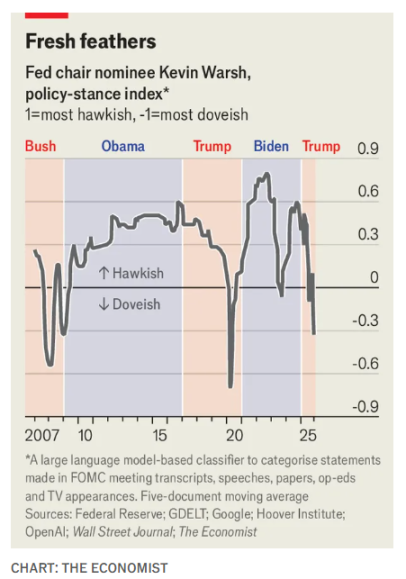
What changed? The imminent productivity boom driven by artificial intelligence—and Trump’s enthusiasm for deregulation. Warsh believes these factors will suppress inflation. He worries high rates could stifle the growth they unleash. Yet even if productivity surges as he predicts—which remains uncertain—this argument is flawed. While higher productivity allows faster economic growth without pushing up prices, once inflation does rise—as it currently does, remaining above the Fed’s 2% target—rates must rise to curb demand. Second, productivity gains typically boost investment, raising the “neutral rate”: the theoretical level at which Fed policy is neither accommodative nor restrictive. Cutting rates while that benchmark rises risks overstimulating the economy and fueling inflation.
If Warsh wavers on interest rates, he remains resolute on the main fault line of U.S. monetary policy: the Fed’s bloated balance sheet, now worth trillions of dollars. Traditional debates over quantitative easing (QE)—the financial term for buying bonds with newly printed money—often focus on whether its effects are minimal or nonexistent. Warsh stands out for attributing a broad array of “crimes” to QE: fiscal profligacy, capital misallocation, rising inequality, diminished Fed independence, a more fragile banking system, and falling productivity. Some of these charges hold merit; others less so. But all appear overstated.
To erase what he sees as QE’s imprint on the economy, Warsh wants to shrink the Fed’s balance sheet—a move directly at odds with the Fed’s recent decision to end quantitative tightening (QT), which shrinks the balance sheet by letting bonds mature without reinvestment. If Warsh begins selling bonds outright, the immediate effect would be lower bond prices and higher yields. These yields set key economy-wide rates—including mortgage rates. Warsh plans to offset those rises by lowering short-term rates. The result would be a steeper yield curve, as the spread between long- and short-term borrowing costs widens. Striking the right balance would be a delicate dance—especially given the uncertainty around how much Fed bond purchases affect yields.
Even if he succeeds, another problem looms. The bonds the Fed holds correspond to banks’ reserves—the very reserves the Fed created when it bought those bonds. Since the financial crisis, these reserves have become the primary tool for setting interest rates. If too few reserves remain, the interbank overnight lending market could descend into chaos—replaying, on a larger scale, the 2019 “repo” liquidity crisis.
Then consider the most direct dimension of Warsh’s proposed “institutional reform”: reshaping the Fed itself. The Fed has made mistakes in recent years—it was caught off guard by the post-pandemic surge in inflation. Some of Warsh’s criticisms are reasonable, such as urging central banks to steer clear of politicized areas like climate change and racial justice.
Others are more debatable. Warsh faults the Fed for relying too heavily on data—especially outdated government statistics. Yet without credible data to track the economy, all that remains are unfalsifiable speculations—like predictions of future productivity booms. And private data providers, which Warsh champions as replacements for official statistics, still have a long way to go. Just look at stock markets: they still swing sharply on releases of jobs or inflation data.
As Fed chair, Warsh must please three constituencies: Trump, financial markets, and his fellow Fed rate-setters—a technocratic group whose votes he needs to get anything done. Trump desperately wants lower rates; markets grow increasingly anxious about U.S. assets; and his Fed colleagues will obstruct his tenure if they see him as overly politicized.
To earn applause from all three, Mr. Warsh will need to deliver the finest performance of his life.
Join TechFlow official community to stay tuned
Telegram:https://t.me/TechFlowDaily
X (Twitter):https://x.com/TechFlowPost
X (Twitter) EN:https://x.com/BlockFlow_News