The Fed's $40 billion Treasury purchase is not the same as quantitative easing
TechFlow Selected TechFlow Selected
The Fed's $40 billion Treasury purchase is not the same as quantitative easing
Why RMP is not equivalent to QE?
 Navigating Web3 tides with focused insights
Author: Alex Krüger
Compiled by: TechFlow
The Federal Reserve has just committed to purchasing $40 billion in U.S. Treasuries per month, and markets have already started shouting "Quantitative Easing (QE)!"
While this number may superficially appear to signal economic stimulus, the mechanism behind it tells a different story. Powell's move is not about stimulating the economy, but rather preventing disruptions in the financial system’s operations.
Below is an analysis of how the Fed's Reserve Management Purchases (RMP) structurally differ from Quantitative Easing (QE), along with their potential implications.
What is Quantitative Easing (QE)?
To strictly define quantitative easing and distinguish it from standard open market operations, the following conditions must be met:
Three Mechanical Conditions
-
Mechanism (Asset Purchase): The central bank purchases assets—typically government bonds—by creating new reserve balances.
-
Scale (Large-Scale): The purchase volume is significant relative to total market size, aiming to inject substantial liquidity into the system rather than making fine adjustments.
-
Objective (Quantity Over Price): Standard policy adjusts supply to achieve a specific interest rate (price) target, whereas QE commits to purchasing a predetermined quantity of assets regardless of resulting interest rate changes.
Functional Condition
-
Positive Net Liquidity (QE): The pace of asset purchases must exceed the growth rate of non-reserve liabilities (such as currency and the Treasury General Account). The goal is to force excess liquidity into the system, not merely provide required liquidity.
What are Reserve Management Purchases (RMP)?
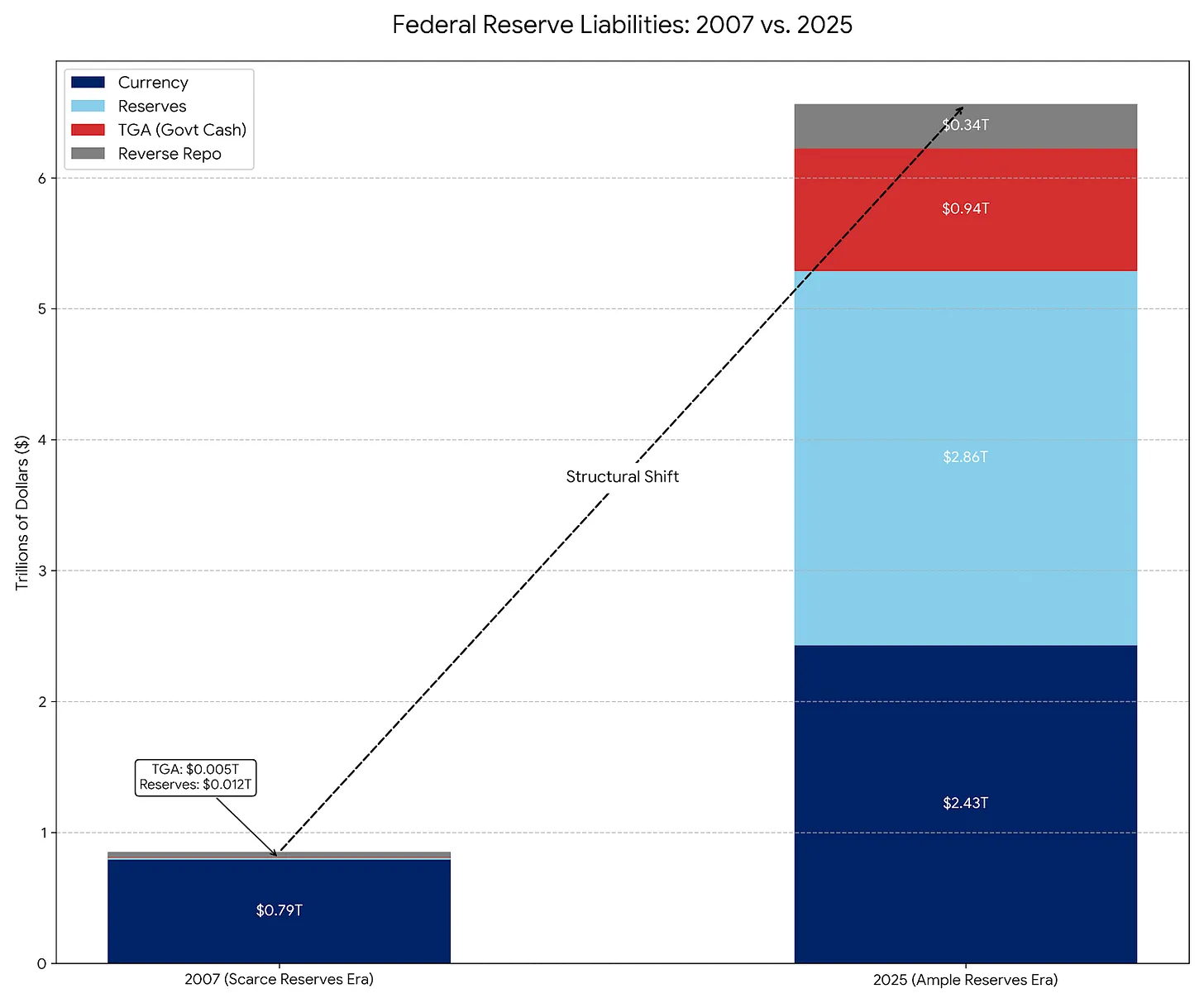
RMP is essentially the modern successor to Permanent Open Market Operations (POMO), which was the standard operating procedure from the 1920s until 2007. However, since 2007, the composition of the Federal Reserve's liabilities has changed dramatically, necessitating an adjustment in operational scope.
POMO (Scarce Reserves Era)
Before 2008, the Fed's primary liability was physical currency in circulation; other liabilities were small and predictable. Under POMO, the Fed purchased securities solely to meet the gradual public demand for physical cash. These operations were calibrated to be liquidity-neutral, small in scale, and designed not to distort market prices or suppress yields.
RMP (Abundant Reserves Era)
Today, physical currency constitutes only a small fraction of the Fed's liabilities, which are now dominated by large and volatile accounts such as the Treasury General Account (TGA) and bank reserves. Under RMP, the Fed purchases short-term Treasury bills (T-Bills) to buffer these fluctuations and "maintain ample reserve supply on an ongoing basis." Like POMO, RMP is designed to be liquidity-neutral.
Why Launch RMP Now: The Impact of TGA and Tax Season
Powell is implementing the Reserve Management Purchase program (RMP) to address a specific financial system issue—the TGA (Treasury General Account) liquidity drain.
Mechanism: When individuals and businesses pay taxes—especially during major tax deadlines in December and April—cash (reserves) moves from their bank accounts to the Fed's government checking account (TGA), which lies outside the commercial banking system.
Impact: This transfer drains liquidity from the banking system. If reserves fall too low, banks may stop lending to each other, potentially triggering a repo market crisis (similar to September 2019).
Solution: The Fed is now launching RMP to offset this liquidity drain. By creating $40 billion in new reserves, they replace the liquidity that will be locked into the TGA.
Without RMP: Tax payments tighten financial conditions (negative). With RMP: The impact of tax payments is neutralized (neutral).
Is RMP Actually QE?
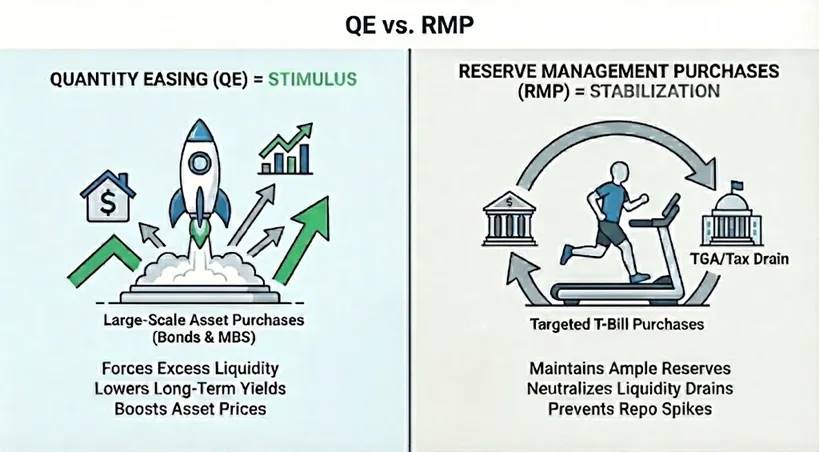
Technically: Yes. If you are a strict monetarist, RMP fits the definition of QE. It satisfies all three mechanical conditions: large-scale asset purchases ($40 billion per month) funded by new reserves, with a quantity-based rather than price-based objective.
Functionally: No. RMP serves to stabilize, while QE aims to stimulate. RMP does not significantly loosen financial conditions; instead, it prevents financial conditions from tightening further during events like TGA replenishment. Because the economy naturally drains liquidity, RMP must run continuously just to maintain the status quo.
When Will RMP Become True QE?
RMP would transition into full QE if one of the following two variables changes:
A. Duration Shift: If RMP begins purchasing long-term Treasuries or mortgage-backed securities (MBS), it becomes QE. In doing so, the Fed removes duration risk from markets, lowers yields, pushes investors into higher-risk assets, and thereby boosts asset prices.
B. Quantity Shift: If natural demand for reserves slows (e.g., TGA stops growing), but the Fed continues buying $40 billion monthly, RMP becomes QE. At that point, the Fed injects more liquidity into the financial system than needed, inevitably channeling excess funds into financial asset markets.
Conclusion: Market Implications
RMP aims to prevent tax-season liquidity drains from affecting asset prices. While technically neutral, its reintroduction sends a psychological signal to markets: the "Fed Put" is back online. This announcement is net positive for risk assets, providing a "gentle tailwind." By committing to $40 billion in monthly purchases, the Fed effectively sets a floor under banking system liquidity. This eliminates tail risks of repo crises and strengthens market confidence in leverage.
It should be noted that RMP is a stabilizer, not a stimulant. Since RMP merely replaces liquidity drained by the TGA rather than expanding the net monetary base, it should not be mistaken for systemic easing associated with true QE.
Join TechFlow official community to stay tuned
Telegram:https://t.me/TechFlowDaily
X (Twitter):https://x.com/TechFlowPost
X (Twitter) EN:https://x.com/BlockFlow_News
 @krugermacro