Conversation with He Yi: “My ambition is to have a world worthy of me—life is either about gaining or learning.”
TechFlow Selected TechFlow Selected
Conversation with He Yi: “My ambition is to have a world worthy of me—life is either about gaining or learning.”
“If there exists a true ‘Hand of God’ in this world, it would treat those who truly love the world with greater kindness.”
 Navigating Web3 tides with focused insights
Compiled & Translated by TechFlow
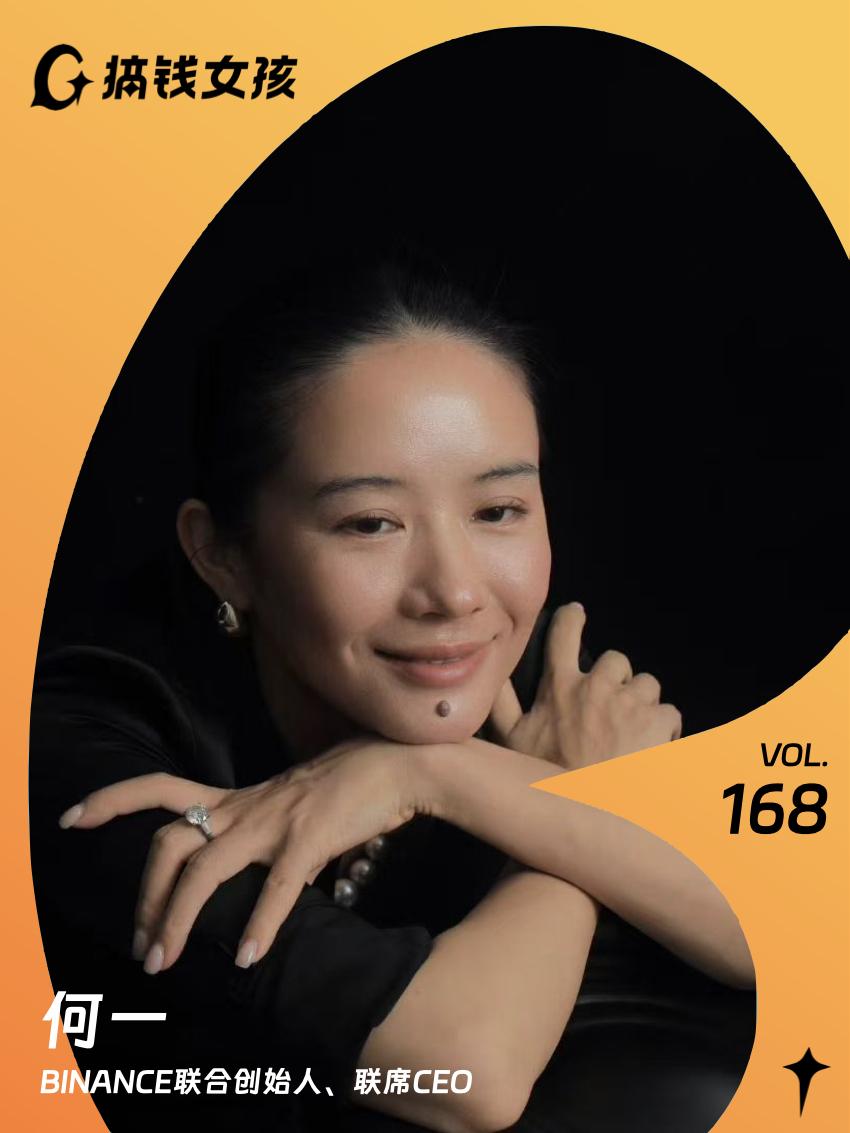
Guest: He Yi, Co-Founder and Co-CEO of Binance
Host: Xiao Hui, Founder and Host of the podcast “Girls Who Make Money”
Podcast Source: Girls Who Make Money
Original Title: He Yi: “My ambition is to have a world worthy of me!”
Release Date: May 14, 2026
Key Takeaways
In this episode of “Girls Who Make Money,” the host speaks with He Yi, Co-Founder and Co-CEO of Binance, tracing her journey from childhood and upbringing to career choices, ambition, self-awareness, execution capability, and how women can uplift themselves. He Yi recalls how, as the second child in her family, she learned early on to proactively advocate for herself—demanding to start school at age four, immersing herself in martial arts novels and Yishu’s works during adolescence, and refusing to accept returning to her hometown as a teacher after graduating from normal school. These experiences collectively forged her strong sense of agency. She also explains why she went “all-in” on Bitcoin at the peak of her broadcasting career: Bitcoin prompted her to rethink “What *is* money?” and revealed to her a future financial system built on global consensus and trust networks. For ordinary people, her advice is refreshingly simple: first clarify the cost, then dare to try; iterate your understanding through action—life is either about gaining or learning.
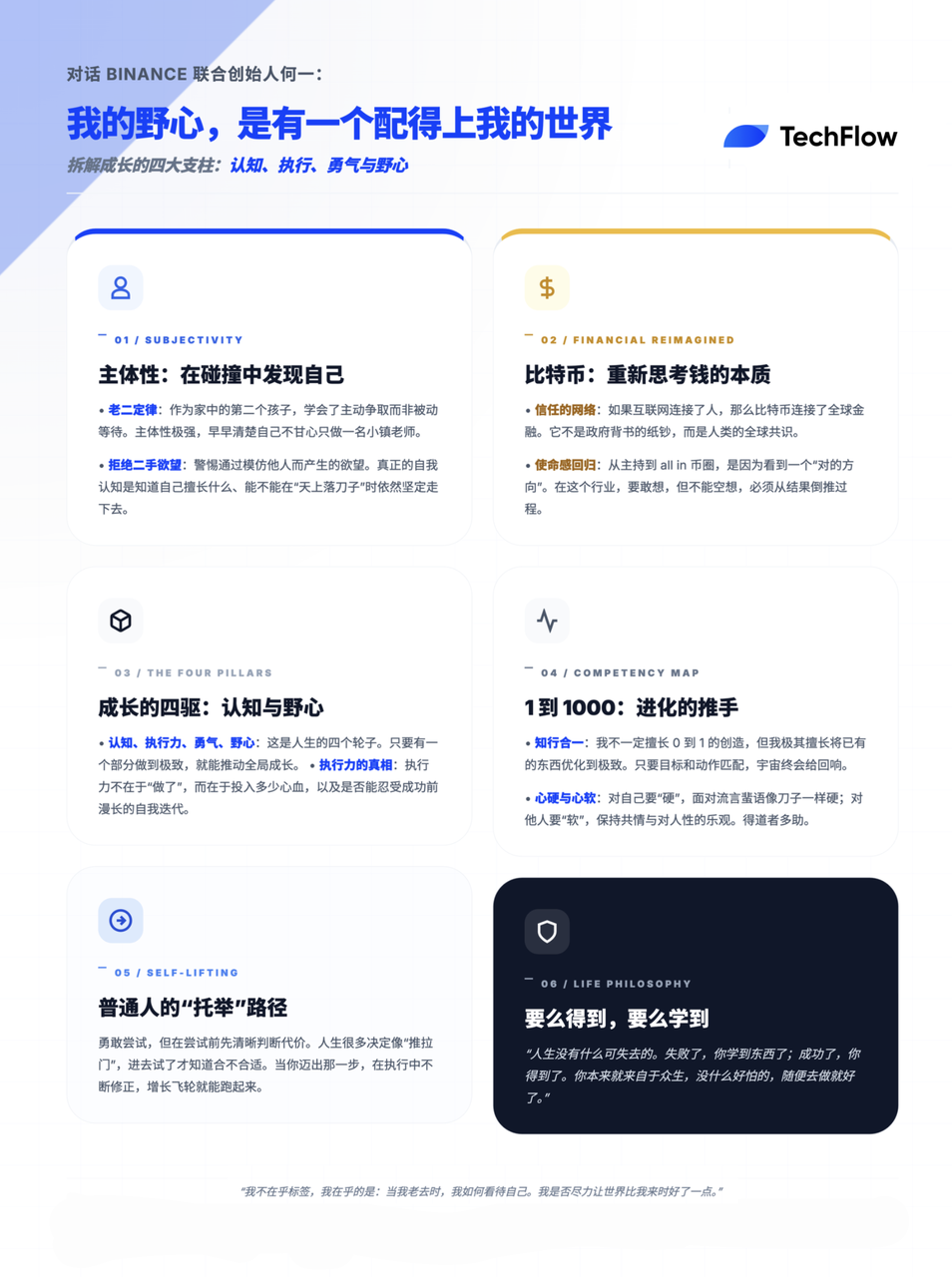
Highlights of Key Insights
On Agency and Self-Awareness
- "People don’t exist in isolation; we discover who we are through every collision with the world. Through each interaction, each response—and how we face it and handle it—we gradually come to understand ourselves better."
- "I think, speaking in today’s terms, I’ve always had strong agency—I knew exactly what I wanted from an early age."
- "Why should only city kids be allowed to appreciate beauty—flowers, plants? Why can’t I?"
- "Do you truly know what you have and don’t have, what you’re good at and not good at—and can you steadfastly walk that path, even if knives fall from the sky?"
On Ambition and a Larger World
- "I’ve probably always been somewhat ambitious—I’ve always felt I need a world worthy of me."
- "When you see parts of the world you want to change, you naturally desire a larger world—to test your limits."
- "Often our desires are second-hand—imitations triggered simply by seeing others do something."
- "Dare to dream—but don’t just daydream. Start without constraints, then work backward from your desired outcome to define the process."
On Cognition, Execution, Courage, and Ambition
- "These four pillars—cognition, execution, courage, and ambition—are interdependent. If one pillar reaches an extreme, it pushes another to grow. With two growing, you’ll likely keep moving forward."
- "Self-awareness determines whether you can objectively assess whether something is your optimal choice—and whether you genuinely love it, even if it doesn’t pay."
- "Execution isn’t merely about taking action—it’s about how much time and energy you invest, whether you engage wholeheartedly, and whether you can endure the long, grueling process of iterative self-improvement before success."
- "Many believe they understand everything—they just lack luck—but often, they lack even the courage to take the first step."
- "If you truly love something, doing it feels effortless."
On Bitcoin and the Reconfiguration of Financial Understanding
- "Bitcoin made me reconsider what money truly is—that’s what moved me most."
- "If the internet can connect people worldwide, then perhaps a trust-based network can connect global finance."
- "It’s not currency printed by any single nation or government under its credit guarantee—it’s human consensus."
- "The moment I encountered Bitcoin, I knew it was the right direction—I wanted into this space, and I wanted to do this work."
On Choice, Mission, and the Boundaries of Capability
- "I’m confident in myself. If I joined Binance, I could clearly envision what I’d contribute—and transform it into a globally top-tier platform. It would only be a matter of time."
- "I may not excel most at building something entirely new from scratch (0→1), but I’m exceptionally skilled at optimizing and iterating existing systems to their maximum potential."
- "No matter who you wish to become or where you wish to go, the universe will respond—if you align intention with action."
- "Many life decisions are like sliding doors—you can reverse them afterward. Go ahead and try. You might lose an opportunity, but you’ll gain invaluable insights."
On Success, Mental Fortitude, and Uplifting Ordinary People
- "Being mentally tough doesn’t mean being cold-hearted toward others—it means standing firm against opposing views or attacks directed at you."
- "I’m tough on myself, but soft toward others."
- "If there truly were a ‘hand of God’ governing this world, it would favor those who hold profound love for humanity."
- "This world contains both black and white, light and darkness—you must accept darkness as part of reality, but that doesn’t mean you must choose to embody it."
- "Life is simple: either you gain—or you learn. Just act. There’s nothing to lose."
Stripping Away All Social Labels—Who Are You?
Xiao Hui: Today, I’m interviewing a woman widely regarded as legendary—here in Hong Kong. Born in a rural village in Yibin, Sichuan, she later serendipitously became an on-location host for Travel TV, then evolved into “Xiao He the Customer Service Rep”—a name familiar to countless users in the blockchain industry. Today, her latest title is Co-CEO of Binance—the world’s largest blockchain trading platform and ecosystem.
Such a dramatic reversal of fortune is astonishing—so I’m deeply curious about how she grew into who she is today. Please welcome He Yi, Co-CEO of Binance—and everyone’s “Sister He.”
He Yi:
Hello everyone—I’m He Yi of Binance, and also your customer service rep, Xiao He.
Xiao Hui: Most people imagine CEOs—or female executives—as domineering, commanding presences. Yet you exude warmth and approachability. So today, I’m especially curious to look back: how did “Xiao He” evolve step-by-step into today’s “Sister He”?
Recently, a popular self-introduction trend asks: If you stripped away all social labels, how would you introduce yourself?
He Yi:
I’d say first and foremost: a mother, a daughter, and someone constantly breaking past her own limits.
Xiao Hui: That’s refreshingly grounded. For me, self-definition seems to require external validation across multiple dimensions. Without clear self-definition, I default to wondering how others define me. For instance, I’ve received feedback saying “Xiao Hui is approachable”—since I conduct interviews, people say I make others feel comfortable opening up. But that’s still *their* view of me—I seem to rely heavily on others’ confirmation to affirm my identity.
He Yi:
That suggests you’re still exploring life. People don’t exist in isolation; we discover who we are through every collision with the world. Through each interaction, each response—and how we face it and handle it—we gradually come to understand ourselves better. It simply means you’re young—and full of vitality.
“The Second-Child Effect”: How He Yi Learned Early to Advocate for Herself
Xiao Hui: Before today’s interview, I did some research—and discovered a striking similarity between us: you’re the second of three siblings; I’m the third. Psychology has a concept called “the second-child effect.” It reminded me of my own elder sister.
My elder sister’s personality contrasts sharply with yours—she’s bold, flamboyant, mischievous, and a constant headache for our parents. I’m the obedient one—the “ideal daughter.” I wonder: looking back, did being the middle child leave any imprint on your character?
He Yi:
Yes, quite noticeably—especially since I now have three children myself. Firstborns receive intense parental attention; even minor changes trigger alarm, so they get unconditional, abundant love. By the time the second child arrives, parents often adopt a more relaxed approach—“Raise the first by the book, raise the second by instinct.” They’re less anxious: if the child falls ill, they know how to respond calmly.
The youngest—often the “baby”—receives extra tenderness and indulgence. So throughout childhood, parents inevitably tell the eldest, “Make way for your younger brother.” Even if you don’t compete, they reflexively insist you yield. The eldest receives assured love; the youngest, too. The second child must proactively claim attention—or risk feeling forgotten.
Sometimes, so-called “rebelliousness” is actually a cry for help. Consequently, second children may develop greater independence and self-reliance.
Early Awakening of Agency: At Age Four, She Demanded School—And Got In “By Exception”
Xiao Hui: At what point did you realize: “If I don’t fight for it, it won’t happen”?
He Yi:
My earliest memory is demanding school at age four. My elder sister—six years older—was already enrolled. I thought: Why can she attend school, but not me? So daily, I nagged my parents: “I want to go to school! I want to go to school!”—until they finally gave in and sent me.
My elementary school homeroom teacher was a friend of my parents. When he asked their child’s age, they lied—saying I was six. Back then, no ID checks or household registration documents were required; they simply said, “We’ll sort it out later—if her grades suffer, she’ll repeat a grade.” So I was enrolled. I never repeated—and performed well academically.
Xiao Hui: Because you pursued what mattered to you, you succeeded. That may be the core of your character: fearless in articulating your needs. If your current environment doesn’t fit, you instinctively seek one that does.
He Yi:
Another vivid childhood memory: I lived in rural Sichuan, surrounded by wildflowers and weeds. Every day in elementary school, I’d pick wildflowers—only to be teased by my mother: “Rural kids loving flowers? That’s a city-kid luxury.” To them, wildflowers were mundane—not worth attention.
Yet I distinctly recall thinking: I disagree. Why should only city kids appreciate beauty—flowers, plants? Why can’t I?
This may reflect my early drive to assert myself—or persistently uphold my convictions. In modern terms: strong agency, early self-awareness—perhaps born with rebellious instincts.
Xiao Hui: I share a similar experience. I’m left-handed—writing with my left hand. As a child, my parents tried briefly to switch me to my right. Fortunately, my kindergarten teacher was open-minded: “No need—she writes well enough. Don’t force it.” Folk wisdom even claims left-handers are smarter—so my teacher protected my preference, and my parents accepted it.
Still, I held firm—no compromise. They urged change; I refused. Yet they never escalated. Were your parents hands-off—or did you face environmental pressure?
He Yi:
My mother was extremely strict. But speaking in today’s terms, I’ve always had strong agency—I knew myself deeply from an early age.
One outrageous childhood incident: before age ten, I gambled—pennies with older kids. Eventually, I lost five yuan with no pocket money. When my mother found out, she beat me severely—bamboo switches, painfully sharp. Afterward, she demanded: “Will you gamble again?” I replied, “No.”
But later, I realized: I still owed that debt. Integrity matters—how could I ignore five yuan? So I switched gambling partners—and got caught again. Another beating. But this time, I was repaying—and slowly winning back. I kept playing until the debt was cleared—then stopped forever.
Before age ten, I grasped gambling’s essence: losses breed the urge to win back; wins spark greed for more—there’s no end. So I lost all interest—effectively “trained out” of it by ten.
Xiao Hui: As a child, you endured harsh beatings while strategizing debt repayment. How many beatings total?
He Yi:
Not many. Besides gambling, another incident involved reading novels. Our village had a scrap collector whose home overflowed with books—I borrowed freely, later renting novels too. In junior high—just over ten—I got caught again.
Xiao Hui: What were you reading? Romance novels like Qiong Yao?
He Yi:
I rarely read Qiong Yao—preferring martial arts novels and semi-classical texts like *Strange Tales from a Chinese Studio*. Options were limited—whatever the scrap dealer collected, I read. Later, renting novels, I devoured Li Bihua and Yishu—two Hong Kong writers who profoundly shaped me.
Li Bihua—a dark, brilliant writer—had a sixteen-character motto I still remember: “Kill and repay with life; borrow and repay with money; gamble and accept defeat; profit and bear loss.” I once set it as my QQ profile.
Yishu’s novels may seem melodramatic—typical of youth fiction—but their core theme remains vital: “Buy your own flowers.” Heroines dominate—reflecting 1970s–80s Hong Kong feminism. Female independence and agency emerged early there—becoming foundational to my character.
Xiao Hui: Returning to your adult career: your path seems wildly unconventional—seizing opportunities spontaneously, with little planning. First curiosity: before hosting, your youthful dream was modeling. I recall you mentioning in media interviews: “I wanted to model before age sixteen.”
He Yi:
True. I attended normal school because my parents—both teachers—deemed it ideal. Graduating meant becoming a teacher. Once, a teacher told our class, “It’d be a shame if you didn’t teach.” I retorted publicly: “It’d be a shame *if I did.*”
Ambition Awakened During Normal School: “It’d Be a Shame If I Taught”
Xiao Hui: You’re truly born rebellious—so defiant! Yet your strong academics let teachers overlook it. Why were you certain teaching wasn’t for you?
He Yi:
Not that I *couldn’t* teach—but I refused to settle for *only* teaching.
Xiao Hui: Why? Teaching was a stable, respected profession then.
He Yi:
Possibly because reading broadened my horizons beyond my immediate world. I attended Yibin University—if I returned home, I’d teach in my village. I couldn’t accept that.
Reading Li Bihua and Yishu exposed me to richer worldviews. I sensed a wider world existed—and I yearned to explore it.
“Second-Hand Desire”: Often, Our Desires Are Mere Imitations
Xiao Hui: So you rejected teaching—then pivoted to modeling. How?
He Yi:
It’s slightly embarrassing. I read a book titled *Mimetic Desire*: seeing others carry Hermès bags triggers your own desire; seeing others buy art inspires yours. But is that *your* authentic desire?
Often, it’s second-hand desire—imitating others’ actions, hence “mimetic.”
As a child, I didn’t know who I was—or my latent potential. In junior high, my desk-mate ranked first in school-wide speeches—I’d never tried. In normal school, I attempted it—and excelled, winning first place.
Another classmate dreamed of modeling. Seeing her succeed, I thought: “I can too.” So—with under 1.6 meters—I entered Sichuan’s modeling contest. Honestly, they likely just wanted my entry fee; anyone else would know my height disqualified me. But they offered a “flat photography” category—Sichuan girls loved photoshoots then—so that became my first step into television.
“Ambition” Isn’t Negative—I Demand a World Worthy of Me
Xiao Hui: This mimetic impulse defines adolescence. Seeing peers succeed sparks curiosity: “They did it—can I?”
He Yi:
This is our most primal desire and ambition—nothing wrong with it. Many Chinese hesitate to discuss “ambition”—especially women. It carries negative connotations. Yet I’ve always been ambitious—I’ve always believed I deserve a world worthy of me.
Xiao Hui: I still can’t say that. I often feel undeserving upon achieving things—striving to *earn* worthiness, not declaring the world must *match* me. It implies dissatisfaction with reality.
He Yi:
Exactly. I dislike attributing my success to family or background. I feel blessed—like heaven’s chosen daughter. Yet when you see parts of the world you wish to change, you naturally crave a larger world—to test your limits.
This may be ambition’s earliest form: refusing complacency.
Xiao Hui: Your life features repeated leaps—each time abandoning comfort for uncharted territory. Like becoming Travel TV’s on-location host—an opportunity often described as falling from the sky.
He Yi:
It wasn’t purely accidental. Many stay in comfort zones due to inaction—or failing to refine their craft daily.
Like your podcast, originally named *Voluntary Confession*—slightly condescending. Renaming it *Girls Who Make Money* shifted focus: “Make money” signals action; “girls” specifies audience. Without prior effort, you wouldn’t know the old approach failed—or how to iterate toward *Girls Who Make Money*’s success.
Many try once, fail in three days—and quit. Execution isn’t mere action—it’s time, energy, sincerity, and enduring prolonged self-refinement before success.
The Four Pillars of Growth: Cognition, Execution, Courage, Ambition
He Yi:
I see these four pillars as cognition, execution, courage, and ambition. If one pillar reaches an extreme, it propels growth in another. With two pillars advancing, momentum builds further.
This isn’t my theory—I saw it online—but it resonated deeply as a powerful summary.
Xiao Hui: These four pillars resemble a car’s wheels. If one turns, the car moves—even slightly.
He Yi:
Start with courage and ambition—try, then iterate cognition through action.
But many people’s cognition says: “I know everything—astronomy, geography, geopolitics. I’m superior to famous figures or successful people. I’m just unlucky—others succeeded via underhanded means.” Yet they lack even the courage to take the first step—trapped in self-deception, not the real path to success.
Xiao Hui: Let’s revisit execution—it’s pivotal. “The proactive enjoy the world first” is fundamentally about execution. My podcast had zero ads for six months; growth was gradual. I didn’t expect virality—just small feedback: “Better than your last show.” That sustained me.
I still held a day job—no pressure to monetize. Later, growth accelerated; I felt propelled by traffic—and the era’s momentum—pushing me to improve further. Only after two years did I go full-time. Had I quit earlier—over lack of ads or metrics—I wouldn’t be here.
I’m grateful for my execution. But when *should* one persist versus quit? We hear “failing the night before dawn.” I watch peers—some launched accounts simultaneously, with more followers initially—yet they quit. Maybe one more push would’ve worked. How do you gauge timing?
He Yi:
We must understand ourselves—but most don’t. Self-understanding means objectively judging whether something is your optimal choice—and whether you love it, even if it doesn’t pay.
Most pursue things because others do—without passion—so quitting feels easy. But true passion makes effort feel effortless.
Xiao Hui: I’m the type who endures effort—if I love it, my resilience holds. But asking me to analyze SWOT pre-action—strengths, opportunities—I’m not wired that way.
He Yi:
Like my stint as an assistant心理咨询师—before hosting. Or as a university teaching assistant. These revealed lifestyles mismatching my vision. Trying taught me they weren’t for me.
Remember *Infernal Affairs*? Chen Huilin sat elegantly—like our chat: “Talk, then pay.” Seemed high-end, brain-powered work. But actual user intake and triage revealed China’s market wasn’t ready.
While triaging, I calculated consultation fees—and observed top-tier psychologists at the Chinese Academy of Sciences. I saw their lives, schedules—and knew: “Not for me.”
Sometimes, full clarity isn’t needed—or five-to-ten-year forecasts. If foreseeable outcomes confirm misalignment, choose differently. I never imagined today’s “success”—as defined by others.
Cognitive Awakening Through Bitcoin: Uncovering Money’s Essence and Decentralized Finance
Xiao Hui: Returning to cognition—the “four pillars.” We cited: “You can’t earn beyond your cognition.” But how *raise* cognition? “Boarding the train late” feels urgent. Your pivot from hosting to blockchain required massive learning. I recall a telling moment: you promoted Bitcoin for others—writing a dedicated article, not just forwarding casually. I thought: “How meticulous!” How did learning reveal the industry’s promise?
He Yi:
I’m deeply curious—researching anything that intrigues me. My worldview differs from specialists trained to PhD level. I’m more of a generalist.
Studying Bitcoin reshaped my cognition. Previously, “making money” mattered—but what *is* money? Bitcoin forced me to confront that question—its most compelling aspect.
That instant sparked realization: if the internet connects global people, a trust-based network could connect global finance. Think of Bitcoin as “world money”—not currency printed by any nation or government under its credit, but human consensus.
I instantly grasped Bitcoin’s significance—and decisively “went all-in,” quitting hosting.
Xiao Hui: Was your hosting career ascending then?
He Yi:
Yes—progressively improving. Initially, I lacked on-location experience—clueless about camera angles or lighting. Sometimes, I blocked my co-host’s shot. Gradually, I gained experience—earning short-film roles and contract offers. Yet something felt off—not my true passion.
Hosting seemed fine—scenic locations, steady pay. But after two years—meeting diverse people and places—I wondered: “How many more years can I do this?” Then Bitcoin struck me as the right direction—I wanted into this space, to do this work.
Quitting Hosting Mid-Career—Because I Craved a Larger World
Xiao Hui: You glimpsed a grand vision—a calling—and felt exhilarated.
He Yi:
Yes. I’m intuitive—often choosing by feeling. If something excites me, I’ll try—even without knowing its future. If it fails, I’ll reassess.
Xiao Hui: Your choices lean on intuition—“I trust my gut.”
He Yi:
Later, I learned Yang Zhenning’s theory: intuition operates faster than logical analysis—processing information rapidly. My interpretation: accurate intuition stems from deep cognition and knowledge structures enabling swift judgment. But everyone’s cognition, knowledge, and mental maps differ—so intuitions vary.
Xiao Hui: How sharpen intuition—or insight? You saw Bitcoin’s value and foresaw its future; others find it abstract and disengage.
He Yi:
Curiosity drives me. Humanity advanced because pioneers dared the unthinkable—like Elon Musk building reusable rockets, previously deemed impossible.
Dare to dream—remove constraints—then reverse-engineer from the goal. What milestones enable this outcome? Are current technologies sufficient—or which can we adapt, skip?
Xiao Hui: You recognized Bitcoin’s value in 2013, then joined—but later left and returned. Upon returning, you said: “Back to where my mission lies.” Why link this to your mission? What *is* your mission?
He Yi:
I joined a prior blockchain firm in 2014, leaving in 2015 due to management conflicts. For ~6 months, I chatted with entrepreneurial friends—none aligned with my goals.
Mobile video was emerging—Meipai launched, Ice Bucket Challenge peaked. A tech firm courted me for months. It felt like a genuine tech frontier—so I joined.
In 2017, CZ founded Binance and invited me as advisor. Conversing, I reflected: I’d quickly made live streaming popular in China—during the “thousand-platform war.” Now, I sought a bigger challenge: experiencing what a *global* top-tier company feels like. Dare to dream—but don’t just fantasize.
Xiao Hui: Was that mission self-focused—seeking a grander stage to become greater—or helping/impacting more people?
He Yi:
“Impacting more people” sounds amusing. Youthfully naive, I once discussed aspirations with a friend. She asked: “What kind of person do you want to be?” I pondered deeply: “Someone who impacts the world.” She laughed: “Crazy!”
Xiao Hui: Where is that friend now?
He Yi:
She’s in crypto—brought by me. Her goal? “A handsome, kind, wealthy-but-not-too-wealthy boyfriend.” She achieved it.
So the universe responds to your aspirations—provided you align intention with action.
Xiao Hui: Yet it’s hard. Many struggle to realize ambition—from idea to action, gaps remain. We see results—but each choice mattered deeply.
You called yourself lucky. What underlies that luck? How raise odds of fortunate choices? You’d succeeded at Xiaokaxiu and Yixia Tech—a clear, worldly success. Yet you chose an uncertain future—one you saw as promising but unproven. Faced with two paths, you chose the latter—solely believing it promised a larger world?
He Yi:
Rather, I trusted myself. Beyond Binance, others approached me. E.g., “Your ICO is hot—want funding? I’ll raise $100M for you—just pay my fee.”
I seriously considered: With $100M, what would I build? Nothing came to mind. But joining Binance? I envisioned its trajectory—my marketing expertise transforming it into a global top-tier platform. It’s merely a matter of time.
I Excel at Optimizing and Scaling Existing Systems
Xiao Hui: So you’re a catalyst—not a 0→1 founder. You scale from 1→100—or 1→1000.
He Yi:
Possibly. Creating something entirely new from scratch isn’t my forte. I don’t claim to invent from nothing—but I excel at optimizing and scaling existing systems to their utmost potential.
Xiao Hui: That’s rare—especially in AI’s era. Building is easy; scaling and iterating? Hard.
He Yi:
The path feels visible. I foresee steps one, two, three—processes leading to my envisioned success.
To Realize Ambition—Try More
Xiao Hui: Returning to women: How do women realize ambition? Structurally, barriers abound—crypto has few women; fewer still in leadership. You overcame countless obstacles to reach here.
At each crossroads, you voiced ambition—to become greater, claim a grander stage. Perhaps practicing early made it natural. But for me—a woman often lacking confidence or worthiness—I wait to achieve first, then escalate. I don’t declare top goals upfront—preferring cautious, stepwise progress.
He Yi:
Just try. Many life decisions resemble sliding doors—you can reverse them. Trying costs little; you might lose an opportunity—but gain immense learning.
First: try—don’t fear. But before trying, clarify the decision’s nature and cost. Many think: “Find a crypto ‘big shot’—become He Yi.” Domestic relationship influencers debate “male competition vs. female competition,” labeling me. If asked, crypto “big shots” call me “top-tier male competitor”; collaborators call me “male competitor among male competitors.”
Yet relationship influencers online dub me “female competitor among female competitors”—outside my imagination.
These are external interpretations—irrelevant. Crucially: Do you truly know your strengths, weaknesses, talents, limits—and can you steadfastly follow that path, even if knives fall from the sky?
Xiao Hui: But pain reveals endurance—until then, you don’t know your limits. Starting my podcast, I faced varied feedback—e.g., “Your Mandarin isn’t standard”—while others praised it. Questions I asked out of curiosity were labeled “stupid.” Such critiques sting.
I assumed I’d withstand criticism—until harsh comments hurt. Pain reveals boundaries. But since this is my chosen path, I endure.
He Yi:
Enduring hardship builds resilience. Your success with *Girls Who Make Money*—and the struggles behind it—only you truly know.
Does Achieving Success Harden the Heart?
Xiao Hui: Does success inevitably harden the heart—make one cold?
He Yi:
Not necessarily. Everyone has innate gifts. One of mine is empathy—I’m fundamentally gentle.
Xiao Hui: But in male-dominated industries, does gentleness make you easily manipulated? You said “male competitor among male competitors”—that sounds intensely role-bound, requiring hardened resolve.
He Yi:
“Male competitor among male competitors” means: if someone insults you in business and you cry, exit—go home and sleep.
So mental toughness means facing dissent or attacks head-on—standing firm. I’m tough on myself, but soft toward others.
I believe: if this world is simulated, if a true “hand of God” exists, it favors those with profound love for humanity. As God, whom would you elevate among billions—granting resources and influence? Surely the one bearing societal burdens and public suffering. Virtue attracts support.
Xiao Hui: Now I grasp your ascent: honoring your ambitions—and possessing vast compassion, embracing others. Hence your frontline customer-service involvement. I’d find it exhausting—focused solely on my tasks. But your nature embraces collective welfare.
He Yi:
You originate from the masses. Emerging from the grassroots, I witness inequality. I hold deeply optimistic views of human nature. This world holds black and white, light and darkness—you accept darkness as inherent, but needn’t embrace it.
Xiao Hui: People say: “The dragon-slaying youth becomes the dragon.”
He Yi:
Not inevitable—merely perspective. It depends on your vantage point.
Xiao Hui: Final question: How can ordinary people uplift themselves—especially women from humble backgrounds? What’s most vital—or your key advice?
He Yi:
Dare to try—but first, clarify your understanding. Step forward, then iteratively refine cognition through action—your growth flywheel ignites.
“Nothing to Lose—Either Gain or Learn”
Xiao Hui: What if you fail?
He Yi:
Failure means learning. You have nothing—what’s there to fear?
So I’ll borrow a guest’s words: “Life is simple: either gain—or learn. Just act. Nothing to lose. Either gain—or learn.”
Join TechFlow official community to stay tuned
Telegram:https://t.me/TechFlowDaily
X (Twitter):https://x.com/TechFlowPost
X (Twitter) EN:https://x.com/BlockFlow_News
 深潮TechFlow