Binance's New CEO He Yi's Latest Interview: Admires Duan Yongping and Discusses Women's Career Choices
TechFlow Selected TechFlow Selected
Binance's New CEO He Yi's Latest Interview: Admires Duan Yongping and Discusses Women's Career Choices
The change in title is merely an official announcement that follows the current, behind which lies a quiet rewriting of Binance's power structure, organizational trajectory, and even the industry narrative.
 Navigating Web3 tides with focused insights
Compiled by:律动
If CZ represents the generation of "technological idealism" at Binance's founding, He Yi has always been the most down-to-earth and emotionally vibrant face within this vast machine. From "Co-Founder & Chief Customer Service Officer" to her self-proclaimed identity as "Customer Service Xiao He" in the community, her personal narrative is almost inseparable from every peak and hardship the company has experienced.
On the morning of December 3, Dubai time, on the main stage of Binance Blockchain Week, Binance CEO Richard Teng announced that co-founder He Yi has officially become a Co-CEO.
In the days when CZ stepped back from the spotlight, He Yi may have already grown accustomed to shouldering more decisions typically made by a top leader—internally managing team dynamics and business rhythms, externally handling regulatory and public pressure, while maintaining trust directly within the community.
Now, the change in title is merely an official confirmation of what was already underway—a quiet reshaping of Binance’s power structure, organizational trajectory, and even the industry's narrative.
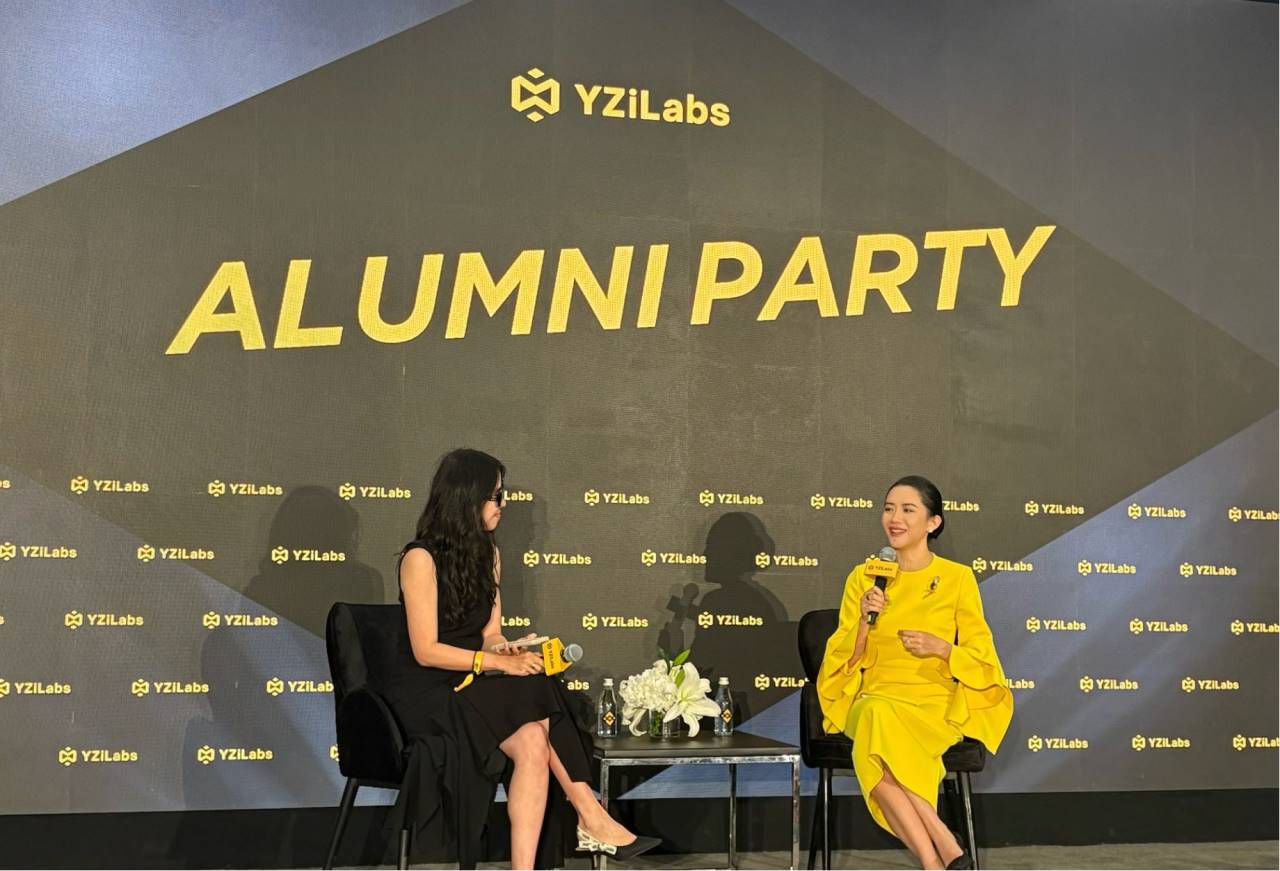
This interview was compiled by律动 based on the complete on-site recording, moderately condensed and restructured while preserving He Yi’s original tone and sharpness. Beyond the noisy stream of crypto news, we hope you can see a more multidimensional Binance, and a more authentic He Yi.
Full interview below:
From "Customer Service Xiao He" to Co-CEO
Q: Why introduce a Co-CEO role? How will you and Richard divide responsibilities?
He Yi: First, everyone knows Richard comes from a regulatory background and deeply understands compliance processes. He is the best bridge for communicating with regulators and has elevated our compliance standards to a new level. As for me, I’m something of an industry OG. On this foundation, my main responsibility is ensuring the user-centric corporate culture remains strong within the company.
Also, I’ve mentioned before wanting Binance to become a long-lasting company. That’s why over a year ago, I took over HR—to continuously rethink and reform how we build an organization driven by systems rather than dependent on any single individual.
This is the context behind introducing the Co-CEO model. In traditional finance, such as J.P. Morgan, this setup is common. Our goal is to achieve 1+1>2.
Q: As a woman reaching the position of Co-CEO, do you have new perspectives or thoughts?
He Yi: Discussing gender topics is indeed tricky. Whether in fast-moving consumer goods or other industries, the key isn’t the industry itself, but whether you set a ceiling for yourself. If subconsciously you believe you can’t do it, then you truly won’t be able to.
Secondly, many women like leveraging gender advantages in the workplace—good appearance, approachability—believing this leads to smoother communication and greater influence. But this can backfire on your professional image. Others may respect your communication skills, but not your professional competence. Whether in Web2 or Web3, the core is always enhancing professional skills.
If you’re in marketing, become the best in the field; if you handle user growth or PR, make your data and content exceptional; if you're a KOL, refine your content to the highest standard. When people respect your expertise, they naturally move beyond gender discussions.
In business competition, no one gives you a break because you’re a woman. In life, “ladies first” applies, but in business, it’s a brutal battlefield where knives go in sharp and come out bloody—no one attacks less fiercely, and sometimes they’ll curse even harder. Sometimes what you perceive as an advantage is actually a weakness. Ultimately, everyone must identify their core strengths.
Q: Recently, some intermediaries claim they can get projects listed on Binance. Have you heard of such cases? Have you discovered violations, fired so-called “white gloves,” or tightened listing rules?
He Yi: First, Binance has never had any so-called “white gloves.” These middlemen emerged precisely because our listing bar is high. They either just help fill out forms or play probability games—pitching to 100 projects with “no success, no fee,” then taking credit and payment when a project gets listed purely due to its own merit.
If you encounter anyone claiming guaranteed listings, please report them—even hand them over to law enforcement. Binance now holds more licenses than ever; it’s absolutely not a lawless zone. We firmly combat such fraud.
Lastly, everyone knows I’m Binance’s second-largest shareholder. A “white glove” scheme would mean stealing money from my own pocket to harm the company—this makes zero logical sense. If you understand our equity structure, you’d know I have no need for such actions.
Community, Retail Users, and Emotions
Q: The community is often seen as central to crypto. You often call yourself “Binance’s eternal customer service.” With prediction markets recently gaining traction, will you consider using users’ votes and predictions there as structured public feedback to guide Binance’s strategy, helping shape products and policies closer to community needs?
He Yi: I’ve learned a huge lesson: Never say never. I once said Binance wouldn’t do futures contracts because I didn’t understand them; later I dismissed Memecoins, only to realize I simply didn’t get them.
So regarding prediction markets, I might not fully grasp them yet—I’ve learned to stay open-minded and avoid saying “never.” But I also can’t promise “definitely yes.” When a market grows influential, diverse voices emerge, and it easily becomes entangled with interests.
Everyone has their stance and interests; data often reflects only a slice. Frankly, I don’t yet fully understand prediction markets or have spent enough time studying them, so I can’t give a definitive answer now.
Q: What are Binance’s plans regarding memecoins?
He Yi: I think this question has multiple dimensions. First, from an exchange perspective, I actually dislike people turning my tweets into memes. It puts me under immense pressure—if I casually drop a joke, it could become a coin; people cheer when it rises, blame me when it falls, making me hesitant to speak. But truthfully, people don’t care who posted the meme—whether it’s called He Yi, Doggy, or Piggy—they just need an emotional outlet they can trade.
While everything can be a meme today, over the long term, what truly endures will revert to Buffett-style value investing. Maybe I’m old-fashioned, often feeling out of touch, learning and trying to “surf 5G waves” as I go.
Memes are novel, but which ones will sustain long-term value and genuine substance—that’s what determines price: short-term emotion, long-term value. Every asset goes through phases of “overbought” and “oversold”—when sentiment runs wild, people chase gains; when prices fall, panic selling ensues, fearing “if I don’t sell now, I’ll be stuck.”
From Binance’s side, we try to negotiate with project teams—can the TGE price be lower? Can more tokens be allocated for user airdrops? Then the team turns around and calls Binance “greedy” for demanding so many tokens for airdrops, which then spreads as “sky-high listing fees.”
In reality, some memes have almost nothing fundamentally. Personally, I believe they’ll eventually crash, yet users keep buying and trading. If we completely ignore such demand, we lose market share. So we must strike a dynamic balance between offering sufficient trading options and meeting platform risk controls—a continuous, ongoing博弈.
Cycles, Expansion, and Regulation: Bitcoin, Hong Kong, and the U.S.
Q: You once mentioned admiring Duan Yongping in a livestream—he excels in both building companies and investing. Now as Binance Co-CEO, will you dedicate part of your efforts to investment and startup incubation within the Binance ecosystem?
He Yi: When I first started recommending Duan Yongping publicly, he wasn’t as widely recognized as he is today. Now he’s a hotly discussed entrepreneur.
You could say I deeply envy him—building a highly efficient, successful organization where the founder can step back, yet the company continues evolving on its own.
For me, Binance’s success alone isn’t the goal. I hope outstanding entrepreneurs can grow from the Binance ecosystem, building their own brands. In the future, we could see more “Binance-ecosystem versions of OPPO, VIVO, Xiaotiantai, Pinduoduo” emerge in crypto.
The deeper reason I admire Duan Yongping lies in his thinking about “how to build systems,” not just relying on individual brilliance. Today, people mostly discuss him as an investor because crypto remains a highly financialized, investment-driven space. From an investment view, Duan Yongping follows Buffett’s lineage—his logic is simple: hold leading assets long-term.
What counts as “leading assets”? I’ve shared this on social media—purely personal views, not investment advice. If you believe strongly in an industry’s long-term potential and think it will grow bigger and brighter, just hold its leading assets.
In crypto, the most decentralized leading asset is Bitcoin. Another angle—if you’re picking a company—look for the one that’s the most competitive, largest in scale, and constantly evolving. That might be Binance. Regardless of whether Buffett or Duan Yongping understand crypto, the underlying logic of resource and value allocation in the world remains consistent.
Conversely, many believe a tiny startup team launching a new token can 10x or 100x—why? As a platform, what we can do is talk seriously with teams: What’s your current valuation? Funding structure? Are you willing to allocate part of the supply at reasonable prices to reward early real users via airdrops or incentives? If they’re willing to pay the cost for seed users, that’s sound business practice.
But can the project ultimately succeed? No one can guarantee that. All we can do is assess whether it’s a serious team, whether their logic holds, whether they have prototypes or real progress—not just empty storytelling. As for each token’s future price, no one can fully control it.
BNB is like an aircraft carrier to us—we want to use this flagship to support more entrepreneurs, fostering a thriving ecosystem. But I cannot and will not promise anyone that buying means only upward movement—such a thing doesn’t exist in any market.
Q: Where did Binance excel in 2025? Where did it fall short? How will you improve toward your vision of making Binance a “long-lasting” company?
He Yi: Binance still has much to improve—user experience isn’t smooth enough, localization lags behind local exchanges in intuitiveness, technical stability, and building a more positive industry image. To outsiders, crypto often seems like a den of thieves—prosper together, fall together. We need to show society our positive value.
We’re not perfect—maybe just slightly better than competitors, primarily because we genuinely care about users. With nearly 300 million users, traditional finance giants entering, the market is now highly competitive and moves in tandem with traditional finance. During volatility, whales dump altcoins before Bitcoin—that’s inevitable logic.
Retail users are Binance’s foundation. I stay on the front lines to fight for more inclusive opportunities for retail amid competing pressures. For example, the spike on October 11 happened precisely because we don’t bet against our users.
When markets plunged sharply, market makers halted trading, causing liquidity vacuum and price gaps in the matching engine. If we engaged in counter-party betting, this wouldn’t happen. Overall, we continue exploring how to build a fairer, more transparent market.
Q: What is Binance’s biggest challenge now? Which business areas will you prioritize next?
He Yi: The biggest challenge remains talent density. Technology today isn’t just crypto—AI is exploding too. Traditional finance and internet giants have extremely high talent concentration. We’re competing across the entire market for the top-tier talent.
Yet crypto remains relatively stigmatized, so the talent pool is small. When you ask candidates to relocate to UAE, they hesitate. We need people who understand financial products, understand crypto, and truly believe in this industry. If you don’t believe, and only write code for a $10K salary without caring what it’s for, such a mindset can’t build a globally top-tier company.
So my most important task is finding the best people for Binance. Some peers reacted strongly—I want to clarify I’m recruiting broadly, not targeting any single company, but searching across the industry. Talented individuals interested in crypto—please reach out.
Q: What’s your take on the recent market downturn? And how do you see the industry’s trajectory and potential risks in 2026 and beyond?
He Yi: Disclaimer: personal view, not investment advice. Bitcoin is the most decentralized crypto asset. “Peak then decline”—you have to look at cycles. In the long run, today’s dip may just be a minor tremor.
But I believe the current drawdown and volatility won’t be as extreme as in the past. It’s evolved from a niche asset to a mainstream core asset. While there may be news of certain countries selling seized assets, more and more sovereign funds and wealth are allocating to Bitcoin.
So I say the underlying logic has changed—the strict cyclical theory and volatility patterns are being重构ed. Past strategies that worked brilliantly across cycles may no longer apply. The players have changed, the pond has grown, the fish have grown larger. If you stick to the old logic of feeding on tiny fish in corners, it might not work this cycle.
Q: Why adopt the Co-CEO system now? What fundamental changes will this new management structure bring? And could you share three key initiatives you personally lead that you consider most vital to Binance?
He Yi: Honestly, day-to-day tasks haven’t changed dramatically. But from my personal perspective, a few things have become more significant.
First, sustaining Binance’s culture. I believe Binance reached today primarily because of our culture, and at its core is user-first. No matter how the market shifts, this principle must remain unchanged.
I want to spend more time pushing systemic development—as mentioned earlier, we need to enhance overall organizational efficiency, not just empower isolated points. Making the organizational machine run more efficiently is a direction I deeply focus on.
Though I’m not technically trained nor traditionally a product person, I firmly believe technological innovation is the fundamental force driving progress. Under this belief, I strongly advocate increasing AI integration and application within Binance. Only by embedding these new technologies into operations and organization can tech transformation feed back into the entire industry, enabling us to move forward more steadily and further.
Q: What specific plans does Binance have in Hong Kong? How do you assess Hong Kong’s strategic priority in Binance’s global map? Also, the event on October 11 nearly drained the entire industry’s liquidity. As the market leader, how does Binance view “restoring liquidity”? Under the new Co-CEO structure, what concrete strategies or measures will Binance take to repair and rebuild industry liquidity?
He Yi: Regarding Hong Kong regulation, we greatly respect its status as an Asian financial hub. But reviewing local exchanges’ financial reports, their operations appear quite difficult. We remain open to Hong Kong and hope to make meaningful moves. However, reportedly, local exchanges still face restrictions in accessing international liquidity, making execution challenging. Currently, we can only feel our way forward, one step at a time.
About the industry-wide liquidity drain: understand that this usually occurs when top market makers pause trading during crises—it doesn’t mean money disappeared. On-chain data shows users aren’t broke; they’re holding large amounts of stablecoins. So the market isn’t lacking liquidity—it lacks enough quality investment opportunities.
Your money isn’t earned by Binance, but flows into the hands of more sophisticated players. The overall market is expanding, but during volatile periods, many adopt conservative strategies—stablecoin yield products or allocating only to major coins like Bitcoin—people seek psychological comfort.
Q: You mentioned stablecoin yield products—does Binance plan to relaunch PYUSD-related products or partnerships? Any consideration of fully re-entering the U.S. market? If U.S. politics shift—e.g., Democrats return to power—do you expect Binance’s regulatory environment to worsen?
He Yi: My current mindset boils down to one phrase: never say never. Honestly, I don’t know what’s next—often, it’s just one step at a time. If something can be tried, we try it. If it fails, we learn to accept it—what happens, happens.
U.S. political dynamics are far beyond our control. Frankly, we’re not close to the so-called Trump family. Some Chinese media love sensationalizing—first saying CZ did this, then “paying fines for pardon”—none of it is true. View the U.S. more simply: it’s essentially a highly competitive two-party game. Within this partisan struggle, we’re at best collateral damage.
As a commercial entity, we’re merely surviving in the cracks—nowhere near “influencing parties.” To put it bluntly, we’re not important enough. If one day Binance could influence government decisions or enter partisan battles, then we’d have truly arrived. But for now, we’re just small potatoes.
"I Want to Try"
Q: Comparing your current strategic initiatives as Co-CEO with your dreams at age 18, how much has changed? What internal drive has sustained you? What is your strongest belief? If you could revisit your 18-year-old—or even younger—self, what did you then believe was life’s most important pursuit: wealth, family, or something else?
He Yi: At 18, I didn’t have a clear concept of wealth, but I loved Chen Changsheng from Mao Ni’s novel *Ze Tian Ji*. Whenever facing challenges, he says: “I want to try.” That resonates with me. Though I don’t look like someone who could make a living off looks, I tried becoming a host anyway—my cost was low, demands minimal, I did my own makeup, accepted any pay.
Same with entrepreneurship—though I’d never done it, I wanted to try. Once, a friend asked my life dream. I had a bit of “literary youth syndrome” and said, “I want to impact the world.” She thought I was crazy and ignored me.
Years later, an internet figure ranking included me, and she suddenly messaged: “Look, you achieved what you said—you impacted the world.” The list was pretty obscure, and I’d forgotten all about it. But looking back, my driving force has always been “I want to try.” So what if I haven’t done it? Never been a CEO? Just do it, and you’ll learn.
Q: How do you deal with fear, anxiety, confusion?
He Yi: For me, the key is first accepting these emotions—they’re natural human reactions, not something that “shouldn’t happen.” I love a line: “Clouds in the sky, water in the bottle.” Though Jiajing’s ending wasn’t great, this phrase deeply moves me. Learn to accept whatever good or bad happens in life. Clouds are there, sky is there, water and bottle each in their place—everything has its arrangement. I used to say: whatever fate gives you, live it well, enjoy it fully.
Join TechFlow official community to stay tuned
Telegram:https://t.me/TechFlowDaily
X (Twitter):https://x.com/TechFlowPost
X (Twitter) EN:https://x.com/BlockFlow_News
 BlockBeats