Huobi Growth Academy | In-Depth Research Report on the U.S. Stock Market’s Cryptocurrency Sector in 2026: Opportunities, Risks, and Allocation Framework
TechFlow Selected TechFlow Selected
Huobi Growth Academy | In-Depth Research Report on the U.S. Stock Market’s Cryptocurrency Sector in 2026: Opportunities, Risks, and Allocation Framework
The U.S. stock market’s cryptocurrency sector is currently at a critical juncture in 2026, transitioning from the “product innovation phase” to the “ecosystem maturity phase.”
 Navigating Web3 tides with focused insights
Executive Summary
Since the U.S. Securities and Exchange Commission (SEC) made its historic approval of spot Bitcoin ETFs in January 2024, the U.S. cryptocurrency investment sector has matured significantly. By 2026, investors can access the crypto market through four primary channels: spot ETFs, crypto treasury and mining companies, leveraged and inverse ETFs, and blockchain-themed funds. As of March 30, 2026, U.S. spot Bitcoin ETFs collectively hold approximately 1.29 million BTC, with total assets under management (AUM) reaching roughly $86.9 billion; spot Ethereum ETFs stand at approximately $18 billion. Notably, the rise of the Ethereum treasury company model is reshaping institutional participation logic—exemplified by Bitmine Immersion Technologies (BMNR), which generates native yield annually via staking, delivering fundamentally different business resilience compared to Bitcoin treasury firms. On the regulatory front, the 2025 GENIUS Act established the first federal stablecoin framework; the U.S. Strategic Bitcoin Reserve was formally launched; and banks received explicit authorization to provide crypto custody services—effectively eliminating prior compliance bottlenecks. However, the high volatility of leveraged ETFs, debt risks inherent in treasury companies, and slashing risk associated with staked assets remain significant, non-negligible investment hurdles. For investors seeking exposure to this sector, constructing a tiered portfolio comprising core holdings, industry beta, and high-risk allocations may represent the most viable participation strategy.
I. Definition and Evolutionary Logic
The U.S. equities-based cryptocurrency sector, in essence, refers to investment products that package cryptocurrency-related assets into tradable stocks on traditional securities exchanges. Investors need not hold private keys to participate in this high-growth sector—they can do so directly through familiar brokerage accounts. This model’s evolution mirrors the full journey of crypto assets from “geek circles” to mainstream institutional adoption.
In terms of developmental stages, the sector’s growth has passed through three critical inflection points. The first stage—the “Underground Mining Era” (2017–2020)—was typified by pure-play mining firms such as Riot Blockchain and MARA Purpose. These companies featured narrow business models, chaotic governance, and opaque valuation frameworks, trading primarily on the Pink Sheets with extremely poor liquidity and virtually no attention from mainstream institutions. During this era, crypto equities were tightly coupled with their underlying cryptocurrencies and exhibited far greater volatility than the base assets themselves—earning them the moniker “leveraged Bitcoin.”
The second stage—the “Compliant Securitization Era” (2021–2023)—was marked by Coinbase’s (NASDAQ: COIN) direct listing and MicroStrategy’s (NASDAQ: MSTR) large-scale Bitcoin accumulation program. The emergence of compliant exchanges signaled the industry’s move toward formal regulation. Coinbase, the only publicly listed U.S. crypto exchange, achieved a milestone with its April 2021 direct listing on NASDAQ. Simultaneously, MicroStrategy acquired over 150,000 BTC between 2020 and 2023, repositioning itself as a “Bitcoin Treasury Company”—introducing an entirely new corporate valuation paradigm.

The third stage—the “ETF Product Explosion Era” (2024–present)—began with the SEC’s approval of spot Bitcoin ETFs, marking crypto assets’ formal entry into the U.S. mainstream financial product ecosystem. BlackRock’s iShares Bitcoin Trust (IBIT) amassed tens of billions of dollars in AUM within months of launch, becoming the fastest-growing ETF category in history. The defining feature of this stage is productization—crypto assets’ risk-return profiles are packaged into standardized financial instruments, lowering the compliance barrier for institutional entry while enabling retail investors to gain professional-grade exposure management at lower cost.
II. Market Structure and Competitive Landscape
In structural terms, the U.S. equities-based cryptocurrency sector in 2026 exhibits a “tripod” product architecture: spot ETFs dominate, crypto equity firms deliver beta exposure, and leveraged and thematic products serve precision-demand use cases.
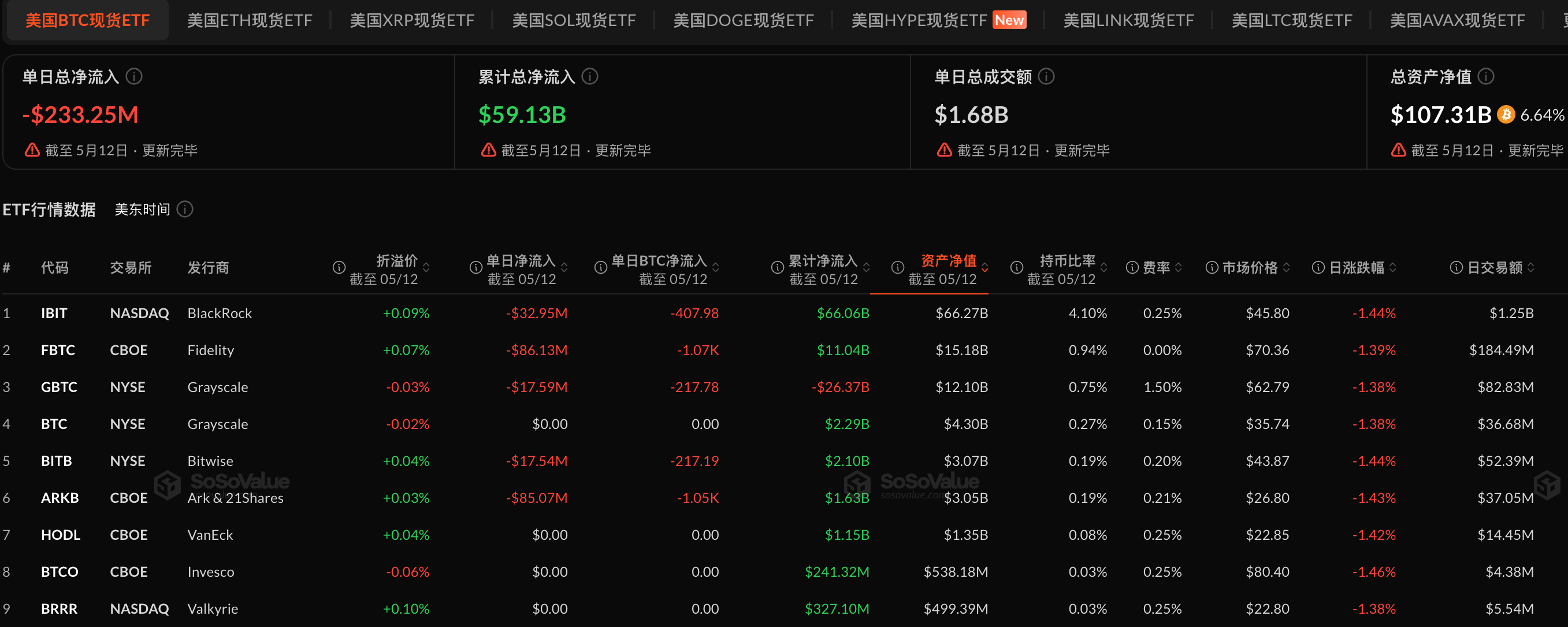
In the spot ETF space, the market is highly concentrated. Bitcoin ETFs collectively hold ~1.32 million BTC, with total AUM standing at approximately $107.3 billion. BlackRock’s iShares Bitcoin Trust (IBIT), with ~$55 billion in AUM, commands roughly 60% market share; its 0.25% expense ratio confers clear competitive advantage among peers. Fidelity’s Bitcoin Trust (FBTC), also priced at 0.25%, holds ~$13 billion in AUM and serves as IBIT’s most direct competitor. Grayscale’s GBTC—once the largest crypto trust—has transitioned to an ETF but faces headwinds from its relatively high 1.50% fee, leaving it with ~$10 billion in AUM. Meanwhile, the BTC Mini Trust—charging just 0.15%—attracts fee-sensitive capital, currently holding ~$3.5 billion in AUM. On the entrant front, Morgan Stanley’s MSBT officially listed in April 2026, signaling the formal entry of traditional banking giants into the crypto ETF arena—a development with profound industry implications.
For Ethereum ETFs, BlackRock’s ETHA (~$7.1 billion in AUM) leads the field—and is currently the largest single Ethereum ETF. Notably, BlackRock’s ETHB, launched in 2026, is the first ETF to support staking yield, pioneering a new path for ETFs to generate native crypto returns. This innovation could reshape ETF product design logic. Following 2025’s regulatory reforms, altcoin ETFs officially opened for registration: XRP- and Solana-themed ETFs each attracted ~$1 billion in initial capital. Over 26 emerging altcoin ETFs—including Dogecoin and Chainlink—are expected to launch in 2026, transitioning the ETF product line from a BTC/ETH duopoly to a “one-dominant, many-strong” multi-category era.
In the crypto treasury and mining company segment, structural divergence is underway. MicroStrategy (MSTR), the pioneer of the Bitcoin treasury model, currently holds ~700,000 BTC—the largest Bitcoin position among all public companies globally. Yet, with Bitcoin’s price down ~18% year-to-date in 2026—approaching the acquisition cost basis for several firms—pure-play miners like MARA and RIOT have sharply curtailed their buying activity, prompting market skepticism regarding the sustainability of the treasury model. In contrast to Bitcoin treasury firms’ widespread “forced selling” dilemma, emerging Ethereum treasury companies—led by Bitmine Immersion Technologies (BMNR)—demonstrate a fundamentally distinct business logic. BMNR, leveraging its MAVAN staking infrastructure, generates ~$196 million in recurring staking revenue annually—enabling it to cover operating expenses without selling crypto assets, thereby establishing genuine “native cash flow generation.” As of 2026, BMNR holds ~4.8 million ETH, valued at ~$10.8 billion—representing 3.98% of global ETH supply—with a strategic target of holding 5% of total ETH supply. Achieving this scale would make BMNR a systemically influential holder within the Ethereum ecosystem.
Regarding leveraged, inverse, and thematic ETFs, risk-return profiles differ markedly—requiring careful investor due diligence. Leveraged ETFs amplify daily returns using derivatives: during late-2025 market turbulence, 2x long MicroStrategy ETFs MSTX and MSTU plunged ~80%, erasing ~$1.5 billion in retail investor capital—highlighting their extreme risk profile. Key products include BITO (1x BTC futures), ETHU (2x ETH futures), and MSTZ (inverse MSTR). Blockchain-themed funds offer indirect exposure for more conservative investors—BKCH (Global X) holds heavy positions in Coinbase and core miners; BLOK (Amplify) covers ~80 blockchain-related equities; STCE (Charles Schwab), with a low 0.30% fee, includes ~40 stocks including MicroStrategy and Bitdeer—making it suitable as a long-term core holding tool.
III. Core Risk Analysis
Beneath the high-growth characteristics of the U.S. equities-based cryptocurrency sector lie equally complex and multifaceted risks. Before building an allocation strategy, investors must develop clear awareness of the following four key risk dimensions.
The first risk is dynamic regulatory uncertainty. Although the 2025 GENIUS Act established the first federal stablecoin framework, the U.S. Strategic Bitcoin Reserve was formally created, and banks gained explicit authority to offer crypto custody services, the overall regulatory architecture remains in flux. Jurisdictional boundaries between the SEC and CFTC over crypto assets remain incompletely clarified, and policy friction persists around certain altcoin ETF approvals. Furthermore, potential shifts in financial regulatory direction under a hypothetical 2026 Trump administration introduce uncertainty about policy continuity—making the sustainability of current regulatory tailwinds uncertain.
The second risk is the high volatility of underlying assets. Crypto markets are renowned for extreme price swings—Bitcoin’s ~18% YTD decline in 2026 exemplifies this. Such volatility transmits directly to investors via ETFs and equities, and frictional costs—including management fees, position discounts, and liquidity premiums—often magnify realized losses beyond the underlying asset’s raw price drop. Investors allocating to this sector should treat it strictly as a high-risk asset class, rigorously controlling position sizing and avoiding excessive concentration that could trigger tail-risk events.
The third risk is the financial structure risk embedded in crypto treasury companies. Take MicroStrategy as an example: its “treasury model” relies on raising capital via convertible bonds and preferred stock, then deploying proceeds into Bitcoin—betting that BTC appreciation will outpace financing costs. Yet this model carries substantial financial leverage—if Bitcoin continues falling, both the value of BTC holdings and financing-side interest expenses and repayment obligations expand simultaneously. While BMNR’s staking-yield model offers superior resilience, staking yields themselves fluctuate with ETH price, and slashing risk remains ever-present: malicious validator behavior could result in ETH penalties. Investors allocating to such assets must assess both corporate financial structure and cyclical risks of the underlying crypto assets.
The fourth risk is product-level liquidity and tracking error. For leveraged ETFs and certain smaller crypto equities, intraday volatility can trigger liquidity dry-ups, widen bid-ask spreads, and raise transaction costs. More critically, leveraged ETFs suffer from “compounding decay”: even if the underlying index moves correctly, long-term holding can incur cumulative losses due to daily rebalancing—as starkly demonstrated by MSTX/MSTU’s collapse in late 2025. Moreover, although Grayscale’s GBTC historically traded at deep discounts pre-ETF conversion—and those discounts have since narrowed—it still lags competitors like IBIT in institutional appeal due to its higher fee and lack of staking yield support.
IV. Innovation Trends and Sector Opportunities
Despite these risks, the U.S. equities-based cryptocurrency sector displays several noteworthy trends in 2026—trends actively reshaping its investment logic and product landscape.
Trend One is the emergence of “staking ETFs”—the most groundbreaking product innovation of 2026. BlackRock’s ETHB marks the first ETF to enable staking yield distribution, allowing shareholders to earn Ethereum network rewards indirectly—without running validator nodes or engaging with DeFi protocols. This transforms ETFs from passive holding tools into active yield-generation vehicles, dramatically expanding their utility. For institutional investors, ETHB delivers a compliant, convenient, and private-key-free pathway to ETH yield—a demand previously unmet in traditional finance. Should ETHB gain broad market acceptance, we anticipate a wave of staking ETFs across other PoS chains, further stretching the boundaries of the ETF industry.
Trend Two is the rise of specialized Ethereum treasury companies. Unlike Bitcoin treasury firms’ “buy-and-hold-for-appreciation” model, Ethereum treasury companies generate native yield via staking—creating a self-sustaining business loop: even during bear markets, staking income can cover operational costs, eliminating forced sales. BMNR’s strategic goal—to hold 5% of global ETH supply—would make it a systemically influential holder within the Ethereum ecosystem, whose strategic decisions (e.g., participation in PoS governance or adjustments to staking parameters) would materially impact the entire network. This model may catalyze a proliferation of dedicated ETH treasury firms—forming an entirely new investment sub-sector.
Trend Three is the structural inflow of institutional capital into on-chain fixed-income assets. Data shows that amid Bitcoin’s ~18% YTD 2026 decline, institutional money is migrating toward on-chain fixed-income instruments. This trend closely tracks the maturation of Ethereum’s staking ecosystem—projects like EigenLayer and Pendle Finance have built restaking and yield-tokenization infrastructure, enabling staking returns to be structured, fractionalized, and even used as collateral in DeFi. BMNR’s stable yield stream generated via MAVAN staking perfectly aligns with institutional demand for “crypto-native yield uncorrelated with token price risk.”
Trend Four is the continuous expansion and multi-chain diversification of the ETF product suite. From the BTC/ETH duopoly, to the introduction of XRP/SOL-focused ETFs, to the anticipated 2026 approvals for Dogecoin- and Chainlink-themed ETFs, the ETF product set is evolving from “mainstream coin coverage” to “precision thematic allocation.” Chainlink’s oracle infrastructure, Solana’s high-performance L1 positioning, and Dogecoin’s meme-culture identity map directly onto distinct investment themes—DeFi, infrastructure, and community culture—respectively. Multi-chain ETFs will empower investors to express targeted views on specific sectors—not merely hold passive exposure to the broader crypto market.
V. Participation Strategy and Investment Logic
For investors considering allocations to the U.S. equities-based cryptocurrency sector, the following risk-tiered reference framework is offered for adaptation based on individual circumstances.
At the core holding level, spot BTC and ETH ETFs—particularly low-fee options like IBIT and ETHA—are the most universally applicable tools. With existing AUM of ~$86.9 billion for BTC spot ETFs and ~$18 billion for ETH ETFs—and backed by BlackRock, the world’s largest asset manager—these products offer ample liquidity, low tracking error, and clear regulatory compliance. They are recommended as “sector beta” allocations, with position sizing held between 1% and 5% of portfolio—primarily capturing directional exposure to overall crypto market trends.
At the industry beta level, blockchain-themed funds (e.g., BKCH, BLOK) deliver diversified exposure across exchanges, mining equipment manufacturers, and infrastructure providers. Compared to direct single-stock ownership, thematic funds mitigate idiosyncratic “black swan” risk while capturing systemic upside from the broader crypto ecosystem’s growth. For lower-risk-tolerance investors, this may represent the optimal entry point. STCE’s comparatively low 0.30% fee makes it well-suited as a long-term core holding.
At the high-risk/high-return level, Ethereum treasury firm BMNR and Bitcoin treasury firm MSTR suit investors willing to accept elevated volatility for potential outsized returns. BMNR’s staking-yield model grants it superior operational resilience relative to MSTR, while MSTR’s “aggressive accumulation + leveraged buying” strategy demonstrates exceptional upside elasticity in bull markets. Allocation to such assets is advised at 0.5%–2% of portfolio, requiring ongoing monitoring of corporate financial structure changes and how crypto price movements affect debt-servicing capacity.
At the tactical allocation level, leveraged and inverse ETFs (e.g., MSTX, MSTZ) are appropriate only for professional investors with short-term timing capability—and holding periods should be measured in days or weeks, never months or years. Due to compounding decay, even correct directional bets can yield significantly lower returns than the underlying index’s price movement over extended horizons. Most retail investors should exercise strict discipline and avoid this category entirely.
It bears special emphasis that the above analysis is for informational purposes only and does not constitute investment advice. Cryptocurrency assets carry exceptionally high volatility and uncertainty. Investors must conduct thorough self-assessment of personal risk tolerance before making decisions. Leveraged products suffer from compounding decay; staked assets face slashing risk; crypto treasury firms bear financial leverage pressure—no single asset should command an oversized position. Portfolio diversification remains the cornerstone of long-term survival.
VI. Conclusion and Outlook
In summary, the U.S. equities-based cryptocurrency sector stands at a pivotal juncture in 2026—transitioning from a “product innovation phase” to an “ecosystem maturity phase.” Spot Bitcoin ETFs have opened the institutional gateway; Ethereum staking ETFs and Ethereum treasury companies are redefining the business model for “compliant crypto asset holding.” The regulatory framework established by the 2025 GENIUS Act delivers unprecedented policy certainty; bank authorization for crypto custody and the establishment of a federal stablecoin framework confirm crypto assets’ irreversible integration into the U.S. financial system.
Looking ahead, four key indicators merit close tracking. First, whether Ethereum treasury companies’ staking-yield scale can sustain meaningful growth will determine the long-term viability of this business model. Second, capital inflows into staking ETFs (e.g., ETHB) will validate market acceptance of the “ETF + native yield” innovation. Third, the actual pace of approvals and initial fundraising success for XRP-, Solana-, and other altcoin ETFs will reveal the breadth of productization beyond flagship tokens. Fourth, further clarification of the federal regulatory framework will define whether the sector’s long-term institutional tailwinds persist.
Join TechFlow official community to stay tuned
Telegram:https://t.me/TechFlowDaily
X (Twitter):https://x.com/TechFlowPost
X (Twitter) EN:https://x.com/BlockFlow_News
 @HTXAcademy