Podcast Notes: Hyperliquid Has Become the Top Interest for Traditional Hedge Funds
TechFlow Selected TechFlow Selected
Podcast Notes: Hyperliquid Has Become the Top Interest for Traditional Hedge Funds
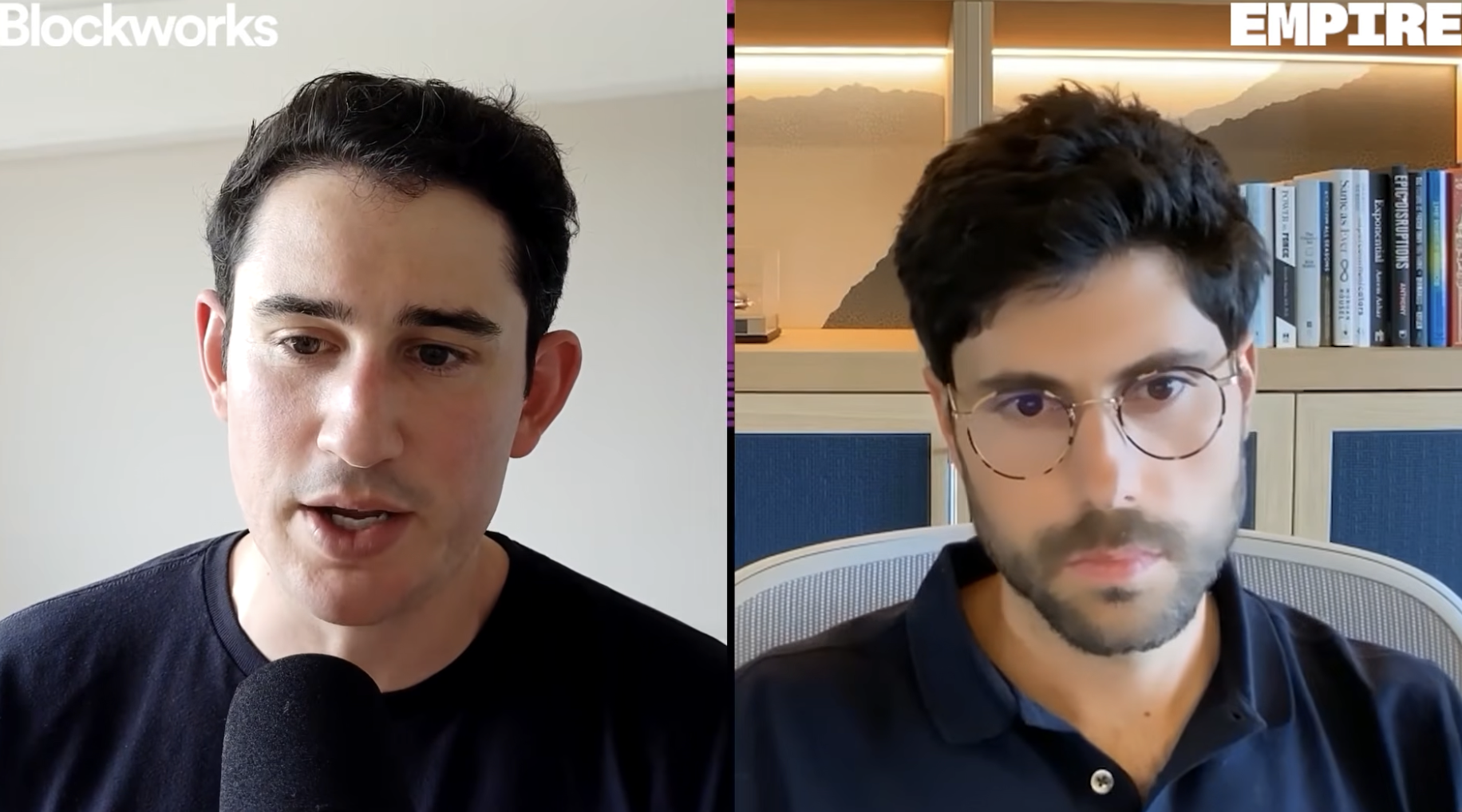
The Empire podcast episode is hosted by Jason Yanowitz and Santi, focusing on Hyperliquid’s institutionalization, regulatory easing signals, and market structure fragmentation.
 Navigating Web3 tides with focused insights
Original link: Empire Podcast – Markets Bounce Back, The Hyperliquid Thesis, and Kraken Raises $200M
Hosts:
Jason Yanowitz (Co-founder of Blockworks)
Santiago Roel Santos (Santi, crypto investor; former Partner at ParaFi Capital)
Editor’s Note
Santi raised a cautionary observation on the show: This is the strongest interest from traditional hedge fund managers in crypto since May 2020—when Paul Tudor Jones famously dubbed Bitcoin “the fastest horse on the track”—and this time, the focus isn’t BTC, but Hyperliquid.
The catalyst? The Iran conflict. With commodity markets closed over the weekend in traditional finance, a pricing venue was urgently needed. Trade XYZ’s weekend oil price forecast for Monday’s open had a median error of just 50 basis points—prompting commodity positions on Hyperliquid to surge to 17% of total holdings, surpassing Ethereum. Santi forecasts that commodity trading volume on Hyperliquid will exceed Bitcoin’s volume this year—and that Hyperliquid’s market cap could climb from $25 billion to $100 billion.
Two other notable signals: Kraken’s valuation dropped from $20 billion at end-2025 to $13.3 billion; Deutsche Börse invested $200 million for a 1.5% stake (the discount likely reflects structural differences between common and preferred shares). Separately, the SEC clarified this week that self-custodial DeFi frontends (e.g., MetaMask, Phantom) are exempt from broker-dealer registration requirements—resolving one of DeFi’s longest-standing legal uncertainties.
Key Quotes
Hyperliquid and the Weekend Market
This is the most intense interest I’ve seen from traditional hedge fund managers in crypto since Paul Tudor Jones called Bitcoin “the fastest horse on the track” in May 2020—and the focal point is Hyperliquid. The weekend market is a major driver. (Santi)
Hyperliquid essentially transplants CME’s matching engine, order book, clearinghouse, and margin system onto a single integrated blockchain—every trade, every liquidation, every funding rate is immutably recorded on a public ledger. (Santi)
My prediction: Commodity trading volume on Hyperliquid will surpass Bitcoin’s this year. It’s currently valued at $25 billion—I see a clear path to $100 billion. (Santi)
I assign a 30–40% probability to U.S. regulatory approval. If it happens, it would trigger an instant re-rating: CME’s market cap is $117 billion, and the market always needs a benchmark. (Jason)
Hyperliquid’s Institutional Adoption Pathway
This week, I got a call from a large hedge fund manager asking me to explain Hyperliquid. His team spends most of its time on Twitter—trading ideas even originate there. Their fund can’t buy HYPE tokens directly, so they bought shares in Hyperliquid’s Digital Asset Treasury (DAT), now one of their largest positions. He said it’s among the few assets he can buy that aren’t tied to AI-driven trading. (Jason)
Trading Philosophy and Personal Positioning
My core logic for consistent accumulation is rooted in my own consumption patterns. The companies I spend the most on annually—Amazon, DoorDash—are exactly what I accumulate. A mentor once told me: “The younger you are, the more alpha you can extract by staying close to the front lines—and alpha on the internet will only get scarcer over time. You must discover it with your own eyes and through firsthand use.” (Jason)
Macro-Crypto Correlation
The past 10 trading days rank among the most anomalous in history—since 1950. The S&P 500 rose 9.8%, placing it in the 99.7th percentile of all 10-day gains. (Santi)
I believe crypto performed well because macro conditions improved—and equity markets rallied. The correlation is extremely strong. Bitcoin hit $75,000 largely because market odds of the Clarity Act passing rose from 50/50 last week to 60–65% today. (Jason)
Regulatory Shift
This week, the SEC informed MetaMask, Phantom, and virtually all DeFi frontends: “You are not brokers.” This resolves one of DeFi’s biggest legal uncertainties. (Jason)
L2s and “Melting Ice”
The L2 sector has been “melting ice” for over a year. In 2017, with no users and no data, you could sell dreams. Today, the crypto market has near-zero patience for whitepaper-style narratives. (Santi)
I think this cycle will see real protocol failures—not like before, where projects merely settled into obscurity awaiting the next cycle—but outright abandonment. Capital will concentrate only on assets that have demonstrably succeeded: Hyperliquid, Bitcoin. (Santi)
The Next Wave of Opportunity
My three investment theses: (1) Demand for stablecoins outside the U.S. will keep expanding—and remains vastly underserved; (2) The world will only grow more volatile; (3) There’s a severe global affordability crisis. All three have onchain implementation pathways. (Santi)
Last year’s top three themes were derivatives, prediction markets, and stablecoins. Projects in those categories secured funding and users; those outside were crushed. This year will bring three new themes—I just don’t know what they are yet. (Jason)
I suspect tokenization—especially traditional issuers experimenting on public, permissionless networks—will be one of them. (Santi)
III. Full Transcript
Opening: Podcast Data Review and Content Divergence in the AI Era
Santi: This is the most intense interest I’ve seen from traditional hedge fund managers in crypto since May 2020—when Paul Tudor Jones (renowned macro hedge fund manager) called Bitcoin “the fastest horse on the track”—and the focal point is Hyperliquid (an onchain perpetuals exchange). The weekend market is a major driver.
Jason: Hello everyone, welcome back to Empire Weekly. Santi, how are you doing?
Santi: Nothing special—happy to be back. So much is happening in crypto and across the world. It’s great to live in the moment.
Jason: Santi’s recently been encroaching on our producer’s job. He imported all Empire data into Claude, using the newly released Opus 4.7 model, and asked: “How can Empire become better?”
Santi: Not quite—but I did do that. I exported data from Megaphone and YouTube, reviewed every episode since 2021, and ran correlation analyses against crypto asset prices. We often say “play count correlates with crypto prices,” but the actual data shows weak correlation.
Jason: So it’s not strongly correlated?
Santi: Correct. Crypto content broadly splits into two buckets: pure price commentary—which explodes on YouTube—and deep-dive interviews like ours, which perform better on Spotify and Apple but struggle on YouTube. Retail-focused YouTube creators gain followers fastest during bull markets—they ride the momentum.
Jason: YouTube’s algorithm demotes us. TLDR: We’d need clickbait titles—but that contradicts our brand. I’ve spoken many times with Brian and David from Bankless about this—their thumbnails are deliberately exaggerated. But my ego won’t let me cross that line. I’ll never produce BitBoy-style content.
Santi: Respect their lane.
Jason: Never become BitBoy—or Joe McCann (a prominent crypto personality). Okay, let’s dive in.
Market Overview: S&P’s 10-Day Streak and the Dual Nature of the AI Narrative
Santi: Wait—I want to talk about the broader market first. Two weeks ago we were still discussing a 10% market decline—and now the Nasdaq has just posted 10 consecutive up days.
Jason: Yes—it’s historically rare. My data check shows such streaks occur roughly once every 5–7 years. Since the 2000 dot-com bubble, it’s happened only a handful of times.
Santi: Honestly, the past 10 trading days rank among the most anomalous since 1950. The S&P 500 rose 9.8%, placing it in the 99.7th percentile of all 10-day gains.
Jason: I’ve been reflecting on this: Just stay optimistic—and you’ll be on the right side of history. I don’t know how or if this ends—or whether this is a new paradigm—but the data is undeniable.
Last week’s deep-dive feature on Hyperliquid in Colossus (Patrick O’Shaughnessy’s interview magazine) was outstanding. On the macro front, I’m always ready to revise my views. I recently listened to Leopold Aschenbrenner’s (former OpenAI researcher, now running a hedge fund) 4-hour podcast. He was fired from OpenAI two years ago—and nailed his predictions. In the first couple hours, he argues: We’ll reach AGI far sooner than most expect—and if different regimes acquire it, it becomes an existential risk on par with nuclear arms races. He advocates nationalizing AI labs and opposes open-sourcing. His tone conveys urgency—he believes very few truly grasp how fast and far this will go, and markets haven’t taken it seriously enough.
Santi: Is that his “Situational Awareness” piece from two years ago?
Jason: Yes. I tweeted: “I finally finished Leopold’s AI essay—read it whether you care about AI or not. Here are my notes.” That tweet blew up—10,000+ bookmarks, 1.6M views. But my foolishness? I only took notes—didn’t buy anything.
Santi: He bought himself. How big is his fund now?
Jason: I don’t know the initial size—but it’s now $5.5 billion. He rotates positions aggressively. His top holdings include Bloom Energy ($300M invested, now worth $1B) and a massive SanDisk position. By the way, his partner is Anthropic CEO Dario Amodei’s Chief of Staff.
Santi: That’s rich context. Before joining OpenAI and launching his hedge fund, he worked at Future Fund—the FTX-backed initiative founded by Sam Bankman-Fried. That podcast also covered his time working with SBF and lessons learned—fascinating stuff.
Jason: On FTX: SBF held 7.8% of Anthropic. Did you see this week’s news? Anthropic’s latest valuation is $80 billion. That FTX stake alone would now exceed Coinbase’s entire market cap.
Santi: Right—and it was liquidated by the bankruptcy trustee for ~$1.5 billion.
Jason: Wild. FTX creditors were fully repaid—even with a premium. Public-market investors are nervous, constantly searching for something. AI evokes both fear and excitement—a coin with two sides. This fuels volatility and pullbacks—but the market fundamentally wants to rise. Everyone realizes this train is out of control—and unstoppable.
Santi: On one side: No one knows how to model AI’s risks and opportunities into valuations. Labs drop breakthroughs one after another—falling behind creates anxiety. On the other: Listening to podcasts with Leopold, Elon, and Dario gives you chills—you feel humanity stands at a civilizational inflection point. Rockets fly to space and return—and markets are both anxious and upward-bound.
Trading Philosophy: Finding Alpha Through Consumption Habits
Jason: Tell us about your positions.
Santi: I posted that “Situational Awareness” tweet—and haven’t sold anything since. I’m just a bag holder—buy and hold. I’m not an exciting podcast guest because I trade rarely. I bought Robinhood at $10–$15 and held through $125—and am still adding. Same with DoorDash: My annual spending leader is my accumulation target.
Jason: That logic is brilliant. I remember you saying: Track your yearly consumption shifts—some companies you spend more on each year. Amazon is one. DoorDash is another.
Santi: In college, I took a class where a guest speaker visited—my friend’s father. He ran a $5–10 billion hedge fund. He said his best trades came from observing his own and his children’s consumption. When his daughter said, “I want an iPhone,” he bought Apple. When she said, “All my friends use Snapchat,” he joined Snapchat’s early funding round. To us 18- and 19-year-olds, he said: “You don’t realize proximity to the front line *is* alpha. Every year you age, it gets harder to extract alpha. And we’re heading toward a world where alpha on the internet disappears—you must discover it firsthand.”
Jason: Reddit used to be pure alpha. One hedge fund made money scraping Reddit. Before *Barbie*’s release, they read Reddit reviews and saw “this movie is genius”—while Rotten Tomatoes rated it poorly. They went long Mattel (Barbie’s maker) and profited massively. So yes—you can spin up a Claude instance to scrape Reddit.
Deep Dive: Hyperliquid—Wall Street’s New Darling
Santi: Okay, onto the news.
Jason: So much to cover: Tether backing Drift’s (Solana-based perpetuals protocol) user relief plan; Tether launching a new wallet—two Tether stories; Rob’s VC manifesto; Kraken raising $200M ahead of IPO; Hyperliquid’s deep feature in Colossus. Let’s start with Hyperliquid.
Santi: First, Colossus. Patrick O’Shaughnessy runs the *Invest Like the Best* podcast and Positive Sum Asset Management. He launched Colossus—a print-and-digital magazine focused on deep tech-finance profiles—world-class quality. Their latest feature covers Hyperliquid founder Jeff (Jeff Yan).
Jason: Let me steal one of your insights. On our episode with Logan (Logan Jastremski), you said something spot-on: “It’s been a long time since outsiders cared this much about a crypto project.” Like Polymarket’s breakout during the presidential election controversy, Jeff has captured Wall Street’s imagination. The geopolitical catalyst? People wanting to trade commodities over weekends—and Hyperliquid caught that wave.
Santi: Even if tensions ease around Iran and the Strait of Hormuz, this trend won’t stop. The train has left the station—you’ll see more volume and activity flow in. Currently, non-crypto assets on Hyperliquid already exceed crypto assets in trading volume.
Jason: Really?
Santi: Commodities are now Hyperliquid’s second-largest asset class—behind Bitcoin. I’ll make a verifiable prediction: Commodities will surpass Bitcoin this year. Hyperliquid could become a top-five crypto by market cap. At $25 billion today, I see a clear path to $100 billion. Coinbase and Robinhood operate at this scale. If Hyperliquid executes consistently, they have the technical talent, have won over crypto traders, and are now winning over Wall Street traders.
Jason: Here’s the data: Bitcoin accounts for 25% of Hyperliquid’s positions, commodities 17%, Ethereum 16%, HYPE tokens 10%, indices (~leveraged S&P) 7%, L1 tokens 4%, equities 4%, Solana 3.5%, followed by memecoins, privacy coins, and DeFi.
Santi: I think the most fascinating story in crypto right now is oil’s growth on Hyperliquid—thanks to Shoku’s Trade XYZ (a derivatives frontend in the Hyperliquid ecosystem). When Iran tensions spiked, volume and open interest exploded—because oil markets are closed on weekends, making Hyperliquid the sole weekend pricing venue. It crossed the mainstream chasm.
Jason: We built a site—weekendmarkets.com—to showcase all this data. When traditional markets close, Trade XYZ is the only active price discovery venue. Weekend volume hits billions of dollars, with a median forecast error for Monday’s open of just 50 basis points. Now, Trade XYZ’s price is the most information-rich signal relative to Friday’s close across all financial markets. The site shows all traded equities and commodities, charts, heatmaps, and methodology. Traditional institutional investors are now more interested in Hyperliquid’s weekend markets than in any other crypto topic.
Santi: Oil’s daily volume is $500M, with $350M in open interest.
Jason: Non-crypto folks ask you questions. Are they more interested in commodities—or equities?
Santi: Most interested in Hyperliquid itself. I’ll say it plainly: This is the greatest interest from traditional hedge fund managers in crypto since Paul Tudor Jones called Bitcoin “the fastest horse” in May 2020—six years later. This time, the focal point is Hyperliquid—and the weekend market is the core driver.
This week, a hedge fund manager called me to explain Hyperliquid. His fund is huge—and he and his team spend most of their time on Twitter, where trading ideas originate. This underscores Twitter’s importance. He told me a top trader posted about Hyperliquid on Twitter—so he dug in, listening to every podcast Jeff appeared on. His fund can’t buy HYPE tokens directly, so they bought shares in Hyperliquid’s Digital Asset Treasury (DAT)—which perfectly aligns with DAT’s bull case. Now it’s one of their largest positions—and he says it’s one of the few assets he can buy untethered from AI-driven trading.
Jason: I just asked AI to explain Hyperliquid to TradFi: “Imagine CME transplanted its matching engine, order book, clearinghouse, and margin system onto a single integrated blockchain—every trade, every liquidation, every funding rate immutably written to a public ledger. That’s Hyperliquid.”
Hyperliquid’s Regulatory Outlook: CME as the Best Benchmark
Santi: Could Hyperliquid undergo a massive re-rating upon U.S. regulatory approval?
Jason: I’m neither a lawyer nor a regulator—so this exceeds my expertise. But Hyperliquid *has* hired Jake Chervinsky (ex-Chief Legal Officer at Variant Fund) to lead the Hyperliquid Policy Institute. The logic goes like this: Post-2008, Dodd-Frank mandated futures trade only via regulated entities like CME or Cboe—to ensure transparency and prevent black swans. If you’re Hyperliquid—or Jake—you’d argue to the CFTC: “Your original intent was transparency and risk prevention. We’re DeFi—we’re fully transparent, and our clearing mechanism passed stress tests on October 10. If they haven’t made this argument yet, they should.” Imagine Hyperliquid gaining U.S. approval—triggering an instant re-rating. CME’s market cap is $117 billion—markets always need a benchmark.
Santi: I’d assign that a 30–40% probability.
Jason: Have you heard any bearish views on Hyperliquid from hedge funds?
Santi: Not much. Most are just beginning to learn—no firm long/short views yet. Remember: At Solana’s peak, protocol revenue hit $100M—mostly from memecoin trading.
Jason: Real Economic Value (REV) peak.
Santi: Yes—in January 2024 or 2025, Solana hit $500M REV, nearly all from memecoins. Now the question: Should protocol revenue from memecoin trading command the same valuation multiple as revenue from TradFi commodity trading?
Jason: Absolutely not—commodity revenue is higher-quality.
Santi: So I think Hyperliquid can scale far beyond that.
Jason: I saw this data: At DAS (Digital Asset Summit, hosted by Blockworks), Hyperliquid was the third-most-mentioned protocol across all panels, firesides, and keynotes—after Bitcoin (742 mentions) and Ethereum (143). Hyperliquid: 66 mentions. Morpho (lending protocol): 59. Then Solana, Canton, Espresso (shared sequencing), Circle, Stellar, Avalanche, Jupiter, Tether, Maple, Optimism, Superstate. Espresso at #7 was surprising.
Drift’s Relief Plan and Tether’s “Multi-Bird” Strategy
Jason: What else caught your eye this week?
Santi: Tether invested in Drift to help users recoup losses (Drift suffered a ~$285M exploit earlier this year). The structure mirrors Bitfinex’s token issuance to compensate victims—affected users recover via future protocol fees. Tether pledged up to ~$127M, totaling nearly $150M.
Jason: Specifically, users must trade on Drift using USDT to recoup—creating a win-win for Tether: PR upside plus locked-in stablecoin usage. On Twitter, people compared USDC—reportedly, someone contacted USDC to freeze hacker funds, and Circle responded slower than Tether. That’s a loss for Circle.
Santi: It’s a smart mechanism—inciting continued protocol usage. It’s arguably the only viable option; the alternative would be massive dilution via base-layer inflation.
SEC’s Landmark Guidance and Clarity Act Progress
Jason: Also, the SEC’s new guidance. This week, they declared self-custodial DeFi frontends exempt from broker-dealer registration. Under Gensler, the SEC’s main attack on DeFi was demanding these protocols register as broker-dealers—a requirement fundamentally incompatible with DeFi’s permissionless nature and practically unattainable. On Tuesday, the SEC’s Division of Trading and Markets issued staff guidance excluding crypto wallet interfaces from broker-dealer registration. The SEC explicitly told MetaMask, Phantom, and virtually all DeFi frontends: “You are not brokers.” This resolves one of DeFi’s biggest legal uncertainties. They introduced a new category: “covered user interface”—if you translate user trade parameters into onchain instructions, you fall under this protection. Custodial wallets are excluded—but self-custodial wallets, browser extensions, mobile apps, and software embedding self-custodial wallets are covered.
Santi: I’m surprised DeFi tokens didn’t re-rate on this news.
Jason: Robinhood did re-rate on regulatory tailwinds—they lowered the $25,000 minimum equity requirement for day traders. Overall, Aave rose 20% this week, and Bitcoin hit $75,000. I think the main driver is rising odds of the Clarity Act (crypto market structure legislation) passing. Last week, you asked Empire listeners whether Clarity would pass—and consensus was 50/50. I was in Washington, DC last week—and everyone said 50/50. Now it’s shifted to 60/40—or even 65/35.
Some crypto figures claimed on CNBC: “If Clarity doesn’t pass by April 1, it’s dead.” For some reason, that narrative stuck. But from my understanding, even delays to May 1—or August—or 2027—still leave room for passage. Of course, the longer it drags, the more junk provisions get inserted. Some say if it reaches mid-2027, it becomes the “DeFi Act”—heavily rewritten by special interests.
MicroStrategy’s Accumulation and STRC’s 11.5% Yield
Santi: I lean toward crypto’s strength reflecting macro strength—correlation is extremely tight. At the Bitcoin layer, MicroStrategy raised funds via STRC (perpetual preferred stock) this week to buy nearly 14,000 BTC.
Jason: Total holdings: 780,000 BTC, total invested ~$60B, average cost ~$75,000. Among their largest purchases. Now, beyond mNAV premiums/discounts, STRC dynamics matter.
Santi: Saturn—a protocol whose TVL (Total Value Locked) surged rapidly—essentially tokenizes STRC onchain, offering ~11.5% APY.
Jason: I visited MicroStrategy’s Tysons Corner, Virginia office Thursday—entire meeting revolved around STRC. STRC yields 11.5% annually—very attractive amid low DeFi yields. I won’t dive into risks today—save that for future discussion. We should invite Saylor or MicroStrategy on the show—people want to know: “Where does this 11.5% come from—and what’s its sustainability and risk profile?”
Kraken’s Valuation Halving and Exchange Business Model Breakdown
Santi: Speaking of Kraken—they raised $200M from Deutsche Börse.
Jason: Valuation dropped from $20B at end-2025 to $13.3B—a significant discount.
Santi: I hadn’t seen that number. Might be secondary-market trading—buying common rather than preferred shares—so structural differences apply.
Jason: Correct—Deutsche Börse acquired 1.5% at a $13.3B valuation. My guess: Common shares carried ~35% discount.
Also, Kraken had a minor security incident—unrelated to user funds, internal support-team issue—worth mentioning as a footnote. But back to fundamentals: Kraken operates exceptionally well, with potential to reach Coinbase-scale. Arjun (Arjun Sethi, Kraken Co-CEO) is doing a great job. I may explore secondary-market opportunities.
Santi: I invested in Backpack (exchange founded by Armani Ferrante)—much smaller but fascinating. Armani is an excellent builder. Core to evaluating exchange business models is fixed-vs-variable cost ratio. Exchanges are inherently tied to crypto prices—highly profitable when prices soar, but squeezed in downturns. I previously compared Coinbase, Robinhood, and Kraken: Robinhood ranked highest—diversified (non-crypto volume high) and adept at cost-cutting in bear markets. Coinbase second, Kraken third—but that was pre-Arjun. They’ve since restructured teams, hired strong operators, and built an excellent DeFi team. So my prior assessment may have been overly conservative. Any business evaluation hinges on operating leverage and resilience—bear markets mustn’t crush margins. That’s the cross-cycle investor lens.
Stock Tokenization and X’s New Cashtag Feature
Jason: What about stock tokenization (X Stocks)? I saw Pre-IPO stock discussions on Twitter—like Anthropic.
Santi: Volume remains small—no dramatic performance like oil.
Jason: I have data: Pre-IPO stock volume is ~$17M—still tiny. I spoke with X Stocks team at Kraken recently—they and other exchanges believe stock tokenization will break out massively this year. X Stocks team, Kraken leadership—all betting heavily on this.
Here’s Nikita (X’s Product Lead) on Twitter: “X has long been traders’ and investors’ best financial information source—billions flow daily based on timeline content. Today, we launch cashtag functionality on U.S./Canada iPhones, delivering real-time financial data. Search or post a cashtag or contract address—and X auto-matches stocks or tokens. Tap any cashtag to see price charts and related posts—without leaving X.” This advances Elon’s “everything app” vision.
Scroll Controversy and the L2 “Melting Ice” Effect
Santi: How’s the Ethereum ecosystem faring? Beyond Tom Lee’s ETH $62K call.
Jason: Unclear—I’m not deeply immersed. ECC (Ethereum Community Conference) just wrapped—vibes were muted, though some interesting projects bubbled beneath.
Santi: Ether.fi migrated from Scroll to Optimism mainnet—moving over 70,000 validators.
Jason: You’re a Scroll investor—I don’t know how much you can discuss. Scroll appears to have acted ungracefully. When Ether.fi sought to migrate from Scroll to Optimism, Scroll manually spiked onchain gas fees. One of Ether.fi’s founders tweeted: “This situation is even worse than people imagine.”
Santi: Context first: Ether.fi is critical to Scroll—if removed, Scroll’s TVL collapses. I lack first-hand insight into internal events. Onchain data tells this story: Over six days in early April, Scroll increased data-publishing fees on Ethereum mainnet by 1000x—two orders of magnitude. Users paid >$50,000 extra in fees. Timing was suspicious—coinciding precisely with Ether.fi’s migration window. Onchain data is indisputable—and unflattering.
Jason: What’s wrong with Scroll?
Santi: I was an early investor. At the time, ZK-rollups and zero-knowledge proofs were hot—I believed in the path’s intrinsic value, and Scroll’s co-founders are deep cryptographers—so I backed it. But it’s not just Scroll—many L2s have faded into obscurity. Name one L2 performing well? Vitalik’s recent L2 roadmap article was itself an acknowledgment—the market sensed this long ago. Optimism, Arbitrum, zkSync price action confirms it. Scroll’s market cap is $8M, fully diluted valuation $45M—$45M below its Series A valuation. That’s dire.
Jason: Can it rebound? What’s required? Where will volume come from?
Santi: This reminds me of conversations with infrastructure providers: They’re “melting ice”—whether they admit it or not. In 2017, with no users and no data, you could sell dreams. Any founder—Elon or Scroll—must sell dreams first, then deliver. Crypto spent years in “limbo”—whitepapers and experiments—with market patience. Not anymore. A year ago, I predicted sharp “haves vs. have-nots” divergence in crypto—today it’s extreme. Compare Hyperliquid’s activity to other projects.
Three Investment Theses and the “True Protocol Death” Cycle
Santi: Neobanks are trending—Plasma (stablecoin-dedicated chain), Ether.fi, and even Aave’s neobank experiment. As an investor, I anchor my personal portfolio on three theses:
1. Stablecoin demand outside the U.S. will keep growing—and remains vastly underserved;
2. The world will only grow more volatile;
3. A severe global affordability crisis persists.
All three have onchain implementation paths—so I allocate accordingly.
But most other projects face steep hurdles. Solana’s REV fell from a $500M peak to $20M. What can revive Solana? Underlying positives exist—Western Union piloting on Solana, strong engineering team actively solving problems. Yet in conversations with these teams, I believe they must “go for the jugular”—using capital or unconventional means to cement themselves as enduring protocols.
Finally, I believe this cycle will see true protocol deaths—not mere dormancy awaiting the next cycle. Past logic was “hold dust—dust becomes moon”—e.g., Lend merging into Aave. That won’t be widespread this time. Markets prefer concentrating capital in Hyperliquid and Bitcoin.
The Next Three Narratives and RWA Trends
Jason: Beyond Hyperliquid and Bitcoin—what else do you discuss with everyday people that resonates or rings familiar?
Santi: Stablecoins and prediction markets are hot—but prediction markets lack tokens.
Jason: These concepts enter mass awareness with lag. Our consistent framing: Last year’s top three themes were perps, prediction markets, and stablecoins. Projects in those lanes secured funding and users; others were crushed. This year brings three new themes—I just don’t know what they are.
Santi: Will they?
Jason: I suspect yes. “Tokenization” (stock tokenization, RWAs) is overused—but will be one of this year’s top three. I met Daniel (Tokeny founder) recently—he’s spearheading ERC-3643, emerging as the RWA standard. RWAs are central this year. We should discuss more on the show what traditional issuers are doing—and will do—onchain. I believe this activity will unfold on public, permissionless networks.
Santi: Jamie Dimon’s (JPMorgan CEO) arc is fascinating—from outright crypto opposition to clearly embracing “blockchain we can do.” His gap with Larry Fink (BlackRock CEO) has never been narrower—and shrinks monthly. He’s fiercely opposed the Clarity Act, even publicly attacking Brian Armstrong (Coinbase CEO). I think TradFi is stalling until Clarity passes—ensuring the final bill reflects their input.
Jason: Jamie Dimon told CBS they’re considering “prediction market services.”
Santi: What are “prediction market services”? They want to collect fees. Everyone wants prediction markets. To me, prediction markets are just another form of derivatives—CDS (Credit Default Swaps)—with increasingly blurred boundaries.
YouTube Comments and Wrap-Up
Jason: Time for YouTube comments—I haven’t read them in a while. Bad ones first—or good ones?
Santi: Bad ones first.
Jason: Comment 1: “I like Santi. The Santi who claims full-time crypto work yet completely missed Hyperliquid. His investment Inversion zeroed before launch.” Comment 2: “I like Santi—but he clearly doesn’t use DeFi, hasn’t farmed yield in years—why is he talking about this?”
Santi: I never claimed I was qualified.
Jason: Comment 3: “Santi is everything—except a contrarian investor. He excels at telling us what’s already happened—not predicting the future.”
Santi: Fair critique.
Jason: Comment 4: “Just wanted you to know Empire is my favorite crypto podcast—I live in Bangkok, so I can’t attend DAS.” Valid excuse. All negative comments target you—none attack me.
Santi: Others comment on your looks and insights. Rob (Rob Hadick, Dragonfly Partner) even had his whole team help delete negative comments.
Jason: This week’s content recommendations?
Santi: Leopold Aschenbrenner’s 4-hour podcast—I’m at 2.5 hours. An episode featuring Amazon VP Ethan Evans is highly recommended—I’ll listen next.
Jason: I’ll re-listen to David Senra’s *Founders* podcast and his founder interviews. I’ve referenced Tony Xu (DoorDash) countless times. Just finished Evan Spiegel’s (Snap founder) episode—decent. Some people naturally possess storytelling “it factor”—others don’t. Tony Xu has it. Evan barely does.
My “it” pick this week: Allbirds (the bankrupt footwear company, now sold). They launched an AI—allbirds.ai—a ChatGPT wrapper that answers every query with “shoes shoes shoes.” This stock briefly surged 10x yesterday.
Santi: When things like this happen, we’re closer to the top than the bottom.
Jason: My weekly content is watching *Seinfeld* for the first time. After work, I have just 20 minutes to shut down my brain. Several things we’re building aren’t public yet—pace is intense—and I often can’t finish a full episode in 20 minutes.
Santi: How culturally disconnected am I? I’ve never watched *Seinfeld*. I didn’t watch TV as a kid.
Jason: Do you have a TV in your room?
Santi: No. I don’t even keep my phone in the bedroom.
Jason: Neither do I. When I bought this house, the previous owner had a large TV mounted on the wall. I said, “No TV in the bedroom”—a mistake. I should’ve kept it.
Final note: We’re committed to making Empire better. Next, we’ll cover public companies building meaningful crypto-related businesses—including Better (mortgage lender), Figure, Klarna, and Western Union. Beyond Hyperliquid, this may be the biggest catalyst of the next cycle—traditional firms going live. I’ve been speaking with Framework’s team about Better’s positioning—and researching Figure—some intriguing developments.
Santi: We spoke with Figure’s team recently too—indeed intriguing.
Jason: That’s it for today. Thanks for listening—and keep criticizing us in the comments and Telegram. See you next week.
Santi: Enjoy your weekend.
Join TechFlow official community to stay tuned
Telegram:https://t.me/TechFlowDaily
X (Twitter):https://x.com/TechFlowPost
X (Twitter) EN:https://x.com/BlockFlow_News
 深潮TechFlow