API stories can’t sustain valuations; AI giants begin entering the consulting arena
TechFlow Selected TechFlow Selected
API stories can’t sustain valuations; AI giants begin entering the consulting arena
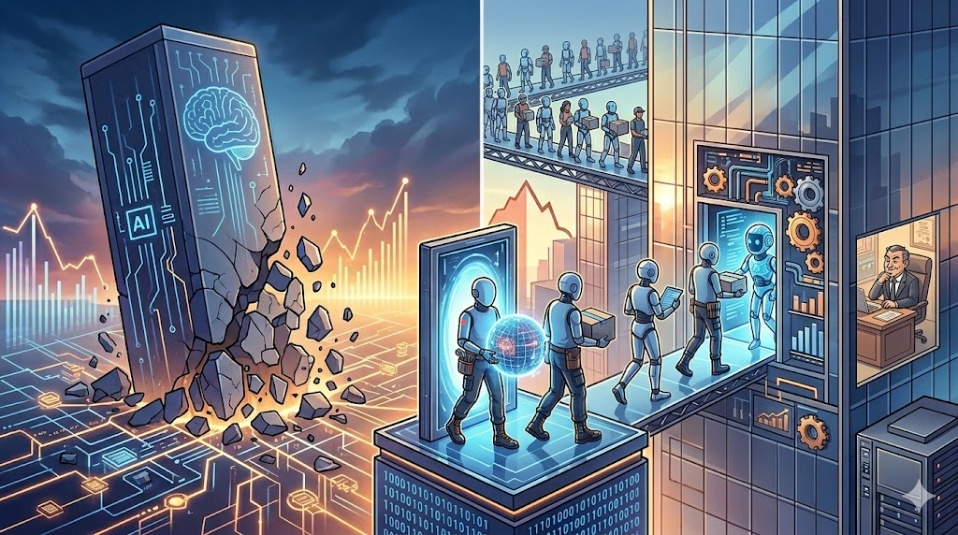
The API story is running out of steam; AI giants invest $770 million to enter the “consulting” business—a covert, high-stakes transformation battle pitting them directly against traditional institutions and upending white-collar roles.
 Navigating Web3 tides with focused insights
Recently, OpenAI officially announced the establishment of OpenAI Deployment Company (hereinafter “Deploy Co.”), with TPG leading a $4 billion+ investment round involving 19 investors and a post-money valuation of $14 billion. The company’s core business is to embed Frontline Deployment Engineers (FDEs) directly into client organizations—to integrate the models powering ChatGPT into enterprise data systems, workflows, and operational processes. Also in May, Anthropic unveiled a joint venture with Blackstone, Hellman & Friedman, and Goldman Sachs, committing approximately $1.5 billion to pursue the same objective: placing engineers inside clients’ offices.
Together, these two transactions—totaling roughly $5.5 billion—represent the most structurally significant developments in the global AI sector so far in 2026. They jointly signal a pivotal shift: cutting-edge model companies are acknowledging that selling APIs alone can no longer sustain their valuations. Instead, they must follow the “frontline deployment” model pioneered by Palantir in the mid-2000s—and transform themselves, at least partially, into consulting firms. This article unpacks the capital structure, underlying drivers, and labor-market implications of this strategic pivot.
$4 Billion, 17.5% Guaranteed Return
According to OpenAI’s official announcement, Deploy Co. is majority-owned by OpenAI, with external investors collectively committing over $4 billion. TPG led the round; Advent International, Bain Capital, and Brookfield serve as co-founding partners. The remaining 16 investors include SoftBank Corp., Goldman Sachs, Warburg Pincus, BBVA, B Capital, Emergence Capital, Goanna, and WCAS—spanning private equity (PE) and strategic capital.
What is truly unusual lies in the capital structure’s fine print. Citing anonymous sources, Axios reported that external investors received preferred shares—not common stock—with two defining terms: OpenAI guarantees investors a minimum 17.5% return and caps profit participation. In other words, this is not a conventional equity financing but rather a structured transaction akin to subordinated debt—investors enjoy downside protection and upside limits.
This arrangement is uncommon in private equity. In its April analysis, SaaStr noted: “PE firms typically target internal rates of return (IRRs) above 20%, yet it is almost unheard of for portfolio companies to contractually guarantee such returns.” MarketWise interpreted the structure as signaling PE investors’ caution regarding OpenAI’s core valuation and cash burn—they prefer guaranteed returns via a subsidiary’s preferred shares over holding OpenAI’s common stock. Given OpenAI’s parent-company valuation has reportedly reached ~$85.2 billion (per StartupHub.ai), this “parent company can’t raise more, so we spin out a subsidiary with structured terms” approach itself constitutes a powerful signal.
Axios also disclosed another detail: Deploy Co.’s pre-money valuation stands at $10 billion, rising to ~$14 billion post-funding. This implies OpenAI has packaged “future enterprise AI service revenue” into a quantifiable, cash-flow-based asset—and priced and sold it to 19 institutions.
On the ground, the acquisition of Tomoro resolves execution. Tomoro is an AI consulting and engineering firm founded in London in 2023 in an “alliance-style” partnership with OpenAI. Headquartered in London, it operates offices in Edinburgh and Manchester, established its APAC headquarters in Singapore last year, and maintains additional offices in Sydney and Melbourne. Its client roster includes Tesco, Virgin Atlantic (which deployed an AI travel concierge), Supercell (which launched an in-game support agent serving 110 million users within 12 weeks), Fidelity International, Red Bull, Mattel, and the NBA. Tomoro claims to have quadrupled its headcount over the past 12 months and grown monthly global revenue more than tenfold. This acquisition will bring approximately 150 “experienced frontline deployment engineers and deployment specialists” into Deploy Co. overnight.
Bain, McKinsey, and Capgemini All Invest Simultaneously
Among the 19 investors, the most anomalous participants are not PE firms—but three consulting giants: Bain & Company (the consulting sibling of Bain Capital), McKinsey & Company, and Capgemini.
Dan Primack, Axios columnist, offered two interpretations of this arrangement. The milder reading is that these three consultancies will deepen their understanding of OpenAI’s capabilities and roadmap—and then relay those insights to their own clients. The sharper interpretation is that OpenAI has persuaded traditional consulting firms to fund a company that may ultimately disintermediate them.
This dynamic reappears, more subtly, in Anthropic’s $1.5 billion joint venture. According to The Wall Street Journal, the JV’s capital structure comprises ~$300 million each from Anthropic, Blackstone, and Hellman & Friedman; ~$150 million from founding investor Goldman Sachs; and the remainder from Apollo Global Management, General Atlantic, GIC, Leonard Green, and Sequoia Capital—bringing total committed capital to ~$1.5 billion.
Blackstone Operating Officer and President Jon Gray described the JV’s mission as “breaking one of the most critical bottlenecks in enterprise AI adoption”—by “expanding the pool of engineers capable of real-world implementation.” Marc Nachmann, Global Head of Asset & Wealth Management at Goldman Sachs, stated in the announcement that the JV will “enable mid-sized enterprises to access Anthropic’s solutions and democratize access to highly scarce frontline deployment engineers.”
Notably, both Deploy Co. and the Anthropic JV have targeted their initial customers from among portfolio companies of PE firms. Collectively, Blackstone, Apollo, TPG, Bain Capital, Brookfield, Advent, and Warburg Pincus manage over 2,000 portfolio companies—a vast, contractually bound internal distribution channel. Embedding models into these companies’ operations serves dual purposes: generating returns for limited partners (LPs) and enabling PE partners to reduce costs and boost profitability.
Anthropic’s Lead Is OpenAI’s Real Catalyst
Risk investment firm Menlo Ventures has published biannual reports on enterprise LLM market share since 2023. Its 2025 year-end edition shows Anthropic now commands 40% of the enterprise LLM API market—up sharply from 24% in 2024 and 12% in 2023. OpenAI’s share has declined from 50% in 2023 to 27%—nearly halving its enterprise footprint. Google’s share rose from 7% in 2023 to 21%.
The gap is even starker in coding. Anthropic holds ~54% of the programming market share, versus OpenAI’s 21%. Since launching Claude Sonnet 3.5 in June 2024, Anthropic has held the top spot on programming benchmark leaderboards for 18 consecutive months. Deedy Das, Partner at Menlo Ventures, observed: “Anthropic is sweeping the enterprise market—OpenAI has ceded nearly half its share.”
This reversal places direct pressure on OpenAI’s leadership. In March, Fidji Simo, CEO of OpenAI’s Applications division, called Anthropic’s progress a “wake-up call” during an all-hands internal meeting—and characterized OpenAI’s response posture as “code red.” Per The Wall Street Journal’s citation of meeting notes, Simo told employees, “We absolutely cannot miss this moment due to distractions from peripheral requests,” and demanded the company “deliver measurable results in productivity—especially enterprise productivity.”
The timeline thus becomes clear: Simo issued the internal alarm in March; by April, OpenAI had entered advanced negotiations with TPG, Advent, Bain Capital, and Brookfield over a $10 billion joint venture; on May 4, Anthropic announced its $1.5 billion JV first; and on May 11, OpenAI officially launched Deploy Co. and acquired Tomoro. The entire sequence was driven by Anthropic’s market-share data—and accelerated by the rapid penetration pace of Claude Code.
An Internal Mirror of White-Collar Flip: FDE Headcount Up 800%, SWE Demand Shrinks
Deploy Co. and the Anthropic JV aim to solve a human problem—specifically, the supply shortage of FDEs.
Per publicly available Indeed data, U.S. job postings for FDE roles surged from 643 to 5,330 over the past 12 months—an increase of 729%. LinkedIn data shows U.S. FDE postings from January–September 2025 rose over 800% year-on-year—the fastest-growing segment among tech roles. Geographically, New York has overtaken San Francisco as the top FDE hiring hub (~35% share), while San Francisco accounts for ~11%—a shift driven by financial services and regulated industries in New York absorbing FDE talent.
Salary bands significantly exceed those for traditional software engineers. PitchMeAI, citing Anthropic’s public job listings, reports base salaries for Anthropic’s U.S.-based Applied AI FDE roles range from $280,000 to $320,000. Mid-to-senior FDE total compensation (TC) at OpenAI and Anthropic now consistently falls between $350,000 and $550,000, with some staff-level positions nearing $600,000. Palantir’s average FDE TC sits at ~$238,000, with staff-level TC exceeding $630,000. Entry-level FDE TC typically starts at $180,000–$250,000.
In sharp contrast to the FDE boom, traditional software engineering (SWE) roles continue to shrink. Per Indeed data via FRED, U.S. SWE job postings have declined 35%–45% from their mid-2022 peak, hitting a five-year low by early 2025. Stanford’s Digital Economy Lab, analyzing ADP payroll data, found employment among early-career SWEs aged 22–25 fell nearly 20% from its end-2022 peak. Pragmatic Engineer’s industry survey notes that AI-infrastructure and regulated-industry engineering roles remain in expansion—but demand for traditional SWEs across most other sectors is in retreat.
Rowan, Co-Founder and CEO of Apollo Global Management, called the AI wave “unquestionably the largest technology cycle of my career” during Apollo’s quarterly earnings call—and predicted “nearly every job will be augmented or replaced, resulting in a complete flip: blue-collar jobs rise, white-collar jobs face pressure.” Similarly, Blackstone President Jon Gray, speaking at the Milken Institute Conference, forecast AI would usher blue-collar employment into “massive prosperity.”
The rise of the FDE mirrors Rowan’s macro logic—but in Silicon Valley’s internal form, more discreetly. FDEs are “blue-collar engineers” wrapped in premium pay: they travel 50% of the time, embed onsite at client offices, wrestle with legacy systems and compliance audits, debug across data silos, and respond to political demands from clients’ CIOs. This violates Silicon Valley’s long-held dogma of “zero marginal cost, pure software, remote work.” The FDE model essentially pushes engineers back onto the front lines—into clients’ physical spaces and concrete business contexts.
Gergely Orosz, Editor-in-Chief of The Pragmatic Engineer newsletter, wrote in a May analysis: “In both OpenAI’s and Anthropic’s arrangements, FDEs are being hired under independent subsidiaries—which means newly hired FDEs will likely receive equity in Deploy Co. or the Anthropic JV, not in the parent companies.” In other words, the valuation premium attached to the model layer and the labor premium attached to the deployment layer are structurally decoupled. The parent company sells “future revenue”; the subsidiary runs a “labor-intensive business far more intensive than SaaS”—and the two are bound together via structured terms.
Model Layer Commoditizes; Deployment Layer Capitalizes
Connecting these four threads reveals a relatively complete inflection-point narrative. Differentiation at the model layer is narrowing: OpenAI, Anthropic, and Google collectively hold 88% of the enterprise API market, and model quality scores are converging. Yet industry estimates consistently peg enterprise AI deployment success rates at only 5%–20%; implementation difficulty remains AI’s true monetization bottleneck. Over 18 months, Anthropic has proven that in a homogenized model race, superior product focus and more reliable enterprise delivery capability can overtake early leaders.
OpenAI’s response is to use capital structure to buy time. The $4 billion Deploy Co. is not a conventional funding round—it’s a “securitization of future enterprise revenue,” featuring guaranteed returns and capped profits, sidestepping the awkward reality that OpenAI’s parent company can no longer raise capital at its current valuation. Anthropic’s $1.5 billion JV converts PE firms’ investment networks into instant distribution channels. Together, these deals expand AI giants’ boundaries—from “model APIs” to “on-site deployment”—and draw traditional consulting’s core profit pools squarely into competitive sightlines.
The simultaneous investment by Bain & Company, McKinsey, and Capgemini imbues this pivot with distinctive financial-gaming significance. Whether these three consultancies joined to “understand the competition” or have already accepted partial disintermediation, they are—in effect—providing capital to potential future rivals. Such a configuration is exceptionally rare in 20 years of consulting industry history.
The explosive growth of FDE roles alongside the contraction of traditional SWE roles is not contradictory. They represent two sides of the same structural flip: after intelligence spills over from the model layer, enterprises no longer want to “build another piece of software”—they want to “make this AI actually run in my business.” The former increasingly resembles a commodity; the latter increasingly resembles a high-margin service. To borrow Rowan’s phrasing: a complete flip—and the world isn’t ready.
The next key observation point is whether PE giants yet to enter—Carlyle, KKR, EQT—will follow suit, and whether Meta’s newly announced Enterprise Solutions division will adopt a similar structure. If they do, this $5.5 billion bet will definitively shape the capital narrative for enterprise AI in 2026–2027. If they don’t, then this move remains merely an emergency self-rescue by top-tier AI firms.
Join TechFlow official community to stay tuned
Telegram:https://t.me/TechFlowDaily
X (Twitter):https://x.com/TechFlowPost
X (Twitter) EN:https://x.com/BlockFlow_News
 深潮TechFlow